
It is late August. ERAS is open, your personal statement is on version 11, and now you are staring at the LOR section. You have six people who offered to write you letters. You can only use four. Two are research mentors, one is the intern year chief from your sub‑I, one is a beloved pre-clinical course director, one is a department chair you barely worked with, and one is the attending who watched you grind through a brutal ICU month.
You know this: the letters can quietly make or quietly kill an application that looks “fine” on paper.
Let me break down how to build a deliberately balanced LOR set—clinical, research, and leadership—so that your letters read like a coherent argument for your candidacy, not a random pile of “good student, hard worker” clichés.
1. The Ground Rules: What Programs Actually Expect
Before you obsess about balance, you need to understand the hard constraints: how many, which kinds, and what is non‑negotiable for your specialty.
Most programs:
- Require 3 letters minimum
- Allow 4 letters via ERAS
- Strongly prefer at least 2 “clinical” letters from attendings in your chosen specialty or closely related fields
Here is how this typically looks in practice.
| Specialty | Typical # of Letters | Minimum Specialty Letters | Chair Letter Expected? |
|---|---|---|---|
| Internal Medicine | 3–4 | 2 IM attendings | Often preferred |
| General Surgery | 3–4 | 2–3 Surgery attendings | Usually |
| Pediatrics | 3–4 | 2 Peds attendings | Sometimes |
| Neurology | 3–4 | 1–2 Neuro attendings | Sometimes |
| Psychiatry | 3–4 | 1–2 Psych attendings | Rarely required |
If your dean’s office or your specialty-specific advising manual says “minimum 2 specialty letters” then that is not a suggestion. You hit that first, then you think about “balanced.”
A “balanced” set does not mean equal numbers. It means:
- You meet (or exceed) the clinical expectations for your specialty
- You add targeted letters that highlight other strengths: research, leadership, teaching, or unique niche skills
- The mix collectively answers the question: “Would I want this person as my junior resident and future colleague?”
For most categorical residencies, the sweet spot if you can upload 4 letters is:
- 2 strong clinical letters in your target specialty
- 1 additional clinical or adjacent specialty letter (e.g., MICU for IM, SICU for Surgery, Peds ED for Peds)
- 1 non-clinical or hybrid: research, leadership, or a department chair who actually knows you
You are building a portfolio, not just collecting praise.
2. Clinical Letters: The Backbone of Your Set
If the research letter is the “bonus track,” the clinical letters are the album. Programs read these first and weight them more heavily. When your file goes to committee, the senior faculty in the room care less about your pipetting prowess and more about: Can you manage a cross‑cover list without imploding?
What makes a clinical LOR actually strong?
Not the name. Not the title. Content.
Strong clinical letters usually have:
- Direct observation over enough time (ideally ≥ 3–4 weeks)
- Specific clinical behaviors: note-writing, presentations, patient ownership, procedural skills, response to feedback
- Comparative language: “top 10% of students I have worked with in the last 5 years,” “one of the strongest acting interns on our service this year”
- Clear endorsement: “I give my highest recommendation for residency training”
Red flag: generic, short, devoid of detail, or lukewarm “I recommend without reservation” with nothing to back it.
Prioritizing clinical letter writers
You probably have multiple potential clinical writers. Rank them like this:
- Attending in your chosen specialty who worked with you directly on an audition/sub‑I or core rotation where you performed very well
- Attending in your chosen specialty on a strong elective or consult service with heavy responsibility
- Attending in a closely related field where you excelled (ICU, ED, hospitalist)
- “Big name” faculty or chair who barely knows you
Pick 1 and 2 first. Do not chase prestige at the cost of content. I have seen “Chair of X” letters that are two paragraphs of fluff and no specifics; program leaders sniff that out instantly.
How many clinical letters?
If ERAS allows 4:
- For competitive specialties (Derm, Ortho, ENT, Plastics, Neurosurg): 3 clinical specialty letters + 1 “other” (research or chair in same field)
- For moderately competitive (IM, Gen Surg, EM, Anesthesia, Neuro, Peds): 2 strong specialty letters, 1 adjacent clinical, 1 flex (research/leadership/chair)
- For less competitive or smaller fields (FM, Psych, PM&R, Path, etc.): 2 specialty letters minimum; the rest can be tailored to your narrative (psychotherapy continuity clinic supervisor, FM faculty from longitudinal clinic, etc.)
If you only have room for 3 letters at some programs (yes, some insist), clinical still dominates:
- 2 specialty clinical
- 1 “best of the rest” (research vs leadership vs extra clinical, depending on your story)
3. Research Letters: Powerful, but Situational
Here is where people screw this up. They either:
- Over-prioritize the famous PI who barely saw them clinically, or
- Hide a genuinely impressive research trajectory because “I heard programs don’t care about research letters.”
Both positions are wrong in the extreme.
When a research LOR is high yield
A research letter is very useful if:
- You are applying in an academic, research‑heavy field or to research-heavy programs (think academic IM with physician‑scientist tracks, Neurology at MGH, Radiation Oncology, Derm, Neurosurgery)
- You have 1+ substantial projects (posters, manuscripts, significant data work), not just “I joined the lab 3 months ago”
- Your mentor supervised you closely and can comment on your intellectual ability, problem‑solving, resilience when experiments failed, writing, and independence
In those situations, a research letter can be your differentiator. Especially if your clinical letters are strong but not superstar-level.
When a research LOR is low yield
It drops off in value when:
- The mentor barely knows you (“X was in my lab and helped with data collection.” Period.)
- The project was tiny or very recent; there is nothing substantive to write about
- You are applying mostly to community-based programs that are explicitly clinical and not research-focused
- It is used instead of a required clinical letter in your specialty
Research letters do not substitute for weak clinical performance.
Balancing research vs clinical in your set
If you have space for 4 letters and real, meaningful research:
Competitive, research‑leaning applicant to academic programs:
- 2 clinical specialty letters
- 1 clinical adjacent / ICU / ED
- 1 research mentor who supervised you intensively
Applicant with modest research, strong clinical:
- 2 clinical specialty
- 1 adjacent clinical
- 1 leadership/teaching/other letter (unless your research letter is unusually strong and personal)
If you are not sure whether your research letter is worth including, ask the mentor directly: “Do you feel you know my work and abilities well enough to write a strong letter for residency?” Watch how quickly and confidently they say “Yes.” Hesitation is information.
4. Leadership & “Other” Letters: Underrated, When Used Correctly
These are the letters from:
- Chief residents
- Student group advisors
- Longitudinal clinic preceptors
- Global health or free clinic faculty
- Course directors for longitudinal professionalism/ethics/clinical reasoning courses
- Program directors from away electives who mostly saw your leadership and team-role behavior
Most people either ignore these or treat them as consolation prizes. That is a mistake. If curated correctly, a leadership/character letter can answer the “What is this person like at 2 am on call?” question more directly than a research mentor ever could.
When a leadership-type letter is high yield
Consider including a leadership letter when:
- You have a significant, sustained leadership role: clinic director for your student‑run free clinic, class president, national organization rep, QI project lead with measurable outcomes
- The writer has known you for a long time (1+ years) and watched you mature and handle conflict, responsibility, and mentorship of juniors
- Your clinical letters already cover your day-to-day medicine; you want an additional voice emphasizing professionalism, integrity, communication, or teaching
Programs are increasingly sensitive to team culture and toxicity. A letter saying “I have seen this person de-escalate tense family situations, calm down angry interns, and carry emotional weight without dumping it on others” is not fluff. It is gold.
Who writes the best leadership letters?
Not just anyone who has “Director” in their title.
Best leadership letters usually come from:
- Faculty advisors who worked with you directly in a student-run clinic or longitudinal program
- Chief residents who had administrative roles you reported to (but only if they worked with you directly and can be specific—many programs still prefer attending-written letters)
- Faculty who oversaw complex projects where you had to coordinate multiple stakeholders (hospital administration, nursing, other students)
Be cautious with:
- Generic “Dean of Students” letters that are obviously boilerplate
- Course directors from preclinical years who cannot speak to your current clinical or leadership abilities
- Letters that are leadership in name only but read like “nice, punctual, participated regularly”
Where to slot leadership letters in your LOR mix
Assuming 4 slots and a decent leadership story:
- 2 clinical specialty
- 1 clinical adjacent
- 1 leadership/character letter that reinforces maturity, teamwork, and broader impact
Or, for applicants with heavy research but also real leadership responsibilities:
- 2 clinical specialty
- 1 research
- 1 leadership (especially if your clinical letters already show you are competent at the bedside)
Leadership letters should not replace your second specialty clinical letter in competitive fields. They are the complement, not the backbone.
5. Strategy: Curating the Set, Not Just Collecting Names
Now, the actual curation step: you may have 6–8 possible writers. You have 3–4 slots. How do you choose?
You start from the top: what narrative are you trying to project?
- “Clinically excellent, ready to hit the ground running”
- “Future physician‑scientist with strong clinical foundation”
- “Leader/educator who will strengthen your residency culture and teaching mission”
Then you align letters to that narrative.
Step 1: Map each potential writer to a “role”
Take a piece of paper (yes, literally) and make a quick table. Something like this:
| Writer | Type | Strength of Relationship | Main Themes They Can Address |
|---|---|---|---|
| Dr. A – Sub‑I Hospitalist | Clinical | Worked 4 weeks closely | Patient ownership, work ethic |
| Dr. B – Cardiology attending | Clinical | 2-week consult rotation | Presentations, clinical reasoning |
| Dr. C – Research PI | Research | 1.5 years, 2 publications | Initiative, academic potential |
| Dr. D – Free clinic director | Leadership | 2 years, clinic lead | Leadership, service, teamwork |
You are looking for coverage and depth. If three people would all write “hard-working, read about her patients, good team player,” you do not need all three.
Step 2: Decide your backbone
Pick the 2 clinical specialty letters that are clearly strongest. This is non-negotiable.
Then, ask:
- Do I have a third clinical letter that is significantly better than my best research/leadership letter?
- Or does my research or leadership letter add unique, deep content that the clinical letters cannot provide?
If your third clinical letter is lukewarm or generic, and your research mentor loves you and supervised a major project, you may be better off with:
- 2 clinical specialty
- 1 research
- 1 leadership or adjacent clinical
Rather than:
- 3 meh clinical
- 1 research/leadership squeezed in
Step 3: Think program-specific tailoring
ERAS allows you to assign different letters to different programs. That is underused.
For example:
- For research-heavy academic programs:
- Upload 4: 2 specialty clinical, 1 ICU/adjacent, 1 research
- For community or clinically focused programs:
- Use 3–4: 2 specialty clinical, 1 ICU/adjacent, optionally swap research for leadership if the program emphasizes teaching or service more than publications
You do not need one universal combination for all programs. But do not create 10 different custom mixes either; that is unmanageable. Two or three “standard” sets is usually plenty.
6. Timing, Logistics, and Preventing the “Weak Surprise Letter”
Strong content requires two things: the right writer and the right preparation. Too many students passively request letters and hope for magic.
Ask early, and ask specifically
You want:
- To ask at the end of a strong rotation, when your performance is fresh
- To be explicit: “Would you feel comfortable writing me a strong letter of recommendation for internal medicine residency?”
That single word—“strong”—is your insurance policy. A hesitant “uh, sure” is a red flag. A confident “absolutely, you did great on the service” is what you want.
Provide targeted material
You should not dump 12 documents on them. But you also should not make them guess who you are. Send:
- Updated CV
- Personal statement (even if in draft form)
- Short summary of: which programs/types you are targeting, particular strengths they have seen in you, and any specific points they might consider including (clinical examples, leadership roles, research outcomes)
You are not scripting their letter. You are reminding them of concrete details they can expand on.
Monitor, but do not harass
Reality: some attendings need gentle nudging. ERAS lets you see when letters are uploaded; your school may also track. If someone has not uploaded by 2–3 weeks before your real submission plan, send a polite reminder.
If the letter still does not appear and your gut tells you this person is disorganized, have a backup letter ready. A late, rushed letter is not worth sacrificing your entire application timing.
7. Edge Cases and Common Traps
Let me run through some of the situations I see repeatedly.
Trap 1: The “Famous Name” Chair Letter
You did a 1-week observership with the department chair, shook their hand at grand rounds twice, and now their admin says they can “provide a standard chair letter.” Students drool over the name. Committees roll their eyes.
Unless your specialty requires a chair letter (General Surgery often does, some IM programs expect it), I would not burn a slot on a perfunctory, content-light letter just for a name. If a chair actually supervised your sub‑I and can go deep on your clinical performance, that is a different story.
Trap 2: Overweighting Preclinical Letters
Your preclinical small-group facilitator loved you. Great. They also have no idea how you function at 5 am in the ICU, whether you can handle cross-cover, or what you are like with real patients.
Use preclinical letters rarely, and only if:
- The faculty member also taught or observed you in a clinical capacity, or
- They supervised a multi-year project (e.g., longitudinal course director) with ongoing interactions
Otherwise, those letters read as “nice student, did well on multiple choice tests, participated in group.” Programs want more.
Trap 3: Too many research letters for a clinically weak file
If your clerkship grades are mediocre and your Step score is average-low, a stack of research letters does not fix that. It just broadcasts “would rather be in the lab than on the wards.”
In that situation, you double-down on the best clinical letters you can get, plus maybe one tightly focused research or leadership letter that still emphasizes grit, reliability, and ability to work with teams. Not your Western blotting technique.
Trap 4: Chief resident letters that sound like friend notes
Chiefs can write phenomenal letters if they worked with you as an attending-equivalent on a sub‑I or as clinic preceptors. They can also write fluffy, social letters if they know you primarily as “nice person from didactic.” Programs want attending-level assessments first.
If you take a chief letter, pair it with at least two solid attending clinical letters and make sure the chief supervised you meaningfully.
8. Visualizing a “Balanced” LOR Portfolio
Here is how the mix often shakes out for different archetypes. Not theoretical; this mirrors what I have seen in applicants who matched very well.
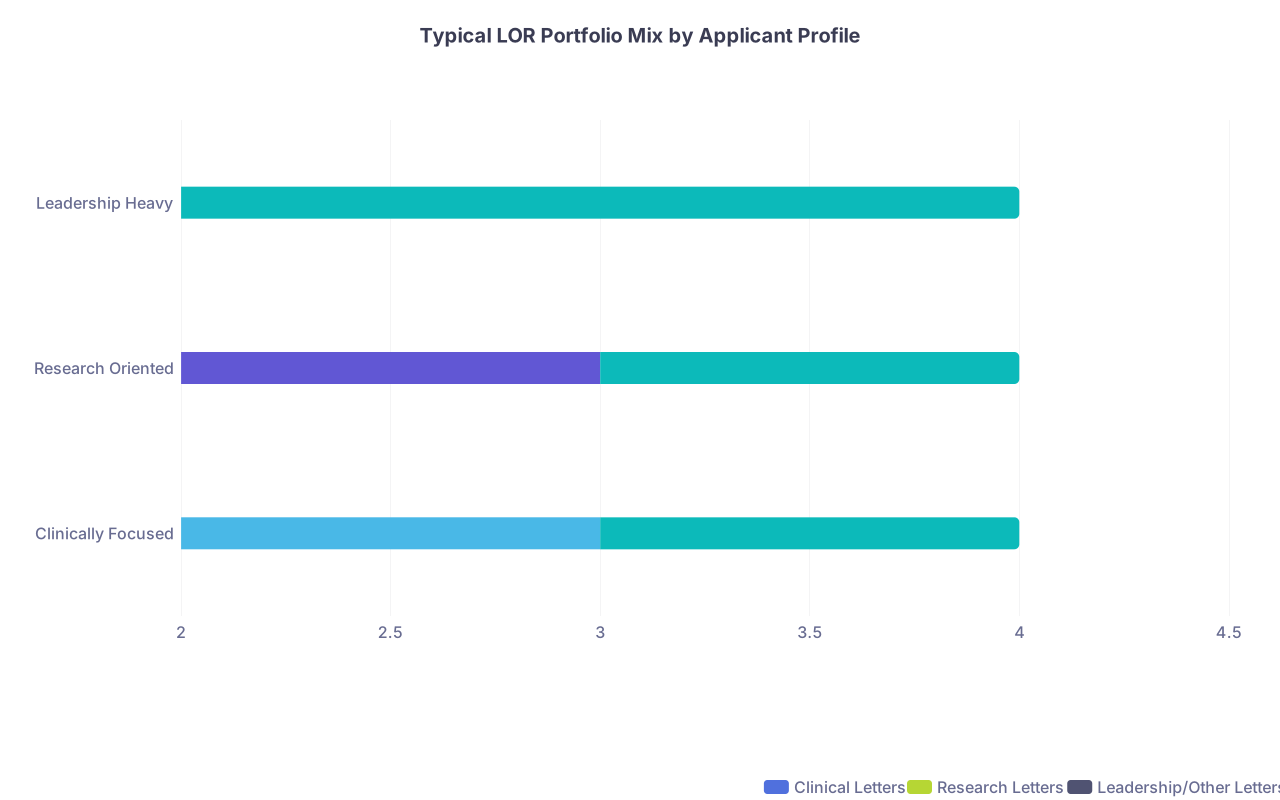
| Category | Clinical Letters | Research Letters | Leadership/Other Letters |
|---|---|---|---|
| Clinically Focused | 3 | 0 | 1 |
| Research Oriented | 2 | 1 | 1 |
| Leadership Heavy | 2 | 0 | 2 |
- Clinically focused applicant: 3 clinical (2 specialty, 1 adjacent) + 1 leadership/character
- Research oriented: 2 clinical, 1 research, 1 leadership or extra clinical
- Leadership heavy: 2 clinical, 2 leadership/character (if leadership work was substantial and sustained)
Do not obsess over perfection. You are aiming for coherent and convincing, not mathematically balanced.
9. Putting It All Together: A Simple Flow
If you want an at-a-glance sense of how to decide “who makes the cut,” here is a stripped-down process.

| Step | Description |
|---|---|
| Step 1 | List all potential letter writers |
| Step 2 | Identify specialty requirements |
| Step 3 | Prioritize getting more clinical exposure in specialty |
| Step 4 | Select top 2 specialty clinical letters |
| Step 5 | Add best adjacent clinical letter |
| Step 6 | Evaluate research and leadership options |
| Step 7 | Use 1 slot for research or leadership |
| Step 8 | Use best remaining clinical letter |
| Step 9 | Assign specific combinations to program types |
| Step 10 | Have >=2 strong specialty clinical options? |
| Step 11 | Any adjacent clinical letters clearly superior to non-clinical? |
| Step 12 | Strong research or leadership mentor with deep knowledge? |
That is your blueprint. Do not start from “Who liked me?” Start from “What does my target specialty expect clinically, and what story am I trying to tell on top of that?”
10. One More Thing: Consistency With The Rest Of Your Application
Programs are not reading your letters in isolation. They see:
- Your personal statement
- Your CV (research, leadership, work, volunteer)
- Your transcript and clerkship comments
If your personal statement screams “I am a future clinician-educator, I built curricula, I love teaching,” but your letters are all research PIs and ICU attendings with nothing about teaching, that is a mismatch.
Similarly, if you lean heavily on a leadership letter about free clinic work, and there is barely a mention of that on your CV, people will wonder what is real.
Make sure your letter mix:
- Reinforces the key themes in your personal statement
- Matches the strengths that are obvious on your CV
- Does not try to invent a persona (teacher, leader, scientist) that is not backed up by your documented history
You are not manufacturing an image; you are amplifying your actual track record.
11. Concrete Example Sets
Let me give a few concrete, realistic sets, because abstractions only go so far.
Example 1: Internal Medicine, academically oriented, strong research
- Dr. X – IM Sub‑I attending (4 weeks, “top intern I have worked with this year”)
- Dr. Y – Cardiology consult attending (excellent presentations, great reasoning)
- Dr. Z – Research PI in outcomes research (2 years, 1 first-author, can speak to analytic skills)
- Dr. W – Student-run free clinic director (2 years, leadership and longitudinal patient care)
For academic IM programs: use all 4.
For more community IM programs: consider X, Y, W, and optionally drop the research letter if you need to emphasize clinical and leadership more.
Example 2: General Surgery, solid clinically, limited research
- Dr. A – Surgery Sub‑I attending
- Dr. B – Trauma surgery SICU attending
- Dr. C – Department Chair (actually supervised you on a major rotation and knows you well)
- Dr. D – Student surgical interest group advisor (minimal interaction, mostly logistical)
Your 3–4 should be: A, B, C. D only if Dr. D truly has deep knowledge of your leadership and you have a 4th slot to fill.
Example 3: Psychiatry, massive community work, modest research
- Dr. P – Psychiatry core clerkship attending
- Dr. Q – Outpatient psych elective attending
- Dr. R – Director of student mental health outreach program (you led for 2 years)
- Dr. S – Research mentor on a minor project (6 months, no publications yet)
Portfolio: P, Q, R, maybe S if applying to psych programs that highlight research or academic interest. For community psych programs, P, Q, R is often more coherent than throwing in a weak research letter.
12. Quick Reality Check: What Actually Matters Most
Let me be blunt. Program directors care most about:
- The best 2 clinical letters in your specialty
- Whether any letter implies concern (directly or between the lines)
- Whether anyone stakes their reputation on you: “I would be delighted to have this student as a resident in our program.”
Everything else—research prestige, leadership gloss—is secondary.
You are not trying to “game” the system with a clever mixture. You are trying to make it extremely easy for a busy faculty member skimming your file to conclude:
“This applicant is clinically safe, intellectually engaged, and a decent human being. We should interview them.”
Key Takeaways
- Start from the non-negotiables: meet your specialty’s expectations with at least 2 truly strong clinical letters in that field, then build around them.
- Use research and leadership letters strategically, not reflexively—include them when they add deep, specific, non-redundant insight that reinforces your actual track record.
- Curate your LOR set as a portfolio that tells one coherent story, and align it with your personal statement, CV, and target program types rather than chasing titles or famous names.