
Clinical Performance Domains LORs Should Highlight for Residents
Letters of recommendation that ramble about how someone is “hardworking” and “a pleasure to work with” are useless. Program directors read those by the dozen and forget them immediately.
What makes a residency LOR actually move an applicant up the rank list is very specific: it clearly describes how the resident performs in core clinical domains that predict success in that specialty and in that program’s environment.
Let me break down those domains the way PDs, CCCs, and selection committees actually think about them. If you are asking for a letter, these are the lanes you want your writer in. If you are writing one, these are the boxes you must check with concrete examples.
1. Clinical Reasoning and Decision-Making
If a letter does not say anything substantive about the applicant’s brain, it is already below average.
Clinical reasoning is the first filter. Committees want to know: does this person think clearly in front of a patient, sort messy data, and land on a defensible plan without hand-holding?
What strong letters actually describe
Forget “smart” and “intelligent.” Those words are cheap. Useful letters talk about:
- How the resident approaches undifferentiated problems
- Their ability to prioritize and triage
- How quickly they build safe, coherent plans
- How they adjust when new data contradicts their hypothesis
You want the letter to sound like this, not like a generic evaluation blurb:
- “On night float, Dr. K admitted a series of high-acuity patients with sepsis, GI bleed, and acute decompensated heart failure. I repeatedly watched him separate signal from noise quickly, frame the immediate life threats, and initiate appropriate early management before I even arrived at bedside.”
- “Her assessment and plan sections were consistently the best on the team: prioritized, problem-based, and updated daily to reflect new studies and evolving diagnoses.”
Subdomains to hit
For clinical reasoning, the LOR should, ideally, give at least one concrete example in each of these areas:
Problem representation
How they summarize a case in 1–2 precise sentences that show they understand what actually matters.Differential diagnosis
Not just listing 20 conditions, but focusing on high-yield, probable, and dangerous diagnoses, and explaining why.Testing strategy
Ordering studies with intent—choosing diagnostics that alter management rather than “shotgun” panels.Management decisions
Reasoned choice of therapies, escalation, and de-escalation. Not just following templates.
If the writer cannot think of a single good example, that is a problem in itself.
2. Medical Knowledge and Learning Trajectory
Committees are not simply asking “Do they know enough?” They are asking “Can this person grow fast enough in our program to be safe and independent by graduation?”
Knowledge is not static. Programs care as much about slope as about starting point.
How this usually gets done wrong
Common useless phrases:
- “Strong fund of knowledge.”
- “Always prepared for rounds.”
- “Did well on teaching sessions.”
These say nothing. Every average applicant has those in at least one letter.
What should replace them
Strong letters talk about:
- Breadth and depth of knowledge relative to training level
- Integration of evidence into practice
- How the resident responds to feedback and knowledge gaps
- Evidence of self-directed learning
You want phrases like:
- “At the start of the ICU rotation, Dr. J had limited experience managing ventilators. Within two weeks, after targeted reading and asking focused questions, he was independently formulating reasonable vent strategies which I only fine-tuned.”
- “She frequently returned the next day having read the primary literature on a complex case, and integrated it into updated plans and mini-teaching pearls for the team.”
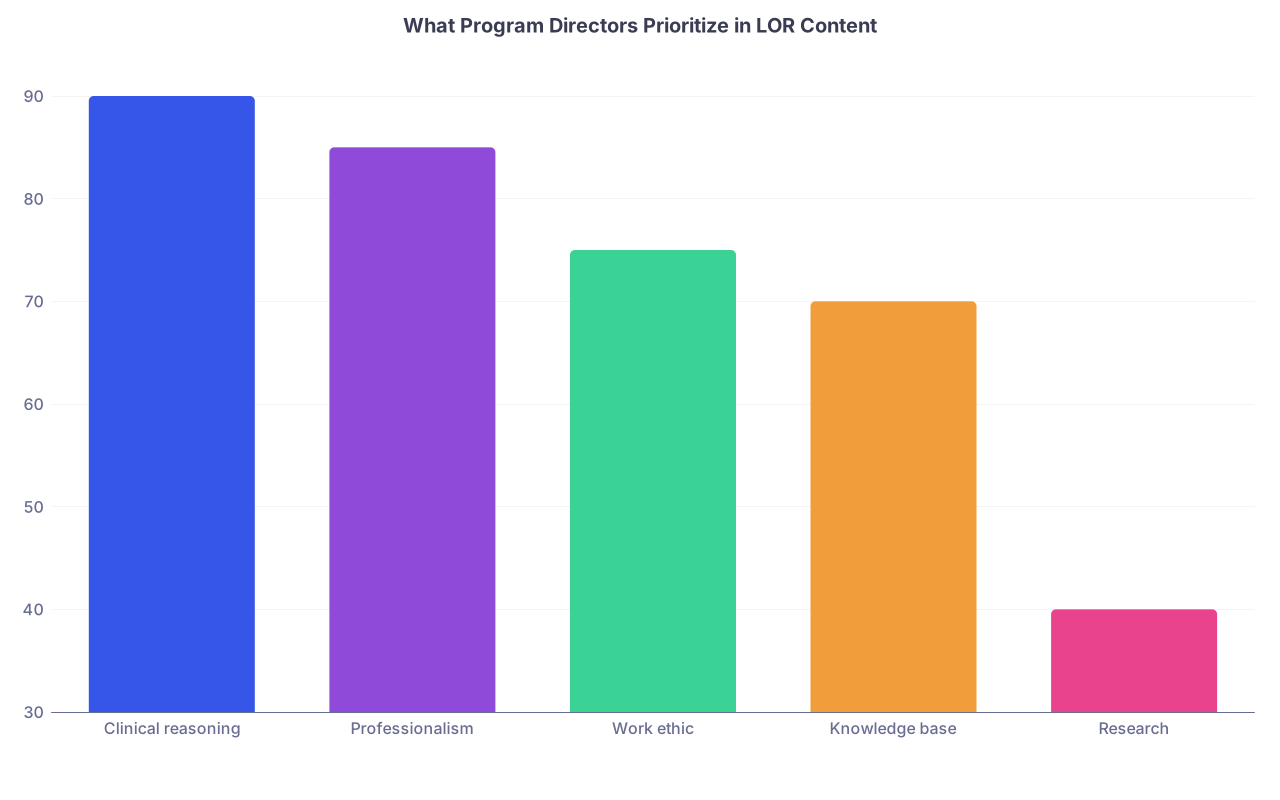
| Category | Value |
|---|---|
| Clinical reasoning | 90 |
| Professionalism | 85 |
| Work ethic | 75 |
| Knowledge base | 70 |
| Research | 40 |
Programs consistently rate clinical reasoning and professionalism above raw knowledge or research. The letter needs to show the resident is moving quickly on the learning curve, not just that they scored well once on a written exam.
3. Clinical Independence, Reliability, and Ownership
This is where letters start to separate real residents from “professional medical students.”
Programs want to know: Can I trust this person with my patients when I am in another room, or asleep at 3 a.m.?
The “ownership” lens
Good LORs describe ownership explicitly. That means:
- Taking responsibility for following labs, imaging, and consult recommendations
- Tracking down missing information
- Anticipating next steps instead of waiting for orders
- Calling for help at the right time, for the right reasons
Examples that actually matter:
- “By the end of the rotation, I rarely needed to modify his daily management plans. He anticipated consultant recommendations, had already ordered appropriate follow-up tests, and routinely updated families before I asked.”
- “On nights, she consistently identified patients at risk of deterioration and intervened early—escalating oxygen, re-evaluating vitals, and calling me with a clear summary and proposed plan.”
Reliability and follow-through
One thing PDs deeply care about but rarely say out loud: they are allergic to flakiness.
Letters should make clear whether:
- Tasks get done completely, not half-finished
- Handoffs are thorough and accurate
- The resident double-checks high-risk details (doses, anticoagulation, allergies)
- The resident is solid on nights and weekends, not just on daytime ward rounds
Compare two statements:
- Weak: “She is very reliable and always willing to help the team.”
- Strong: “If Dr. L told me she had personally followed up on a critical lab or imaging result, I did not re-check it. That level of reliability is rare among PGY-1s.”
That is the kind of line that sticks in a PD’s head.
4. Communication: With Patients, Team, and Consultants
“Good communication skills” is filler unless it is broken down into specific behaviors. Committees want to know if this person actually makes care smoother—or creates friction.
Think of communication in three directions: downward (to patients and families), sideways (to team and consultants), and upward (to seniors and attendings).
With patients and families
Strong letters describe how the resident:
- Explains diagnoses and plans in understandable language
- Manages difficult conversations (uncertainty, bad news, conflict)
- Handles emotionally charged families without defensiveness
- Respects cultural, language, and literacy differences
Concrete versions:
- “I watched him de-escalate an angry family who felt ‘no one was listening.’ He sat down, repeated their concerns back to them, clarified the plan in non-technical language, and within ten minutes they thanked him for finally making things clear.”
- “Our palliative care team specifically complimented her for how she framed goals-of-care discussions in a manner that preserved patient autonomy but did not abandon them in decision-making.”
With the healthcare team
Here, the letter should cover:
- Quality of oral case presentations
- Clarity and brevity when giving sign-out
- Professional tone with nurses and allied staff
- Responsiveness to pages and questions
A detail that matters more than people realize: how a resident speaks to nurses. Good letters do not ignore that.
The kind of line that jumps off the page:
- “Our charge nurses repeatedly told me they preferred to work with Dr. S on nights because he answered pages quickly, listened to bedside concerns, and followed through when they raised early warning signs.”
And for presentations:
- “Her case presentations were focused and organized: one- to two-sentence one-liners, relevant positives and negatives, followed immediately by a prioritized assessment and plan. Rounds moved faster when she presented.”
5. Teamwork, Leadership, and Teaching
Residency is not solo practice. Program directors think in terms of “Will this person make my teams function better or worse?”
Team functioning and leadership potential
This is where LORs should move beyond “gets along with everyone.”
Key domains:
- How the resident supports junior learners (students, interns)
- How they run a team when acting as senior or de facto leader
- Whether they create a psychologically safe environment
- How they handle disagreements and conflict
Good letters provide scenarios:
- “As an acting intern-level resident, she took responsibility for orienting new medical students, helping them identify appropriate tasks and encouraging them to present on rounds. Our students explicitly requested to be assigned to her service.”
- “During a high-volume admitting day, Dr. P naturally stepped into a leadership role—redistributing admissions, keeping the list updated, and ensuring our sickest patients were seen first—without ever raising his voice or blaming others when things got hectic.”
Teaching ability
Programs, especially academic ones, care whether a resident will be an asset to their teaching mission.
Concrete indicators:
- Giving impromptu chalk talks on rounds
- Asking teaching-level questions instead of quiz-style “gotchas”
- Helping medical students write better notes or think more clearly
- Being sought out by juniors for help
Weak: “She enjoys teaching students.”
Strong: “On multiple occasions, I found the medical students deep in discussion with Dr. R about acid-base interpretation or chest pain evaluation, using whiteboards and cases they had just seen. Their end-of-rotation evaluations consistently named her as their best teacher.”
6. Professionalism, Ethics, and Judgment Under Pressure
Program directors fear one thing more than mediocre board scores: a professionalism headache that consumes hours of their time and puts patients or the program at risk.
Letters must answer a blunt question: Is this person safe from a professionalism standpoint?
Core professionalism domains
A strong LOR gives evidence, not adjectives, in these buckets:
Integrity and honesty
Tells the truth about errors, does not hide or fudge data.Accountability
Owns mistakes and corrects them; does not blame others reflexively.Respect for patients and staff
No eye-rolling, sarcasm, or dismissiveness, even when frustrated.Boundaries and confidentiality
Maintains appropriate professional distance, follows HIPAA rules.
Again, specifics matter:
- “When he missed a critical lab result early in the rotation, he informed me as soon as he realized it, discussed it directly with the patient, and presented a clear plan to prevent similar misses in the future. I never saw him repeat that error.”
- “I have never seen Dr. T speak disparagingly about a patient or colleague, even in private or during stressful overnight shifts—an unfortunately uncommon trait.”
Judgment under stress
How someone behaves at 3 p.m. on a calm clinic day is irrelevant. Committees want the 3 a.m. version.
Letters should talk about:
- Performance during codes and rapid responses
- Decision-making when overwhelmed or behind
- Emotional regulation (or lack thereof) during crises
A line that helps a committee sleep at night:
- “In two separate rapid responses, Dr. M quickly identified airway and hemodynamic instability, called for necessary resources, and maintained a calm, structured approach to ACLS while communicating clearly. The nursing staff consistently expressed confidence in his leadership during these events.”
7. Procedural Skills and Technical Aptitude (Where Relevant)
For procedure-heavy specialties—surgery, EM, anesthesia, OB/GYN, some IM subspecialties—committees care how quickly someone picks up hands-on skills and whether they are safe.
What committees look for
They are not asking whether the resident is already a seasoned operator. They want to know:
- Is the resident safe with basic procedures at their level?
- Do they learn technique quickly when taught?
- Do they respect their own limits and ask for help?
- Are they careful—meticulous with sterility, time-outs, and documentation?
Letter content that works:
- “By the end of the month, she was performing ultrasound-guided peripheral IVs and paracenteses with appropriate supervision. Her attention to sterile technique and pre-procedure time-outs exceeded what I expect from a typical PGY-1.”
- “In the OR, he progressed from simple skin closure to intracorporeal knot tying quickly, but never pushed beyond his abilities and consistently sought feedback on technique.”
For non-procedure-heavy fields (psych, pathology, radiology), this section may be minimal or reframed as “technical facility with tools and systems” (e.g., EMR, imaging software).
| Specialty | Procedural Emphasis | What LOR Should Address Briefly |
|---|---|---|
| Internal Med | Moderate | Basic bedside procedures, safety |
| Surgery | High | OR skills, tissue handling, progression |
| EM | High | Airway, lines, resuscitative procedures |
| Pediatrics | Low–Moderate | Age-appropriate procedures, comfort |
| Psychiatry | Low | Focus more on interviewing, not procedures |
8. Systems-Based Practice and Efficiency
This is the unsexy domain that quietly makes or breaks residency performance. Programs are trying to avoid residents who drown in the EMR, forget routine follow-up, and generate constant “near misses.”
Systems thinking
Letters should address whether the resident:
- Understands hospital workflows (labs, imaging, consults, discharges)
- Uses order sets and pathways intelligently
- Knows how to marshal resources (case management, social work, pharmacy)
- Recognizes and closes “loops” in care
Example:
- “Dr. C consistently thought beyond the admission: from the first day she was already engaging case management and social work, anticipating barriers to discharge (insurance, transport, home support) and documenting a clear outpatient follow-up plan.”
Efficiency and organization
This is where overlapped domains come in: time management, task prioritization, EMR use.
Strong letters highlight:
- Ability to manage a normal or high census without falling apart
- Keeping documentation accurate and up to date
- Responding to pages while staying on top of primary responsibilities
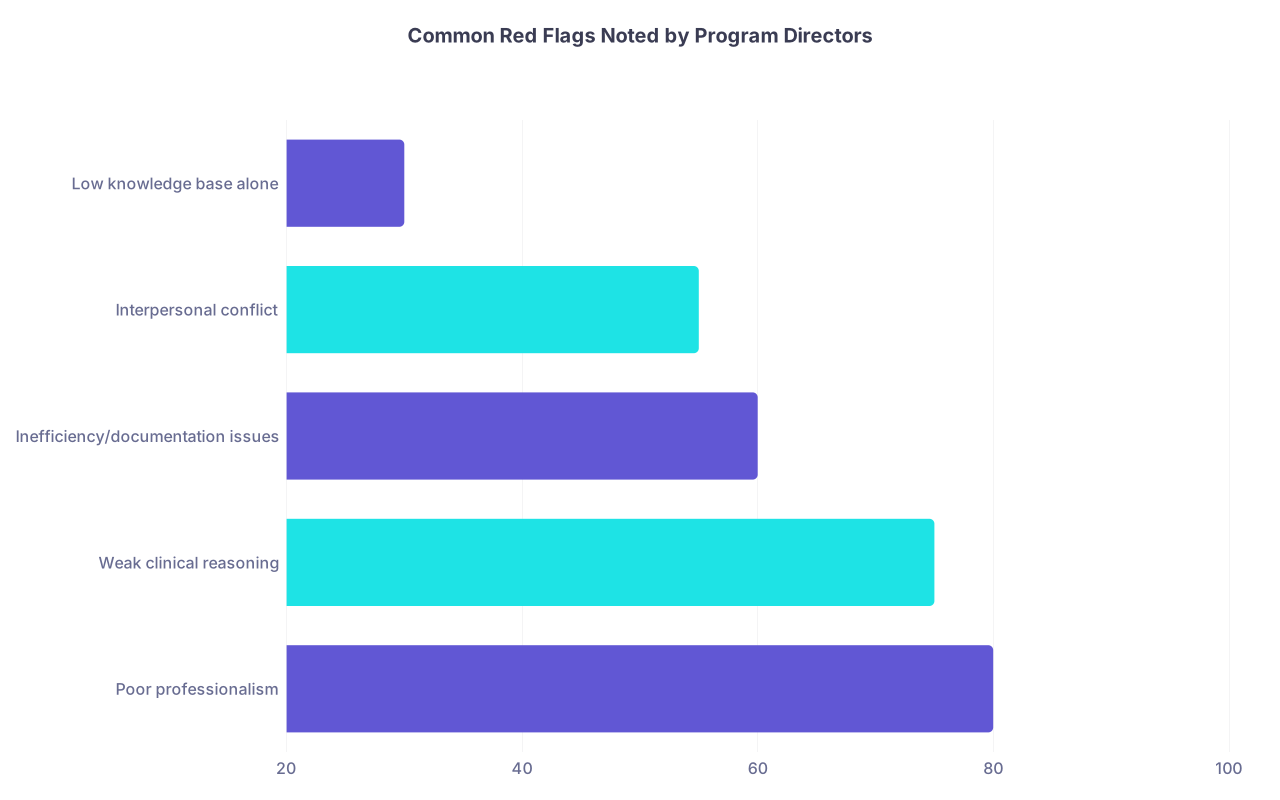
| Category | Value |
|---|---|
| Poor professionalism | 80 |
| Weak clinical reasoning | 75 |
| Inefficiency/documentation issues | 60 |
| Interpersonal conflict | 55 |
| Low knowledge base alone | 30 |
Notice how inefficiency/documentation problems are not minor annoyances; they show up as meaningful red flags in many PD surveys.
9. Comparative and Global Assessment
The most powerful lines in a letter are not adjectives; they are comparisons.
Program directors read hundreds of LORs. They calibrate quickly. “Outstanding” and “excellent” are basically noise. What cuts through is:
- Ranking statements
- Peer group comparisons
- Clear “yes/no/with reservations” recommendations
What strong comparative language looks like
Examples that actually change rank-list positions:
- “Among the more than 100 residents I have supervised in the past decade, Dr. N is easily in the top 5 in terms of clinical reasoning and professionalism.”
- “I would be thrilled to have her as a resident in our own program, and I have no reservations whatsoever about recommending her to your program.”
- “Compared with other PGY-2s on our service this year, he is already functioning at the level of a strong graduating resident in his clinical judgment.”
Weak comparative statements:
- “One of our good residents this year.”
- “Comparable to her peers.”
- “Would do well in any residency program.”
Those are essentially negative signals in a competitive stack.
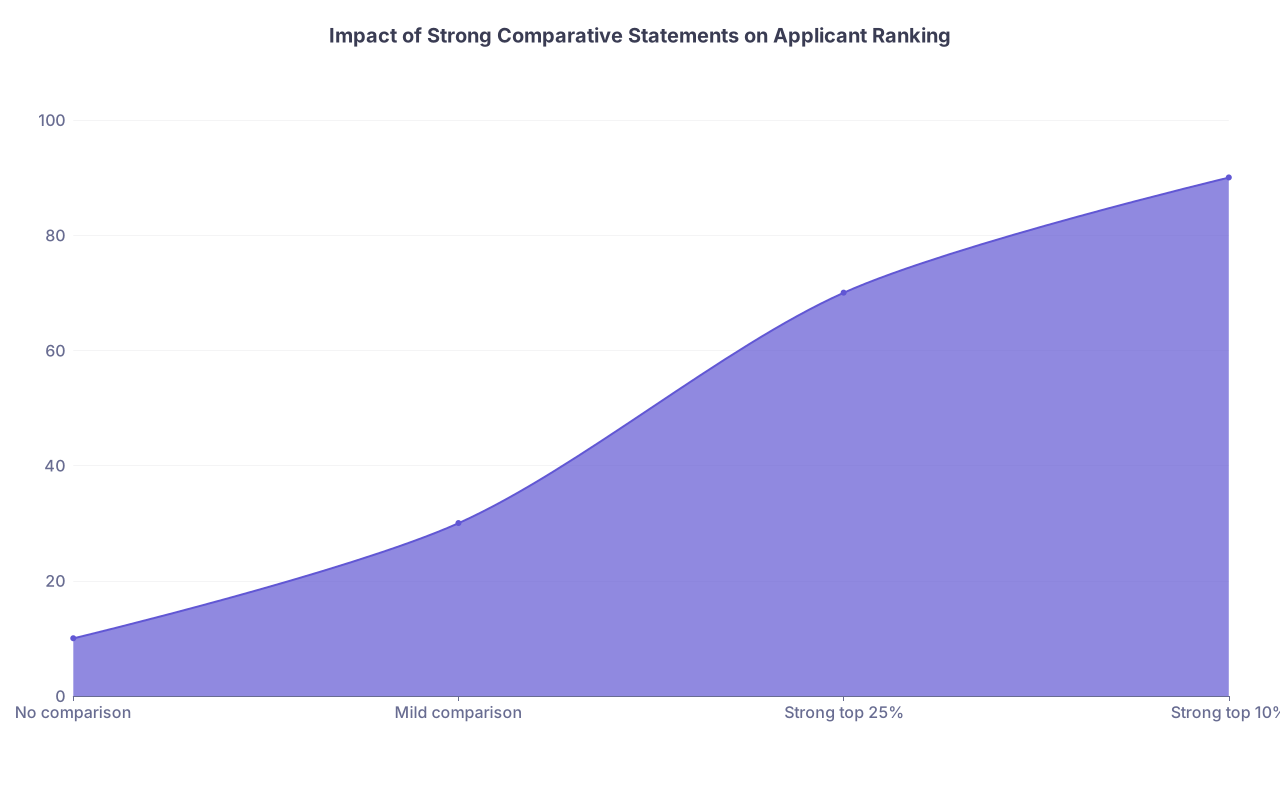
| Category | Value |
|---|---|
| No comparison | 10 |
| Mild comparison | 30 |
| Strong top 25% | 70 |
| Strong top 10% | 90 |
Programs will differ in the exact effect, but a letter that clearly places someone in the top 10–25% of residents the writer has worked with carries disproportionate weight.
10. How to Steer a Letter Toward These Domains (As an Applicant)
You cannot write the letter for your attending. You can, however, heavily influence what they remember and mention.
Here is the move that works:
Send a targeted CV and “LOR highlights” document
One page. Bullet out specific clinical cases or examples touching these domains:- A time you managed a complex admission and built the plan
- An instance where you handled a difficult family or bad news
- A system improvement or efficiency trick you implemented
- Instances of teaching or leadership on the team
Ask for a “strong, detailed letter that comments specifically on my clinical performance”
Do not just say “letter for residency please.” Signal that concrete clinical domains matter.Remind them of concrete cases
“You might remember the patient with massive GI bleed we admitted together; that was a pivotal learning experience for me.”
Many attendings are happy to write robust letters, but they are busy and forget details. You are helping them help you.

| Step | Description |
|---|---|
| Step 1 | Identify Strong Clinical Rotations |
| Step 2 | Ask Attending Early |
| Step 3 | Provide CV and Highlights |
| Step 4 | Request Domain-Focused LOR |
| Step 5 | Send Gentle Reminder if Needed |
| Step 6 | Confirm Submission in ERAS |
11. Specialty-Specific Emphases
Same domains, different weighting. A psychiatry PD and a surgery PD read the same letter very differently.
| Domain | IM/FM/Peds | Surgery | EM | Psych | Radiology |
|---|---|---|---|---|---|
| Clinical reasoning | High | High | High | High | High |
| Procedural skills | Moderate | Very High | High | Low | Low |
| Communication with patients | High | Moderate | High | Very High | Low–Mod |
| Team leadership/teaching | High | High | High | Moderate | Moderate |
| Systems/efficiency | High | High | High | Moderate | High |
So, if someone is applying to psychiatry:
- Emphasize interviewing, formulation, therapeutic alliance, managing complex psychosocial situations.
- Less emphasis on line placement; more on communication, empathy, and boundaries.
For EM:
- Decision-making under time pressure
- Resuscitation skills
- Triage and multitasking
- Interprofessional communication in chaotic environments
For radiology:
- Analytic thinking, pattern recognition
- Independence and meticulousness
- Reliability with follow-up and communication of critical findings
A savvy letter writer subtly shifts which examples they choose and how much real estate each domain gets, based on target specialty.

12. Red Flags and What Their Absence Means
There is one more subtlety: what a letter does not say. Program directors are very good at reading omissions.
If a 2-page letter from a core rotation:
- Says nothing meaningful about clinical reasoning
- Never mentions professionalism or reliability
- Avoids comparative language altogether
That silence speaks loudly. Committees assume: “There was nothing positive and specific to say in those domains.”
On the flip side, a tight, well-structured letter that checks the domains we have walked through—even if it is not effusive—is far more powerful than a gushy, vague letter that ignores clinical performance.

13. Putting It All Together: What an Ideal LOR Actually Looks Like
No gimmicks. No flowery prose. Just an attending systematically answering the questions a program director genuinely cares about:
- How does this resident think?
- Can I trust them with patients, especially when I am not there?
- Do they make the team better?
- Are they moving quickly enough along the knowledge and skills curve?
- Are there any hints of professionalism or reliability issues?
- Where do they stand compared with their peers?
If a letter hits:
- Clinical reasoning and judgment
- Independence, ownership, and reliability
- Communication, teamwork, and professionalism
with concrete stories and a clear comparative statement at the end, it will stand out in a crowded field.

Key Takeaways
- Residency LORs that actually move an applicant up the rank list are built around core clinical performance domains: reasoning, independence, communication, teamwork, professionalism, and (when relevant) procedural skills.
- Specific examples and clear comparative statements are far more persuasive than generic praise; “top 10% of residents I have worked with” plus concrete cases will always beat “hardworking and a pleasure to work with.”
- As an applicant, you can and should nudge your letter writers toward these domains with targeted reminders and case highlights, so their letters show program directors exactly how you function in real clinical settings.