
Program directors do not remember your adjectives. They remember your cases.
Let me be blunt: a letter of recommendation full of “hard‑working,” “team player,” and “excellent fund of knowledge” does almost nothing for you. The letters that move a PD from “meh” to “we should interview this one” are anchored in one or two concrete clinical stories. Very specific. Very memorable. And very rare.
You are not writing these letters—but you are influencing them. Or you should be.
Let me break this down specifically: what “anchor stories” are, why PDs’ brains latch onto them, the types of stories that actually play in selection meetings, and how you—without being annoying or unethical—can help your letter writers generate them.
What PDs Actually Remember From LORs
Most program directors read hundreds of letters each season. After the fifth stack, all the adjectives blend together. What cuts through the noise is a short, vivid narrative with three features:
- A real clinical situation
- A clearly visible behavior or decision by you
- A concrete outcome or take‑home point that maps to residency performance
If you remember nothing else: “She is the best student I have worked with in 10 years” is a nice line; it is not an anchor. This is an anchor:
“On a chaotic night in the MICU, when three patients decompensated within fifteen minutes, Alex independently recognized early tamponade physiology on a borderline hypotensive patient, calmly presented the case to me with a differential and a stepwise plan, and then helped coordinate the bedside echo and emergent pericardiocentesis. The resident later told me, ‘I forgot he was a student.’”
That story does several things at once:
- Situation: high‑pressure ICU night
- Behavior: early recognition, structured presentation, coordinated action
- Outcome: correct diagnosis, appropriate escalation, resident feedback
PDs quote these kinds of stories in rank meetings. I have heard versions of: “She’s the one whose attending said she basically ran the ward when the resident was pulled to a code.” That is an anchor story doing its job.
Why Anchor Stories Work On PD Brains
There is a very simple, slightly cynical reason: PDs are not hiring “good students,” they are hiring future colleagues who will handle 3 a.m. disasters without imploding.
So their brain is scanning LORs for implicit answers to these questions:
- Will this person be safe on call?
- Will they crumble when overwhelmed?
- Can they think, communicate, and act in real time?
- Are they going to need constant hand‑holding, or will they push things forward?
Adjectives do not answer those questions. Stories do.
Think about a selection committee discussion. You have 10 minutes per borderline applicant. No one is parsing nuanced descriptions of fund of knowledge. They are exchanging mental thumbnails:
- “This is the student who ran the sepsis huddle and caught the subtle hemoglobin drop before the GI bleed.”
- “This is the one whose surgery attending said he stayed two hours past sign‑out to talk a family through goals of care after a bad outcome.”
- “This is the one who de‑escalated a combative patient in the ED instead of calling security first.”
Those thumbnails are almost always distilled from 1–2 strong anchor stories in a letter.
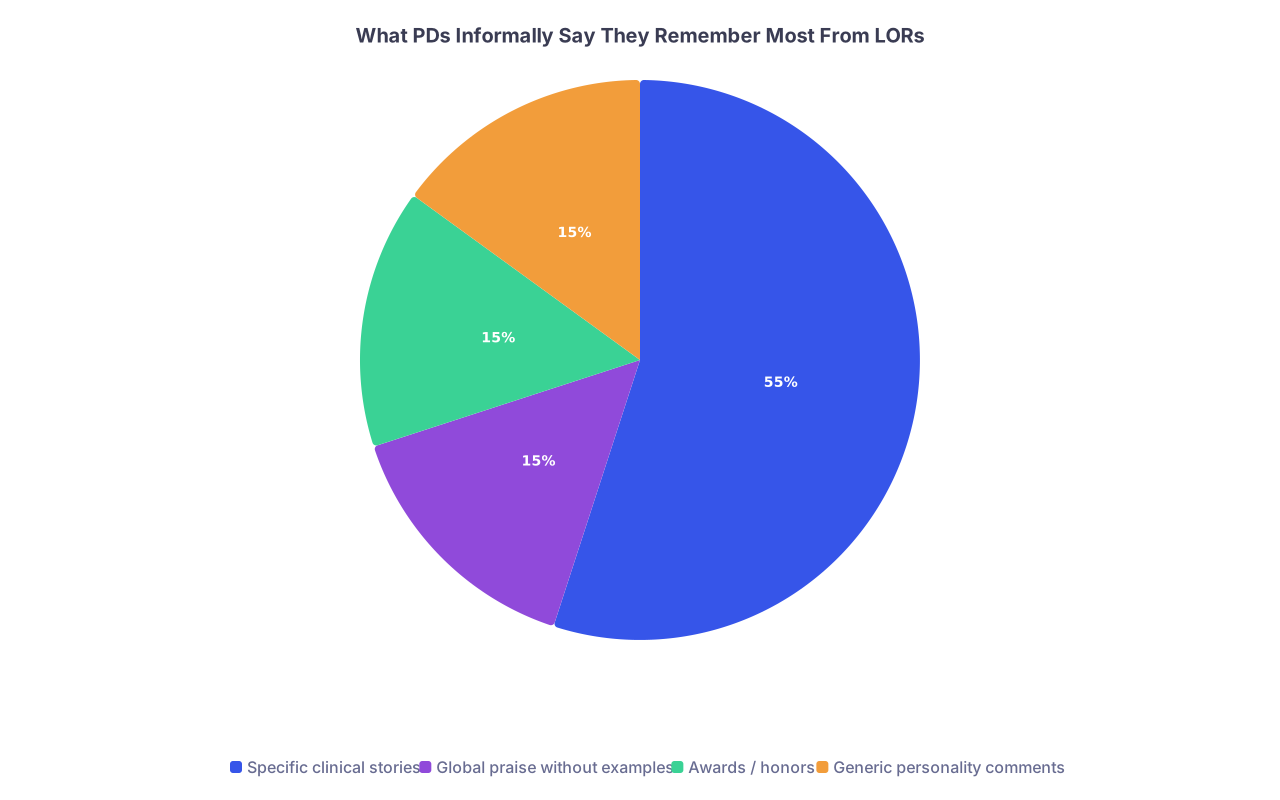
| Category | Value |
|---|---|
| Specific clinical stories | 55 |
| Global praise without examples | 15 |
| Awards / honors | 15 |
| Generic personality comments | 15 |
Is this perfectly scientific? No. But if you sit through enough rank meetings and informal PD roundtables, the pattern is obvious.
The Anatomy of a High‑Impact Anchor Story
Let me dissect this properly. A high‑impact anchor story in a LOR usually has 5 components:
- Context – Where were you, what was happening, why did it matter?
- Trigger Problem – What went wrong, or what challenge appeared?
- Your Action – What you did, specifically, not the team in general.
- Outcome – What changed because of your action (clinical, team, or process).
- Interpretive Statement – The attending’s explicit conclusion about what that behavior means for residency.
Take this letter excerpt and watch how each element shows up:
“During a busy week on our inpatient general medicine service at [Hospital], we admitted a young woman with type 1 diabetes and severe DKA from the ED overnight. The next morning, our intern called in sick, leaving us short‑staffed during morning admits.
When we arrived on the floor, I learned that Jordan had independently seen the patient before rounds, reviewed the overnight labs and insulin drip orders, and identified that the initial potassium repletion plan was insufficient given the degree of acidosis and expected shift with insulin. Jordan calmly presented the patient with a prioritized problem list, suggested an evidence‑based repletion strategy, and flagged the issue to the night team resident and pharmacist before any arrhythmias occurred.
This is the kind of anticipatory, systems‑aware thinking I usually see in my senior residents. Jordan functioned at a level that will make internship a smooth transition, not a trial by fire.”
Map it:
- Context: short‑staffed medicine week, new DKA admit
- Trigger Problem: high‑risk electrolyte management during DKA, intern out sick
- Action: early review, independent assessment, evidence‑based suggestion, proactive escalation
- Outcome: safer electrolyte management, no complication, impressed night team
- Interpretation: “functions like a senior resident,” “internship will be a smooth transition”
That is an anchor story. A PD will retain “DKA, potassium, acted like a senior” long after they forget the USMLE score.
The Five Anchor Story Types PDs Secretly Crave
Not all stories are equal. Some resonate immediately with what PDs are terrified about: unsupervised trainees making bad calls under pressure, or hiding when things get messy.
Here are five categories of anchor stories that consistently land in discussions.

1. The “3 A.M. Decision” Story
Even if it happened at 3 p.m., the idea is the same: acute issue, incomplete data, need for timely, safe action.
Examples:
- Recognizing early signs of compartment syndrome in an ortho patient and insisting on re‑evaluation.
- Calling for an attending to come in when a neonate’s status “just felt off” despite reassuring vitals.
- Quickly formulating ABC priorities in a crashing trauma patient before the team even fully assembles.
What PDs extract:
“This person is not going to sit on an evolving catastrophe because they are afraid to bother someone or cannot synthesize urgency.”
2. The “Owns the Patient” Story
Ownership is the currency of residency. Not “I wrote a note,” but “I owned this admission from start to discharge.”
Examples:
- Tracking a subtle creatinine trend over several days, realizing the patient’s “baseline CKD” was wrong, and pushing nephrology consult that altered diagnosis.
- Coordinating with PT, social work, and family to get a complex discharge done before a long weekend, preventing readmission.
- Noticing that a patient’s chest pain had shifted in character and location, tying it to a missed PE risk and advocating for a CT that changed management.
What PDs extract:
“When things fall through cracks, this person will notice. And act. They will not use ‘but I’m just a student/intern’ as an excuse.”
3. The “Leadership Under Chaos” Story
Not “this student is a leader” in the vague sense. Concrete leadership behaviors under conditions of chaos or conflict.
Examples:
- During a multiple‑admission surge, organizing the team’s task list, volunteering to pre‑chart the sickest patient, and keeping the team moving.
- Mediating between a furious family and a burned‑out resident to reset expectations and prevent a formal complaint.
- During a code, taking over documentation unprompted, reading back orders, and ensuring time stamps were accurate.
What PDs extract:
“This is someone who does not disappear when the floor gets ugly. They contribute to stability instead of adding friction.”
4. The “Difficult Communication” Story
Everyone can deliver good news. PDs want to know who can handle the hard, messy conversations.
Examples:
- Sitting with a family after a poor surgical outcome, explaining in plain language what happened without dumping it all on the surgeon or sugar‑coating reality.
- Taking time to explore why a patient keeps “non‑compliantly” leaving AMA, uncovering literacy/immigration/financial issues, then adjusting the plan.
- De‑escalating a verbally aggressive, intoxicated ED patient by setting limits, validating frustration, and avoiding unnecessary restraints.
What PDs extract:
“This person understands that medicine is 50% communication. They will not make bad situations worse with rigidity or avoidance.”
5. The “Ethical Backbone” Story
These are gold. PDs remember who did the right thing when it was uncomfortable.
Examples:
- Speaking up when a resident wanted to discharge a patient prematurely to clear beds, raising specific safety concerns and offering to do the legwork to make discharge safer.
- Questioning a medication order that looked off, even though “the computer didn’t flag it,” leading to catching an early chemotherapy dosing error.
- Asking to step back from a borderline‑exploitive pelvic exam teaching situation and suggesting a more respectful alternative.
What PDs extract:
“This person has a moral compass and is not paralyzed by hierarchy when patient safety or professionalism is on the line.”
How Applicants Can Ethically “Seed” Anchor Stories
You cannot dictate what your letter writer says. You should not write your own letter. But walking in empty‑handed and then hoping they remember your best moments is naive.
You need to seed anchor stories.
| Approach | Example | Impact |
|---|---|---|
| Helpful, ethical | Brief bullet list of 3–5 concrete cases you were central to | High |
| Neutral | Sending your CV and personal statement only | Low |
| Annoying | Telling them what adjectives to use | Negative |
| Unethical | Drafting your own letter text | Disqualifying |
Here is how to do it without being that student everyone gossips about.
Step 1: Keep a “Story Log” During Rotations
Do not trust memory. On your medicine/surgery/whatever rotation, keep a very short, private running list. No identifiers. Just:
- Initials or a nickname only you understand
- One‑line description of the situation
- Your specific role
- What changed because of you
Example entries:
- “DKA – potassium repletion plan, flagged risk, revised orders, no arrhythmia.”
- “Elderly CHF pt – caught med reconciliation mismatch; prevented duplicate beta‑blocker.”
- “Angry COPD smoker – spent 20 minutes, turned around AMA, stayed and accepted NIV.”
This is not journaling. This is building raw material.
Step 2: Convert Raw Moments Into Letter‑Friendly Bullets
When you ask for a letter, you send a short document along with your CV. Three to five bullets per rotation, max. Each bullet should look like a skeleton anchor story:
- “On your Y3 medicine rotation, I independently followed a complex DKA patient overnight when the intern was out sick: reviewed labs, noticed insufficient potassium repletion relative to degree of acidosis, and proactively contacted the night resident and pharmacist to adjust the plan before rounds. The patient had an uncomplicated ICU course.”
- “On trauma surgery, I took ownership of a young MVC patient with multiple fractures and evolving anemia: created and updated a running problem list, coordinated daily with ortho and rehab, and identified a delayed splenic bleed when his abdominal pain and heart rate drifted during an otherwise ‘stable’ afternoon, prompting a CT that changed management.”
You are not telling them what to say. You are reminding them what actually happened, in LOR‑ready format.
Step 3: Frame It When You Ask For The Letter
Email or in‑person, something like:
“Dr. X, I really valued my time on your service and the feedback you gave me, especially about my independent management of our DKA and trauma patients. I am applying in internal medicine this cycle and would be grateful if you felt comfortable writing me a strong letter of recommendation that comments specifically on my clinical reasoning, ownership, and performance under pressure.
I attached my CV and a brief list of a few cases where I felt I contributed meaningfully to patient care on your service, in case that helps jog your memory as you think about specific examples.”
This is direct but not pushy. You are asking for:
- A strong letter (gives them a graceful out if they cannot)
- Comment on specific domains (clinical reasoning, ownership, etc.)
- Permission to use your bullets as memory aids
A surprising number of attendings will be relieved. They are busy. Most are not keeping a mental highlight reel of student moments.

| Step | Description |
|---|---|
| Step 1 | Clinical Rotation |
| Step 2 | Capture story log |
| Step 3 | Convert to bullets |
| Step 4 | Request LOR with bullets + CV |
| Step 5 | Attending drafts letter with anchor stories |
| Step 6 | PD reads and retains key cases |
Specialty‑Specific Nuances: What Stories Matter Where
Not every specialty cares about the same anchor stories. The underlying pattern is similar—concrete behavior, clear outcome—but the flavor shifts.

Internal Medicine / Pediatrics
They love:
- Longitudinal ownership: following a complex patient for days, catching slow‑burn issues.
- Systems awareness: handoffs, discharge planning, avoiding readmissions.
- Communication: family meetings, breaking bad news with supervision, nuanced social history.
Anchor story example:
“Over a 10‑day hospitalization, she was the first to see that the ‘frequent flyer’ heart failure patient’s readmissions all clustered around missed PCP appointments after payday, and she worked with social work to set up synchronized refill delivery and home health, which drastically reduced subsequent ED visits.”
General Surgery / Surgical Subspecialties
They pay attention to:
- Grit and reliability in the OR and on the floor.
- Situational awareness during cases.
- Ownership of postop patients, including complications.
Anchor story example:
“On trauma surgery, when a fresh postop patient developed escalating tachycardia and abdominal pain at 2 a.m., he quickly reviewed the vitals trend, examined the patient before calling the chief, and succinctly presented a concerning picture for ongoing intra‑abdominal bleeding. His clarity and urgency accelerated our return to the OR and likely prevented a much worse outcome.”
EM / Anesthesia / Critical Care‑oriented Fields
They look for:
- Comfort with ambiguity and fast decisions.
- Triage instincts.
- Calm behavior in truly chaotic situations.
Anchor story example:
“During a multiple‑casualty MVC, she quietly took over initial airway assessment on each new arrival, documenting, placing basic adjuncts, and flagging high‑risk features to the attending before the residents even finished their initial eval. Her composure and pattern recognition matched that of our junior EM residents.”
Psychiatry
They care deeply about:
- Communication and rapport with challenging patients.
- Safety awareness.
- Tolerance for uncertainty and complex psychosocial stories.
Anchor story example:
“With a chronically psychotic, intermittently hostile inpatient who had refused interviews with residents, he found a way to build rapport over several brief, non‑threatening daily interactions. Over five days the patient allowed a full interview, leading to a crucial history of trauma and substance use that had been missing from years of records.”
The core is consistent: one or two vivid, specialty‑relevant stories beat twenty lines of “excellent interpersonal skills.”
Red Flags Hidden in Bad Stories (Or No Stories)
You should also understand what happens when letters do not contain solid anchor stories.
PDs are very good at reading between the lines. Some dangerous patterns:
All Generalities, No Cases
“Hard‑working, pleasant, punctual, well‑liked.” Translation: “Did not screw up. Did not impress.”Vague Praise, Weak Comparators
“One of the stronger students I have worked with.” How many students is that? In what time frame? Versus, “Among the top 10% of students I have worked with in the last five years.”Damning With Faint Narrative
The only “story” is something like: “She always arrived on time and completed her notes.” That is the floor, not the ceiling.Subtle Concerns Buried In Stories
Some attendings will not say “poor work ethic” outright. They will write: “He performed well when closely supervised and appreciated clear direction.” A PD’s brain reads, “Needs hand‑holding. Not ready.”
If you are proactive about seeding anchor stories, you reduce the odds of letters that are technically positive but functionally useless.
Putting This Into Practice For Your Match Cycle
Let me make this concrete. You are in the middle of M3/M4 or a prelim year, gunning for the match. Here is what you actually do over the next 3–6 months to maximize anchor stories in your LORs.
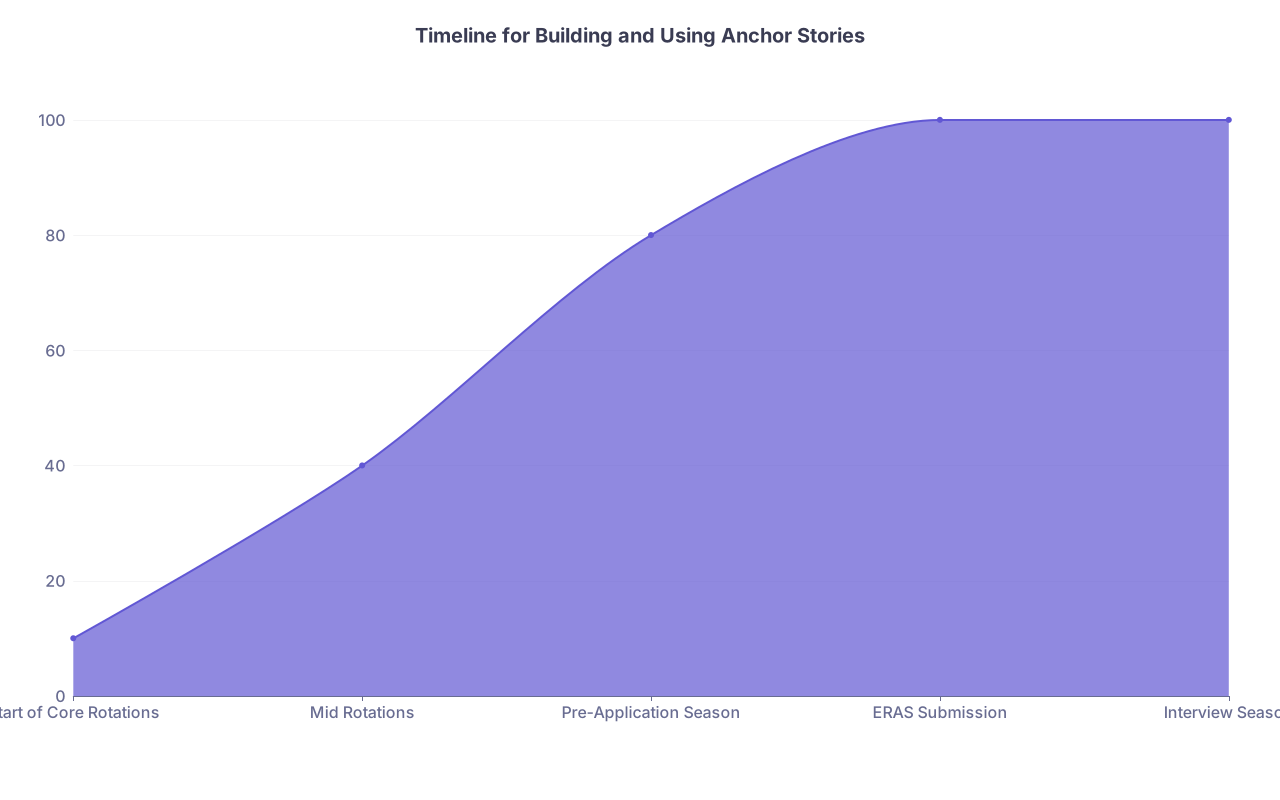
| Category | Value |
|---|---|
| Start of Core Rotations | 10 |
| Mid Rotations | 40 |
| Pre-Application Season | 80 |
| ERAS Submission | 100 |
| Interview Season | 100 |
Interpretation: percent “readiness” of your story bank if you follow through.
On each key rotation (home department, sub‑I, away elective), keep a running story log from week 1. Do not wait for something “epic.” Many anchor stories are medium‑size clinical wins, not dramatic saves.
Every 1–2 weeks, pick 1–2 of those log entries and flesh them out into 3–4 sentence mini‑narratives for yourself. It makes later bullet creation trivial.
When you get strong real‑time feedback (“You really managed that DKA like a resident,” “Impressed with how you handled that family meeting”), write down the context and details that day. Those are anchor‑story seeds.
When it is time to ask for a letter:
- Pick people who have actually seen you think and act, not just pass by on rounds.
- Ask early (a few weeks before you need it).
- Send: CV, personal statement draft if you have one, and 3–5 case bullets from that rotation.
For your most important letters (home PD, sub‑I attendings), consider a brief in‑person or Zoom meeting where you discuss your career goals and mention 1–2 cases that you felt represented your best work. Often they will spontaneously say, “Oh yes, I remember that; I’ll include it.”
You are not gaming the system. You are supplying accurate memory cues so that busy physicians can write the kind of letters they wish they had time and recall to write for their best students.
FAQ (Exactly 4 Questions)
1. What if I honestly do not have any “heroic” cases to use as anchor stories?
You do not need heroics. PDs are suspicious of letters that read like action movies. Solid, non‑dramatic examples are often better: noticing a med error in reconciliation, catching a subtle trend in labs, taking ownership of discharge planning, or calmly reorganizing the to‑do list on a hectic call night. The point is authentic responsibility and thinking, not fireworks.
2. Is it okay to send my letter writer a draft of my own letter to “help” them?
No. That crosses the line. Many institutions explicitly forbid students from drafting their own letters, and PDs can smell self‑written fluff. What is appropriate is a focused case list, your CV, and maybe a paragraph describing what you learned on their service and what you hope they can comment on (clinical reasoning, teamwork, etc.). Let them write the letter in their own voice.
3. How many anchor stories should each letter contain?
Ideally one very strong, well‑developed story and maybe one secondary, shorter example. More than that and the letter turns into a rambling narrative that PDs skim. Less than that and it becomes generic. A sweet spot is a paragraph of global assessment, a robust story paragraph, and a brief reinforcement anecdote.
4. Do program directors actually read every LOR in detail given the volume of applications?
For competitive or borderline candidates, yes—someone will read them closely. For obvious automatic interview or automatic screen‑out cases, sometimes letters get skimmed. But the moments that matter for your match—being pulled up from the middle, being defended in a rank meeting—are driven heavily by memorable anchor stories in at least one or two key letters. You are playing for those decision points, not for automated filters.
Key takeaways: Program directors remember cases, not adjectives. Strong LORs are built around 1–2 specific anchor stories that show how you think, act, and own patient care. Your job is to collect those stories in real time and ethically seed them to your letter writers so they can advocate for you with the kind of concrete detail that actually moves the needle in match decisions.