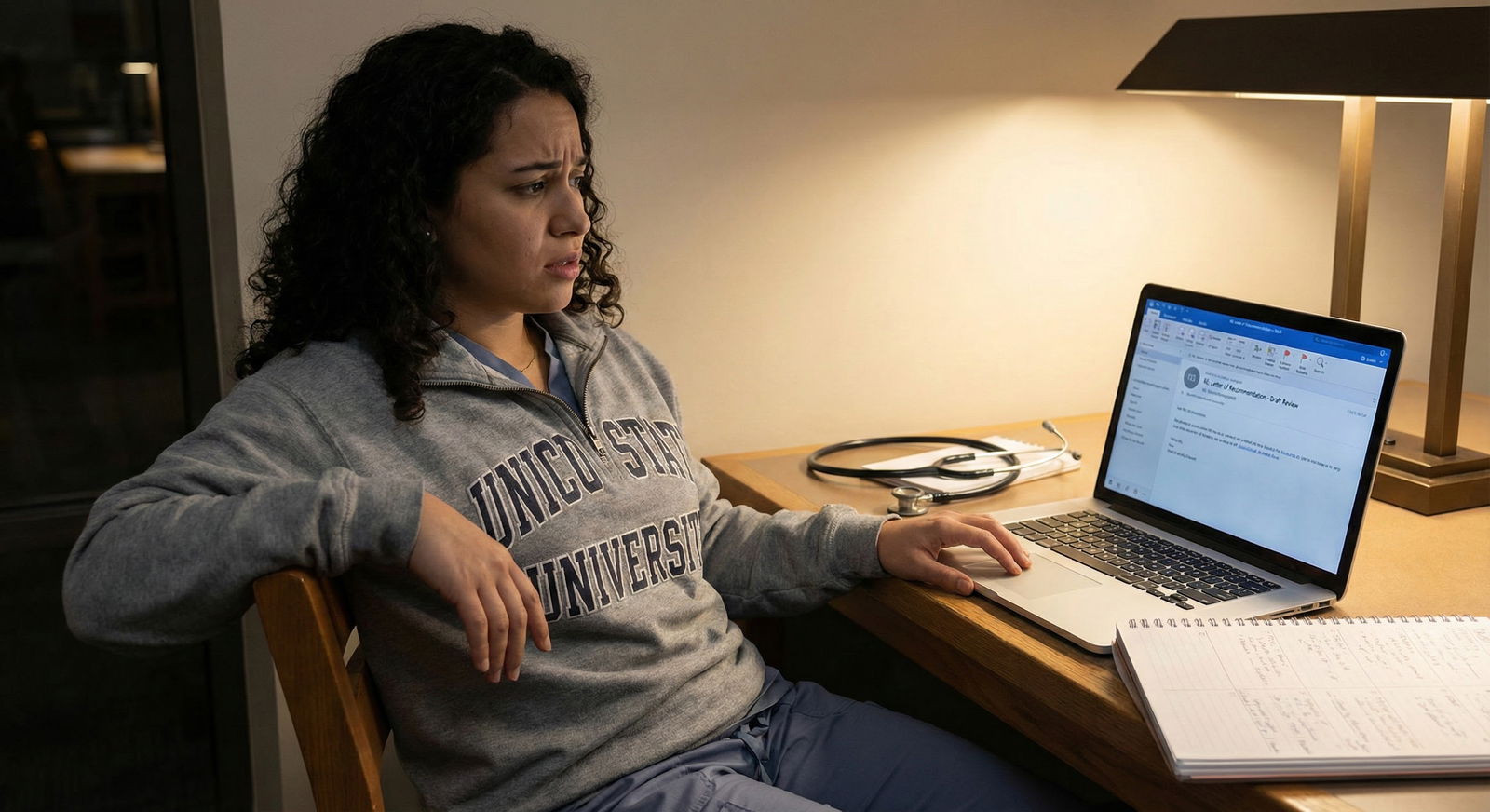
Most residency letters talk about “professionalism” and “teamwork.” Very few prove it. Programs can tell the difference in five seconds.
Let me break this down specifically: if a letter does not translate those nebulous words into concrete, observable behavior, it becomes white noise. You are trying to help a writer generate the opposite: sharp, specific, high‑yield content that program directors actually remember and quote in meetings.
This is about engineering the raw material that makes that possible.
What PDs Actually Mean by “Professionalism” and “Teamwork”
On paper, everyone cares about the ACGME competencies. In real life, selection committees are asking two blunt questions:
- Will this person make my life easier or harder at 2 a.m.?
- Can I trust them not to melt down or act like a jerk when things go sideways?
Professionalism and teamwork are just the nice, bureaucratic labels.
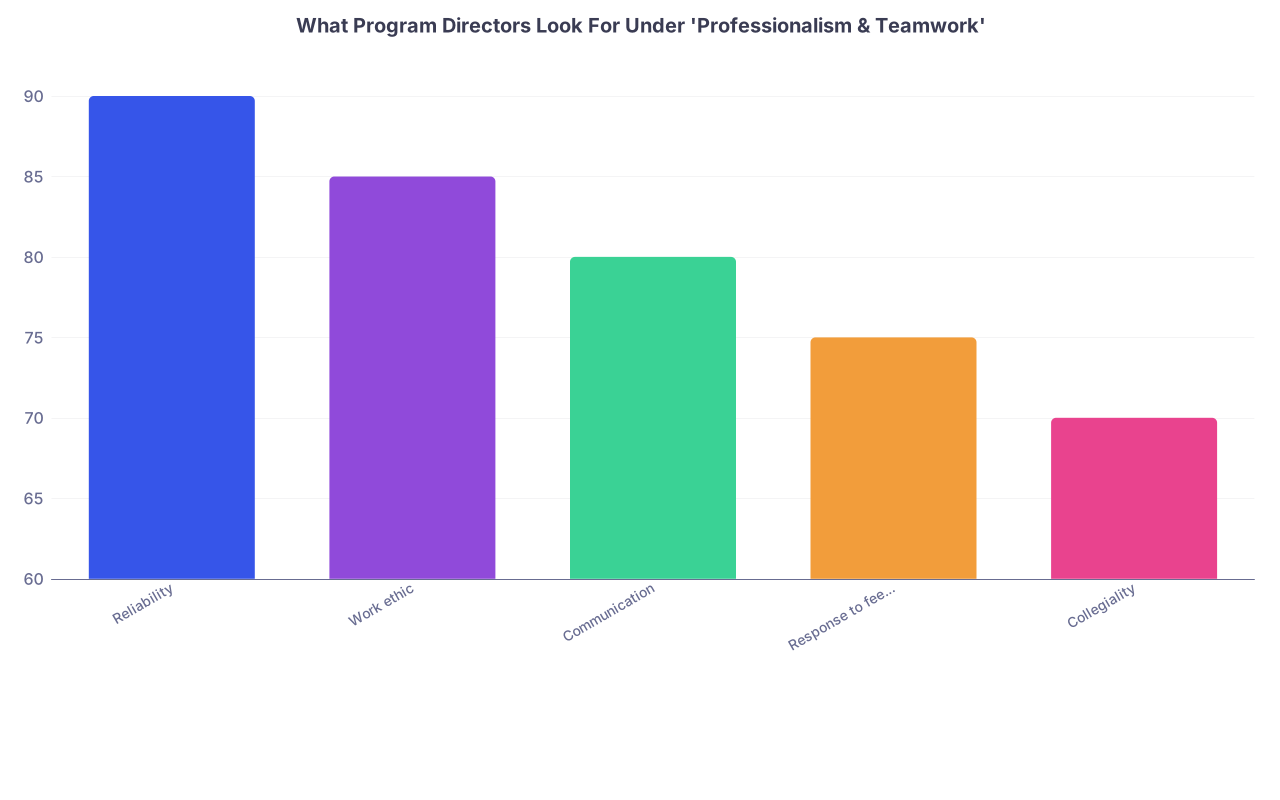
| Category | Value |
|---|---|
| Reliability | 90 |
| Work ethic | 85 |
| Communication | 80 |
| Response to feedback | 75 |
| Collegiality | 70 |
Here is how program directors translate common LOR buzzwords in their heads:
- “Professional” with no examples → Likely average. No obvious disasters, no standout.
- “Always on time, stayed late to help with sign-out, owned follow-up” → Reliable, might anchor an intern night team.
- “Great team player” → Could mean anything from “nice” to “non-entity.”
- “Actively helped restructure our sign-out template, improved flow with nursing” → This person actually improves the system.
Your goal is to get your letter writers to write the second type of sentence, not the first. That requires two steps:
- You need to actually behave in ways that produce those stories.
- You need to organize those stories for your writers so they can recall and describe them with specificity.
The Core Behaviors That Turn into Strong LOR Lines
Let us get concrete. When I read a residency letter, there are about ten recurring behaviors that reliably separate average from excellent on professionalism and teamwork.
Professionalism: What Becomes “Gold” in a Letter
Professionalism in strong LORs usually shows up in four domains:
- Reliability and ownership
- Integrity and patient-first thinking
- Response to stress and feedback
- Respectful behavior with everyone, not just attendings
Examples that actually show up in excellent letters:
- The student who quietly called back every family member who left a message about a patient, documented it, and updated the team at sign-out.
- The sub-I who volunteered to handle all pre-op H&Ps over a weekend, then emailed the senior a clear summary of each case Sunday night.
- The student who discovered a documentation error that made an attending look bad, corrected it, told the attending straightforwardly, and never weaponized it.
Those events become sentences like:
“On multiple occasions, including one weekend with eight new surgical admissions, [Name] volunteered to take responsibility for pre-operative evaluations, completed them meticulously, and communicated clearly to seniors, which made the OR day run noticeably smoother.”
That is what you are engineering.
Teamwork: How It Actually Shows Up Day to Day
Teamwork that moves the needle is not “gets along with peers.” That is baseline. Programs want:
- Interprofessional respect (nurses, PT, case management)
- Situational awareness about team workload
- Ability to both lead and follow
- Conflict handled without drama
On a busy inpatient team, that looks like:
- You see your co-student drowning in notes at 3 p.m.; you quietly finish your own work and then ask, “Which of these can I help close?”
- You notice your senior is stuck in a family meeting; you autonomously field pages for straightforward issues and update them afterward.
- On surgery, you take ownership of organizing the list and distribute tasks at the start of rounds without being asked, improving efficiency.
Those behaviors turn into lines like:
“Nurses repeatedly sought out [Name] because they trusted that if an issue was raised, it would be addressed promptly and respectfully. One charge nurse told me, unprompted, ‘If they were a resident here, I would sign up to be on their team every time.’”
You cannot script a quote like that later. You have to produce it in real time.
Turning Behaviors into Usable LOR Content
Most students fail at the translation step. They do the work, but their writers forget the details and default to mushy adjectives.
Your job is to bridge the gap between what you did and what your letter writer remembers at 11 p.m. clicking through a letter template.
Step 1: Capture Professionalism/Teamwork Episodes While They Happen
You do not need a novel. You need a simple, ruthless log. One page. Running list.
Create a note (paper or digital) with four headers:
- Professionalism – reliability/ownership
- Professionalism – integrity/ethics
- Teamwork – interprofessional
- Teamwork – peer/leadership
Under each, jot bullet points with:
- Date or approximate time frame
- Setting (e.g., “IM wards, MS4 sub-I week 3”)
- Very short description of what happened
For example:
- IM wards, week 2 – stayed late to call all families before long weekend, attending mentioned on rounds.
- Surgery sub-I, week 3 – reorganized sign-out template, senior said “keep this when you are an intern.”
- MICU, week 1 – caught insulin dose error, clarified with nurse, paged fellow, documented; nurse thanked me next day.
You are building a menu of stories that can be weaponized in letters later.
Step 2: Convert Raw Episodes into Letter-Ready Bullets
When you approach a writer, you should not just attach your CV. You should hand them 6–10 tight bullets framed like this:
- Context (rotation, level of responsibility)
- Specific behavior
- Impact on patient care or team function
For example:
- During my IM sub-internship (July 2025), I assumed responsibility for daily medication reconciliation on all my patients, which prevented several near-miss discrepancies; the senior resident later asked if they could adopt my checklist for future students.
- On surgery, I independently coordinated with nursing, anesthesia, and the floor team to ensure all pre-op labs and consents were completed before the first case, helping the team start on time each day that week.
That structure makes it very easy for a busy attending to turn your bullet into a narrative paragraph.

Step 3: Match Stories to the Writer’s Perspective
Different writers are credible on different aspects:
- Clerkship director: global professionalism, reliability, integrity.
- Ward attending: day-to-day ownership, clinical teamwork.
- Subspecialty preceptor: advanced teamwork in complex settings, interprofessional collaboration.
- Research PI: longitudinal professionalism, follow-through, accountability in non-clinical setting.
Do not give all of them the same generic list. Curate.
If your gen surg attending saw you manage floor issues with nurses, feed them those teamwork stories. If your IM clerkship director is writing the “departmental” letter, highlight consistent punctuality, ethical decisions, and how you handled constructive criticism.
Sample Phrases That Actually Sound Like a Strong LOR
Let me give you concrete language. These are sentence frames that show, not tell. You want your behavior to allow a writer to honestly fill these in about you.
Professionalism: Reliability & Ownership
Instead of: “Very professional and reliable.”
Aim for:
- “On our busiest call night with twelve admissions, [Name] stayed until every pending lab had a clear follow-up plan documented and communicated to the night team, without being prompted.”
- “[Name] consistently arrived before the residents, pre-rounded thoroughly on all assigned patients, and often identified overnight events that even the residents had not yet seen.”
Notice the structure: specific context + concrete behavior + implied impact.
Professionalism: Integrity & Response to Feedback
Instead of: “Open to feedback.”
Aim for:
- “After receiving feedback about the need for more concise presentations, [Name] restructured their SOAP notes and, within two days, delivered some of the most focused and efficient presentations on the team.”
- “When they realized a progress note contained an error that could confuse cross-cover, [Name] immediately corrected the record, notified the on-call resident, and apologized without defensiveness.”
Teamwork: Interprofessional Collaboration
Instead of: “Good team player, works well with nurses.”
Aim for:
- “Nurses frequently commented that [Name] was ‘the student who actually follows up when we page.’ Their responsiveness built a level of trust that is frankly uncommon for students.”
- “[Name] independently coordinated with case management and PT to ensure a safe discharge plan for an elderly patient living alone, anticipating barriers the team had not fully appreciated.”
Teamwork: Peer and Team Dynamics
Instead of: “Well-liked by peers.”
Aim for:
- “When a co-student fell ill during a call shift, [Name] quietly absorbed the extra workload, never complained, and maintained the same calm, respectful demeanor with staff.”
- “[Name] took initiative to organize the patient list each morning, assigning tasks among students and interns in a way that improved both efficiency and learning opportunities.”
Those are the kinds of phrases that stand out when a PD is reading their 73rd letter of the season.
Coaching Your Writers Without Being Annoying
There is a delicate line between being proactive and being pushy. You need to respect that your letter writer is doing you a favor, but also recognize that you control more of this process than most students realize.
What You Should Provide to Every Letter Writer
At minimum, give them:
- Your CV (updated, not the one from M1)
- Your personal statement (even if still in draft; they need to see your narrative)
- A one-page “Highlights for Letter” document with:
- Your intended specialty and why you chose them to write
- 4–6 bullets on clinical professionalism/teamwork episodes they saw
- 1–2 bullets on other domains (clinical reasoning, work ethic) for context
| Item | Purpose |
|---|---|
| Updated CV | Background, scope of experience |
| Personal statement draft | Narrative, specialty interest |
| Highlight sheet (1 page) | Specific episodes to jog memory |
| ERAS photo (optional) | Visual recall for writer |
| Deadline & logistics clearly stated | Reduces friction, earns goodwill |
You are not telling them what to write. You are making it easier for them to remember concrete things they already saw.
How to Ask Directly for Professionalism/Teamwork Content
You can explicitly signal that you value this domain without sounding scripted. Example email language:
“Given my interest in internal medicine and the importance of functioning well on multidisciplinary teams, I would especially appreciate if you could comment on my professionalism, communication with staff, and ability to work within the team during the rotation, if you felt you observed these.”
Notice the “if you felt you observed these.” That gives them an out if they cannot honestly endorse you, which is exactly what you want. A lukewarm letter hurts more than a missing one.
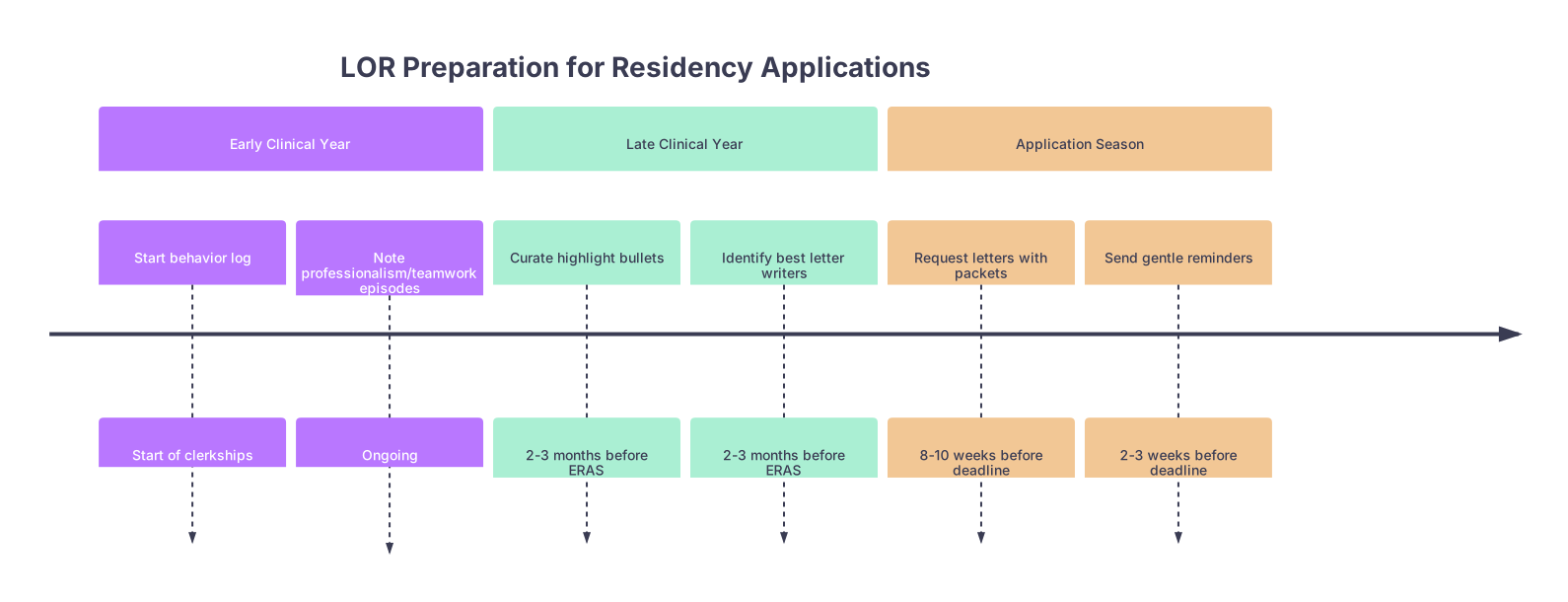
| Period | Event |
|---|---|
| Early Clinical Year - Start behavior log | Start of clerkships |
| Early Clinical Year - Note professionalism/teamwork episodes | Ongoing |
| Late Clinical Year - Curate highlight bullets | 2-3 months before ERAS |
| Late Clinical Year - Identify best letter writers | 2-3 months before ERAS |
| Application Season - Request letters with packets | 8-10 weeks before deadline |
| Application Season - Send gentle reminders | 2-3 weeks before deadline |
Specialty Nuances: Tailoring Professionalism & Teamwork Signals
Programs read letters through the lens of their own culture. What counts as “strong teamwork” looks a little different in EM vs Pathology vs Surgery.
Internal Medicine and Pediatrics
They care about:
- Reliability on complex, longitudinal care
- Communication with families and consultants
- Team-based problem solving on wards
Great IM/peds letters often include:
- Multidisciplinary family meetings where you contributed meaningfully.
- Times you coordinated with consultants and actually followed through.
- Handling difficult family dynamics without escalating conflict.
Surgery and Surgical Subspecialties
They care about:
- Ownership of patients in a high-stress environment
- Respectful but efficient collaboration in the OR and on the floor
- Resilience and composure with hierarchy
Strong professionalism/teamwork lines here:
- You proactively checked on post-op patients before being asked, communicated changes to the team, and followed up labs.
- You took feedback in the OR, adjusted immediately, and came back having practiced skills; scrub techs respected working with you.
Emergency Medicine
They read heavily for:
- Performance under pressure
- Team communication in real time
- Situational awareness and triage mindset
Useful stories:
- Managing multiple patients at once, including close coordination with nurses and consultants.
- Calm, organized behavior during a trauma or code, even in a subordinate role.
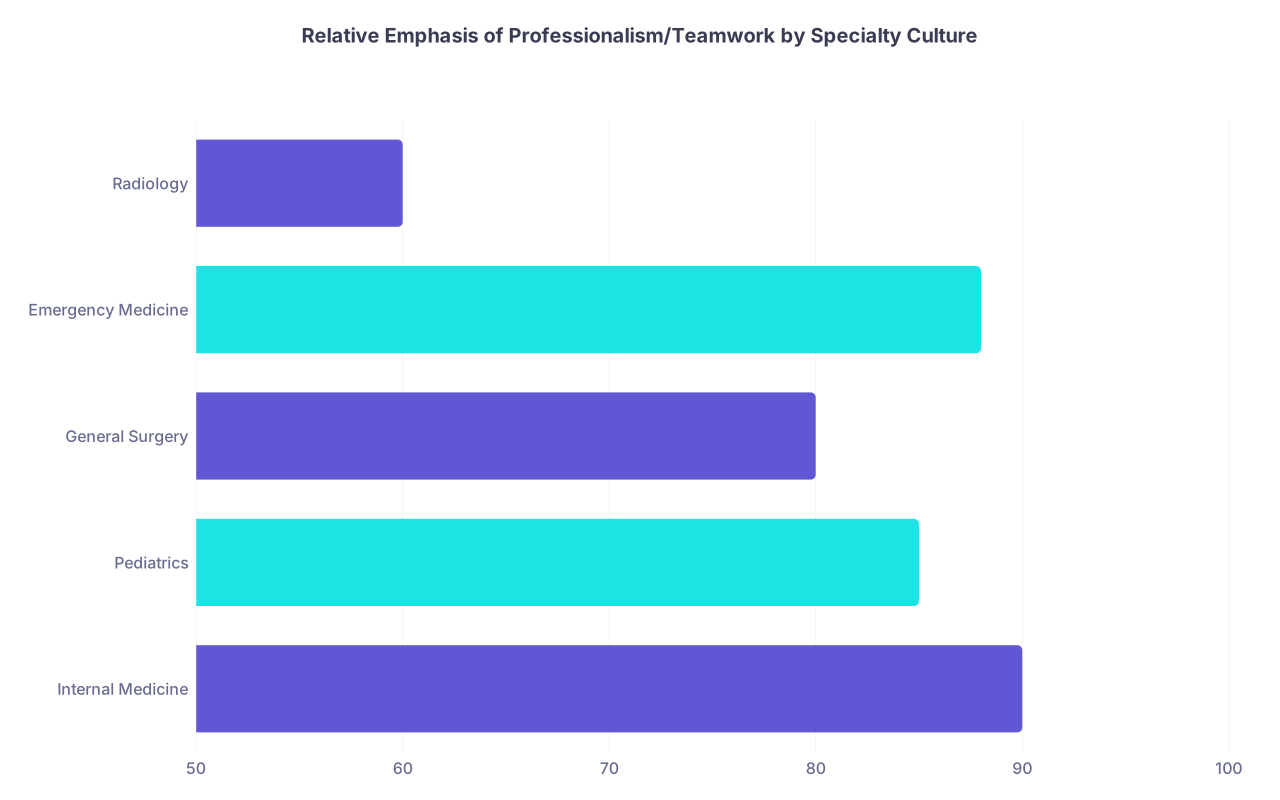
| Category | Value |
|---|---|
| Internal Medicine | 90 |
| Pediatrics | 85 |
| General Surgery | 80 |
| Emergency Medicine | 88 |
| Radiology | 60 |
Radiology, Pathology, Anesthesia
Different flavor, same core:
- Radiology: reliability, communication with referring teams, teaching during consults.
- Pathology: meticulousness, respect for specimens and process, collegial consulting.
- Anesthesia: pre-op communication, crisis teamwork in OR, calm demeanor.
You still want concrete examples; they are just anchored in those specialty-specific interactions.
What Weak Letters Sound Like (And How to Avoid Inspiring Them)
You have probably seen these. They are the kiss of death in a competitive specialty.
Classic weak lines:
- “I expect [Name] will be a solid resident.”
- “[Name] completed all assigned duties.”
- “[Name] is quiet but pleasant to work with.”
Translated by a PD:
- “Middling.”
- “Minimum effort.”
- “We do not trust this person with higher responsibility or do not know them well.”
Notice what is missing: situational context, impact, and any sign that the writer feels enthusiastic enough to be specific.

To avoid this:
- Do not ask for letters from people who barely know you, even if they are “famous names.”
- Do not leave writers with only generic information about you.
- Do not behave passively during rotations and then expect your personality to be remembered.
Your day-to-day micro-behaviors are what letter writers remember: Did you pick up the pen during sign-out? Did you offer help without being asked? Did you communicate clearly with the nurse who was clearly frustrated?
Those tiny behaviors become the adjectives and, more importantly, the stories.
Putting It Together: A Concrete Example Packet
Let me show you what this looks like in practice. Imagine you are an MS4 applying to Internal Medicine. You want your inpatient wards attending to hit professionalism and teamwork hard.
Your “Highlights for Letter – Dr. Smith IM Wards July 2025” might include:
- Professionalism – reliability: “I arrived by 6:15 a.m. daily to pre-round on all 6–8 of my patients, prepared updated med lists, and identified overnight events so the team could start work rounds efficiently. You commented a few times that my pre-rounding notes helped frame your assessment quickly.”
- Professionalism – ownership: “On our heavy call day (~10 new admissions), I stayed late to ensure all my patients had updated problem lists and follow-up labs ordered, and I left a detailed sign-out for the night team. You mentioned during feedback that my follow-through built trust.”
- Professionalism – feedback: “After mid-rotation feedback about being more concise, I rewrote my presentation templates; you mentioned near the end that my SOAPs had become appropriately focused.”
- Teamwork – interprofessional: “I often coordinated with our case manager and PT to clarify discharge barriers for older patients living alone (e.g., arranging home PT vs SNF). The case manager told me she appreciated that I looped her in early before discharge day.”
- Teamwork – peer support: “When my co-student was out sick one call day, I took on both sets of patients, and we discussed how that reflected managing intern-level workloads.”
That is one page. It does not tell Dr. Smith what to say. It reminds them what actually happened.
From that, a busy attending can write:
“During a demanding four-week inpatient rotation with a high patient census, [Name] consistently arrived early to thoroughly pre-round on 6–8 patients, synthesizing overnight events and medication changes in a way that allowed our rounds to proceed efficiently. When a co-student fell ill during a call shift, [Name] quietly assumed responsibility for additional patients, stayed late to complete thorough documentation and sign-out, and never once complained. Our case manager remarked that [Name] was unusually proactive for a student in looping her in early about discharge barriers, which smoothed several complex discharges. These behaviors demonstrated a level of ownership and team-oriented mindset that I typically see in strong interns, not medical students.”
That paragraph is gold. And you essentially built the raw material.
Frequently Asked Questions
1. How early should I start tracking professionalism and teamwork examples?
Start with your very first core clerkship. You will not remember the details six months later. A simple one-page running log starting M3 will be enough. Add 1–2 bullets per rotation, especially during high-intensity blocks (IM, surgery, EM, ICU). By the time you request letters, you will have a menu of specific stories to choose from.
2. What if I feel like I have no “big hero” stories, just consistent reliability?
That is fine. Program directors value consistency more than theatrics. You do not need a dramatic code story. You need clear evidence that, day after day, you showed up, did the work, communicated, and supported your team. Small but repeated behaviors—always calling back families, consistently helping co-students, regularly coordinating with nurses—add up to a powerful narrative when described specifically.
3. Is it appropriate to give writers specific sentence suggestions?
Providing sentence ideas is reasonable; dictating exact wording is not. What works best is giving bullet-point episodes with context and impact, like, “Coordinated with nursing and case management to arrange safe discharge for complex patient.” Some attendings will naturally turn that into strong prose. If one explicitly asks you for “draft language,” keep it brief, honest, and focused on facts, not self-praise, and let them edit freely.
4. How many letters should emphasize professionalism and teamwork versus clinical skills?
Every strong letter will touch on both, but you can adjust emphasis. For most specialties, at least two of your core clinical letters should have substantive professionalism/teamwork content. If you have a research letter, that one can lean more on reliability, follow-through, and collaborative skills in a scholarly environment. For a competitive specialty, having at least one letter that clearly paints you as a “glue person” on the team—someone who makes teams function better—is a real asset.
Key points:
- Programs do not believe generic claims about “professionalism” and “teamwork”; they believe specific, behavior-based stories tied to impact.
- You can shape your LOR content by deliberately creating, tracking, and packaging those stories for your writers in a concise highlight sheet.
- Strong letters come from strong day-to-day behaviors that make life easier for your team. Engineer those behaviors now, and the letters tend to write themselves.