
Relying on faculty to “just write whatever you think is best” is the fastest way to get a lukewarm letter.
If you want strong residency letters, you stop being passive and start handing your writers a professional, strategic brief.
Let me break this down specifically.
Most students treat LORs like a black box: ask → pray → upload. Strong applicants do something very different. They design a personal LOR brief—essentially a mini dossier—that quietly steers faculty toward exactly the kind of letter programs want to see.
Not manipulative. Not fake. Just organized, targeted, and about three levels more professional than what 90% of your classmates are doing.
What a “Personal LOR Brief” Actually Is (And Is Not)
A personal LOR brief is a short, structured packet you give each recommender to make their life easier and your letter better. Done right, it:
- Reminds them who you are in their context (rotation, cases, projects).
- Highlights 3–5 concrete strengths, with examples they can borrow.
- Aligns those strengths with the specialty’s values.
- Gives them logistics (deadlines, where to upload, waivers) in one place.
What it is not:
- Not a drafted letter you want them to sign. Faculty hate that. Some find it unethical.
- Not a generic CV dump with no guidance.
- Not a one-size-fits-all document you spam to every writer without tailoring.
Think of the brief as a hybrid between an executive summary and a targeted cheat sheet. You are doing the cognitive heavy lifting. They are providing authentic, independent judgment.
Why Programs Care About How Your Letter Is Written
Residency programs do not just read the adjectives. They read how the letter is constructed, what details are chosen, what is omitted, and how the writer positions you relative to peers.
, Alignment with specialty traits, Length/effort](https://cdn.residencyadvisor.com/images/articles_svg/chart-what-pds-informally-prioritize-in-a-lor-5303.svg "What PDs Informally Prioritize in a LOR")
| Category | Value |
|---|---|
| Specificity of examples | 90 |
| Comparison to peers | 80 |
| [Writer seniority](https://residencyadvisor.com/resources/lor-residency/the-unspoken-lor-hierarchy-whose-signature-really-moves-pds) | 75 |
| Alignment with specialty traits | 70 |
| Length/effort | 60 |
If your attending is writing from vague memory, you get:
- Generic phrases (“hardworking,” “team player”) with no teeth.
- No comparison language (“among the top…”) because they do not remember clearly.
- No specialty fit comments because they do not know your story.
A good brief fixes that. It prompts their memory and offers specific episodes: “this is the day she stayed late to coordinate that DKA transfer,” “this is the talk he gave on GI bleeding that impressed the whole team.”
You are not scripting the letter. You are curating their recall.
Anatomy of a Strong LOR Brief
I will give you structure first, then we will dissect each piece and show you how to tweak by specialty.
Core sections your brief should include
At minimum, you want:
- One-page cover summary (high-yield, skimmable).
- Focused context about your work with that faculty.
- Bullet-point strengths with case-level examples.
- Specialty and program goals (why this field, where you are aiming).
- Updated CV / ERAS experiences list (appendix).
- Logistics: deadlines, waivers, upload instructions.
Most students either overshoot (send a 12-page autobiography) or undershoot (send nothing but a CV). You are going to sit in the middle: thorough but ruthless about relevance.
Section 1: The One-Page Cover Summary
This is the page your recommender will actually look at when they start typing. If you blow this page, the rest of the brief will not save you.
Ideal length: ~¾ to 1 page, clean formatting, lots of white space.
Key components:
- Clear title: “Residency Letter of Recommendation Brief – [Your Name], [Graduation Year]”
- Short tagline about your application: “Applying Internal Medicine, academic track, interest in cards/heme-onc.”
- Relationship snapshot: 2–3 sentences.
- 3–5 highlighted strengths, each 1–2 lines, linked to specific events.
- 2–3 sentences on fellowship/long-term goals.
Example skeleton:
Residency Letter of Recommendation Brief – Priya Shah, MS4 (Class of 2025)
Applying: Internal Medicine, categorical, interest in academic General IM / medical educationOur work together:
I worked with you on the inpatient general medicine service at [Hospital] from March 4–31, 2024 as a third-year medical student. You were my attending for Weeks 2–4. During that time we co-managed 24 unique patients, 8 of whom I followed for >3 days.Suggested themes you might consider mentioning (if accurate):
• Ownership & follow-through – Especially on the cirrhosis patient (Mr. X) whose diuretic regimen we adjusted; I called his SNF, coordinated follow-up, and updated his family daily.
• Clinical reasoning – My workup of the patient with fever and back pain (ruled out epidural abscess, ultimately diagnosed psoas abscess).
• Communication – Family meeting with the COPD patient in Week 3 where you had me lead the goals-of-care discussion.Long-term goals:
I hope to train in an academic IM program with strong general medicine and QI, then pursue a role combining hospitalist work with residency education.
Notice: specific, anchored in your shared experience. You are not asking them to trust your self-description; you are pointing to episodes they witnessed.
Section 2: Context – How You Worked With This Faculty
Most attendings barely remember what they had for breakfast last Tuesday, much less the details of every student two rotations ago. You want to reconstruct the context so they can write with confidence.
Keep this to half a page max. Include:
- Rotation name, site, and dates.
- Your role (MS3 vs MS4, sub-I vs core, research mentee vs clinic-only).
- Typical responsibilities (number of patients, procedures, projects).
- Any specific projects you did together (presentations, QI projects, teaching sessions).
Example:
Context of Our Work Together
• Rotation: Surgery Sub-Internship – Acute Care Surgery, County Hospital
• Dates: July 1–28, 2024
• Role: Acting intern. I carried 6–8 patients daily, wrote daily notes, placed orders under supervision, followed consults, and responded to pages.
• Responsibilities: First call for new consults overnight with the resident; primary on 2–3 floor patients including coordinating discharges.
• Projects with you:
– Case presentation at M&M on 7/19 (delayed recognition of bowel ischemia).
– Drafted updated post-op order set for appendectomy patients that we discussed in sign-out.
You are reminding them: “Here is what I actually did; here is what you actually saw.”
Section 3: Targeted Strengths with Real Cases
This is the heart of the brief. If you half-ass this section, your letter will sound like everybody else’s.
Aim for 3–5 strengths. Not 10. More is not better; it just makes the writer ignore all of them.
Each strength should have:
- A label that maps to common evaluation domains.
- 1–2 sentences of context.
- A concrete, shared example.
Typical domains programs care about:
- Clinical reasoning / judgment
- Work ethic / ownership
- Teamwork and communication
- Professionalism / reliability
- Technical skill (for surgical/procedural fields)
- Teaching / leadership (especially for academic tracks)
Here is how you structure them.
Example: Internal Medicine
1. Ownership and Reliability
You often commented on my follow-through with complex discharges. For example, with Ms. R (HFpEF exacerbation, multiple social barriers), I called her PCP, arranged home nursing through her insurer, and updated her son daily, which you cited on feedback as “doing the work of an intern.”2. Clinical Reasoning
On the patient admitted for suspected pneumonia who was ultimately found to have PE, I generated the differential that included PE despite a normal CXR, and suggested obtaining a D-dimer based on her recent immobilization. You later told me you appreciated my “systems-based thinking.”3. Communication and Teamwork
You had me lead sign-out on Friday of Week 3 because I had the most complete mental model of our service. You mentioned that my sign-outs were concise and prioritized illness severity well.
Example: Surgery
1. Procedural Skill and Learning Curve
Over the 4 weeks, I progressed from camera holding to primary operator on several laparoscopic appendectomies. You remarked in the OR that I had “steadier hands than most sub-Is” and picked up knot-tying faster than expected.2. Work Ethic and Grit
I consistently arrived in the hospital by 4:45 am to pre-round and stayed until the last case finished, including 2 nights where I remained until after midnight to help with emergent cases, despite not being required to. You once joked on rounds that I “outlast most of the residents.”
Do not invent praise; just remind them what they already said to you or on your eval. Their language will jog their own memory.
Section 4: Specialty Framing and Program Targets
Faculty write better letters when they understand what you are aiming for. “Applying IM somewhere” is useless. “Applying categorical IM with interest in cardiology vs general medicine” is workable. “Aiming at strong academic IM programs in the Midwest with a track record in cards or heme-onc” is ideal.
Spell this out clearly:
- Your specialty choice (and if you have a parallel plan, e.g., IM prelim then neuro).
- The type of program: academic vs community, geographic preferences, features that matter to you (research, specific patient populations, procedural exposure).
- Your long-term vision: clinical, academic, fellowship, rural practice, whatever it actually is.
This allows the writer to aim their comments. A faculty who knows you want EM will emphasize performance under pressure and ED rotations. One who knows you want pediatrics will lean into family communication and empathy.

Example paragraph you might include:
I am applying to categorical internal medicine programs with a strong academic environment, ideally in the Midwest, with interest in cardiology or general academic medicine. I value programs with robust general medicine training, exposure to diverse patient populations (including safety-net hospitals), and opportunities in quality improvement and education. Long term, I hope to combine inpatient clinical work with resident teaching and QI projects.
Now the faculty can write things like, “I believe she will thrive in a rigorous academic IM program” rather than some bland “she will be an asset to any residency.”
Section 5: CV / ERAS Experiences – But Curated
Yes, you append your full CV or ERAS experiences list. But do not make your recommender dig through 7 pages to find the one research project you actually care about.
Use a short preface summarizing the 2–4 most relevant experiences that tie into your narrative. Then append the full document.
For example:
Selected Experiences Relevant to My IM Application
– Clinical: 4-week sub-I in General Medicine (County Hospital), 2-week cardiology consults (University Hospital).
– Research: 1-year involvement with Dr. Patel’s heart failure outcomes group (2 abstracts, 1 pending manuscript).
– Teaching: Peer tutor for MS2 pathophysiology; small-group leader for physical exam workshop.Full CV/ERAS entries follow on subsequent pages.
Attending physicians are busy. You want to hit them with the signal first, then offer the noise for reference.
Section 6: Logistics – Make It Impossible to Mess Up
I have seen very good letters get uploaded late or to the wrong place because students assumed attendings understood ERAS. Many do not.
You want a clean, factual, no-whining logistics section at the end of the brief or in a separate one-page attachment.
Include:
- Whether you waived your right to see the letter (you should).
- ERAS Letter ID and exact name of the letter (e.g., “Internal Medicine – Dr. Smith, University Hospital”).
- Deadline you are aiming for (realistic but firm).
- How they will receive the upload link (ERAS email, institutional portal, etc.).
- Your contact info for questions.
| Item | Details |
|---|---|
| Application System | ERAS (Residency) |
| Letter Type | Internal Medicine Categorical LOR |
| Letter ID | IM123456 |
| Target Upload Date | August 25, 2025 |
| ERAS Waiver Status | Rights waived (confidential letter) |
| Contact for Questions | [email protected], cell: xxx-xxx-xxxx |
You can stick this on a separate page titled “Letter Logistics – [Your Name].” The easier you make their life, the better mood they are in while writing.
Tailoring Your Brief by Specialty
The core structure is the same, but which strengths you foreground needs to match what the field actually values.
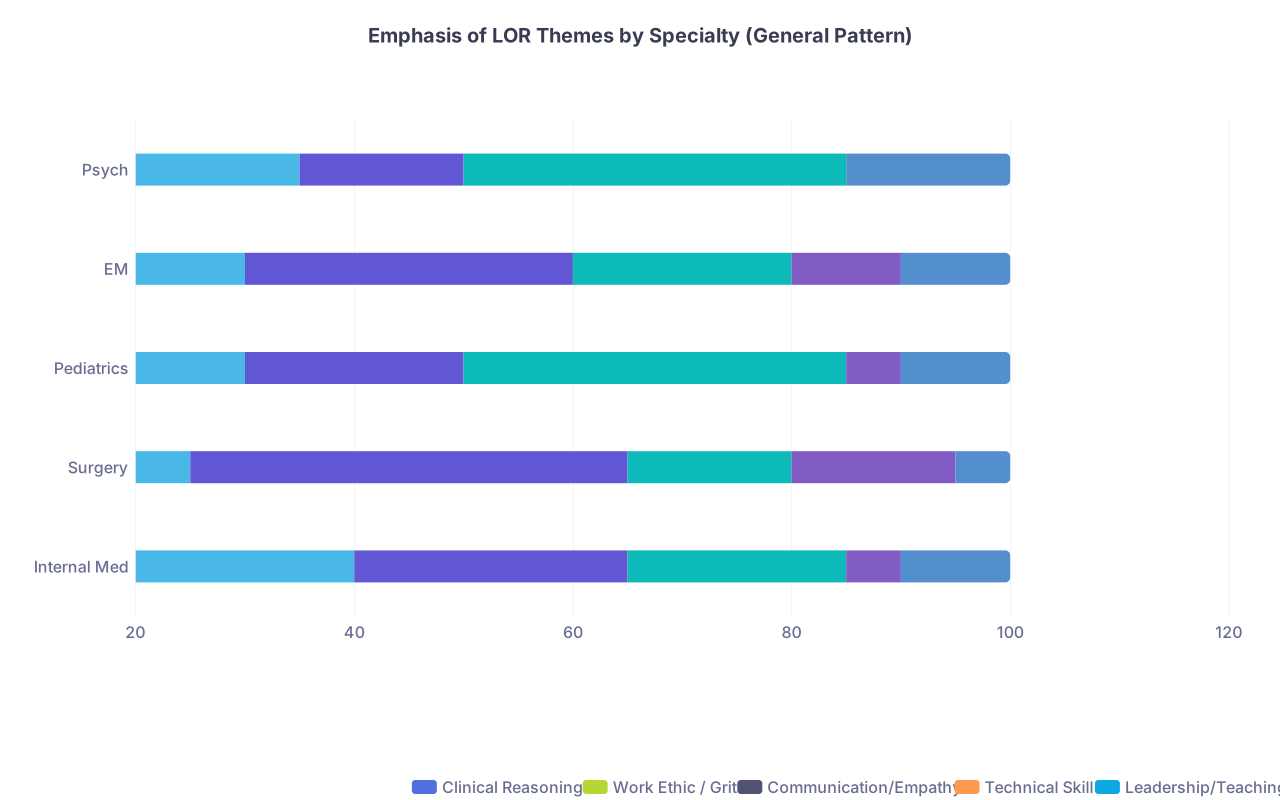
| Category | Clinical Reasoning | Work Ethic / Grit | Communication/Empathy | Technical Skill | Leadership/Teaching |
|---|---|---|---|---|---|
| Internal Med | 40 | 25 | 20 | 5 | 10 |
| Surgery | 25 | 40 | 15 | 15 | 5 |
| Pediatrics | 30 | 20 | 35 | 5 | 10 |
| EM | 30 | 30 | 20 | 10 | 10 |
| Psych | 35 | 15 | 35 | 0 | 15 |
Numbers are conceptual, but the pattern holds:
- Surgery: Grit, technical potential, team integration.
- EM: Calm under pressure, rapid decision-making, team communication.
- Pediatrics: Patience, communication with families, advocacy.
- Psychiatry: Interpersonal skills, insight, professionalism.
- IM: Reasoning, ownership, reliability.
Do not send the same “strengths” page to your peds letter writer and your surgery letter writer. That is lazy and it shows.
Example contrast: EM vs Psychiatry
EM brief theme example:
Performance in Acute Situations
During my EM sub-I you had me lead the initial evaluation of two Level 2 trauma activations. You later commented that I “stayed calm and prioritized life threats appropriately,” especially on the hypotensive elderly patient with occult GI bleed where I quickly established IV access, initiated resuscitation, and presented a focused plan within minutes.
Psych brief theme example:
Therapeutic Rapport and Boundaries
On the inpatient unit you noted my ability to build rapport with challenging patients, including Mr. J with severe paranoia, who initially refused to speak with staff. Over three days, I engaged him consistently, negotiated medication adherence, and maintained clear boundaries. You wrote on my evaluation that I “demonstrated maturity beyond typical MS4 level.”
Same student. Different framing. Because the specialties are looking for different signals.
How to Actually Use and Deliver the Brief
The brief is only as good as the way you introduce it. You want to come across as organized, not demanding.
The live ask
Whenever possible, ask for the letter in person (or via video if needed). Then follow up with the brief by email.
Script (rough, but functional):
“Dr. Lee, I really valued working with you on the wards, and I am applying in internal medicine this cycle. Would you feel comfortable writing a strong letter of recommendation on my behalf?”
Pause. Let them answer. If they hesitate, you do not want that letter.
If they agree:
“Thank you, that means a lot. I put together a brief summary of our work together and some specifics about my application to make things easier for you. I will email it along with my CV and ERAS details. Please feel free to ignore anything that is not useful.”
That last line matters. You are signaling: this is support material, not an expectation.
The email
Subject line: “LOR materials – [Your Name], [Specialty], [Year]”
Body:
Dear Dr. Lee,
Thank you again for agreeing to write a letter of recommendation for my internal medicine residency application. I have attached:
- A 1-page summary of our work together and suggested themes (if they resonate).
- My updated CV.
- A one-page logistics sheet with ERAS letter ID and target upload date.
Please feel free to use whatever is helpful and disregard the rest. I appreciate your time and support very much.
Best regards,
[Your Name]
[Cell] | [Email]
Attached: your brief (PDF), CV, and logistics page.

Common Mistakes That Water Down Your Brief
I have seen a lot of students try to “optimize” this and end up shooting themselves in the foot. Let me call out the common screws-ups.
Overstuffing it.
A 7-page narrative with life story, personal statement draft, and printouts of your research posters is not a brief. It is an obstacle. Keep the high-yield sections up front and let the rest sit quietly in the appendix.Being vague.
“I am hardworking and compassionate” is useless. “Stayed until 11 pm on multiple occasions to stabilize post-op patients and update families, even when not required to remain” gives the writer something they can transform into a credible story.Copy-pasting identical briefs to every writer.
Your outpatient pediatric preceptor does not need a detailed description of your laparoscopic skills. Tailor at least the strengths section and the specialty framing.Telling instead of reminding.
Avoid “Please say I am in the top 5% of students you have worked with.” That is cringeworthy. Instead: “On my final evaluation you commented that I was among the top students you had that year; I have included that evaluation for your reference.” They decide whether to put that line in the letter.Missing the timing.
Dropping a 6-page PDF on someone with a 10-day runway in September is asking for a rush job. Give them 4–6 weeks whenever possible and send the brief when they say yes, not the day before the deadline.
Handling Special Situations
You will not always have the perfect, long longitudinal relationship. The brief becomes even more important when things are less than ideal.
1. Short rotation (2 weeks) or limited contact
A brief helps rebuild the case:
- Emphasize the specific days/cases you worked closely together.
- Include any written feedback, comments, or emails they sent you.
- Keep the strengths aligned with things they plausibly saw.
Do not ask them to comment on your “leadership over the year” if they met you for 8 shifts.
2. Research mentor with minimal clinical exposure
You shift the emphasis:
- Work ethic, independence, curiosity, reliability.
- Communication, writing, resilience through failed experiments.
- Any teaching or mentoring roles in the lab.
Flag in your brief that the letter will be mainly research-focused and that you are supplementing with strong clinical letters.
3. Mixed performance rotation
If the rotation was bumpy early on but you improved, your brief can frame the growth:
“I struggled initially with note efficiency, which you mentioned on mid-rotation feedback. Over the last two weeks I incorporated your suggestions and was finishing timely notes and cross-cover summaries that you and the residents commented had improved substantially.”
You are not hiding the weakness. You are guiding them toward the “trajectory” narrative: programs actually like students who can learn and improve.

One Sample Layout (Front to Back)
To make this concrete, here is a clean order that works:
Page 1 – “Residency LOR Brief – [Name] – [Specialty]”
- Relationship snapshot
- Key strengths with examples (3–5 bullets)
- Long-term goals / specialty framing (2–3 sentences)
Page 2 – “Context of Our Work Together”
- Rotation details
- Responsibilities
- Joint projects or notable cases
Page 3 (optional) – “Selected Experiences Relevant to [Specialty]”
- 4–6 short bullets
- Then: “Full CV attached”
Page 4 – “Letter Logistics”
- ERAS ID, waiver status, deadlines, contact
Appendix – Full CV / ERAS printout
Four or five pages total, but only 1–2 that really demand attention. That is a real brief.
Improving Your Brief Over Time
Do not treat this as a one-and-done artifact. You can start with a generic master version in late MS3, then adapt and sharpen.
A simple way to track what matters:
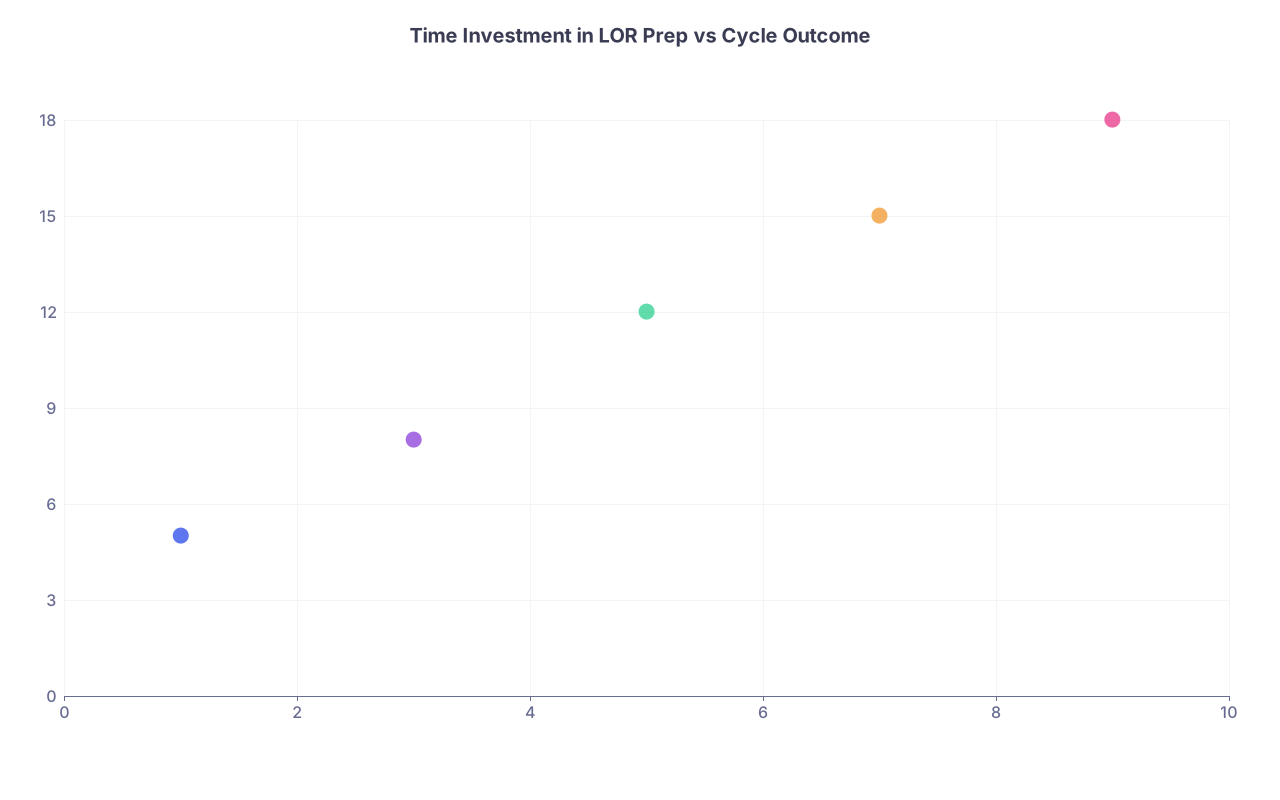
| Category | Value |
|---|---|
| Student A | 1,5 |
| Student B | 3,8 |
| Student C | 5,12 |
| Student D | 7,15 |
| Student E | 9,18 |
Horizontal axis: approximate hours invested in LOR planning (choosing writers, building briefs, follow-up).
Vertical axis: number of solid, clearly enthusiastic letters (based on content and interviews).
Is this exact data? No. But in real life I have watched the same pattern: students who treat LORs as a serious project, not an afterthought, consistently end up with better letters and better interviews. The time pays off.
You iterate:
- After your first couple of asks, adjust your wording based on how faculty react.
- Refine your strengths list as you collect more eval comments.
- Swap in newer, better examples as you do sub-Is and electives.
You are basically running a mini QI project on your own application materials.

The Bottom Line
Three points to walk away with:
Strong LORs are not random. They are the product of deliberate preparation, and a well-designed personal brief is the single most powerful (and underused) tool you control.
Your brief must be specific, contextual, and specialty-aligned—anchored in real shared cases and responsibilities, not generic self-praise.
Respect your letter writers’ time. Ask clearly, provide a concise, targeted packet, and make logistics idiot-proof. You will get better letters, stronger interviews, and a quieter mind on the way to Match.