
How LORs Showcase Growth: Turning Early Struggles into Assets
It is December. You are sitting in a call room between consults, rereading a draft email to a faculty member you are about to ask for a letter of recommendation. The problem is not whether they know you. They do. The problem is they saw you when you were rough. First rotation of third year. Slow notes. Tentative on rounds. You are better now—but you are worried their memory is the older, clumsier version of you.
This is where most applicants get stuck. They assume letters of recommendation are about flawless performance. They should not be. The best residency LORs are about trajectory. They show admissions committees who you were, where you struggled, and exactly how you changed.
Let me break down how that actually works—down to the level of phrases letter writers use and how your own strategy can turn early missteps into one of the strongest parts of your file.
How Program Directors Actually Read Growth in LORs
Residency selection committees are not naïve. They know you did not walk onto the wards as a mini-fellow. When they scan letters, they are reading for three different timelines:
- Where you started
- What you did when things were hard
- Where you ended up (and how steep that slope was)
They are not just asking “How good is this student?” but “How fast do they learn, and what do they do with feedback?”
This is especially true post–Step 1 pass/fail. Letters now carry a larger share of the “growth and grit” signal that used to be inferred from score trajectories.
Here is the basic mental model many PDs use (whether they articulate it or not):
| Growth Signal Type | Committee Interpretation |
|---|---|
| Clear upward trend | High trainability, strong work ethic |
| Stable high performance | Solid, reliable, but less “resiliency” data |
| Early struggle, no change | Risk for remediation, poor insight |
| No mention of trajectory | Writer not engaged or student average |
If your record shows any early academic or clinical struggle, your letters must lean heavily into that first row: clear upward trend.
The Anatomy of a “Growth-Centered” Letter
Most applicants focus on who the letter writer is: big name, PD, chair, famous researcher. What matters more than the name is how specifically they can describe your evolution.
A growth-centered letter has three concrete components:
- Baseline description (early performance, including flaws)
- Feedback or challenge event (what went wrong, or what was missing)
- Response and final state (what you did differently, with examples)
Let me give you a real-style example. This is the type of paragraph that gets PDs to sit up:
“When I first worked with Alex on our inpatient GI service at the start of third year, he struggled to prioritize complex patients and often needed redirection on morning presentations. Over the month, he actively sought feedback, arrived early to pre-chart, and progressively delivered concise, well-structured presentations even on high-acuity patients. By the end of the rotation, he was functioning at the level of a strong acting intern, independently identifying key management issues and anticipating next steps in care.”
Look at the structure:
- The writer admits initial struggle (prioritization, presentations)
- They document a behavioral response (seeking feedback, earlier pre-charting)
- They anchor your new level to a normed benchmark (“strong acting intern”)
That combination—especially the last part—is what converts your earlier weakness into a positive: you are coachable and accelerate when supported.
Types of “Struggles” That Can Be Turned Into Assets
Some issues are easier to spin into growth than others. You need to be honest with yourself about which bucket your struggle falls into and who is in the best position to talk about it.
1. Early Clinical Roughness
Common scenario: First two clerkships. You are slow on notes, passive on rounds, or your differential is shallow. Then something clicks.
This is very fixable, and often ideal for a growth narrative. A strong letter might contain:
- “Initially hesitant with patient interviews, became markedly more confident and efficient.”
- “Documentation was initially verbose, but after feedback, their notes became focused and useful to the team.”
- “Started the rotation relying heavily on seniors, ended it independently formulating appropriate problem-based assessments.”
Programs like this arc. It mirrors internship: everyone is rough in July; what matters is your slope.
2. Knowledge Gaps / Shelf or Exam Underperformance
You bombed an early shelf exam or had to remediate a pre-clinical course. The damage on paper is already done. The LOR’s job is to explain what happened next.
Growth-framing language looks like:
- “After a disappointing clerkship exam score, she systematically restructured her study approach and subsequently achieved honors on three consecutive core rotations.”
- “He entered the ICU rotation with clear knowledge gaps in ventilator management. Through consistent reading and discussion, he ended the month presenting ventilator plans that I would expect from an intern.”
You want at least one letter to clearly connect the dots from early academic stumble → changed behavior → sustained improvement.
3. Professionalism or Communication Issues (Mild, Early)
This one is trickier, but if the issue was real and addressed early, it can still flip into a net positive—if handled by the right writer who directly supervised the remediation.
Example language:
- “At the start of the rotation, some of her notes were submitted late, which we addressed directly. She immediately implemented more structured time management and did not miss a single deadline for the remainder of the year, while also taking on additional QI responsibilities.”
- “He initially struggled with receiving direct feedback without appearing discouraged. Over the course of multiple rotations, I observed a clear change in his affect and responsiveness. He now proactively asks for feedback and operationalizes it quickly.”
If there was a formal professionalism concern (documented), you need careful alignment between your MSPE and your letter. But when the issue was mild, early, and objectively resolved, a letter can actually reassure a committee that the problem is not ongoing.
4. Life-Circumstance Challenges
Illness, family caregiving, financial stress—these often appear in personal statements, but they can also appear in letters. The key: the letter must tie the challenge to professional behavior and growth, not just sympathy.
Good phrases include:
- “Despite commuting two hours daily to care for a sick family member, he consistently arrived prepared and never missed patient care responsibilities. This period clearly sharpened his efficiency and focus.”
- “She navigated significant personal health challenges early in medical school, which initially impacted performance. Since then, she has demonstrated unwavering reliability, never missing a clinical obligation and taking on a leadership role in our residency prep course.”
Committees are fine with adversity. They are not fine with unresolved chaos. The letter must show stability and forward motion.
Where Growth Belongs: Who Should Actually Write These Letters?
You do not want every letter to be about struggle. That would be a problem. You want:
- 1 letter that strongly emphasizes growth from a lower starting point
- 1–2 letters that show high performance (with maybe brief mention of trajectory)
- Optional: 1 research/longitudinal mentor who can speak to maturity over time
The best person to write about your growth is someone who:
- Saw you early when you were not at your best
- Saw you again later when you were clearly stronger
- Has enough investment in you to write with specificity
That usually means:
- A specialty mentor who has worked with you longitudinally
- A clerkship director who saw you across multiple settings
- A research PI who watched you transform from a lost beginner to an independent contributor
Do not pick a “brand-name” attending who only saw you in week 4 when you were already polished. They cannot credibly write the growth arc. They can only say “strong student,” which is forgettable.
How to Seed Growth Narratives Before the LOR Is Written
You cannot control the exact wording of your letters. You can absolutely influence what stories exist for writers to pull from.
This starts months before you ever ask for a letter.
Step 1: Make Your Feedback Loop Visible
You want supervisors to see the growth, not just experience a vague “they got better.” Make the process explicit.
On rotation:
- Ask for concrete feedback early: “If there’s one thing that would make me function more like an intern on this team, what would it be?”
- Reflect it back after a week: “Last week you mentioned my assessments were too long. I’ve been working on being more concise—has that improved from your perspective?”
This does two things. It accelerates your learning. And it plants a clear “before and after” in the writer’s mind.
Step 2: Close the Loop at the End of the Rotation
On the last day or two, say something like:
“I really appreciated your feedback on my note structure and presentations. I felt a lot more confident by the end of the month. Down the line, if I were to ask you for a letter, would you feel comfortable commenting on how I improved over the rotation?”
You are not fishing for praise. You are telling them which story you hope they notice: your growth.
Asking for a Letter When You Know You Struggled
You are worried because you were not a star from day one. That is exactly why this letter can be powerful—if the person ultimately respected how you responded.
When you request the LOR, do not hide the struggle. Frame it.
Email or in-person script:
“Dr. Smith, I am applying to Internal Medicine and would be honored if you could write a strong letter of recommendation for me. I know I started our rotation a bit tentative with presentations, but I learned a lot from your feedback and felt a big improvement by the end of the month. If you are able, I would really appreciate if you could comment on how my performance evolved over the rotation.”
Three things this does:
- Signals self-awareness
- Reminds them of concrete growth episodes
- Gives them permission to mention early struggle in a positive, contained way
If they hesitate or say anything like “I can write a letter, but I am not sure how strong it will be,” you thank them and do not use that letter.
What “Growth” Actually Looks Like in LOR Language
Let us get very precise. When PDs read letters, they latch onto certain phrases that encode trajectory.
Here are patterns that scream positive growth:
- “Over the course of the rotation, he…”
- “By the end of the month, she was consistently…”
- “Compared to when I first met him, she now…”
- “Initially…, but after feedback…”
- “I have worked with her in both early and late clinical years and have seen a remarkable progression in…”
And here are accompanying outcome phrases that convert that into actual value:
- “…functioned at the level of a strong intern.”
- “…became one of the most dependable students on the team.”
- “…developed into a leader among his peers, often coaching junior students.”
- “…now demonstrates clinical reasoning that exceeds that of most students at her level.”
The combination of a time phrase + an outcome benchmark is what matters.
Now, contrast that with weak trajectory language, which you want to avoid:
- “Improved somewhat during the rotation.”
- “Did better after initial issues.”
- “With additional supervision, she was able to perform expected tasks.”
Those read as “barely adequate by the end.” Not what you want.
If you sense a writer might lean toward vague phrases, your job is to arm them with specifics—through your performance and through the materials you give them.
The Role of Your LOR Packet: Directing the Narrative
Smart applicants do not just send a CV and personal statement. They send a targeted “LOR packet” that makes it easy for the writer to craft a growth narrative.
Your packet can include:
- Updated CV
- Personal statement draft
- Brief bullet list: “Experiences and growth you saw that might be helpful to mention”
For example, for a rotation where you improved a lot:
- Week 1: Very slow notes, difficulty prioritizing problem lists
- After mid-rotation feedback: Started pre-charting earlier, used problem-based templates
- End of rotation: Notes completed before rounds, team used my problem lists as the primary structure
- Shelf performance improved from my previous clerkship
You are not writing their letter. You are reminding them of specifics they already witnessed.
Many attendings are busy and forget details. The student who hands them this kind of targeted reminder almost always gets a more concrete, impactful letter.
When Growth Letters Are Especially Critical
Growth-focused LORs move from “nice-to-have” to “non-negotiable” in a few scenarios.
Low or Borderline Exam Scores
If your Step 2 CK is modest for your target specialty, committees will worry about your ability to handle high cognitive load. A letter that highlights your ability to rapidly assimilate feedback and climb learning curves is essential.
For example, for someone applying to EM with a 220s Step 2:
“While his standardized exam scores may not fully reflect his clinical abilities, I have seen him master complex ED workflows and critical care decision-making over multiple rotations. He repeatedly transformed feedback into concrete changes within days, not weeks.”
You want at least one letter explicitly reframing lower scores as an underestimation of how you perform in real-time learning environments.
Non-Traditional or Career-Change Students
If you came from engineering, business, or a prior career and were rusty at the humanities or clinical interaction side, a growth letter can explain the initial lag and the later catch-up.
Writers might say:
- “As an older student returning from a prior career in finance, she initially had more adjustment to clinical workflow. However, her rate of improvement was among the steepest I have seen, and by the end of the year she was functioning indistinguishably from her classmates.”
This helps reassure programs that your trajectory is already on track.
Red Flags in the MSPE
If your MSPE mentions early concerns—professionalism, communication, or low early clerkship performance—some program directors will look directly to your LORs to answer one question: “Is this fixed?”
Your best writer is someone explicitly involved with your remediation and later success. Their letter needs to be crystal clear:
- Acknowledge the prior issue
- Describe the remediation process
- Describe your current, reliable performance without hedging
Vague “he has improved” is not enough. You want “he now consistently exceeds expectations in X area and I have full confidence in him as a resident.”
How Growth Letters Interact with Other Application Pieces
Do not treat your LORs as isolated artifacts. They sit in a matrix with:
- MSPE narrative and grade trends
- Personal statement
- Transcript and exam scores
- Interview performance
If your personal statement talks extensively about “resilience,” but no letter mentions you actually overcoming anything, it feels hollow. Conversely, if your letters rave about your growth and resilience but your own personal statement ignores your struggles entirely, the story feels disjointed.
You want consistency:
- If you had an early clinical struggle, mention it briefly and maturely in your personal statement, then let the letter writers provide the external validation.
- If you had academic remediation, show in your ERAS experiences and statement what you changed—study approach, time management, resource use—and let letters confirm that the new pattern stuck.
On interview day, be ready to tell the same story in a crisp, non-defensive way:
“My first core clerkship was Surgery, and my evaluations reflected my inexperience and difficulty prioritizing patients. That pushed me to ask for more direct feedback on every subsequent rotation and to build a standardized pre-rounding system. Over the rest of the year, my performance improved, and you will see several of my letters specifically mention that trajectory.”
That is someone who knows who they are and learns from it. Faculty like that.
Common Mistakes That Destroy the “Growth Asset”
A few ways applicants sabotage themselves:
Choosing writers who only saw the “before” and not the “after.”
That yields a letter that is all struggle, no rebound.Avoiding mention of growth in fear the struggle will “leak.”
Committees can already see your grades and exams. Silence reads as avoidance, not strength.Letting one letter carry all the baggage.
If every letter harps on how much you “improved,” committees start wondering how far behind you were. Balance one growth-heavy letter with others that just treat you as a strong, steady performer.Overdramatizing the struggle.
Do not ask for letters that essentially narrate your redemption saga from disaster to okay. This is not a Netflix arc. You want “normal early roughness → clearly above average by the end,” not “on the brink → barely salvaged.”
A Concrete Example: Turning a Tough First Clerkship into a Strength
Let me sketch a real composite example that I have seen work.
- Student: Interested in Internal Medicine.
- First clerkship: Surgery. Receives “Pass,” with narrative: “quiet, sometimes disorganized on rounds, struggled with notes.”
- Subsequent clerkships: Honors in IM, Peds; High Pass in OB/Gyn; strong narrative comments.
What they did:
On Medicine rotation, they directly told their attending:
“I struggled on my first clerkship with organization on rounds. I would appreciate any feedback that helps me function more like an intern.”They made visible changes: using checklists, pre-rounding earlier, presenting with problem-based structure.
At the end of IM rotation, they asked the attending and the clerkship director for letters, explicitly referencing their growth.
Resulting IM LOR contained something like:
“I am aware that Alex’s first clinical evaluation in Surgery noted disorganization and quiet participation. When he arrived on our Medicine service, he was candid about this and actively sought feedback from day one. Over four weeks, I watched him become one of the most prepared and organized students on the team, often helping peers structure their presentations. His performance on our service was at the honors level and reflects his ability to respond rapidly and effectively to constructive feedback.”
Read that carefully. The letter uses the prior struggle to demonstrate character. It does not gloss over it. That is how you weaponize a weak clerkship.
Two Visual Ways to Think About Your Growth Story
First, think in terms of your timeline:
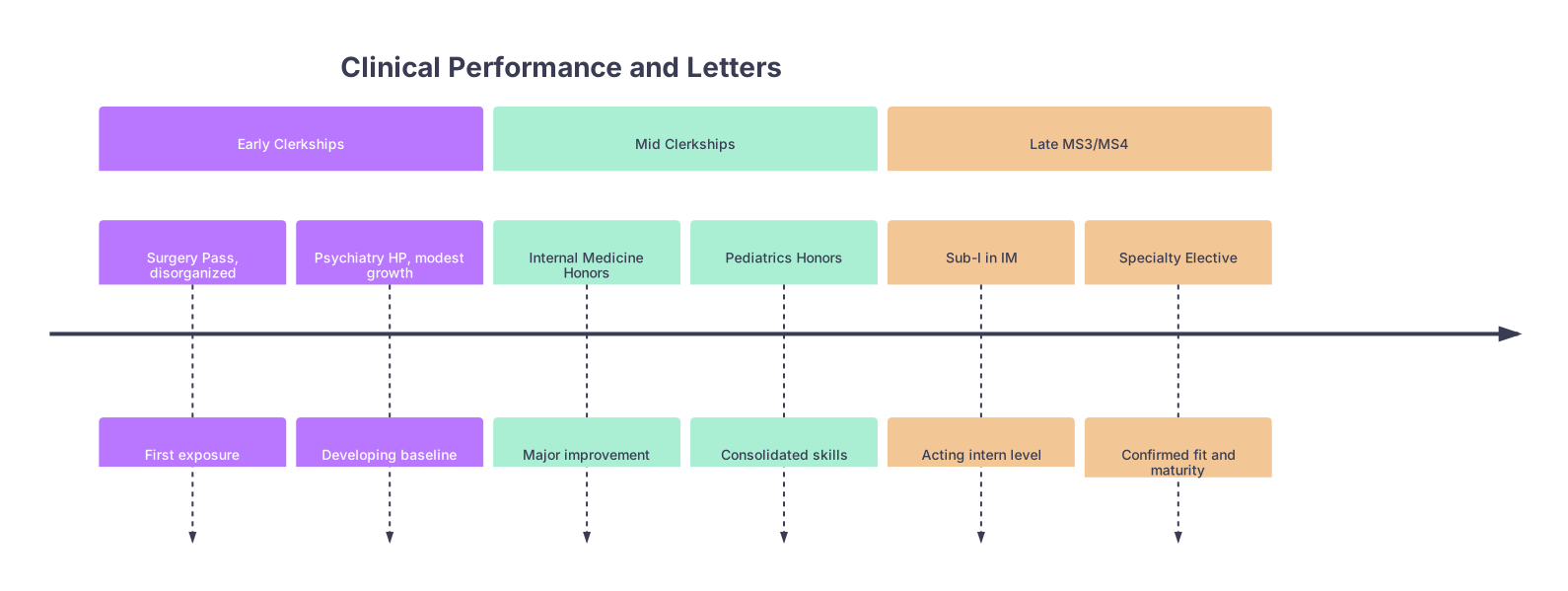
| Period | Event |
|---|---|
| Early Clerkships - Surgery Pass, disorganized | First exposure |
| Early Clerkships - Psychiatry HP, modest growth | Developing baseline |
| Mid Clerkships - Internal Medicine Honors | Major improvement |
| Mid Clerkships - Pediatrics Honors | Consolidated skills |
| Late MS3/MS4 - Sub-I in IM | Acting intern level |
| Late MS3/MS4 - Specialty Elective | Confirmed fit and maturity |
You want at least one letter anchored in each “improvement” phase, with at least one explicitly tying early to late.
Second, think of how committees see your growth versus others:
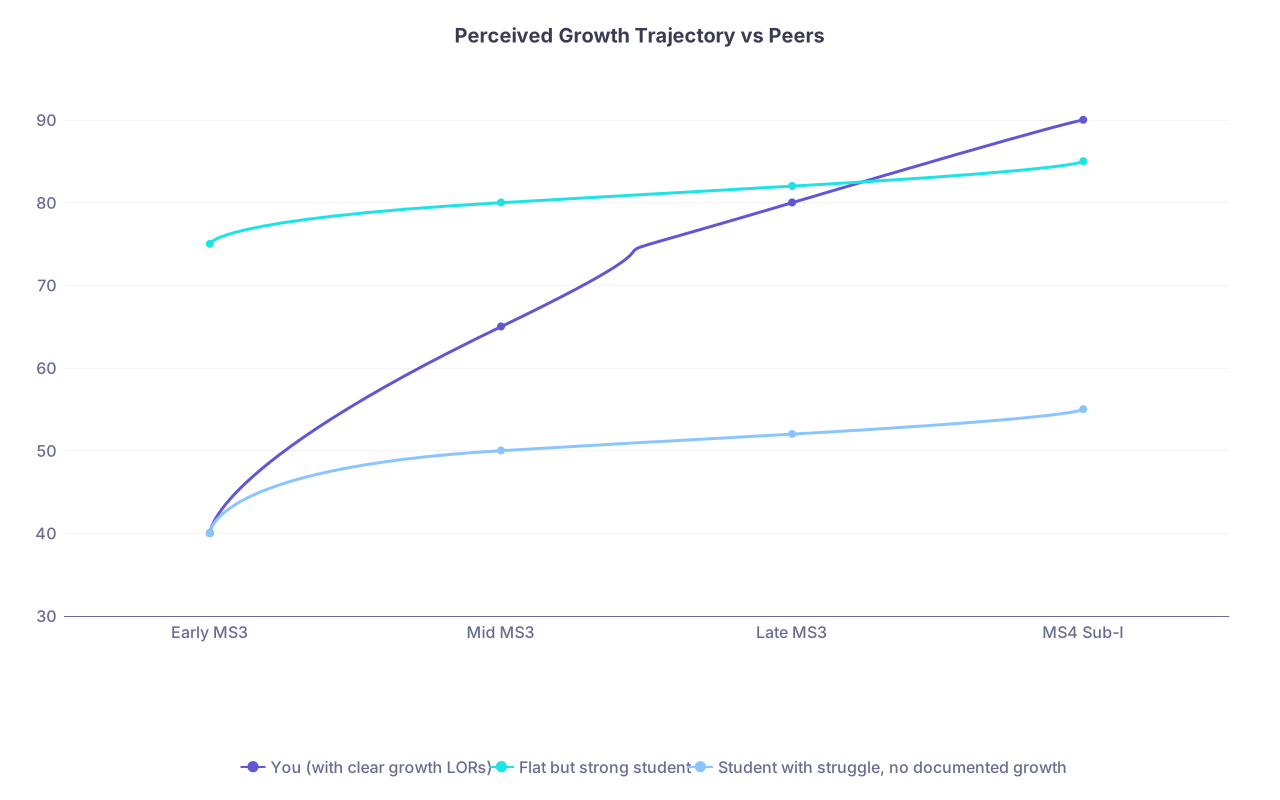
| Category | You (with clear growth LORs) | Flat but strong student | Student with struggle, no documented growth |
|---|---|---|---|
| Early MS3 | 40 | 75 | 40 |
| Mid MS3 | 65 | 80 | 50 |
| Late MS3 | 80 | 82 | 52 |
| MS4 Sub-I | 90 | 85 | 55 |
The absolute numbers do not matter. The slope does. A committee will take the first or second student every time over the third, even if their raw scores are similar.
How to Audit Your Own LOR Strategy for Growth
Before ERAS submission, ask yourself:
- Do I have at least one letter that can credibly describe my early performance and later improvement?
- Does that letter come from someone with enough seniority and longitudinal exposure to be believed?
- Do my other letters balance the story so my entire application does not read like a remediation file?
- Does my personal statement and MSPE align with this growth narrative instead of contradicting it?
If the answer to any of these is no, you still have time to fix things—by strategically choosing different writers, doing an away or sub-I with someone who knows your history, or asking a longitudinal mentor who has seen your pre-clinical to clinical transition.
One More Thing: Growth Continues into Residency
Program directors are not hiring a finished product. They are hiring a pattern.
Letters that showcase your growth tell them:
- You will not crumble when intern year hits
- You will not blame others when feedback is uncomfortable
- You will end PGY-1 wildly better than you started, because that is what you do
That is what they care about. Not that you were flawless on day one of third year.
Key Takeaways
- The best residency LORs do not hide your early struggles; they document your trajectory from rough to reliable, using specific before-and-after examples.
- You can actively shape these letters by choosing writers who saw your evolution, making your feedback response visible, and giving them targeted reminders of your growth.
- When aligned with your MSPE and personal statement, growth-centered LORs convert what looks like a liability—early missteps—into one of the clearest signals that you are exactly the kind of resident programs want to train.