
Decoding Subtle LOR Language: Phrases That Signal Top-Tier Talent
Most applicants read their letters of recommendation completely wrong.
They look for glowing adjectives, superlatives, and generic praise. Program directors do not. They scan for code—specific, standardized phrases and patterns that quietly separate “good resident” from “top 1–2 recruit in this entire cycle.”
Let me break that code down for you.
I will focus on residency letters, especially from academic programs in the U.S. and Canada. This is based on the way actual PDs, APDs, and selection committees talk behind closed doors—on Zoom rank meetings, in hallway debriefs, and in those quick “what do we think about this person?” conversations.
How Program Directors Actually Read Letters
Most applicants imagine a PD slowly savoring each sentence. That is fantasy.
The real process is fast, ruthless, and repetitive.

| Step | Description |
|---|---|
| Step 1 | Open ERAS file |
| Step 2 | Glance at scores & transcript |
| Step 3 | Scan LOR authors & institutions |
| Step 4 | Skim for anchor phrases & comparisons |
| Step 5 | Quick skim for red flags |
| Step 6 | Impression: Top / Solid / Risk |
| Step 7 | Update mental rank & move on |
| Step 8 | Trusted writer? |
The PD’s mental checklist looks more like this:
- Who wrote this? (Department chair? Known “tough grader”? Chief of service? Community physician?)
- From where? (Big-name academic center? Your home program only? Away rotation?)
- What anchor phrases appear? (Comparisons, rankings, explicit “I would rank…” statements.)
- Any hedging or soft concern language?
- Consistency with the rest of the file? (Does this letter match the MSPE, personal statement, and CV?)
They are not counting adjectives. They are weighing calibrated signals.
So your job is not to chase “nice letters.” It is to secure letters that use the right language structure from credible writers.
The Hidden “Ranking” Phrases: How Writers Signal You Are Top-Tier
The most powerful signals are comparative and ranking statements. They translate your performance into something PDs can benchmark against their own trainees.
Here are the phrases that quietly scream “take this person seriously.”
| LOR Phrase Type | How PDs Usually Interpret It |
|---|---|
| Explicit national comparison | Top-tier / auto-interview |
| Explicit class/rotation ranking | Strong to outstanding |
| Implicit very strong endorsement | Solid to strong |
| Warm but generic praise | Average, uncalibrated |
| Hedged or “damned with faint praise” | Concern / possible red flag |
1. Explicit National-Level Comparisons
These are the nuclear weapons of LOR language. PDs love them because they compress years of experience into one line.
Watch for phrasing like:
- “Among the best medical students I have worked with in the last X years.”
- “Ranks in the top 1–2% of students I have supervised at our institution.”
- “One of the strongest subinterns I have encountered in my 15 years on faculty.”
- “Comparable to our top categorical residents in terms of clinical maturity.”
- “I would rank [Name] in the very top tier of all applicants we have seen in the last several cycles.”
These tell a seasoned reader:
- The writer has seen a lot of students.
- They are willing to use hard, specific comparison language.
- They are putting you in the “rare” group, not the “good” group.
If your letter has this type of language from a known, credible writer at a solid program, you are in “top of the pile” territory.
2. Explicit Ranking Within a Cohort
Not every writer will compare you to 20 years of students. Many will compare you to a specific group: your class, rotation cohort, or that year’s subinterns.
Look for:
- “Ranks in the top 5 (or 10) students of the ~150 I have worked with over the past X years.”
- “In the top 10% of students I have taught at the clerkship level.”
- “Easily among the top 2–3 students I have supervised this year.”
- “In my top group of students who have gone on to match in competitive specialties such as dermatology and orthopedics.”
Program directors mentally normalize this. They know some writers are grade-inflated. But these phrases still move you from “generic strong” to “pay attention.”
The key: presence of numbers and percentiles. Anything that sounds like a ranking algorithm.
3. Comparisons to Residents (or Fellows)
This is a very specific high-value signal that often gets overlooked by applicants.
Phrases like:
- “Functions at the level of an intern.”
- “Clinical reasoning at the level of a junior resident.”
- “Would not be out of place among our PGY-2s on this service.”
- “Behaves with the professionalism and independence we expect of our residents.”
These are especially powerful in surgical and procedure-heavy fields where independence and clinical judgment are differentiators.
Program directors think: “We can plug this person into our team without hand-holding.”
4. Explicit “I Would / Will Rank Highly”
A surprisingly direct and common code:
- “I would be delighted to have [Name] as a resident in our program.”
- “We will be ranking [Name] highly on our list this year.”
- “If [Name] chose to apply here, I would place them among our top ranked candidates.”
- “I recommend [Name] to you without reservation and would eagerly welcome them to our residency.”
This is not fluff. Many faculty avoid these phrases unless they mean it, especially if they sit on their own program’s selection committee.
When a PD reads: “We will rank them highly”, that essentially translates to: “We think they are in our interview-day A-list.”
The “Very Strong” Tier: Phrases That Mean You Are Safe And Solid
Not every outstanding candidate gets explicit percentiles. Some letter writers simply are not structured that way. So PDs also look for a cluster of phrases that together paint a “very strong” picture.
Here is what that looks like.
1. Strong Superlatives With Specifics
Examples:
- “Outstanding clinical acumen.”
- “Truly exceptional work ethic.”
- “One of the most prepared and reliable students on the team.”
- “Showed maturity beyond their level of training.”
Now, these phrases by themselves are not enough. Everyone is “outstanding” in half the letters. What matters is pairing them with concrete anecdotes:
- “On multiple occasions, the night team commented that [Name]’s notes were more thorough and accurate than those of the interns.”
- “I recall one busy call night where [Name] independently gathered all relevant imaging, labs, and consult notes before rounds and presented a concise, accurate summary that saved the team significant time.”
Program directors care less about the adjective and more about: Can I see this behavior on my wards?
2. Repeated Language of Trust and Independence
Subtle but powerful:
- “We trusted [Name] to follow through on complex tasks.”
- “Required minimal supervision for a student.”
- “Frequently took ownership of patient care beyond expectations.”
- “Our nursing staff commented on [Name]’s reliability and responsiveness.”
These are higher-order signals. They indicate that the writer felt safe delegating to you. That matters more than whether you can regurgitate guidelines.
3. Multi-Domain Strength (Not Just “Smart”)
Watch for a pattern that spans:
- Clinical reasoning
- Work ethic
- Teamwork and communication
- Professionalism and reliability
- Teaching and leadership
For example, something like:
“[Name] combines sharp clinical judgment, a tireless work ethic, and the ability to communicate with both patients and colleagues at a level rare in a student.”
When all these domains are explicitly praised, PDs relax. They are less worried about hidden landmines (disorganization, arrogance, poor communication) overriding your intelligence.
Red-Flag and “Soft Negative” Phrases: What Actually Hurts You
Now for the uncomfortable part. The language committee members quietly circle in red during rank meetings.
Here is how subtle concern shows up.
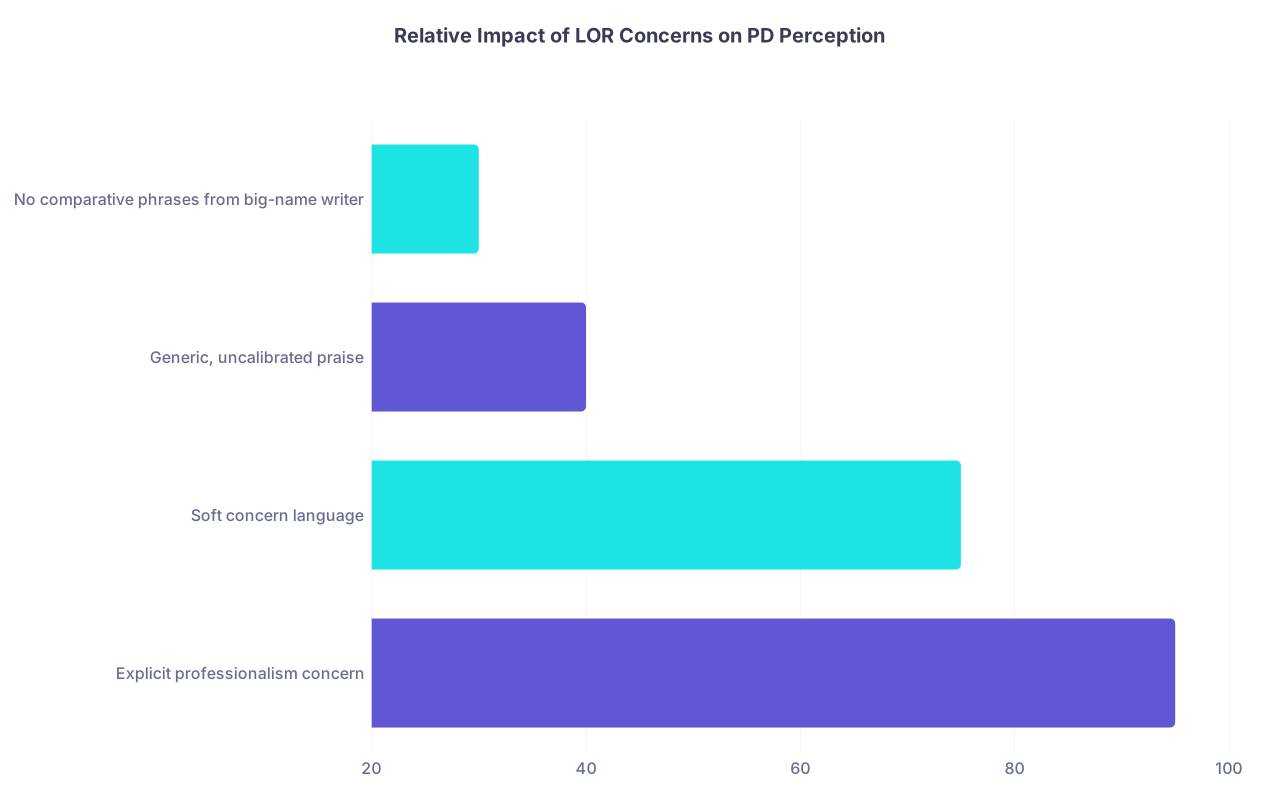
| Category | Value |
|---|---|
| Explicit professionalism concern | 95 |
| Soft concern language | 75 |
| Generic, uncalibrated praise | 40 |
| No comparative phrases from big-name writer | 30 |
1. Hedging and Distance Phrases
Faculty who dislike confrontation almost never write: “I do not recommend this student.” Instead they construct distance.
Look for:
- “I worked with [Name] briefly…”
- “In my limited exposure to [Name]…” (when that exposure actually was not so limited)
- “I did not have the opportunity to observe [Name] directly in patient care.”
- “From what I have heard from others…”
- “I anticipate that [Name] will grow into a capable resident.”
That last one sounds nice. It is not. “Will grow into” = not there yet.
When a PD hears hedging, they think: “If this person were truly excellent, the writer would not be so cautious.”
2. Faint Praise: The Kiss Of Death
This is more dangerous than open criticism, because it looks fine on a quick skim. But PDs and APDs have read thousands of these. They can smell it.
Some classic faint-praise lines:
- “Completed all assigned tasks.”
- “Punctual and cooperative.”
- “Eager to learn.”
- “With further training, [Name] will become a solid contributor to a residency team.”
- “Pleasant to work with.”
Ask any APD: “Pleasant to work with” in isolation, with no performance superlatives? That is code for: “Did not impress us, but we are not going to sabotage them.”
If the strongest line in your letter is about punctuality, you are in trouble for competitive programs.
3. Embedded Concerns and “But” Clauses
This is where serious issues leak through.
Examples:
- “While [Name] initially struggled with time management, they improved over the course of the rotation.”
- “[Name] occasionally required redirection with respect to professional boundaries, but responded well to feedback.”
- “At times, [Name]’s strong desire to be involved led to overstepping the student role.”
- “[Name]’s fund of knowledge is still developing, though this is appropriate for their level.”
Translation:
- There was an actual professionalism or performance issue.
- The writer is being as gentle as possible.
- Committees will talk about this.
One professionalism concern in a LOR can sink you at many programs, especially if corroborated in the MSPE “noteworthy characteristics” or “adverse action” section.
4. Omission Of Expected Praise
Silence speaks loudly.
For a truly strong student, experienced writers will usually mention:
- Clinical reasoning or fund of knowledge
- Work ethic / reliability
- Teamwork and communication
- Professionalism
If a letter discusses only “knowledge” but says nothing about teamwork or professionalism, PDs wonder: Is there a hidden issue they are avoiding?
Or if you are applying to surgery and the letter never mentions:
- Technical skills
- Manual dexterity
- Ability in the OR
That absence is informative.
Specialty-Specific Code Words That Matter More Than You Think
Different fields have different “obsessions.” Letters often betray those priorities. Let me walk through a few.
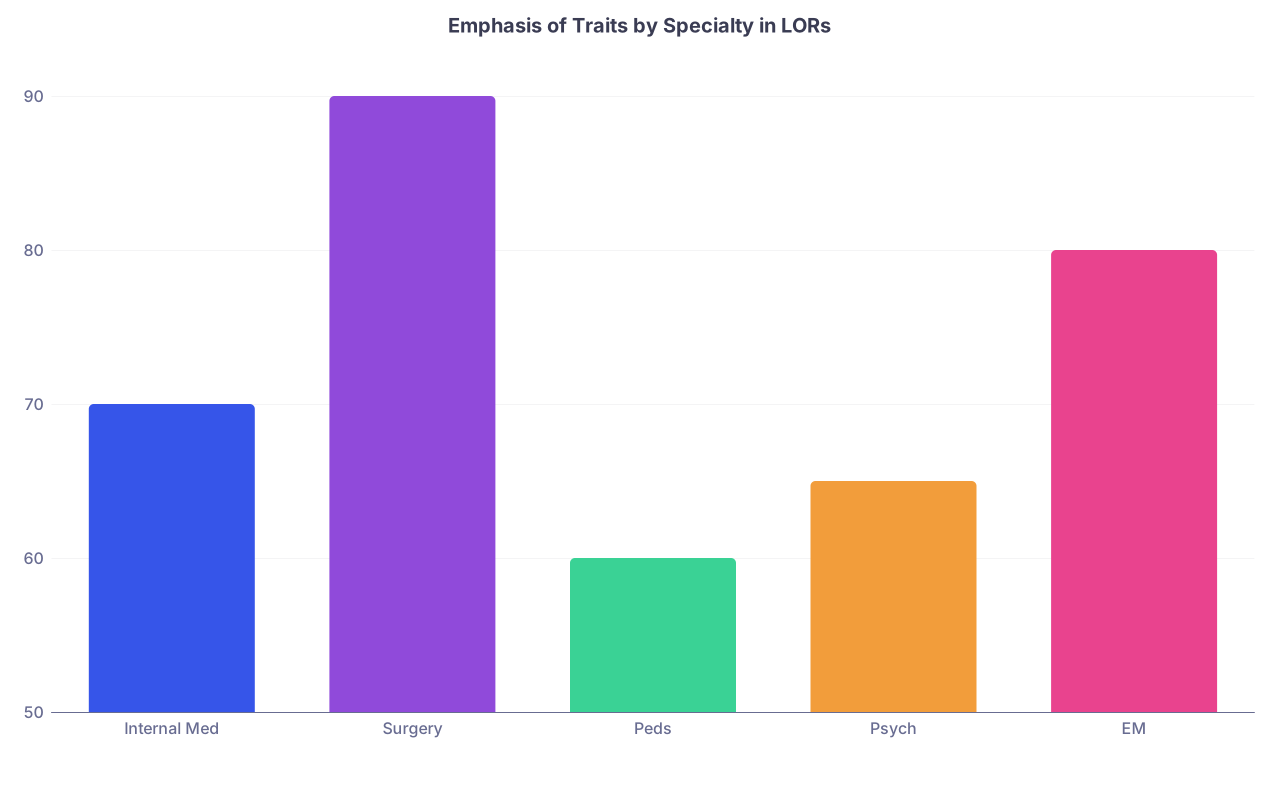
| Category | Value |
|---|---|
| Internal Med | 70 |
| Surgery | 90 |
| Peds | 60 |
| Psych | 65 |
| EM | 80 |
(Values here represent relative emphasis on “grit / work ethic / reliability” coded language.)
Internal Medicine
IM letters quietly prioritize:
- Clinical reasoning and synthesis
- Reliability and ownership
- Teaching and team contribution
Watch for:
- “Outstanding clinical reasoning, especially in complex patients with multiple comorbidities.”
- “Took primary ownership of their panel and consistently followed up on test results and consult recommendations.”
- “A natural teacher who elevated the entire team.”
IM PDs want future senior residents who can run the list, manage complexity, and teach interns without drama.
General Surgery and Surgical Subspecialties
Surgical letters are blunt when they are good.
Signals of real potential:
- “Exceptional operative potential / hands.”
- “Spatial awareness and dexterity that are rare in a student.”
- “Stayed until the work was done, without complaint, even on very long cases.”
- “Thrives in the high-intensity environment of our service.”
Red flags in surgery sound like:
- “At times seemed uncomfortable with the pace and demands of the surgical service.”
- “Will need continued development of manual skills.”
- “More reserved in the OR, required prompting to become engaged.”
Surgical committees are absolutely reading between those lines.
Pediatrics
Peds letters lean heavily on:
- Interpersonal skills with children and families
- Patience, empathy, and calm demeanor
- Team collaboration and communication
Strong pediatric phrases:
- “Connects with children and parents naturally, building trust quickly.”
- “Demonstrated remarkable patience and composure with anxious families.”
- “A true team player who supports colleagues without being asked.”
If a peds letter is heavy on “smart” but light on “kind and reliable,” that is a mismatch.
Psychiatry
Psych programs look for:
- Empathy and nonjudgmental listening
- Insight into patient behavior and systems
- Maturity and emotional stability
So language like:
- “Demonstrates deep empathy without over-identifying with patients.”
- “Insightful in understanding complex psychosocial dynamics.”
- “Calm and grounded even in emotionally intense situations.”
A subtle psych red flag:
- “Sometimes overly affected by difficult cases”
- “May benefit from ongoing development of emotional boundaries.”
Emergency Medicine
EM has one of the most standardized LOR ecosystems (SLOEs). But where traditional letters still appear, they value:
- Ability to prioritize and act under pressure
- Team communication
- Work ethic on shifts (no disappearing, no “pocket rounding”)
Signals:
- “Exceptionally effective at prioritizing tasks in busy shifts.”
- “Our nurses specifically asked if [Name] could return to our ED.”
- “Stayed engaged until after sign-out to ensure smooth transitions.”
Any suggestion of “hesitant,” “easily overwhelmed,” or “struggled with multitasking” will stick.
Who Wrote It: The Uncomfortable Truth About Letter Author Weight
You can have perfect language from someone who does not matter, and it will not move the needle the way you think it will.
Let me be blunt: author identity often outweighs prose quality.

Here is the informal hierarchy most PDs use when scanning LORs (not absolute, but common):
| Writer Type | Typical Impact |
|---|---|
| Home PD/Chair in your specialty | Very high |
| PD/Chair at strong away institution | Very high |
| Core faculty in your chosen field | High |
| Well-known subspecialist researcher | High (if clinical contact) |
| Community physician | Moderate to low (unless known) |
| Fellow or senior resident | Low (unless co-signed by faculty) |
Two critical nuances:
- A brief but strongly comparative letter from a known PD at a respected program can outrank a long, flowery letter from a local community doctor.
- A “lukewarm” letter from a high-power author can actually hurt more than a solid letter from a mid-level faculty member.
So the ideal for competitive specialties is:
- 1–2 letters from PD/chair/vice-chair types in your chosen field
- At least 1 from an away or “big name” institution if you did an audition rotation there
- Only use community letters when they show sustained, deep mentorship or unique longitudinal work
How To Quietly Steer Your Writers Toward Stronger Language
You cannot script your letter. You should not. But you can absolutely make it easier for a busy attending to write a letter that contains the right structure.

| Step | Description |
|---|---|
| Step 1 | Identify potential writers |
| Step 2 | Confirm strong support verbally |
| Step 3 | Provide annotated CV & personal statement |
| Step 4 | Highlight concrete examples of your work |
| Step 5 | Share target programs & specialty |
| Step 6 | Send gentle reminder of deadlines |
Here is what that looks like in practice.
1. Choose Writers Who Actually Know You In A Clinical Context
Obvious, yet ignored every cycle.
A vague letter from a famous researcher who barely saw you on the wards is not as helpful as a precise letter from a core faculty who watched you handle difficult patients at 3 AM.
You want people who can say:
- “I observed [Name] directly over X weeks on our [service].”
- “I supervised [Name] on [number] of complex inpatient cases.”
That specificity is more compelling than a big name without substance.
2. Have the “Are You Comfortable Writing A Strong Letter?” Conversation
Yes, you should ask it that directly. Something along the lines of:
“Would you feel comfortable writing a strong, supportive letter for my residency applications in [specialty]?”
If they hesitate or qualify it (“I can write you a letter, but I do not know you that well”), take them at their word. Do not use that letter for competitive programs.
3. Provide Targeted, Useful Material
When you send your CV and personal statement, add a short, focused summary. Not a script. Just ammunition.
For example:
- 3–4 bullet points of concrete things you did on that rotation (complex cases, QI projects, teaching juniors, presentations).
- Any feedback you received from the team or nursing staff that the writer might have missed.
- Your specialty choice and what kind of programs you are aiming for.
You are not asking them to copy your language. You are helping them remember specifics so they can move beyond generic praise.
4. Understand and Accept Different Writer Styles
Some writers almost never use explicit rankings or percentiles. Others do so routinely.
If your home PD is known for structured, calibrated letters with explicit ranking, push to get one from them. If your favorite attending writes beautiful but vague prose, that is still fine—but pair it with a more “algorithmic” writer somewhere else.
What To Do If You Suspect A Weak Or Harmful Letter
This is the nightmare scenario. It happens more than students realize.
You generally will not see the letter (and you should waive your right to do so for credibility). But you might pick up signals:
- The writer seemed lukewarm when you asked.
- Their verbal feedback during the rotation was mixed or clearly not strong.
- Your dean or advisor gives you a vague look when talking about that letter.
Here is my advice, having watched this play out:
- If you have any doubt, do not use that letter as one of your core specialty letters for competitive programs.
- You can still use it selectively (e.g., for preliminary year programs, or those that require a certain type of letter) if you lack alternatives, but do not anchor your application on it.
- Talk to an honest faculty advisor who has seen letters before. Ask them: “Am I overestimating this writer?” They usually know who writes tepid or even harmful letters.
If your MSPE already contains a professionalism concern, be extremely careful about any letter from someone who mentioned that issue. One negative line repeated in multiple documents is hard to overcome.
The Bottom Line: How To Read And Use LOR Language Strategically
You will almost never see your actual letters, but you can understand the game being played with the language inside them.
The real signals PDs care about are:
- Calibrated comparison: Explicit rank, percentiles, or comparisons to residents and prior top students.
- Trusted authors: Letters from PDs, chairs, and core faculty in your specialty, especially at respected programs.
- Concrete strength across domains: Clinical reasoning, reliability, teamwork, professionalism, and (where relevant) technical skills.
- Absence of hedging: No “limited exposure,” no “with more time they will,” no faint praise about punctuality as the main compliment.
If you remember nothing else:
- Glowing adjectives are cheap. Comparative phrases from credible writers are gold.
- “Pleasant and punctual” without specific praise is not a compliment at residency level.
- A single, well-placed line—“among the best I have worked with in 10 years”—can do more for your application than another research poster or another generic letter.
Treat letters as coded signals, not essays. Then build your application around people who will actually send the right signal.