Most residency letters fail not because they are negative, but because they are generic.
Program directors do not trust adjectives. They trust numbers, cases, and outcomes.
Once you understand that, the entire game of “strong” letters of recommendation (LORs) looks different. You stop chasing “excellent student, a pleasure to work with” fluff and start engineering micro-details that make a PD lean forward and think: “This person actually knows the applicant. And this performance would help my program.”
Let me break this down specifically.
Why Credibility Matters More Than Praise
Residency PDs are reading hundreds of LORs in the middle of service, overnight calls, and admin chaos. They skim. Hard. But they are extremely sensitive to one thing: signal that the writer actually observed you in real clinical work.
A “strong” LOR in PD-speak is not:
- “Hard‑working, empathetic, and a team player.”
- “One of the best students I have worked with.”
Those phrases are nearly content‑free in 2026. Everyone uses them. Everyone claims their student is “top 10%”.
A credible LOR has three properties:
Concrete scope of relationship
Specific time frame, role, and level of supervision.
“I supervised her directly on the inpatient cardiology service for 4 weeks, during which she carried 6–8 patients daily as an acting intern.”Behavior anchored in micro-details
Small, verifiable‑feeling snapshots: numbers, call volumes, specific tasks, actual cases.Outcomes that matter to programs
Impact on patient care, team function, systems, or scholarship—linked directly to what the student did.
You are not writing the letter yourself (or you should not be), but you can absolutely seed your writers with these micro‑details so they can plug them in with minimal work. If you do not, most attendings will default to vague praise at 11:30 pm before a deadline.
The Three Pillars: Numbers, Cases, Outcomes
Think of credible LOR content as a three‑legged stool: numbers, cases, outcomes. You want each good letter to contain all three.
1. Numbers: Quantifying Performance Without Sounding Ridiculous
Numbers are the fastest way to cut through fluff. PDs scan for them almost subconsciously.
Here is what I mean by “numbers” in a LOR:
- Service load
“Managed 10–12 complex medicine patients on our step‑down unit as an AI.” - Timing / response
“Typically had prerounds and notes completed for 7–8 patients by 7:15 am.” - Comparative ranking
“Among ~120 students I have supervised in the last 5 years, I would place him in the top 5–10.” - Output metrics
“Completed 2 quality improvement cycles and submitted an abstract to our regional ACP meeting within a 4‑week rotation.” - Procedural exposure
“Directly performed 15+ independently supervised paracenteses and thoracenteses, all complication‑free.”
The trick is to anchor numbers in reality. Over‑inflated, cartoonish metrics actually damage credibility. PDs know what is plausible.
Compare these two statements:
- Weak: “She was extremely efficient with notes and always early.”
- Strong: “On our busiest week, she carried 8 patients, had all prerounds done and notes drafted before 7:20 am, and still joined sign‑out and AM rounds fully prepared.”
Which one feels like the writer was actually there? Exactly.
Here are some specific numeric details you can track during your rotations (and later feed to letter writers):
| Domain | Example Metric |
|---|---|
| Patient Load | Average census you carried as AI or sub-I |
| Documentation | Time notes typically completed, note quality |
| Call / Nights | Number of calls, nights, or weekend shifts |
| Procedures | Counts of key procedures with complication rate |
| Teaching | Number of prepared talks / chalk talks |
| Scholarship / QI | Abstracts, posters, QI cycles completed |
Do not fabricate. Do not “top 1%” yourself into oblivion. But do collect real, defensible numbers you can hand to your attendings in a one‑page summary.
2. Cases: Single Patient Stories That Prove You Can Function
Cases are the narrative glue. Numbers say “this student is real.” Cases say “this student is safe and useful.”
Strong letters almost always contain 1–3 short clinical vignettes showing you doing high‑value work:
- catching something others missed
- handling complexity
- managing uncertainty appropriately
- communicating in a high‑stakes situation
- driving a plan forward over multiple days
The key? Specific enough that it feels true, but anonymized enough for privacy.
Weak case statement:
“He took excellent care of a very sick patient with sepsis.”
Strong case statement:
“On our MICU team, he was the first to recognize that a patient’s rising lactate and new confusion likely represented evolving septic shock rather than baseline dementia. He immediately alerted me, broadened antibiotics appropriately (after confirming allergies), pushed for repeat blood cultures, and arranged for transfer to the higher‑acuity unit. The patient required vasopressors overnight but improved over the next 48 hours, and his proactive recognition prevented further delay in resuscitation.”
You feel the difference. You can see the intern in that room.
When you are on rotation, you should quietly log cases like this in your own file:
- Date / service
- Patient type (no identifiers): “65‑year‑old with cirrhosis, GI bleed”
- Your specific role: “Noticed new melena overnight, escalated, coordinated urgent scope”
- Outcome: “Hemoglobin stabilized, no ICU transfer”
Later, when you send your “LOR info” to attendings, you can include 3–5 bullet “clinical vignettes you might remember” with 1–2 lines each. Most attendings will be grateful you did the recall work.
3. Outcomes: What Changed Because You Were There
Numbers and cases show you worked. Outcomes show you made a difference.
Outcomes are usually one of four types:
Patient outcomes
- Shortened length of stay
- Prevented readmission
- Prevented complication
- Improved understanding / adherence
Team outcomes
- Smoother workflow
- Fewer pages / miscommunications
- More organized sign‑out
- Morale improved (yes, this counts if anchored properly)
System / process outcomes
- New checklist adopted
- Handoff template revised and used by others
- Clinic schedule redesigned for better throughput
- EMR dotphrases that others now use
Academic outcomes
- Abstracts, posters, manuscripts
- Curriculum adaptations
- Teaching materials that persist after you leave
You are not running randomized trials as a MS4, but tiny, clear outcomes are believable and persuasive.
Compare:
- Weak: “She improved the functioning of our team.”
- Strong: “She created a simple 4‑item discharge checklist for our service (follow‑up, medications, equipment, and red‑flag instructions). Within a week, other students and residents adopted it, and we noticed fewer last‑minute pages from nursing about missing prescriptions or unclear instructions.”
That kind of micro‑outcome makes PDs think, “If I drop this person on my busy floor team in July, they will quietly fix things.”
How PDs Actually Read LORs: What They Scan For
You should write your application expecting readers to skim, because they do. Here is what most seasoned PDs and selection committee members look for when they open a letter:
Who is the writer?
Chair vs APD vs core faculty vs random researcher. Their field vs your target field. Their reputation.How well do they know you?
Duration of contact, type of supervision, number of shifts / weeks.Any comparative language?
“Top 10%,” “among the best residents,” “one of the strongest students in several years.” With or without numbers.Any concrete behaviors?
Specific tasks, case descriptions, metrics.Any red flags or hedging?
“Did everything asked,” “average,” “met expectations,” or ominous omissions (no mention of work ethic, team behavior, or reliability).Alignment with your specialty
Does the letter implicitly say “I would absolutely take this person in my own program”? Or does it read like a generic recommendation?
Here is the unspoken truth: Most LORs sound identical at the surface level. What breaks through are those micro‑details that make the writer’s voice credible.
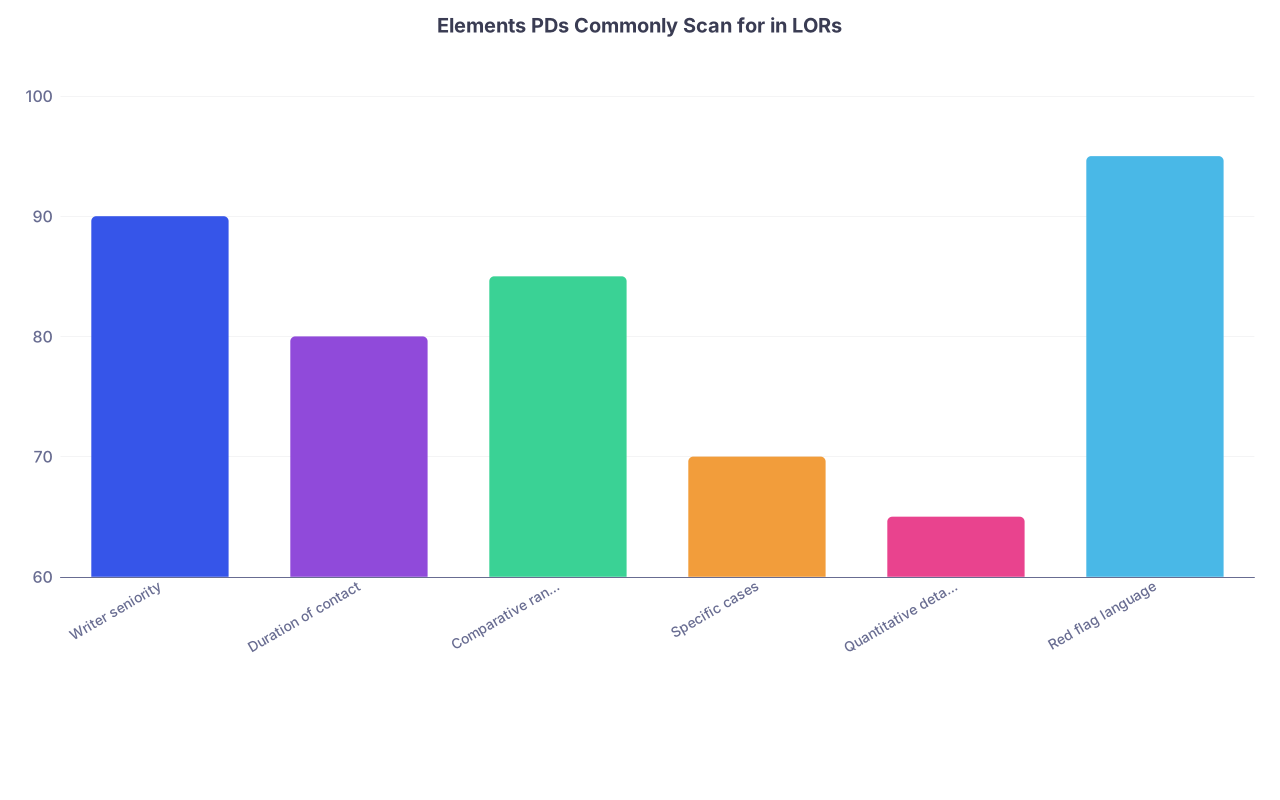
| Category | Value |
|---|---|
| Writer seniority | 90 |
| Duration of contact | 80 |
| Comparative ranking | 85 |
| Specific cases | 70 |
| Quantitative details | 65 |
| Red flag language | 95 |
(The percentages are approximate impressions from faculty surveys and committee discussions, not published gospel. But they reflect how these letters are actually consumed.)
Engineering Micro-Details Without Ghostwriting Your Own Letter
You cannot ethically write your own letters. You can absolutely control the raw material your attendings have to work with.
Think of yourself as the person assembling a “LOR data packet” that makes it nearly effortless for a busy attending to write a credible, specific letter.
Step 1: During the Rotation – Capture Raw Data
On any rotation where you might request a letter, you should quietly track:
- Dates of the rotation and your role (MS3, MS4, AI, sub‑I)
- Typical patient load (range, average)
- Any procedures you meaningfully participated in or performed
“4 paracenteses (2 directly supervised, 2 assisting), 3 LPs assisting” - Call shifts, nights, weekends
- Small QI / micro‑projects you took on
- Any teaching you did (short talks, patient‑education handouts, intern teaching)
- 3–5 memorable cases where you had a clear role
Do this in a plain text file or note app. Two minutes at the end of the day.
Step 2: After the Rotation – Turn It Into a One-Page Snapshot
When you later ask for a letter, you attach a one‑page, bullet‑level summary. Not an essay. Not a draft letter. Just structured facts.
Sections might look like this:
Rotation: Internal Medicine AI, Hospital X, July 2025 (4 weeks)
- Level: Acting Intern (MS4), functioned in intern role
Scope of work
- Average census: 6–8 patients, max 10
- Days: 24 total hospital days, 4 weekend days, no nights
Clinical highlights (short bullets)
- “New onset AF with RVR in cirrhotic patient – identified hemodynamic instability early, coordinated transfer to step‑down, presented concise case to ICU fellow.”
- “Refractory hyperglycemia in DKA – adjusted insulin infusion per protocol, recognized impending hypokalemia, advocated for earlier repletion.”
Numbers / output
- 2 chalk talks (AKI workup, COPD exacerbation management) for interns and students
- Updated our team’s discharge dotphrase for heart failure (now used by residents)
This is not writing the letter. It is giving your attending enough true, concrete data that they can generate a highly credible letter in 15–20 minutes rather than 90.
You dramatically reduce the odds they will produce a generic paragraph about you “showing up on time and being pleasant.”
Step 3: Nudge for Outcomes and Comparisons (Without Being Obnoxious)
You cannot dictate language, but you can gently suggest what matters to PDs in your summary email:
“For your reference, I’ve included a one‑page summary of my work on your service, including some patient care examples and approximate patient load. I know programs often look for specific performance comparisons, so I included a brief snapshot in case that is helpful as you frame things.”
That phrase “programs often look for specific performance comparisons” is a quiet signal. Good attendings understand exactly what that means and will plug in “top X%” language if they feel it is justified.
What Credible Micro-Details Actually Look Like (Realistic Examples)
Let me show you side‑by‑side contrasts. This is where you see how micro‑details change the entire tone of a letter.
Work Ethic
Generic:
“She is very hard‑working and always came in early.”
Credible:
“During our 4‑week sub‑internship, she typically arrived by 5:45 am, had prerounded on 7–8 patients, and drafted assessments and plans before our 7:30 am team rounds. On several occasions I arrived early and found her already in patient rooms clarifying overnight issues with nursing.”
Clinical Reasoning
Generic:
“He has strong clinical reasoning and makes good differential diagnoses.”
Credible:
“When presenting new consults, he consistently generated broad but prioritized differentials, usually with 4–5 diagnoses, clearly distinguishing ‘must not miss’ from ‘less likely but worth considering.’ For example, in a patient with chest pain and known GERD, he correctly emphasized ruling out ACS and PE first before entertaining GI causes, and ordered tests in that sequence.”
Communication and Team Function
Generic:
“She communicates well with patients and the team and was a pleasure to work with.”
Credible:
“She independently called two family meetings during a complex goals‑of‑care discussion week, and both families later told me separately that she ‘made things finally make sense.’ Nursing staff specifically asked for her to return on a subsequent weekend because ‘she keeps us in the loop and answers questions clearly.’”
Professionalism / Reliability
Generic:
“He was professional at all times.”
Credible:
“Over 28 days, he did not miss a single sign‑out, responded to pages promptly (I cannot recall waiting more than a few minutes for him even when he was off the unit), and handled two difficult conversations about delayed discharges without becoming defensive.”
These are tiny, almost mundane details. That is exactly why they are trusted.
Specialty-Specific Micro-Details: What Different Programs Care About
Different specialties weigh different parts of the letter. The micro‑details you seed should match what your target field actually values.
Internal Medicine
Internal medicine PDs care about:
- Longitudinal patient ownership
- Complex reasoning across systems
- Written and spoken communication
- Reliability under high census
Examples of good IM‑type micro‑details:
- “Carried 8–10 patients as AI, wrote full notes and follow‑ups without intern rewriting.”
- “On our heme-onc service, she coordinated outpatient follow‑up for 4 new leukemia diagnoses, ensuring all had appointments and chemotherapy plans before discharge.”
- “Her notes required minimal attending edits; her initial differentials almost always contained the eventual final diagnosis.”
General Surgery
Surgery programs look for:
- Stamina and work ethic
- OR behavior and technical potential
- Calm execution in acute scenarios
- Ability to handle hierarchy and feedback
Good surgical micro‑details:
- “Arrived before chief and intern daily; scrubbed into 3–5 cases per day during busy weeks.”
- “Performed 20+ knot ties and basic suturing by the end of the rotation with smooth technique and no sterility breaks observed.”
- “On trauma call, assisted with 6 activations in one night, recognizing hypotension early in a splenic injury patient and preparing blood products before the team arrived.”
Emergency Medicine
EM committees focus on:
- Throughput and task‑switching
- Comfort with undifferentiated patients
- Efficiency without cutting corners
- Team communication under pressure
Strong EM micro‑details:
- “Regularly managed 6–8 active patients during peak ED hours, tracking labs and imaging independently and updating me briefly every 20–30 minutes.”
- “In a single busy shift, she evaluated 14 new patients, with all charts completed before sign‑out and no significant delays in disposition.”
- “Handled 3 simultaneous chest pain patients by prioritizing ECG and troponins appropriately and escalating high‑risk features without prompting.”
Pediatrics, OB/GYN, Psych, etc.
Each specialty has its own flavor. The pattern holds: numbers, cases, outcomes tuned to what they value (developmental discussions in peds, labor management in OB, safety / boundary awareness in psych).
Red Flags, Lukewarm Language, and How Micro-Details Protect You
There is another, harsher side to all of this: committees are very good at picking up hedged or lukewarm letters.
Phrases that quietly hurt you:
- “Met expectations for his level of training.”
- “Completed all assigned tasks.”
- “Was always present when scheduled.”
- “I recommend her without reservation” with no supporting detail.
These do not sound harmful on paper. But in a stack of letters where others say “top 10%” and list detailed cases, this kind of language sinks applicants into the middle or lower tiers.
Micro‑details help protect you because they give the writer something unequivocally positive to describe, even if you were not the absolute best student they ever had.
An attending may not feel comfortable calling you “top 5%,” but they can truthfully say:
- “Completed full H&Ps and daily notes on 6 patients per day by the end of the first week.”
- “Handled 3 family meetings with minimal attending intervention.”
- “Took the lead on a small QI checklist that is now used regularly on our service.”
That is still a strong letter, even without superlatives.
One Level Deeper: The Meta-Signal Behind Micro-Details
There is a meta‑signal PDs pick up that applicants rarely think about:
When an attending bothers to recall and include micro‑details, it signals they believe you are worth the time.
An overworked APD is not going to spend 30 minutes reconstructing patient cases for a mediocre student. They will usually bang out a generic “hard‑working, pleasant, reliable” template and move on.
High‑resolution letters usually track with strong underlying performance.
So by engineering the raw material—numbers, cases, outcomes—you are doing two things at once:
- Making it easier for a good attending to write a high‑fidelity letter.
- Increasing the chance that the effort they put in is visible to the committee as a proxy for your value.
This is why “micro‑details” and “credibility” are not cosmetic. They change how your file is perceived at a gut level.
Putting It All Together: Your Practical Checklist
Here is how you operationalize all of this across your application year.
During any rotation where a letter is possible:
Track your:
- patient census
- calls / nights / weekends
- procedures
- teaching moments
- small QI / system tweaks you contributed to
- 3–5 strong clinical cases
Behave in a way that naturally generates outcomes:
- Own follow‑ups and discharges.
- Volunteer for the annoying coordination tasks.
- Offer to give a 10‑minute chalk talk.
- Fix one small broken thing (handoff, note, patient instructions).
Before you ask for a letter:
- Prepare a one‑page summary:
- rotation details and role
- scope of work (with numbers)
- 3–5 bullet cases
- micro‑outcomes you drove
When you request the letter:
- Ask the right people: those who supervised you closely and saw your clinical performance.
- Send:
- your CV
- your personal statement draft (if ready)
- that one‑page summary
- Politely mention that specific examples and comparative language are especially helpful in residency selection.
That is it. That is the blueprint.
Key Takeaways
- Credible LORs are built on micro‑details: concrete numbers, specific patient cases, and clear outcomes beat generic praise every time.
- You control the raw material: track your performance, assemble a tight one‑page summary, and feed your attendings the details they need to write specific, believable letters.
- Alignment matters: tune the micro‑details—numbers, cases, outcomes—to what your target specialty actually values, so PDs can see you functioning in their environment on day one.