
The way most students send letter packets is inconsiderate and inefficient—and that is exactly why their letters suffer.
If you hand a busy attending a vague email and a blank ERAS link, you are gambling with the single most leverage‑rich part of your residency application. You can do better. And you should.
Let me break this down specifically: a well‑structured LOR packet is not “extra.” It is the difference between a generic, two‑paragraph template and a detailed, specific letter that actually moves program directors.
We will talk about what to include, how to package it, and how to make your attending’s job so easy that writing you a strong letter feels almost automatic.
The Goal Of A LOR Packet (And What Attendings Really Want)
Most attendings are not sitting around waiting to write your letter.
They are:
- Rounding with 15 patients
- Getting paged every 3 minutes
- Fighting their inbox
- Signing notes they did not write
Then you show up: “Could you write me a strong letter of recommendation?”
If they say yes, here is what they actually need—whether they articulate it or not:
- Who are you? (Beyond “MS4 at X School.”)
- What are you applying to? (Specialty, type of programs, any nuance.)
- What do you want them to emphasize?
- By when? (With a realistic deadline.)
- How do they physically submit the letter? (ERAS, email, portal, etc.)
A proper LOR packet answers all of that in one neat bundle. Physical or digital.
The structure I like breaks down into six components:
- Cover sheet / one‑page summary
- CV (ERAS formatted if possible)
- Personal statement (most recent, not a rough draft)
- Transcript and exam score summary (selective, not your whole life)
- Bullet‑point “reminder sheet” of your work with them
- Logistics page: deadlines, submission instructions, and waivers
You are not dumping documents. You are curating.
Core Components Of A High‑Yield LOR Packet
1. The Cover Sheet: Your One‑Page Cheat Code
This is the single most underrated part of the packet. If they only read one page (and that does happen), this is it.
Your cover sheet should be one page, clean, and skimmable. Think of it as the “executive summary” of you + the ask.
At minimum, include:
- Your full name and contact info
- Your medical school and class year
- Specialty you are applying to
- Type of letter this will be (specialty‑specific, “Chair’s letter,” or general)
- How they know you (rotation, dates, role)
- Three to five bullet points you would love for them to highlight
- Deadlines (realistic)
- Submission mechanism with links or exact instructions
- Whether you have waived your right to view the letter (you should)
It might look roughly like this (structure, not exact wording):
- Name: Jane Doe, MS4, University Hospital SOM, Class of 2025
- Applying to: Internal Medicine
- Rotation with you: General Medicine Inpatient, July–August 2024, Sub‑I level responsibilities
- Letter type requested: Specialty‑specific IM letter for ERAS
“Key experiences/strengths you may wish to mention”:
- Took primary responsibility for 6–8 patients on Ward B, presented on rounds independently
- Led family meetings for complex discharge planning on 3 patients
- Interns and residents asked me to pre‑round and update cross-cover plans
- Developed and presented a short talk on hyponatremia that was used for team teaching later
- Demonstrated consistent follow‑through: followed up on all pending studies before sign‑out
Deadlines and logistics:
- Ideal submission date: September 10, 2024
- ERAS LOR Portal: You will receive an auto‑generated email with your upload link
- I have waived my right to view this letter in ERAS
That is it. No paragraphs, no fluff. Respect their time.
2. CV: Give Them Something Concrete To Pull From
Your attending should not have to guess what you have done outside their rotation. The CV is where they connect your day‑to‑day performance with your broader profile.
Use your ERAS CV if it is close to final. If not, a regular academic CV is fine. But it should be:
- Reverse chronological
- Organized: Education, Honors/Awards, Research, Publications, Presentations, Leadership, Teaching, Work/Volunteer
- Without weird formatting or giant gaps
The CV lets your attending write things like:
“Her interest in cardiology was evident on service and is supported by her year‑long involvement in outcomes research with our cardiology group.”
They do not know that unless you hand it to them.
Do not:
- Include high school achievements
- Send a 9‑page monstrosity with every volunteer hour you ever logged
- Hide major red flags; if there is a F on the transcript, you will handle it in your personal statement or advising, but do not falsify
You want them to see the arc of your development, not your entire autobiography.
3. Personal Statement: The Thematic Anchor
A lot of attendings write letters that echo your personal statement, often subconsciously. I have watched people literally open the PS on one monitor and type the letter on the other.
So if your statement is incoherent or off‑theme from how you performed clinically, that leak shows.
You are including this not because they will critique it, but because:
- It shows them what narrative you are pushing to programs
- It tells them how you see yourself and your future practice
- It suggests which stories to amplify and which to leave alone
Practical rules:
- Send the version you plan to use, not your first draft from May
- Keep file names sane: “Doe_Jane_IM_PS_Final” not “PersonalStatementReallyFinalv7”
- If you are applying to two specialties, label accordingly and give them the correct one for the letter you are requesting
If your statement heavily emphasizes underserved care, continuity, teaching, or research, mention that on your cover sheet so they can echo those themes in concrete terms.
4. Transcript + Score Snapshot: Controlled Transparency
You do not need to bury them in PDFs.
You do need to prevent confusion. They should not be surprised later when a PD calls them and says, “So I see she failed Step 1 the first time.”
Here is how I prefer to handle this:
- Attach your official transcript (or an unofficial copy if that is all you have)
- Provide a one‑line summary of exam performance on the cover sheet or a small “snapshot” box
For example:
- USMLE Step 1: Pass (first attempt)
- USMLE Step 2 CK: 246 (first attempt, June 2024)
- COMLEX Level 1: Pass; Level 2: 590
If you have a blemish (fail, LOA, remediation), do not hide it from the person writing your letter. You will lose trust.
A simple one‑liner in an email or on the logistics page is enough:
“I had to remediate my M2 renal path course in 2022; this is reflected on my transcript. I am happy to discuss context if helpful.”
Most decent attendings will not throw you under the bus for this. But they will feel undermined if they discover it later from a PD.
5. The “Reminder Sheet”: Where The Gold Comes From
This is the part that actually upgrades the strength of your letter.
Attendings see dozens of students a year. Unless you were truly exceptional or truly disastrous, you blend.
Your job is to hand them a memory prompt. One page. Bulleted. Specific.
Divide it into 3 tight sections:
- “Responsibilities I regularly handled”
- “Cases or moments that stood out (from my perspective)”
- “Skills or qualities others commented on during the rotation”
Concrete examples:
Responsibilities:
- Carried 6–8 patients as primary student on Ward B, independently prerounded and wrote notes on at least 4 per day
- Consistently followed up on all post‑round orders (labs, imaging, consults) and updated team at afternoon huddles
- Took first pass on discharge summaries for complex multi‑morbid patients (COPD, CHF, CKD)
- Mrs. S, 68F with decompensated CHF: I noticed progressive weight gain and rising JVP, brought it to the intern, leading to earlier adjustment of diuresis plan
- Mr. R, 55M with alcohol withdrawal: Helped coordinate family meeting with social work to discuss rehab options; family later thanked the team for clear communication
- Journal club: Presented and led discussion on the 2019 NEJM trial of SGLT2 inhibitors in heart failure; you mentioned it was “one of the best student journal clubs” that month
Comments from others:
- Senior resident Dr. X told me I “could function like an intern on day one”
- Night float intern asked to have me on cross‑cover night because I “did not miss details on sign out”
This is not bragging. It is data.
You are not scripting their letter. You are reminding them of real things you did so they can write, “I observed…” and “On my service, she…” with specifics.
6. Logistics Page: Eliminate Every Possible Friction
You would be shocked how many letters are delayed because an attending cannot find the upload link.
Your logistics page (sometimes just the bottom half of the cover sheet) should answer:
- Where do I upload this?
- What is the absolute last reasonable day to submit?
- Do I send it to you or directly to ERAS?
- Do I need to include letterhead, signature, etc.?
For ERAS:
- Tell them you will generate an ERAS Letter Request Form that has a unique Letter ID and upload link
- Attach that form as a PDF to your packet or send it in the same email
- Clarify: they upload directly; you do not see the letter
For non‑ERAS (fellowships outside Match, special programs, military):
- Provide the exact URL or email address
- State formatting requirements if any (PDF, signed, etc.)
Put this in a small table for clarity if you are applying to multiple tracks.
| Letter Type | Platform | Deadline | Submission Method |
|---|---|---|---|
| IM Residency (ERAS) | ERAS | Sept 10 | ERAS LOR Portal upload |
| Transitional Year backup | ERAS | Sept 20 | Same ERAS LOR Portal link |
| Military Match (if any) | Service | Aug 31 | Dedicated branch portal |
You remove excuses. You make it almost harder not to submit the letter.
Digital vs Physical: How To Package The Whole Thing
Most attendings prefer digital now. Some old‑school folks still like a hard folder.
You can do both without creating chaos if you are organized.
Digital Packet: How To Make It Effortless
Send a single email with:
- A concise, respectful request (3–5 sentences)
- The packet components as attachments, clearly named
- The ERAS Letter Request Form attached
- Bullet‑point logistics in the body of the email
Subject line matters. Use something that will surface easily in their inbox search later:
“LOR Request – Jane Doe – IM Residency – ERAS 2025”
Attachment naming convention:
- Doe_Jane_CoverSheet_IM
- Doe_Jane_CV_2025
- Doe_Jane_IM_PersonalStatement
- Doe_Jane_Transcript
- Doe_Jane_RotationHighlights_with_Dr_Smith
- Doe_Jane_ERAS_LOR_Request_Form
In the body, something like:
Dear Dr. Smith,
Thank you again for agreeing to write a letter of recommendation for my Internal Medicine residency applications. I truly appreciated the opportunity to work with you on the general medicine service in July–August.
I have attached a brief cover sheet, my CV, personal statement, transcript, a one‑page summary of my work on your team, and the ERAS Letter Request Form with upload instructions. The ideal submission date is September 10, 2024.
Please let me know if any additional information would be helpful.
Sincerely,
Jane Doe, MS4
That is it. Clean. Professional. Respectful.
Physical Packet: When You Hand It Over
If you are also giving a physical folder (often a good idea for someone you see in person regularly):
- Use a simple manila or university‑branded folder
- Front: small label with your name, “LOR Packet – Internal Medicine”
- Inside, papers in this order:
- Cover sheet
- ERAS Letter Request Form
- Rotation “reminder sheet”
- CV
- Personal statement
- Transcript
Slide a small sticky note on top: “Dr. Smith – thank you again for writing this. The ERAS upload link is on the second page (LOR form). – Jane”
You are making it physically easy to pick up and act on.
What Busy Attendings Care About (And What They Do Not)
I have watched attendings actually write these letters. Here is what gets used and what gets ignored.
Used heavily:
- Your rotation highlight sheet
- Your cover sheet bullets (“Oh right, that CHF patient…”)
- Your CV section headings (to add a line about research, leadership)
- Your ERAS request form (link + your AAMC ID)
Sometimes used:
- Your personal statement (for phrasing and themes)
- Your transcript/score snapshot (for context, not for quoting scores)
Rarely used:
- Long‑winded emails describing your “passion for the specialty”
- Attachments labeled V5_Final Edits_clean_FINAL2.docx
- Out‑of‑date personal statements that no longer match your story
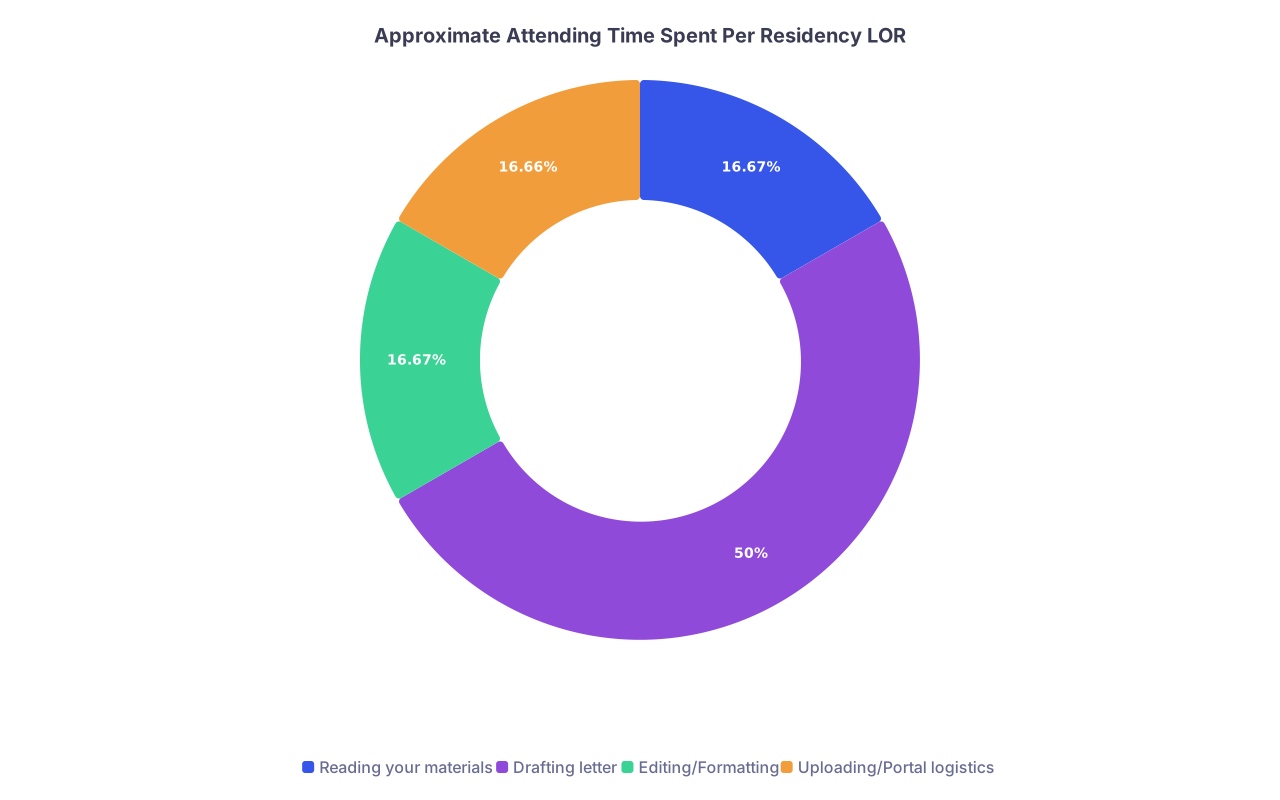
If you want to see how this plays out in practice, think about the time breakdown:
| Category | Value |
|---|---|
| Reading your materials | 5 |
| Drafting letter | 15 |
| Editing/Formatting | 5 |
| Uploading/Portal logistics | 5 |
Total: 30 minutes at best. Sometimes less.
Your packet must be built for a 30‑minute workflow.
Timing, Follow‑Up, And Not Being Annoying
Structuring the packet is only half the fight. The other half is timing and follow‑up without becoming that student.
When To Ask And When To Deliver The Packet
Ask for the letter while they still remember you.
- Ideal: Last week of the rotation, in person.
- Acceptable: Within 1–2 weeks after the rotation ends via email.
- Too late: 3 months later when they barely remember your name.
When they say yes, that is the moment to say:
“Thank you, I really appreciate it. I can send you a short packet with my CV, personal statement, and a summary of my time on your team to make it easier—would that be helpful?”
Ninety percent will say, “Yes, send that.”
Deliver the actual packet within 48–72 hours. You look organized and serious.
Follow‑Up Strategy That Actually Works
The right structure lets you follow up without guilt.
Timeline I recommend:
- T – 6 weeks before your true drop‑dead date: Initial packet + request
- T – 3 weeks: First gentle reminder
- T – 1 week: “Just checking in, ERAS deadline next week” reminder
- T – 3 days: Only if they have a history of cutting it close and you desperately need the letter
Your reminder emails should be short and reference the original packet.
For example, at 3 weeks:
Dear Dr. Smith,
I hope your month is going well. I wanted to send a brief reminder regarding the IM residency letter of recommendation I requested and the packet I sent on August 5. The ideal submission date is still September 10.
Please let me know if there is any additional information I can provide.
Best regards,
Jane Doe
You are not resending all attachments unless they request them. You are not rewriting your life story. Just a nudge.
Special Cases: Multiple Specialties, Chair Letters, And “Composite” Packets
Some of you are not straightforward applicants. Double applications, department letters, etc. The packet structure adjusts slightly, but the principles stay.
Applying To Two Specialties (IM + EM, for example)
Do not confuse your attendings.
Each attending should get:
- One clearly labeled cover sheet for the specialty you want from them
- The matching personal statement
- Rotation highlight sheet specific to how you worked with that attending
If you ask your Medicine attending for an EM letter using your EM personal statement, it looks incoherent. Flip that. Use:
- IM attending → IM‑specific packet
- EM attending → EM‑specific packet
If you absolutely must ask the same attending for two versions (rare, but happens with mentors you have across settings), separate into two packets, even if digital:
- “Doe_Jane_LOR_Packet_IM_with_Dr_Smith”
- “Doe_Jane_LOR_Packet_EM_with_Dr_Smith”
Spell that out on the cover sheets.
Chair’s Letter Or Department Letter
For a Chair’s letter, you often do not know the Chair well. They rely heavily on:
- Clerkship evaluations
- Other faculty letters
- CV and transcript
- Sometimes a brief meeting with you
Your packet here needs an extra element: a one‑paragraph “why this specialty for me” summary, distinct from your full PS.
You keep the basic structure:
- Cover sheet: but add a short paragraph explaining your commitment to the specialty, any key advisors, and your approximate rank list goals (academic vs community, geographic focus)
- CV, PS, transcript, scores, evaluation summaries if available
- List of other faculty writing letters on your behalf (so they can cross‑reference)
A compact summary of who else is vouching for you helps them frame their department‑wide perspective.
A Clean Example: Putting It All Together
Let me walk through what a complete, well‑structured packet looks like for a typical IM applicant, end to end.
You finish your July IM Sub‑I with Dr. Patel.
During the last week:
- You ask in person: “Dr. Patel, I have really appreciated working with you this month. Would you feel comfortable writing me a strong letter of recommendation for my Internal Medicine residency applications?”
- She says, “Yes, of course, send me the ERAS thing.”
Within 48 hours you email:
Subject: LOR Request – Alex Nguyen – IM Residency – ERAS 2025
Attachments:
- Nguyen_Alex_CoverSheet_IM_with_Dr_Patel
- Nguyen_Alex_ERAS_LOR_Request_Form
- Nguyen_Alex_RotationHighlights_with_Dr_Patel
- Nguyen_Alex_CV_2025
- Nguyen_Alex_IM_PersonalStatement
- Nguyen_Alex_Transcript
Brief body text thanking her, summarizing deadlines, confirming you waived your rights.
Her experience:
- She opens the cover sheet, sees who you are, what you are applying to, and what stood out on her team.
- She scans your highlight sheet, remembers specific cases.
- She glances at your CV, confirms your research and leadership.
- She pulls up the LOR portal from the ERAS form, dictates the letter from her notes and your sheet, edits, uploads.
That is it. Minimal friction. Maximum specificity.
If you laid this out visually, the process looks like this:

| Step | Description |
|---|---|
| Step 1 | End of Rotation |
| Step 2 | Ask for strong LOR in person |
| Step 3 | Assemble packet within 48 hrs |
| Step 4 | Email packet + ERAS form |
| Step 5 | Attending reviews cover sheet & highlights |
| Step 6 | Attending drafts letter |
| Step 7 | Upload via ERAS portal |
| Step 8 | You confirm receipt in ERAS |
| Step 9 | Thank them and identify another writer |
You are not depending on luck or memory. You are creating a system.
Final Thoughts: What Actually Matters
If you remember nothing else, keep these three points:
A LOR packet is not about volume; it is about precision. One tight cover sheet, one rotation highlight page, and clean supporting documents will do more for you than a cluttered mess of attachments.
Make the attending’s job idiot‑proof. Clear file names, ERAS form attached, deadlines stated plainly. Every extra step you remove increases the odds of a timely, detailed letter.
Your reminder sheet is where the letter’s strength comes from. Specific cases, responsibilities, and real quotes jog their memory and transform a generic “hard‑working and pleasant” letter into one that program directors actually remember.
Build the packet like you are respecting a very busy person’s time—because you are.