
The biggest mistake strong applicants make is assuming “a good letter is a good letter” regardless of program type. It is not. Competitive academic programs and community programs read LORs through completely different lenses—and if you do not tailor your letter mix, you leave points on the table.
Let me break this down specifically.
1. The Core Difference: What Each Program Type Is Actually Looking For
Forget the generic “strong clinical” / “hard worker” language for a moment. Competitive academic programs and community programs prioritize different dimensions of your letters.
Here is the blunt version:
Competitive academic programs (university hospitals, big-name affiliates, especially in competitive specialties) care about:
- Signal value of the letter writer’s name and institution
- Comparative statements against high-caliber peers
- Evidence of academic potential (research, teaching, leadership)
- Ability to thrive in high-volume, high-expectation environments
Community programs (non-university or smaller affiliated programs) care more about:
- Reliability, work ethic, and being “low-drama”
- Teamwork, communication, and patient-centeredness
- Ability to function independently and safely
- Likelihood of staying in the region or similar practice setting
Both will say they value all of the above. In practice, the emphasis differs.
To make this concrete:
A competitive academic IM program like MGH or UCSF reading your letter wants to know: “Can this person handle high-end, complex medicine and potentially become a fellow or faculty member here or somewhere comparable?”
A solid community IM program reading your letter wants to know: “Will this person show up, not melt down on nights, communicate with nurses and patients, and actually graduate on time?”
That difference drives how you choose your LOR writers and which letters you send to which program.
2. The Two LOR Portfolios You Actually Need
If you are applying broadly (and you should), you need to think in terms of two overlapping but distinct portfolios:
- An “academic-optimized” portfolio
- A “community-optimized” portfolio
You are not writing two different lives. You are emphasizing different aspects of the same person.
| Aspect | Competitive Academic Programs | Community Programs |
|---|---|---|
| Writer prestige | High impact | Helpful but secondary |
| Institution reputation | Very important | Mild bonus only |
| Research / academics | Strongly valued | Usually neutral |
| Clinical independence | Expected but less emphasized | Highly valued |
| Teamwork / reliability | Necessary but assumed at baseline | Central selection criterion |
| Fit signal (staying) | Fellowship track, academic interest | Geographic and long-term practice interest |
You build one ERAS letter pool (e.g., 4 letters), then selectively assign 3 per program based on where that program sits on the spectrum between “hyper-academic” and “pure community.”
3. Who Should Write for Competitive Academic Programs
For competitive academic programs, hierarchy and reputation matter. That is not fair. It is just true.
Priority order of writers for academic-heavy lists
You want, in rough order:
Departmental or division leaders in your specialty
- Program director, associate PD, clerkship director, division chief, or a well-known subspecialist
- Example: For Internal Medicine, a letter from the IM clerkship director or the chief of cardiology at your home institution is gold if they know you reasonably well.
Well-known subspecialists or researchers in your target field
- Especially if you are aiming for academic careers or competitive fellowships later
- They must have actually seen you clinically (ideal) or in a sustained research context (more on that later)
Sub-internship / acting internship attendings at academic centers
- Preferably someone who has seen you on a high-intensity inpatient service
- University-based or well-known tertiary centers carry more weight
Research mentors (conditional)
- Their letters are powerful if:
- You have a sustained, substantive role (≥ 6–12 months)
- You have output: abstracts, posters, manuscripts, QI presentations
- They can speak to work ethic, ownership, growth, and academic potential
- Purely “nice student in my lab for a summer” letters are weak
- Their letters are powerful if:
What “academic-strong” letters actually say
Good academic letters do a few things community-weighted letters do not emphasize as heavily:
Explicit comparison among high performers:
- “Among the ~120 third-year students I work with each year, she ranks in the top 5.”
- “He performed at the level of our PGY-1 residents by the end of the rotation.”
Clear endorsement language:
- “I give my highest recommendation without reservation.”
- “I would rank her at the top of any list.”
Trajectory and potential:
- “I expect him to become an academic leader in cardiology.”
- “She has the drive and curiosity to pursue a subspecialty fellowship successfully.”
Specific academic / leadership markers:
- Examples: leading a QI project, teaching sessions, journal club, writing case reports, starting initiatives on the team
Competitive academic programs are reading for “future fellow / faculty” versus “solid worker bee.” Your academic letters need to push you into the first category.
4. Who Should Write for Community-Focused Programs
Community programs are not impressed by big names who clearly barely know you. A bland letter from a famous chair that says “pleasant and punctual” is inferior to a very specific, detailed letter from a community attending who watched you grind through nights and still be kind to patients.
Priority order of writers for community-heavy lists
Here is who tends to write the most persuasive letters for community programs:
Hands-on clinical attendings during busy rotations
- Community-based IM/FM attending who saw you run your list, call consults, place orders, and deal with cross-cover
- Hospitalist who worked with you during nights or high-acuity ward rotations
Sub-I / acting internship attendings at community or hybrid hospitals
- Especially if they can explicitly say you functioned at near-intern level
- Community PDs love: “I would trust this student on night float on day one as an intern.”
Program leaders at regional/community-affiliated sites
- Site directors for community electives or affiliate rotations
- They know exactly what a “community-intern ready” student looks like
Non-faculty but clinically central figures (occasionally)
- Rarely, but a letter from a long-term NP/PA or clinic director can be strong for FM/psych if:
- They worked with you longitudinally
- They can speak to reliability, communication, patient continuity, and actual responsibility
- Rarely, but a letter from a long-term NP/PA or clinic director can be strong for FM/psych if:
What “community-strong” letters actually say
For community programs, the strongest letters hammer on:
-
- “He never left before finishing his work, even on heavy days.”
- “She consistently followed through on labs, imaging, and patient updates without prompting.”
Communication and team behavior:
- “Nurses repeatedly mentioned how approachable and respectful he was.”
- “She de-escalated multiple difficult family interactions with calm and empathy.”
Readiness for independent function:
- “By the end of the month, he was independently pre-rounding on 8–10 patients and presenting succinctly.”
- “I would feel comfortable if she were the only resident in-house at night with attending backup.”
Fit with community practice:
- “She has expressed a clear interest in working in a mid-sized community similar to ours.”
- “He understands resource limitations and practices safely within them.”
Community PDs are asking: Will you be a safe, collaborative, low-maintenance intern who will finish the program and not burn out or implode? Your letters must answer “yes,” very clearly.
5. How Many Letters and What Mix for Each Type of Program
Most specialties and programs read 3 letters. Some allow 4; a few require or strongly prefer a specific configuration (e.g., 2 specialty + 1 department chair).
You want 4 letters in your ERAS pool in most cases:
- 3 clinical letters in your specialty (or closely related)
- 1 optionally research/other (or an additional clinical if no research)
Then you selectively assign.
Example mixes by program type
Let us take Internal Medicine as a working example.
Assume you have:
- Letter A: IM Clerkship Director, academic tertiary center, strong comparative language
- Letter B: Hospitalist attending from your IM sub-I at the university hospital
- Letter C: Community IM attending from your community sub-I / AI
- Letter D: Research mentor in pulmonary/critical care with an abstract and active work
Now, how to deploy them.
| Program Type | Letters Assigned |
|---|---|
| Top-tier academic IM (MGH) | A, B, D |
| Mid-high academic (university) | A, B, C or A, B, D |
| Hybrid university-affiliate | A, B, C |
| Strong community IM | B, C, A |
| Pure community / regional | B, C, A (or B, C, D if research-minded program) |
Notice the pattern:
- For top academic: favor prestige + research + high-level comparison
- For pure community: favor detailed clinical, reliability, and “intern-ready” language
- For hybrid: blend, but always keep at least one strong academic voice if available
If you only have three letters, you cannot customize as much, but you can control what kind of writers you sought out in the first place.
6. Specialty-Specific Twists You Cannot Ignore
Different specialties modulate the academic vs community distinction differently.
Internal Medicine / Pediatrics
- Academic programs: want at least 2 letters from IM/Peds faculty at academic centers. A research letter becomes quite powerful if you are fellowship-bound.
- Community programs: love detailed sub-I letters from busy ward services or community electives. If you did a community IM or Peds sub-I and crushed it, that writer is mandatory.
Family Medicine
FM is a slightly different beast.
Academic FM programs (e.g., university-based with strong OB and procedures) still care about:
- Leadership, teaching, and advocacy
- Evidence of scholarship or QI
- Clear commitment to underserved / primary care, not “FM as backup”
Community FM programs:
- Weigh continuity clinic, communication, and community engagement very heavily
- Are happy with letters from IM, Peds, or OB attendings if they clearly show primary care skills and patient-centeredness
A famous cardiologist’s letter is almost irrelevant here if you are not going into Cardiology. A strong letter from a community FM preceptor who watched you in continuity clinic every week for 6 months is far more persuasive.
General Surgery
For surgery, hierarchy is non-negotiable for academic programs.
Academic GS:
- You need at least one letter from a program director, chair, or well-known attending surgeon at an academic center.
- Sub-I / acting internship letters from busy academic surgical services are essential.
- Research letters matter if you have serious surgical research.
Community GS:
- Heavy emphasis on grit, operative potential, resilience, and getting along with the OR team.
- A detailed letter from a community general surgeon you scrubbed with repeatedly can carry surprising weight.
Competitive specialties (Derm, Ortho, ENT, Plastics, Rad Onc, etc.)
Here, almost everything is an academic game.
- The “community vs academic” distinction is narrower because even “community” spots in these fields are usually academically influenced.
- In these specialties:
- Name recognition of the letter writer, plus strength of the network, often matters more than in primary care.
- Research mentors who are nationally known in the specialty can be kingmakers if they truly know you.
Community letters in these fields still help for “will this person not be a nightmare to work with,” but they will not compensate for the absence of strong specialty academic letters.
7. Timing Strategy: When to Lock In Which Letters
You do not have infinite high-yield rotations. You must be deliberate.
Here is a basic timeline for a rising M4 targeting a mix of academic and community programs.
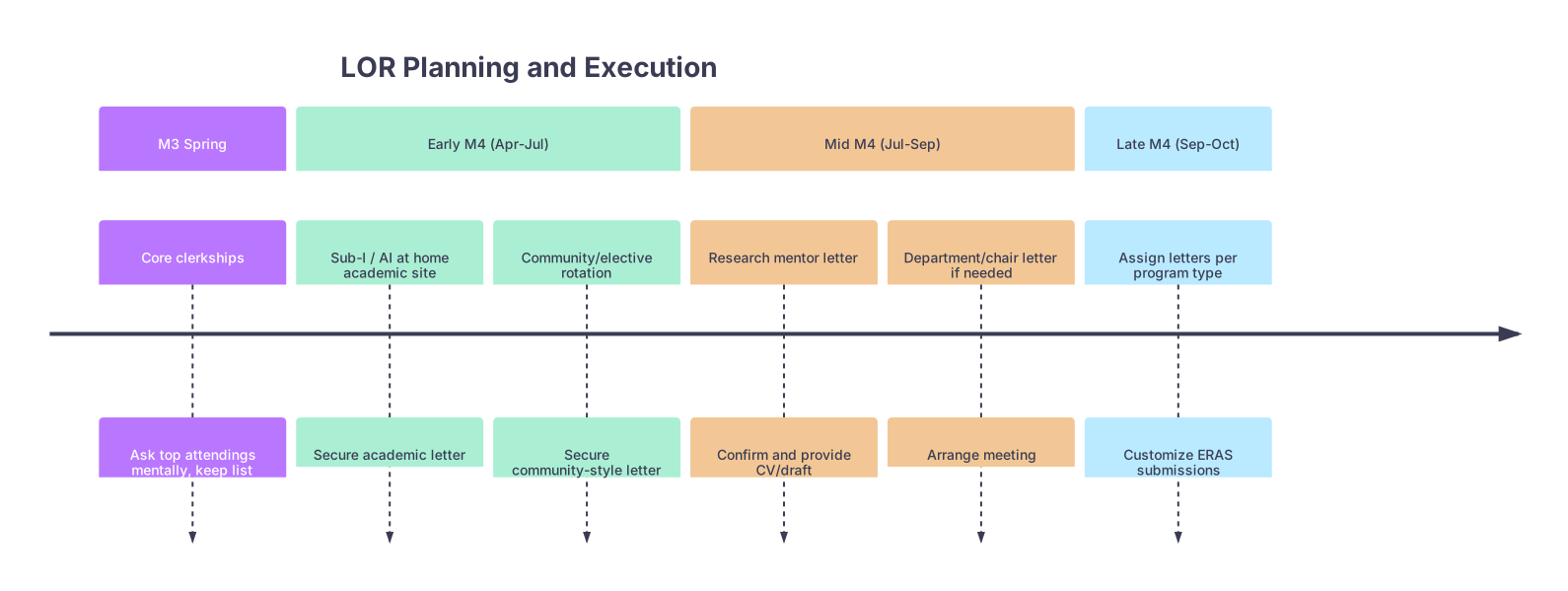
| Period | Event |
|---|---|
| M3 Spring - Core clerkships | Ask top attendings mentally, keep list |
| Early M4 (Apr-Jul) - Sub-I / AI at home academic site | Secure academic letter |
| Early M4 (Apr-Jul) - Community/elective rotation | Secure community-style letter |
| Mid M4 (Jul-Sep) - Research mentor letter | Confirm and provide CV/draft |
| Mid M4 (Jul-Sep) - Department/chair letter if needed | Arrange meeting |
| Late M4 (Sep-Oct) - Assign letters per program type | Customize ERAS submissions |
Key moves:
During M3 core rotations:
- Identify attendings who actually know you and where you feel you performed in the top tier of the team. You are scouting.
During early M4:
- Schedule at least one strong academic sub-I (for academic letters)
- And, if you are seriously considering community programs, at least one community or hybrid sub-I (for community letters)
Before August:
- Explicitly ask: “Would you be comfortable writing a strong letter of recommendation for my [X] residency applications?”
- If there is any hesitation, pivot to someone else.
You are building a letter bank that gives you flexibility in September when ERAS goes in.
8. Content Calibration: How to Nudge Writers for Different Program Types
You are not writing the letter. But you are absolutely allowed to prime your writers with information that helps them frame you correctly.
What I have seen work very well:
For academic-oriented writers
When you send your CV and personal statement draft, include a 1–2 paragraph note like:
- “I will be applying primarily to academically oriented Internal Medicine programs with the goal of pursuing fellowship in cardiology. Any comments on my performance relative to other students, ability to handle complex patients, and academic potential would be particularly helpful.”
Translation: Please use comparative language, mention complexity, and hint at future academic success.
For community-oriented writers
For the community attending or site director, you might send:
- “I will be applying to a mix of academic and community Internal Medicine programs. For community programs, they especially value reliability, team communication, and readiness to function as an intern. If you feel comfortable commenting on any of these aspects, that would be very helpful.”
You are not telling them what to write. You are aligning your request with how programs actually read letters.
9. Common Mistakes That Kill Letter Value
I see the same unforced errors every year.
Let us go through the worst offenders.
1. Prestige over substance
Choosing the department chair who barely remembers you over the sub-I attending who watched you crush 14-hour days.
Programs can smell a generic chair letter. Phrases like “pleasant to work with” and “I expect she will do well in residency” scream “I do not actually know this person.”
If you are applying to community programs especially, a generic big-name letter can actively hurt you by pushing out a much more detailed, grounded one.
2. Overweighting research letters for community programs
Sending a beautifully written, glowing research letter to a community FM or community IM program while excluding the letter from the attending who watched you handle 15 patients in clinic is a misalignment.
Many community programs simply do not care how well you pipetted or managed REDCap. They care how you interact with actual patients, nurses, and staff.
3. Too many non-specialty letters
For most fields, you want the majority of letters from your target specialty or very close neighbors.
- Applying to IM? Letters from IM, hospitalist, or closely related subspecialists.
- Applying to Surgery? Letters from gen surg or surgical subspecialties you worked with clinically.
- Applying to FM? FM, IM, Peds, and OB/Gyn primary-care style letters are acceptable, but 3 random subspecialty letters are not.
If you insist on including a non-specialty letter (e.g., Psychiatry letter for an IM applicant), that letter must be absolutely exceptional and cover traits directly relevant to the field.
4. Not customizing letter sets by program type at all
Sending the exact same three letters to MGH and to a 6-resident community IM program in a rural area is lazy and suboptimal.
Even if you cannot perfectly optimize every program, at least define 2–3 letter “templates” in ERAS:
- “Heavily academic”
- “Balanced”
- “Heavily community”
Then assign programs by list or region.
10. Signals You Are Sending (Sometimes Accidentally)
Programs infer more from your letter mix than you think.
Here is what your choices often signal:
No community letters at all, only big academic names:
- Signal to community programs: “This person will probably leave for fellowship immediately and may treat us as a backup.”
No academic letters, all community or peripheral sites:
- Signal to top academic programs: “May not have been able to secure strong home-institution academic support. Possibly weaker student or less visible.”
Strong research letter to academic programs but not community:
- Signal: “This applicant is fellowship- and academics-oriented; good for us” (academics), “They might not stay here” (community).
You can use this intentionally.
For example, if you genuinely only want community programs in a specific region long-term, leaning into community letters and including mention of geographic ties in personal statements and LOR priming makes sense.
11. Example Scenarios: How To Actually Decide
Let me walk you through a few real-world style scenarios.
Scenario 1: Mid-tier student, strong sub-I, mixed application list
- Step scores: average
- Clinical grades: mostly High Pass, one Honors in IM sub-I
- Research: minimal
- Letters available:
- A: IM sub-I attending, academic hospital (glowing, very detailed)
- B: IM clerkship director (good, but more generic)
- C: Community IM preceptor from 4-week sub-I (excellent, very invested in you)
- D: Research mentor from 8-week summer project (knows you, but not in-depth)
For:
- Top academic IM (e.g., university programs):
- Use A, B, D
- Mid academic / hybrid:
- Use A, B, C
- Community:
- Use A, C, B (if allowed 3), or just A, C
Scenario 2: Strong academic track, fellowship-minded
- Honors-heavy transcript, strong Step 2, 2+ publications
- Letters:
- A: Division chief cardiology (research + some clinical exposure)
- B: IM clerkship director
- C: Academic IM sub-I attending
- D: Community IM attending from away rotation
For:
- Top academic IM:
- A, B, C
- Strong university-affiliated mid-tier:
- A, B, C or A, C, D depending on your feel for the program
- Community:
- B, C, D (no need to push heavy research unless they are research-leaning)
Scenario 3: Applying mostly to community FM, with a few academic FM programs
- Letters:
- A: FM continuity clinic preceptor (6 months, deep relationship)
- B: Community FM attending from rural elective
- C: IM ward attending, academic hospital
- D: Research mentor in public health (health disparities project)
For:
- Community FM:
- A, B, C (prioritize longitudinal FM + community + evidence you handle inpatient)
- Academic FM:
- A, C, D (show continuity, inpatient capability, and scholarly work)
12. How Programs Actually Read LORs (And How Fast)
Let us be honest: no one is line-by-line reading 3-page letters for 1,000 applicants.
In busy programs, PDs and APDs skim for:
- Who wrote it (name, title, institution)
- Key phrases (top %, intern-ready, fully recommend)
- Any red flags (vague language, missing comparative statements in academic letters)
- Specifics that stand out (stories, clear descriptions of responsibility)
Most decisions about letters are made in under 30–60 seconds per applicant.
That means:
- One exceptional, specific letter can outweigh two generic ones.
- Small phrasing differences—“solid” vs “outstanding,” “pleasant” vs “exceptional”—matter disproportionately.
- A letter that screams “this person is already almost an intern” is pure gold for community programs.
You cannot script every line, but you can choose writers who are:
- Enthusiastic
- Specific
- Senior enough that their praise means something
- Aligned with the type of program you are targeting
13. Practical Checklist Before You Assign Letters in ERAS
Right before you finalize your ERAS assignments, run through this.
For each program, ask yourself:
- Is this program primarily academic, primarily community, or hybrid?
- Do my assigned letters:
- Show at least one strong academic voice for academic or hybrid programs?
- Show at least one detailed community/clinical workhorse voice for community or hybrid programs?
- Is there a research letter that should only go to academic-target programs?
- Is any weak or generic letter pushing out a strong one?
- Across all my applications:
- Do a few programs get a clearly “best possible” mix, especially my top choices?
You will not perfectly tailor 80+ applications. That is fine. But if your top 15–20 programs do not have optimized mixes, that is on you.
14. Final Thoughts: How To Stop Treating LORs as Afterthoughts
Letters are not a formality. For borderline cases, they are often the tiebreaker.
If you remember nothing else, remember this:
- Competitive academic programs reward:
- Prestigious, comparative, and research-aware letters that mark you as future faculty.
- Community programs reward:
- Concrete, detailed, reliability-focused letters that mark you as safe, kind, and ready on day one.
So:
- Build a 4-letter bank that includes at least one strong academic leader, one sub-I attending, and one community/“workhorse” attending.
- Align the mix you send to each program with what they actually care about—academic potential vs day-one reliability and community fit.
- Prime your writers so they know which traits to highlight, rather than hoping they guess.
If you do those three things, you will be ahead of most of your competition before anyone has even opened your file.