
The belief that switching specialties late ruins your letters of recommendation is exaggerated. You have less margin for error, yes. But with a compressed, ruthless timeline, you can still assemble a credible, even strong, LOR set.
You are not getting a leisurely year of “Maybe I like derm?” exploration. You are on a countdown. Here is how to run that clock.
Big Picture: What Has To Happen, By When
You do not have time for vague intentions. You need a concrete sequence.
For a late specialty switch (within 4–8 months of ERAS opening), these are your non‑negotiables:
- Identify your new specialty + core programs
- Get face time with attendings who can write (and will remember you)
- Complete at least one focused rotation / elective in the new field
- Line up 2–3 specialty‑specific letters (plus one “general” letter if needed)
- Request letters early enough that you are not begging at midnight before Sept 15
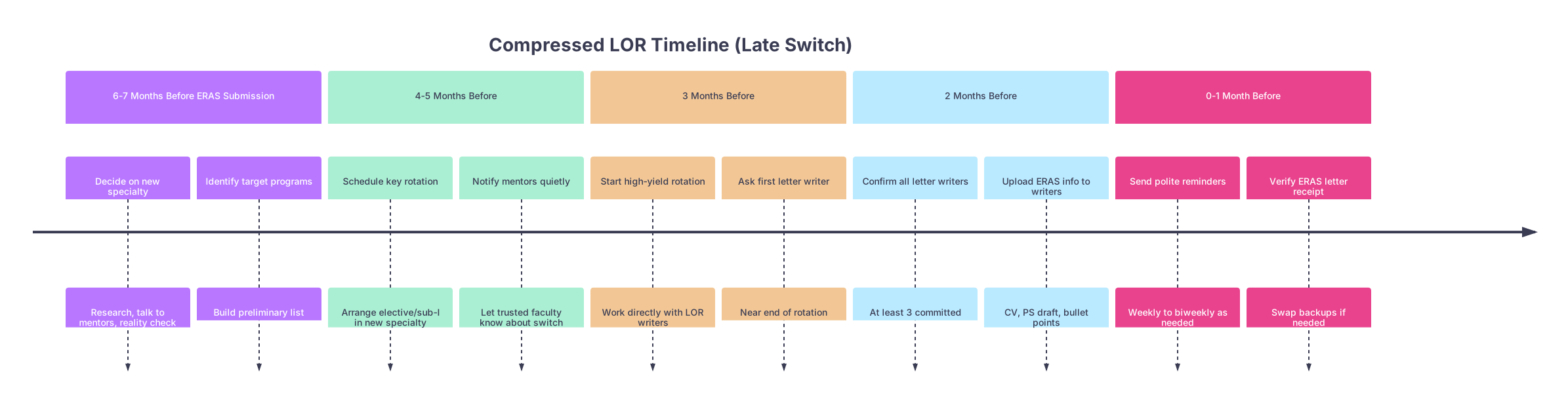
Here is a rough compressed timeline, assuming ERAS opens for editing in June and applications submit mid‑September. You can shift the months depending on your actual calendar.
| Period | Event |
|---|---|
| 6-7 Months Before ERAS Submission - Decide on new specialty | Research, talk to mentors, reality check |
| 6-7 Months Before ERAS Submission - Identify target programs | Build preliminary list |
| 4-5 Months Before - Schedule key rotation | Arrange elective/sub-I in new specialty |
| 4-5 Months Before - Notify mentors quietly | Let trusted faculty know about switch |
| 3 Months Before - Start high-yield rotation | Work directly with LOR writers |
| 3 Months Before - Ask first letter writer | Near end of rotation |
| 2 Months Before - Confirm all letter writers | At least 3 committed |
| 2 Months Before - Upload ERAS info to writers | CV, PS draft, bullet points |
| 0-1 Month Before - Send polite reminders | Weekly to biweekly as needed |
| 0-1 Month Before - Verify ERAS letter receipt | Swap backups if needed |
Now let us walk it month by month, then week by week once you are close.
6–7 Months Before ERAS Submission: Commit, Then Backward Plan
At this point you should stop “exploring” and commit.
1. Week 1–2: Decide You Are Actually Switching
Vague discomfort with your original specialty is not enough. You switch when:
- You have shadowed or rotated in the new field at least briefly
- You have talked to one resident and one attending in that specialty
- You understand competitiveness (Step/COMLEX, research expectation, SOAP risk)
You want to end this 2‑week window with a clear decision: Yes, I am applying to X specialty this cycle.
If you are between two specialties, you are not ready. LORs for “maybe EM, maybe anesthesia” read exactly like that. Weak and generic.
2. Week 2–4: Map Out Your LOR Needs
At this point you should create a brutally honest LOR inventory.
Most core specialties want:
- At least 2 letters from that specialty
- 1 letter from another field or medicine/surgery clerkship director
- Optional: a research letter if you have meaningful productivity
Make a table for yourself:
| Specialty | Ideal Letters (3–4 total) |
|---|---|
| Internal Medicine | 2 IM attendings, 1 chair/PD or sub-I supervisor |
| General Surgery | 2 surgery attendings, 1 chair/PD, 1 optional research |
| Emergency Med | 1–2 SLOEs, 1 EM faculty letter, 1 non-EM clinical |
| Anesthesiology | 2 anesthesia faculty, 1 IM/surg, optional research |
| Psychiatry | 2 psych attendings, 1 IM/FM or neurology |
Then compare this to what you actually have. Many late switchers realize:
- They have strong letters in the old specialty
- They have zero real exposure in the new one
That is the gap you have 4–6 months to close.
4–5 Months Before: Schedule Rotations and Quietly Reposition
At this point you should be maneuvering your schedule hard.
3. Week 1–2: Lock in at Least One Key Rotation
Your priority is one high‑impact rotation in the new specialty before August. Ideally:
- A sub‑I or acting internship, or
- A home elective where residents and faculty know your institution, or
- An away rotation only if your school has weak home options and your new specialty values aways (EM, ortho, neurosurg, etc.)
Do not stack three aways back‑to‑back just because you are panicking. That is how people burn out and collect one mediocre letter and two neutral ones.
You want:
- One rotation where you can be outstanding
- One backup/elective where you can be solid and meet a second potential letter writer
4. Week 3–4: Tell the Right People You Are Switching
At this point you should have a quiet, targeted disclosure strategy. Not a dramatic email blast.
Talk to:
- A trusted faculty mentor (even if not in the new specialty)
- Your dean’s office / advising office
- A resident in the new specialty who can reality‑check your plan
You say something like:
“I know this is a late pivot, but after [specific experiences], I am committed to applying in [new specialty] this cycle. I am trying to arrange [sub‑I/elective] in the next few months so I can earn strong letters. I would appreciate your honest feedback on whether this timeline can still work.”
You are looking for two things:
- Confirmation that your scores, CV, and timing are plausible for this field
- Names of specific attendings/rotations where students actually get good letters
The worst move here: keeping everything secret and assuming it will "work out."
3 Months Before: Start the High-Yield Rotation and Build Letter Relationships
At this point you should be thinking like an applicant, not like a student drifting through a course.
5. Week 1: Day 1–3 of Rotation – Set Up the Ask
First week on your key rotation, you do three things quickly:
Identify 2–3 potential letter writers
- Attendings who work with you repeatedly
- Known “teacher” faculty who write strong letters
- People who are actually respected in the department
Signal your intention early
Short hallway conversation or end‑of‑day check‑in:“Dr. Smith, I am applying into [specialty] this cycle and very excited to be on this rotation. I really want to get as much feedback as possible and would love to work closely with you while I am here.”
Start behaving like a sub‑I even if the rotation is “just an elective.”
- Pre‑round
- Own patients
- Volunteer for notes and follow‑up calls
- Present clearly and succinctly
You are not trying to be the hero. You are trying to be unambiguously in the top few students they have seen this year.
6. Week 2–3: Earn the Letter, Consciously
At this point in the rotation, your goal is to give attendings specific reasons to write about you.
You want them to see:
- Clinical reasoning (not just data dumping)
- Reliability over several shifts / call nights
- Ability to improve after feedback
Make it easy for them:
Ask for mid‑rotation feedback:
“I am hoping to ask you for a letter if things continue to go well. Is there anything I should focus on these next two weeks to be a stronger applicant for [specialty]?”
Then actually do those things. Faculty remember that.
8–10 Weeks Before Submission: The Actual Ask
This is where most late switchers choke. They delay. They send vague emails. They treat the ask like a formality instead of a critical moment.
7. End of Rotation (Last 3–5 Days): Ask In Person
At this point you should be asking in person, face to face, if at all possible.
Script (adapt to your style):
“Dr. Smith, I have really appreciated working with you this month. I am applying to [specialty] this cycle and would be honored if you felt you could write a strong letter of recommendation on my behalf.”
Then stop talking. Let them answer.
Pay attention to their wording:
- “Of course, I would be happy to write you a strong letter.” → Good.
- “Sure, I can write a letter” or “I can write you something.” → Weak. That is a soft no. Have a backup.
Immediately after they agree, follow with:
“Thank you. I will send you my CV, ERAS ID, and a short summary of my work on the rotation. Is there anything specific you would like from me that would help your letter?”
You aim for:
- 2 letters from this key rotation if possible (two attendings who saw you a lot)
- 1 additional letter from another setting (IM, surgery, research, or your prior specialty if they can speak to your work ethic without pushing you back into that field)
6–8 Weeks Before Submission: Lock In All Writers and Deliver Materials
Now you move from “please like me” mode to “project manager” mode.
8. Week 1: Confirm Your Letter Writer List
At this point you should have a concrete list:
- LOR 1 – Specialty attending from sub‑I/elective (committed)
- LOR 2 – Second specialty attending or PD/associate PD (committed)
- LOR 3 – Non‑specialty but strong clinical letter (IM/surg/FM) or research mentor
- Optional LOR 4 – Extra letter you can assign selectively
If one of these is shaky or non‑responsive, identify a backup attending now, not in September.
9. Week 1–2: Send a Tight LOR Packet to Each Writer
Your email should not be a data dump. It should be a focused packet making their job simple.
Send:
- Updated CV
- ERAS ID and instructions for uploading a letter
- Personal statement draft for the new specialty (even if not perfect yet)
- A short bullet list of things they observed that you hope they can mention
Example bullet list (do not write a novel):
- “Led daily care on 6–8 patients on the wards, wrote most progress notes”
- “Presented two new admissions succinctly; integrated feedback about assessment plans”
- “Stayed late to help with [case] on [date], followed up next day with family”
And include a clear deadline:
“I am planning to submit my ERAS application on [date]. If possible, I would be grateful if the letter could be uploaded by [date 10–14 days earlier], so I can make sure it is assigned before submission.”
4–5 Weeks Before Submission: Monitor, Remind, and Backstop
This is where compressed timelines either survive or collapse.
10. Week 1–2: Track What Has Arrived
At this point you should be logging into ERAS weekly to see which letters are in.
Make a simple tracking sheet:
- Writer name
- Type (specialty, non‑specialty, research)
- Date requested
- Date uploaded
- Back‑up plan
If a key specialty letter is still missing two weeks after your requested date, you do:
“Dr. Smith, I wanted to gently follow up on the letter of recommendation. ERAS shows it as not yet received. I completely understand how busy this time of year is. My target submission date is [date], so if there is anything I can provide to help, please let me know.”
If you get silence for another week, activate Plan B with your backup writer.
11. Week 3–4: Decide How To Assign Letters Strategically
Late switchers panic and assign every letter to every program. That is lazy.
Aim for:
- 3 letters assigned per program (4 only if they are all truly strong)
- For your new specialty:
- Always include at least 2 specialty‑specific letters
- Add 1 “general excellence” letter (IM/surg/FM/research)
If you are dual‑applying (e.g., IM and FM, or anesthesia and prelim medicine), customize which letters go to which specialty.
Special Cases: Very Late Switch (≤3 Months Before ERAS Submission)
Now we get into damage‑control territory. This is where you switch in, say, June for a September ERAS submission.
You do not have time for idealism. You prioritize exposure and believable narrative.
At This Point You Should:
- Stack every available week in the new specialty before September
- Notify your dean/PD early so they can help construct a rational story
- Leverage any related experiences (ICU for anesthesia, neurology for psych, etc.) in your letters
Tactical differences:
You might only get 1 truly in‑depth specialty rotation. Then you squeeze 2 letters out of it. One from the primary attending, one from the PD or another faculty who rounds with you several times.
You lean harder on translatable letters:
- A strong IM letter describing complex patient management can work for anesthesia
- A neurology letter describing cognitive workup and rapport can work for psychiatry
But you must normalize the timing in your personal statement and MSPE:
“I discovered [new specialty] during [specific experience] late in third year, and pivoted quickly by doing X, Y, Z to gain focused exposure.”
Programs despise a vague, last‑minute narrative. They can forgive a late but clearly motivated switch.
Red Flags and How To Avoid Them On a Compressed LOR Timeline
A compressed timeline magnifies small mistakes. At this point in the season, you cannot afford these:
Generic, one‑week exposure letters
- “I only worked with the student for 3 shifts, but…” kills you.
- If a faculty barely saw you, do not use them. Period.
Letters pushing the wrong specialty
- Your old specialty mentor writing: “She will make an excellent surgeon” for an anesthesia application. I have seen this. It looks terrible.
Late arriving flagship letter
- Do not plan on a September rotation letter as your anchor. By the time it arrives, many interview offers are already out.
Over‑weighting research letters
- A big‑name researcher who saw you in clinic twice is not better than a mid‑tier clinician who watched you grind for a month.
If you see any of these developing, you pivot. Quickly.
One More Visual: How Your Time Should Shift After the Switch
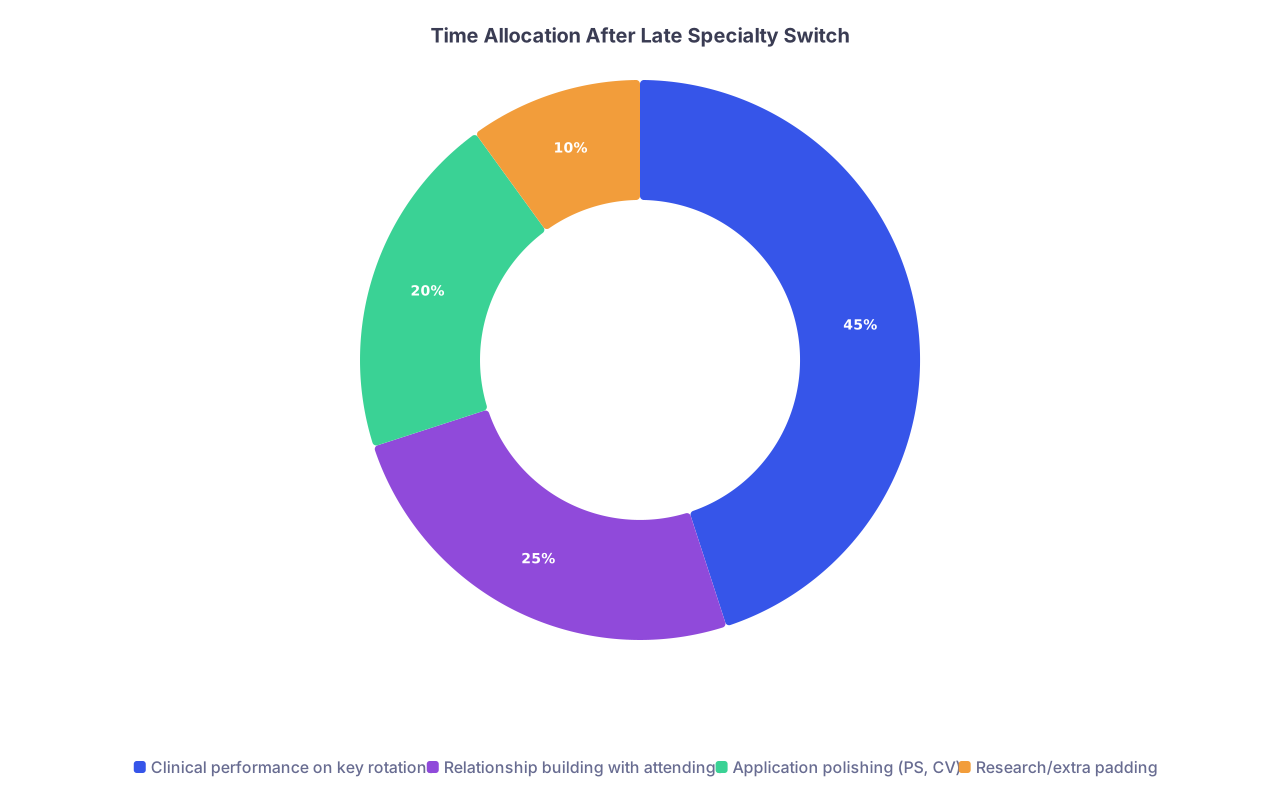
You only have a limited number of weeks. Here is roughly how your effort split should look after you decide to switch, if you want your LORs to be credible.
| Category | Value |
|---|---|
| Clinical performance on key rotations | 45 |
| Relationship building with attendings | 25 |
| Application polishing (PS, CV) | 20 |
| Research/extra padding | 10 |
If you are spending 50% of your time fiddling with your personal statement and only 10% impressing actual letter writers, your priorities are backward.
Final 2 Weeks Before Submission: Tighten, Do Not Tinker
At this point you should stop restructuring your LOR strategy and execute.
- Verify every letter you plan to use is received in ERAS
- Double‑check specialty assignments (no psych letters going to surgery by accident)
- Send thank‑you emails to each writer—brief, sincere, mentioning your submission date
Once you submit, do not harass faculty about “updating” letters or rewriting them. Program coordinators see the timestamps. Endless tweaks from your side scream disorganization.
Three Things To Remember
- A late specialty switch does not kill your chances. A vague story + weak letters does.
- Your LORs are built on 3–6 weeks of spectacular performance and clear, early asks, not luck.
- On a compressed timeline, you survive by planning like a project manager: fixed deadlines, backups for every key letter, and zero tolerance for generic writers.