

You are here
It’s August 20th. You’re three weeks into your first away rotation. You’re exhausted, you finally know where the dressing supplies are, your notes are no longer getting shredded… and you suddenly realize:
“I need a letter of recommendation from this rotation. When do I ask? How do I ask? Do I wait until the last day? Is it too early? Am I blowing this?”
This is where people either handle it cleanly—or fumble badly and leave without a strong letter. I’ve watched both. The difference is all about timing and being deliberate.
You’re going to get a clear calendar here: month-by-month, then week-by-week on an away, then the actual day-by-day script for the final week. No fluff. No vague “just be yourself.”
You’ll know exactly when to:
- Signal you’re interested in a letter
- Lock down your letter writers
- Follow up without being annoying
- Avoid the classic “it’ll go in eventually” black hole
Let’s walk it forward like a real timeline.
Big-Picture Calendar: MS3 Spring → ERAS Submission
First zoom out. Away rotation LORs don’t live in a vacuum—they sit inside your entire residency application calendar.
Assume a “normal” year: ERAS opens in June, submission mid-September-ish, interview season Oct–Jan.
MS3 Spring (March–May): Set the stage
At this point you should:
- Know which specialties you’re targeting (or down to 1–2)
- Have an idea if you need aways (you do for most competitive surgical subspecialties, EM, ortho, derm, etc.)
- Start thinking about LOR balance:
- 1–2 home letters in the specialty
- 1–2 away rotation letters in the specialty
- Possibly 1 “character/medicine” letter (IM, Sub-I, etc.)
Action items by late MS3:
- Identify 2–3 programs where you’re likely to work closely with attendings (small teams, lots of one-on-one time). Those are your prime LOR environments.
- Ask upperclassmen: “Which rotations here actually let attendings get to know you enough to write a strong, specific letter?”
You’re not asking for letters yet. You’re setting up the rotations where asking will be easy and natural.
Early M4 (April–June): Planning Aways and Letter Strategy
At this point you should:
- Have your away rotations scheduled or pending through VSLO
- Map which rotations must produce letters
Build a simple letter map:
| Rotation | Month | Target Letter Writer | Priority |
|---|---|---|---|
| Home Sub-I | May | Program PD | High |
| Away 1 (Program A) | July | Service attending | High |
| Away 2 (Program B) | August | Chair or PD | High |
| Backup IM Sub-I | September | Strong teaching attending | Medium |
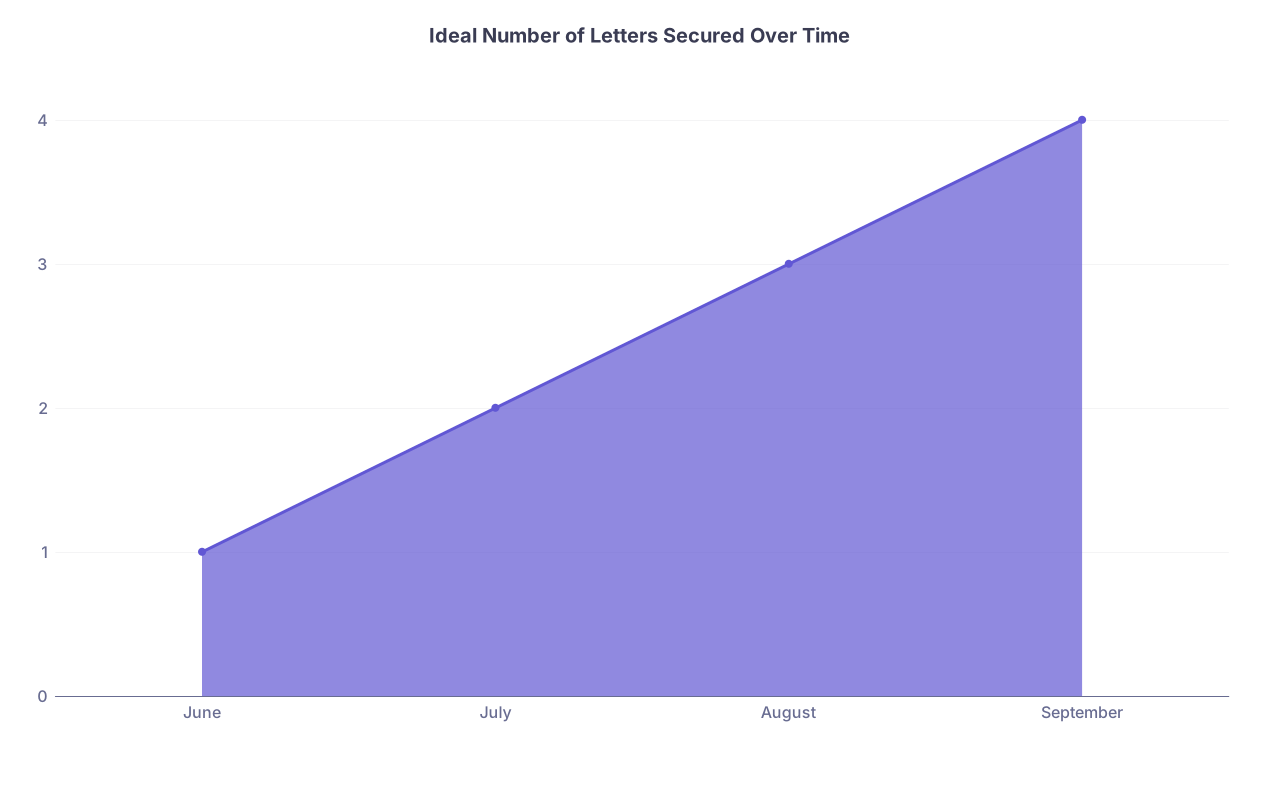
Your goal: by end of August, you want at least:
- 1 strong home letter in specialty
- 1 away letter uploaded or promised
- 1 additional letter (home or away, specialty or strong generalist)
Why? Because if you wait until late September to chase letters, you’re behind and stressed and refreshing ERAS like a maniac.
| Category | Value |
|---|---|
| June | 1 |
| July | 2 |
| August | 3 |
| September | 4 |
Inside a 4-Week Away: Week-by-Week Letter Timeline
Now the part you actually care about: “When do I ask before I leave?”
Let’s assume a standard 4-week away. Adjust if you have 2 or 3 weeks (I’ll note where).
Week 1: Establish presence, not pressure
At this point you should:
- Show up early, stay a little late, be prepared
- Figure out who actually sees your work:
- Service attending?
- Fellowship director?
- PD rounding regularly?
- Senior resident who’s clearly trusted?
Your letter radar is on, but your mouth is shut.
Concrete moves:
- Volunteer for things that show your work: presenting, short talks, following complex patients
- Ask simple feedback questions at the end of the week:
- “Is there anything I can improve on for next week—presentation style, notes, or how I’m helping the team?”
You’re not mentioning letters yet. Asking in Week 1 screams insecurity and makes it harder for an attending to say “yes” honestly.
Special case: 2-week away rotation
- Compress this. You basically have:
- Days 1–3: Show up and be competent
- Days 4–5: Ask for feedback, then ask about letters in Week 2
Week 2: Quietly position yourself as a “letter” student
By the start of Week 2, you should have:
- One or two attendings who’ve seen you enough to form an opinion
- A sense of which resident or fellow might advocate for you
At this point you should:
- Increase visibility:
- Ask to present a short topic talk if that’s the culture
- Take ownership of a couple of complex patients, not ten simple ones
- Ask for mid-rotation feedback explicitly:
- “Dr. Smith, I’m really interested in [specialty] and this program specifically. I want to make the most of this rotation. Do you have any feedback so far on what I could be doing better?”
Why this matters:
- It signals genuine interest in the program
- It shows you’re reflective and coachable
- It sets up the later LOR ask because they’ve already thought about your performance
Again, you’re not officially asking yet, but you’re laying the groundwork so that when you do, it doesn’t feel out of the blue.
Week 3: This is your “ask” week
This is the sweet spot. Too many students wait until the last afternoon of Week 4, when everyone’s in a rush and half checked out.
By mid-Week 3, you should:
- Know exactly who your top 1–2 LOR targets are
- Have had at least one real feedback interaction with them
- Have presented or done something they can reference
Ideal moment to ask
Best time: End of a day when you worked directly with them and things went reasonably well.
Script (modify to sound like you):
“Dr. Chen, I wanted to ask you something quickly before you go. I’m applying into [specialty] this year, and this rotation has been really important to me. If you feel you know my work well enough, would you be comfortable writing a strong letter of recommendation for my residency application?”
Key parts:
- “If you feel you know my work well enough” = gives an out
- “Strong letter” = you’re not looking for a lukewarm template
- You’re asking in Week 3, so if they say yes, they can watch you a bit more with that in mind
Common responses:
- “Yes, absolutely—happy to.” → Great. Follow-up logistics next.
- “I think I could, but I’d like to see a bit more.” → Translation: keep pushing the next week; they may be on the fence.
- “I don’t think I’ve worked with you enough; maybe Dr. X would be better.” → Take the hint. This is them doing you a favor.
If they say yes:
At that point you should immediately ask:
“Thank you, I really appreciate it. What would be the best way to get you my CV, personal statement draft, and ERAS info? Email?”
Write down exactly what they say. Email address. Any extra materials they like (some want a bullet list of cases, some want your strengths).

Week 4: Lock it in and avoid the “oh yeah, send it to me sometime” trap
By the start of Week 4, you should:
- Have already asked your main letter writer(s)
- Confirmed exactly how they want materials and by when you’re hoping the letter is in
If you haven’t asked yet and you’re at the start of Week 4, you’re late—but still salvageable.
Early Week 4 (Mon–Wed): Confirm and send materials
Day-by-day:
Monday
If they already agreed in Week 3:
Send a concise email:
Subject: LOR Materials – [Your Name], [Rotation/Month]
Body:
Dear Dr. Chen,
Thank you again for agreeing to write a strong letter of recommendation for my [specialty] residency applications. I’m very grateful.
As you requested, I’ve attached my CV and a draft of my personal statement. I’ve also included a brief bullet list of patients/cases from this rotation that I was most involved with.
ERAS will open for letter uploads in [month], and I’m planning to submit my application around [target date]. If possible, I’d be very grateful if the letter could be uploaded by [date ~1–2 weeks before you submit].
Please let me know if there’s anything else I can provide.
Best,
[Name]
[School, AAMC ID]
If you haven’t asked yet, you ask in person Monday or Tuesday. Not Thursday at 4:30 p.m.
Tuesday–Wednesday
- Follow through on any extra things they requested
- Keep performing well; they’re now seeing you as “their letter student”
Late Week 4 (Thu–Fri): The final in-person touch
Before you leave—not as you’re running out the door—you should:
- Catch them in a quiet moment:
“Dr. Chen, I just wanted to say thank you for having me on the team this month. I really appreciated the feedback on [specific thing]. I sent you my CV and personal statement on Monday—please let me know if you’d like anything else for the letter.”
You’re reminding them once in person, politely. That’s it.
Special Cases: 2-Week and 3-Week Aways
3-Week rotation
Compress the schedule:
- Week 1: Establish presence and ask for initial feedback by Friday
- Week 2: Ask for the letter mid-week
- Week 3: Send materials Monday, in-person reminder Thursday
2-Week rotation
You cannot procrastinate here.
Day-by-day skeleton:
Days 1–3: Learn workflow, be useful, be prepared
Day 4 or 5: Ask for feedback:
“Since this is a short rotation, I’d love feedback early so I can improve in the second week.”
Day 7–8: Ask for letter in person, same Week 3 script but advanced
Day 9: Email materials
Day 10: Quick in-person thank you and gentle reminder
If they say “it’s too short to really know you,” do not push. Better a “no” than a vague, generic letter.
ERAS & Upload Timing: When You Actually Need the Letter
Let’s align this with the actual ERAS deadlines.
Assume:
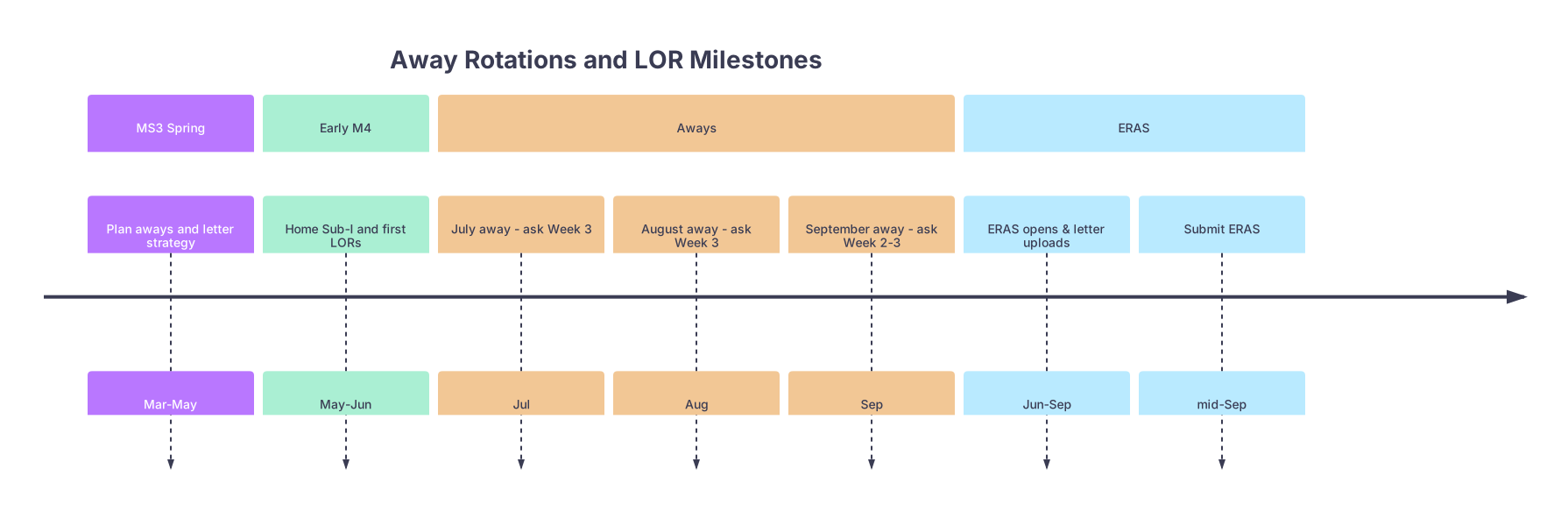
- You’re doing aways in July, August, maybe September
- ERAS submission mid-September
Here’s how those play together:
| Away Month | When to Ask for LOR | When to Have Letter Uploaded |
|---|---|---|
| July | Week 3 of rotation | By early–mid September |
| August | Week 3 of rotation | By late September |
| September | Week 2–3 (max) | As soon as possible; may be post-submission but ok |
A few realities I’ve seen:
- Programs start reviewing apps before all letters are in, but they’ll see new letters as they arrive
- A strong away letter arriving a week or two after you submit ERAS can still help for interview offers
- Your first wave of interviews is driven by:
- At least 2–3 good letters in place
- Your scores, school, and personal statement
- When you submitted (earlier is better, within reason)
So the real target:
- Have 3 letters uploaded or clearly committed by the time you hit “submit” on ERAS
- Additional letters (like late-September away) are a bonus and can still help for later invites and ranking impressions
| Period | Event |
|---|---|
| MS3 Spring - Plan aways and letter strategy | Mar-May |
| Early M4 - Home Sub-I and first LORs | May-Jun |
| Aways - July away - ask Week 3 | Jul |
| Aways - August away - ask Week 3 | Aug |
| Aways - September away - ask Week 2-3 | Sep |
| ERAS - ERAS opens & letter uploads | Jun-Sep |
| ERAS - Submit ERAS | mid-Sep |
Choosing Who to Ask on an Away (And Who Not To)
This part people chronically overthink.
At this point you should prioritize:
Who knows your work best?
- Daily attending on your service
- Fellowship director who rounded with you frequently
- PD who saw you present multiple times
Who writes meaningful letters in this program?
- Ask residents quietly:
- “Whose letter tends to carry weight from here?”
- Often it’s: PD, APD, Chair, or a known subspecialist
- Ask residents quietly:
Given the choice:
- A very strong letter from a “regular” attending > a generic letter from a big-name chair who barely met you
- A letter that says “I would rank this student in the top 10% of residents I’ve worked with in the last 5 years” beats four paragraphs of flattery with no ranking statement
Red flags when choosing:
- Attending has barely seen you outside of one clinic day
- They’re disorganized, always behind on notes → they will forget your letter
- They seem lukewarm when you ask; they hesitate, say “sure, I can write something basic” → pass
Follow-Up Calendar After You Leave
You left the rotation. You asked. They said yes. You emailed. Now what?
Here’s how to not be annoying while also not getting ghosted.
1 week after your email (if no response)
At this point you should send a gentle nudge:
Dear Dr. Chen,
I just wanted to make sure my last email with my CV and personal statement came through. Absolutely no rush on the letter; I just wanted to be sure you received the materials.
Thank you again for your support.
Best,
[Name]
If they respond “Yes, got it, will work on it soon,” stop there for now.
2–3 weeks before your ERAS submission target
If the letter still isn’t in ERAS:
- Send a polite, time-anchored follow-up:
Dear Dr. Chen,
I hope you’re doing well. I’m planning to submit my ERAS application around [target date], so I wanted to check in about the letter of recommendation you kindly agreed to write.
If there’s any additional information that would be helpful, I’m happy to send it along.
Thank you again for your time and support.
Best,
[Name]
If no response after that, you have two choices:
- Let it go and rely on other letters (preferred, if you have enough)
- Ask the program coordinator or letter office (if there is one) whether the letter is in progress
Do not send weekly “just checking in” emails. That’s how you irritate someone who was trying to help you.
Quick Day-by-Day Template: Final Week of a 4-Week Away
Let’s make this painfully concrete.
Monday
- Confirm letter verbally if not already confirmed
- That evening: send email with CV, PS draft, bullet list of cases, and ERAS timeline
Tuesday
- Keep working as usual; no extra asks
Wednesday
- If they haven’t acknowledged the email and you see them:
- “Dr. Chen, just wanted to check that my email with the CV and personal statement came through?” (face-to-face is fine once)
Thursday
Catch them before or after rounds:
“Thank you again for agreeing to support my application—it really means a lot. Please let me know if I can send anything else that would be useful for the letter.”
Friday
- Before you disappear:
- Say an actual goodbye
- Thank them specifically for teaching/feedback
- Confirm they have your email / contact if they need anything
Then walk away. You did your part.
Core Takeaways
- Ask for away rotation LORs in Week 3 of a 4-week rotation (earlier if it’s a 2- or 3-week), not in a panicked blur on the last day.
- Lock down logistics before you leave: email them your CV, personal statement, and a realistic upload target date while you’re still on service.
- Follow up once after a week and once a couple of weeks before you submit ERAS—then move on and let your other letters carry the load if needed.


