

It’s early June. ERAS just opened. Your friends are bragging, “All my letters are lined up, just waiting to upload,” and you’re staring at your portal with zero documents in the Letters section. Your rotations are stacked, your writers are busy attendings, and the portal feels like an unforgiving countdown clock.
Here’s the reality: most applicants do LOR timing badly. They either ask too late, or let letters sit in limbo, or annoy attendings with frantic emails the week before submission. You’re not going to do that.
You’re going to run this from ERAS opening to submission like a project manager. Week-by-week. With specific asks and specific deadlines.
Big Picture: What You’re Aiming For
Before we go month-by-month, you need a target.
For a typical categorical specialty (IM, Peds, FM, Psych, Neuro):
- Aim for 3–4 strong specialty letters, plus
- Optional 1 “wildcard” (research, sub-specialty, or department chair if useful)
For more competitive specialties (Derm, Ortho, ENT, Plastics, Rad Onc):
- Aim for 4 letters total, usually:
- 3+ from that specialty
- 1 from research or a strong medicine/surgery rotation
For prelim/TY/transitional:
- 2–3 letters are usually enough
- Mix of IM/surgery + one “character”/professional letter is fine
Your core constraints:
- Programs usually read 3–4 letters. More than 4 is almost always pointless.
- You can assign different LOR combinations to different programs in ERAS.
- You want all key letters in by 1–2 weeks before your planned ERAS submission date.
So, we’re going to walk from June ERAS opening → mid-September submission and layer your LOR moves onto that.
June: ERAS Opens – Set the Board, Don’t Panic
ERAS typically opens in early June. At this point you should not be randomly emailing attendings “whenever you have time.” That’s how letters vanish.
Week 1 of ERAS Opening (early June)
At this point you should:
Lock your letter strategy
- Decide:
- How many total letters you’re targeting (3 vs 4 vs 5 max).
- Which specialty letters are mandatory for your chosen field.
- Example:
- Applying IM → 3 IM letters + 1 research letter.
- Applying EM → 2 SLOEs + 1 IM/surgery letter.
- Decide:
List specific potential writers
- Categories:
- Recent rotation attendings who know your clinical work.
- Research mentors who supervised you directly (not just “lab director you saw twice”).
- Program or clerkship directors who can speak to your reliability and reputation.
- Put them in a simple table:
- Categories:
| Writer | Type | Strength (1–5) | Relationship | Target Letter Type |
|---|---|---|---|---|
| Dr. A | IM | 5 | Sub-I mentor | “Top IM clin” |
| Dr. B | Research | 4 | 2y mentor | Research letter |
| Dr. C | PD | 3 | Met x3 | Departmental |
If you can’t fill at least 3 strong names now, that tells you something: your upcoming rotations matter even more, and your asks need to be early and deliberate.
- Decide your target submission date
- For most specialties: Submit ERAS within 24–72 hours of the first day programs can see applications.
- That date lives in your calendar, in all caps. Your LOR timing backs up from there by 1–2 weeks.
Week 2–3 (mid-June)
At this point you should:
Pre-ask your top writers verbally (if you still see them)
If you’re still on rotation with them or on campus:- Quick hallway script:
- “Dr. X, I really value the feedback you gave me on this rotation. I’m applying to [Specialty] this cycle and was hoping you’d be willing to write a strong letter of recommendation for my ERAS application?”
- You want them to say “Yes, definitely” or “I’d be happy to.”
- If they hesitate? You thank them and quietly do not use them. That hesitation is a red flag.
- Quick hallway script:
Set expectations immediately
- When they say yes, add:
- “ERAS opens letter uploads soon. I’m planning to submit around [date], so if you could upload by [10–14 days before that], that would be perfect.”
- That sounds organized, not pushy.
- When they say yes, add:
Collect what they’ll need
- At this point, prepare:
- Draft ERAS CV
- Personal statement draft
- Photo (optional, but some like it)
- Short bullet list:
- 3–5 patients / cases you managed with them
- Any feedback they gave you that could be turned into strengths
- At this point, prepare:
Late June–July: ERAS LOR Slots, Formal Requests, and Rotations
You’re now a few weeks into ERAS season. Portals open for LOR entry before program submission. This is when you stop being vague and start putting names into boxes.
When ERAS Allows You to Add Letter Writers
At this point you should:
Create letter entries in ERAS the same day
- For each writer:
- Add their name, title, email, and letter type
- Decide whether you’ll waive your right to see the letter (yes, you should, unless there’s a bizarre reason not to)
- For each writer:
Send the official ERAS request email + personal email
- Don’t rely on the automated ERAS email alone. It gets buried.
- Your email should:
- Remind them of:
- Who you are
- When you worked together
- Your specialty goal
- Attach:
- CV
- PS draft (ok if evolving)
- Any required forms (e.g., SLOE templates, some EM forms)
- Give a specific deadline, earlier than your real one:
- “Programs start reviewing applications on [X date], and I’m planning to submit by [Y date]. If you’re able to upload by [Z date], that would be incredibly helpful.”
- Remind them of:
Enter a tracking system
- Spreadsheet, Notion, piece of paper—do not keep this in your head.
| Writer | ERAS Added | Asked (Email) | Confirmed | Due Date | Uploaded? |
|---|---|---|---|---|---|
| Dr. A | 6/20 | 6/21 | Yes | 8/25 | Pending |
| Dr. B | 6/22 | 6/23 | Yes | 9/01 | Pending |
Strategy Layer: How Early Is “Too Early” vs “Too Late”?
You don’t want letters written nine months ago that sound generic. You also don’t want a letter written the night before submission, full of typos.
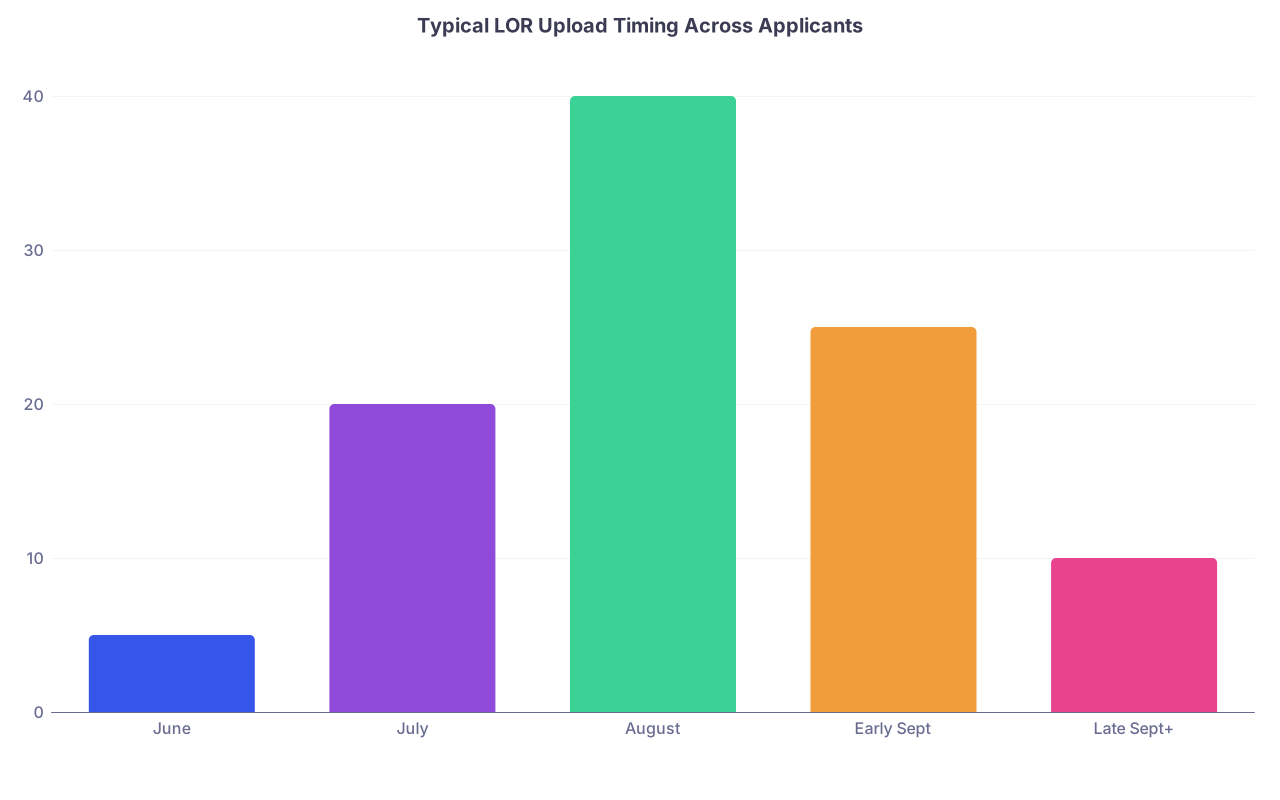
Here’s how timing usually plays out in reality:
| Category | Value |
|---|---|
| June | 5 |
| July | 20 |
| August | 40 |
| Early Sept | 25 |
| Late Sept+ | 10 |
- June: Only hyper-organized or reapplicants have letters done.
- July: Majority of pre-planned research and early clinical letters get requested.
- August: Main upload month.
- Early September: panic uploads.
- Late September+: straggler letters and people who underestimated everything.
Your sweet spot for most letters: written between July–early September, uploaded at least 7–10 days before your application is released to programs.
August: The Critical Build Phase
By August, you should be past “planning” and firmly in “execution.”
Early August (6–7 weeks before applications are transmitted)
At this point you should:
Have at least 2 letters already uploaded or 100% confirmed
- If you have zero by early August, that’s a problem.
- You need:
- At least 1 core specialty letter
- 1 strong general or research/medicine letter
Schedule your first reminder cycle
- One polite email to anyone who:
- Agreed to write
- Hasn’t uploaded
- Is ≥2 weeks away from your soft deadline
- Sample language (short, don’t overthink):
- “Hi Dr. X,
Just a quick check-in about the letter of recommendation for my [specialty] ERAS application. ERAS will start sending applications to programs on [date], and I’m planning to finalize my submission by [earlier date]. If you’re still able to submit the letter by [soft deadline], that would be wonderful. Let me know if there’s anything else I can provide. Thank you again.”
- “Hi Dr. X,
- One polite email to anyone who:
Decide if you need a backup writer
- If one of your original three is flaky, you will feel it by now.
- Use any August rotation attending who is enthusiastic about you as a backup ask:
- “I may already be at my letter maximum, but if one falls through, would you be willing to write one? I’d be honored to have you as a recommender.”
Mid–Late August (4–5 weeks before transmission)
At this point you should:
Lock down specialty-specific must-haves
- EM: you should have your SLOEs in motion.
- Surgery / Ortho: at least 1–2 letters from surgeons who actually saw you in the OR and wards.
- IM: at least 2 letters from inpatient IM rotations or sub-Is.
Assign preliminary LORs to programs in ERAS
- You can assign letters even if they’re not uploaded yet.
- Do that now so you aren’t frantically clicking boxes the night before.
Run a second reminder (if needed)
- For letters due in 2–3 weeks.
- Shorter email, closer to:
- “Hi Dr. X,
Just sending a brief reminder about my ERAS LOR; I know this is a busy time of year. My planned submission date is [date], and your letter would be a key part of my application. I appreciate your help very much.”
- “Hi Dr. X,
September: The Crunch – From “Almost Ready” to Submitted
Here’s where people sabotage themselves. They wait for every letter to be in before hitting submit. Don’t do that.
Most programs will review your application with pending letters as long as they arrive reasonably soon after applications are released. The application itself should not be delayed more than a few days waiting on one slow attending.
Early September (1–2 weeks before ERAS releases apps)
At this point you should:
Have at least 3 letters uploaded
- If you’re at 2 and expecting 2 more, you’re cutting it close.
- Prioritize:
- Core specialty letters
- Best general/research letter
Make a hard decision about the slowest writer
- If someone:
- Has not responded in weeks, or
- Keeps saying “I’ll get to it this weekend” and doesn’t
→ Consider shifting them from “core” to “bonus if it arrives.”
- If someone:
Set your personal cutoff
- Example:
- ERAS transmits Sept 25.
- You decide:
- “I submit by Sept 23 no matter what. Any late letters become extras, not prerequisites.”
- Example:
Final reminder (strictly necessary writers only)
- This is a direct but polite email.
- “Hi Dr. X,
ERAS will release applications to residency programs on [date], and I’m planning to submit by [date]. Your letter is one of my core recommendations for [specialty], and I just wanted to confirm that you’re still able to upload it by then. Thank you again for supporting my application.”
ERAS Submission Week: What You Do and Don’t Wait For
When you’re ~48–72 hours from your target submission date, the questions in your head are usually:
- “Do I wait for Dr. Y’s letter?”
- “Is 3 letters enough if my fourth isn’t in yet?”
- “Will programs think I’m disorganized?”
Here’s how to decide.
Baseline Rules
At this point you should:
Submit if you have 3 solid letters uploaded
Especially if:- At least 2 are from your target specialty (or equivalent core clerkships).
- None are obviously weak or generic.
Don’t delay your entire ERAS for a maybe
- A late letter is far less harmful than a late application, especially in competitive specialties.
- I’ve seen strong candidates hurt more by late submissions than by having “only” 3 letters at the start.
Let ERAS work for you
- You can:
- Add new letters later.
- Re-assign which letters go to which programs after submission.
- Programs automatically see newly uploaded letters you’ve already assigned to them.
- You can:
Triage Scenarios
- Scenario A: You have 3 uploaded; the 4th is a generic departmental letter.
- Submit. That 4th is nice but not essential.
- Scenario B: You have 2 uploaded; 2 key specialty letters are still pending.
- Push your personal submission date by a couple of days (if still before release), and send very direct reminders.
- If still not in by the hard ERAS release date → submit with 2, but understand this is suboptimal. Then add others as they arrive.
- Scenario C: You’re dual applying (e.g., Derm + IM) with different letter sets.
- Make sure each specialty has at least 2 relevant letters uploaded before you hit submit.
Using Different Letter Combinations Strategically
A lot of applicants forget this part: ERAS lets you customize which letters go to which program.
Practical Examples
- You’re applying:
- 60 IM programs
- 20 prelim surgery programs
Strategy:
- To IM:
- 3 IM letters + 1 research letter.
- To prelim surgery:
- 1 IM letter + 1 surgery-adjacent letter (trauma, ICU, EM) + 1 research.
Or for dual-apply (Neurology + Psychiatry):
- To Neuro-heavy programs:
- 2 Neuro letters + 1 IM + 1 research.
- To Psych:
- 2 Psych letters + 1 Neuro (shows neuro interest) + 1 general.
Your scheduling job:
Make sure your most flexible letters (IM, research) are uploaded earlier, because they can fill holes for multiple application buckets while you’re waiting on niche specialty letters.
Managing Problem Writers and Last-Minute Chaos
You will almost always have one problematic letter situation. How you handle it matters.
Red Flags You Should Act On Early
At this point (anytime June–August) you should notice if a writer:
- Takes >2 weeks to respond to your initial ask.
- Repeatedly “forgets” what your specialty is.
- Asks you to “write the letter for them” without offering to edit/add their voice.
Solutions:
- Have at least one backup attending identified by August.
- If a writer seems disengaged, pull back early:
- “I know your schedule is very busy; if it’s easier, I completely understand if you’re unable to write one this year and I can ask someone else.”
- This gives them an out and protects you from a lukewarm letter.
If a Letter Is Clearly Going to Be Late
If it’s already mid-September and they’re still not done:
- Submit without them if you have 3 good letters.
- Keep the assignment active in ERAS so if they upload late, it just appears.
- Don’t spam them with daily emails. One final reminder, then drop it.
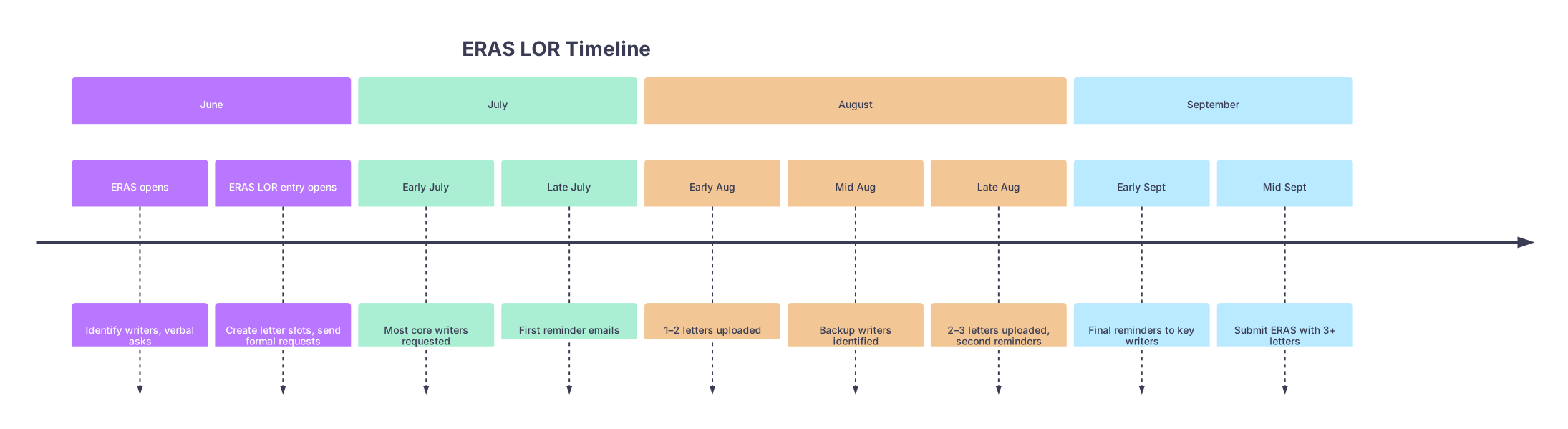
Visual Timeline: From ERAS Opening to Submission
Here’s roughly how the LOR part should unfold:
| Period | Event |
|---|---|
| June - ERAS opens | Identify writers, verbal asks |
| June - ERAS LOR entry opens | Create letter slots, send formal requests |
| July - Early July | Most core writers requested |
| July - Late July | First reminder emails |
| August - Early Aug | 1–2 letters uploaded |
| August - Mid Aug | Backup writers identified |
| August - Late Aug | 2–3 letters uploaded, second reminders |
| September - Early Sept | Final reminders to key writers |
| September - Mid Sept | Submit ERAS with 3+ letters |
Quick Comparison: Good vs Bad LOR Timing Behavior
| Behavior | Strategic | Self-Sabotaging |
|---|---|---|
| Ask timing | Verbal ask at rotation end + formal ERAS request in June/July | First email in early September |
| Deadlines | Gives specific upload date 1–2 weeks pre-submission | “Whenever you have time” |
| Follow-up | 2–3 polite reminders, spaced | Daily emails in final week or none at all |
| Backups | Identifies alternate writer by August | Realizes they need backup after apps open |
Two Scheduling Mistakes Almost Everyone Makes
They don’t reverse-engineer from a fixed submission date.
You should know your target submission day as soon as ERAS opens, and all letter deadlines are set backward from that by 10–14 days.They treat all letters as equally urgent.
They’re not. Your strongest specialty letters get earliest deadlines and the most follow-up. Lower-value or “extra” letters can trickle in later without affecting your core application.
Final Tightening: How to Use the Last Week Before Submission
At this point you should:
- Verify in ERAS:
- Each program has exactly 3–4 letters assigned
- No obviously mis-matched letters (e.g., surgery-only letter going to Psych)
- Confirm:
- You have at least:
- 2 core specialty letters uploaded
- 1 additional strong general/research letter
- You have at least:
If not, your last week priorities are simple:
- One final, clear email to essential writers.
- Submission of ERAS on your chosen date, regardless of that last “nice-to-have” letter.
2–3 Things to Walk Away With
- Pick your submission date early and work backwards. Your LOR deadlines exist to protect that date, not the other way around.
- Secure 3 strong letters on time, not 5 mediocre ones late. Core specialty letters first, backups ready, and extras only if they don’t delay you.
- Use ERAS flexibility. Assign different letter combos to different programs and let late letters supplement, not control, your application timing.
That’s how you run LORs strategically—from ERAS opening to the moment you hit submit—without chaos running you.


