

It’s mid-October. ERAS is submitted, programs have your application, and interview invites are trickling in—or not. You’re staring at your Letters of Recommendation section and thinking:
- “Should I try to add that new letter from my Sub-I attending?”
- “Can I update a letter if my mentor forgot to mention my Step 2 score?”
- “Is it too late to ask, or will I look disorganized?”
This is the post-submission gray zone. At this point you’re not building your application from scratch anymore; you’re tuning it. Small changes. Strategic moves. And letters of recommendation are one of the few levers you still have.
Here’s the timeline of what to do, when to do it, and when to leave it alone.
Big Picture Timeline: When LOR Changes Still Matter
Let’s map the territory first.
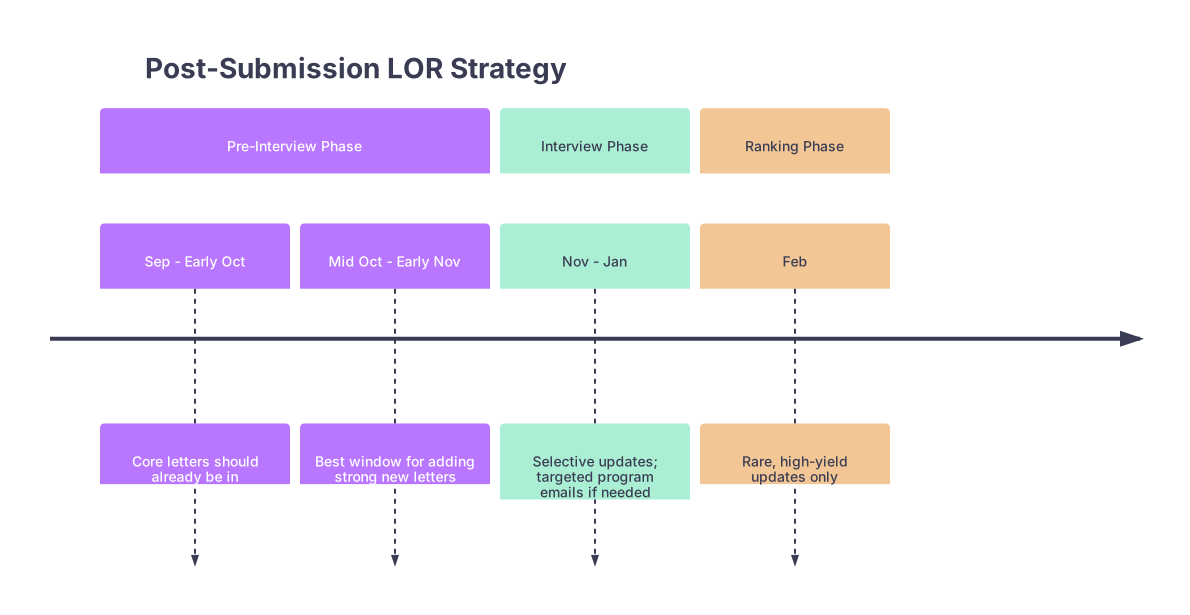
| Period | Event |
|---|---|
| Pre-Interview Phase - Sep - Early Oct | Core letters should already be in |
| Pre-Interview Phase - Mid Oct - Early Nov | Best window for adding strong new letters |
| Interview Phase - Nov - Jan | Selective updates; targeted program emails if needed |
| Ranking Phase - Feb | Rare, high-yield updates only |
At this point you should think in phases, not just dates.
Phase 1: Immediately after submission (Mid-Sep to early Oct)
- Expected: 3–4 letters already uploaded.
- Goal: Ensure your “core set” is complete and specialty-appropriate.
- You can still add letters that were pending when you submitted.
Phase 2: Early interview season (Mid-Oct to late Nov)
- Interview invites are actively going out.
- Strong new letters from Sub-I’s, away rotations, or newly completed experiences can still influence decisions at many programs.
Phase 3: Peak interview season (Dec to early Jan)
- Most interview decisions are made or close to it.
- Letters can still matter at some programs (especially if they review continuously), but impact is smaller.
Phase 4: Rank list season (Late Jan to Feb)
- Almost no one is changing interview decisions based on new letters.
- Rare exception: a huge, prestige-name letter or a major remediation narrative.
Now let’s walk through what you should be doing each step.
Before You Touch Anything: 30-Minute Reality Check
Before you start pinging letter writers or programs, do a quick structured review.
At this point you should:
Count your letters by type
- For most specialties:
- 3 letters is the floor.
- 4 solid, relevant letters is the sweet spot.
- Example for Internal Medicine:
- 2 IM faculty (ideally inpatient)
- 1 additional clinical (IM or related)
- Optional: 1 research or chief resident letter
- For most specialties:
Ask three blunt questions
- Do I have enough letters? (3–4 total)
- Do I have the right mix for my specialty?
- Is there a clear gap that a new or updated letter would fill?
-
- Are there letters you requested that still say “Not Received”?
- Did you forget to assign a letter to some programs? (happens more than people admit)
If you already have:
- 3–4 letters
- At least 2 from your chosen specialty
- No glaring weaknesses called out by advisors
…then your bar for “should I add or update a letter” should be pretty high. You’re not trying to impress the portal; you’re trying to impress actual humans with limited attention.
Phase 1 (Mid-Sep – Early Oct): Cleaning Up and Completing Your Core Set
This is the most forgiving window.
At this point you should:
Week-by-week priorities
Week 1 after submission
- Confirm every critical letter is uploaded:
- Core specialty letters
- Chair/PD letter if your specialty expects one (e.g., EM SLORs, some IM departments)
- If a crucial letter is missing:
- Send a short, polite reminder to the writer:
- Subject: “ERAS Letter of Recommendation – [Your Name]”
- Body: 3–4 lines max, remind them of the original ask and deadline.
- Send a short, polite reminder to the writer:
Week 2–3 after submission
- Assess late-breaking options:
- Sub-I just ended with a glowing evaluation?
- Research mentor now actually knows you well?
- If the new letter will clearly be stronger than your weakest existing letter, it’s worth adding.
Should you request an updated letter in this phase?
Usually no, unless:
- The letter writer submitted something before working closely with you (e.g., wrote it after one clinic day, now you did a full 4-week rotation with them).
- A major, time-sensitive change occurred:
- Big Step 2 CK jump that fixes a Step 1/2 concern (for specialties that still care).
- Significant professionalism remediation completed and documented.
Even then, I’d only ask for an update if:
- The writer already offered: “Let me know if you want me to update this after your Sub-I.”
- Or your advisor specifically says, “You should get an updated letter from Dr. X.”
Do not ask for an update just because:
- You added a line to your CV.
- You got a minor poster or abstract accepted.
- You’re simply anxious that your letters might be “not good enough.”
Phase 2 (Mid-Oct – Late Nov): Strategic Adds That Still Move the Needle
This is the sweet spot for high-yield new letters, not mass updating.
At this point you should:
Identify high-impact new letters
A new letter is worth pursuing in this window if:
It’s from:
- Your Sub-I attending who directly supervised you.
- A big-name faculty in your specialty with a solid national reputation.
- A research PI in your chosen field who’s known for writing detailed, supportive letters.
And it can:
- Replace a generic, weak, or non-specialty letter.
- Or fill a clear specialty gap (e.g., you applied EM with zero EM letters and now have one).
| New Letter Type | Impact Level |
|---|---|
| Sub-I attending in your specialty | High |
| Department chair in your specialty | High |
| Research PI in same specialty | Medium-High |
| Non-specialty preclinical faculty | Low |
| Short-term shadowing experience | Very Low |
How to request a new letter in this phase
When you’re asking for a brand-new letter after submission, your email should:
- Acknowledge timing.
- Explain why their perspective now matters.
- Be specific about deadlines.
Example skeleton:
Dear Dr. Smith,
I’m currently applying to Internal Medicine residency and submitted my ERAS application last month. After working closely with you on the inpatient service this October, I was hoping you might be willing to write a letter of recommendation reflecting my performance on this Sub-I.
I already have several letters, but I believe your evaluation of my clinical reasoning and work with complex patients would add an important perspective. If you’re comfortable supporting my application, I would be grateful to have the letter uploaded by [date ~2 weeks out], as programs are actively reviewing applications now.
I’m happy to provide my CV, ERAS personal statement, and any additional information that would be helpful.
Thank you for considering this,
[Name]
Notice what you’re not doing here:
- You’re not apologizing excessively for the timing.
- You’re not implying they’re rescuing a weak application.
- You’re not being vague about deadlines.
Should you tell programs about the new letter?
Usually no. Most programs will see the new letter automatically when they reopen your file. You are not emailing every program saying “I have a new letter!” That just clogs inboxes.
You consider notifying a program only if:
- You’re very interested in them.
- You do not yet have an interview.
- The new letter is genuinely high-impact (Sub-I there, rotation at their affiliate, or a national name in the specialty).
Even then, I’d limit this to a small handful of top-choice places.
Phase 3 (Dec – Early Jan): Interview Season and Selective Updates
By this point, the big letter moves are mostly over. Programs have:
- Pre-screened
- Sent most of their interview invites
- Started interviewing in earnest
At this point you should:
Stop chasing minor upgrades
Do not:
- Ask for “updates” that only add a line about a poster or elective.
- Keep nudging that flaky letter writer if you already have 3–4 good letters.
- Replace one average letter with another average letter.
Energy is better spent on:
- Interview prep
- Program research
- Thank-you notes and post-interview communication
When a late new letter is still worth it
A December or early January letter might still matter if:
It comes from:
- Your away rotation at a highly respected program.
- A department chair or PD in your specialty who knows you well.
And your situation is:
- You were weak on specialty letters before (e.g., had only 1, now you’ll have 2).
- You’re still getting interview invites rolling in (some programs are slower).
Again, you don’t broadcast every new upload. You use it mostly as quiet reinforcement—programs that are still reviewing may notice.
Phase 4 (Late Jan – Feb): Rank List Season and Last-Resort Updates
This is where people wildly overestimate the value of new letters.
By now:
- Most interviews are done.
- Programs are finalizing rank lists.
- Faculty who wrote your letters barely remember what month they uploaded them.
At this point you should:
Only consider an update if it’s truly substantial
You think about asking for a targeted updated letter only if:
Something significant and relevant changed:
- You completed a remediation or professionalism plan and crushed it.
- You had a major rotation that transformed a clear weakness (e.g., struggled on early IM; later IM Sub-I was outstanding and documented).
And you have:
- Direct feedback from a trusted advisor or PD that says “this could realistically move your rank at some programs.”
If that’s not you, do not mess with your letters this late. It won’t help, and it annoys people.
When to contact programs about updated letters in this phase
Extremely rare scenarios:
- You know (because they told you) that a program had reservations about X, and your new letter directly addresses X.
- Or you had a serious previous issue (leave, remediation) and a new letter from a PD or chair now strongly supports your readiness.
This is a 1:1 targeted email to specific programs, not a mass mail.
How to Balance ERAS Limits, Assignments, and Replacements
Quick sanity check on mechanics, because people mess this up:
- You can store more letters in ERAS than you assign to a program.
- You can assign up to 4 per program.
- You can change which letters are assigned to a program even after submission (as long as the program hasn’t passed its final review window—but most don’t lock you out).
At this point you should:
- Identify your top 3–4 letters overall.
- For each program:
- Ensure it has the best specialty-relevant mix.
- Replace weaker generic letters with stronger, more recent or specialty-specific ones.
You don’t need to notify a program every time you swap assignments. They’ll see what’s there when they look.
Exactly When to Ask for an Updated Letter (vs New vs Nothing)
Here’s the blunt framework I use with my own students:
| Situation | Action |
|---|---|
| Missing core specialty letter | Request new ASAP |
| Weak generic letter, strong new Sub-I letter | Add & reassign |
| Strong existing letters, minor CV changes | Do nothing |
| Serious concern now clearly improved | Consider update |
| Already 4 strong letters, no major changes | Do nothing |
If you’re not sure whether a letter is weak:
- Ask an advisor or PD who knows your performance and your institution’s letter culture.
- Red flags I’ve actually seen:
- “Worked adequately” instead of “worked hard.”
- Vague 3-sentence letters.
- Obvious generic template with your name swapped in.
Generic but positive is not ideal, but it’s not worth a post-submission panic campaign either if the rest of your app is solid.
Day-by-Day Plan If You Decide You Do Need LOR Changes
Let’s say you’ve gone through all this and decided either:
- You need a new letter, or
- You need one key updated letter.
Here’s a tight 7-day micro-plan.
Day 1–2: Clarify the ask
- Decide:
- New letter vs updated letter.
- Exactly which programs will get it.
- Draft:
- Your email ask.
- A short bullet list of the things you hope they’ll emphasize (clinical reasoning, teamwork, patient ownership, etc.).
Day 3: Send the request
- Email your chosen writer(s).
- Include:
- Your CV
- Personal statement
- ERAS ID
- Clear deadline (10–14 days is reasonable)
- Log it in a simple spreadsheet:
- Writer, date requested, date needed, status.
Day 4–5: Fix your side of the portal
- Double-check ERAS:
- Request code generated properly.
- Correct specialty selected if relevant (e.g., EM SLOE vs non-standard letter).
- Review letter assignments to:
- Your top 10–15 programs.
- Any program where you’re hoping a better letter might tip you to an interview.
Day 6–7: Gentle follow-up (if needed)
- If writer hasn’t acknowledged:
- One polite follow-up.
- Then stop. Pestering burns bridges and doesn’t speed much up.
Once the letter is in:
- Reassign for key programs if it’s replacing something.
- Then leave it alone.
Two Things Applicants Get Wrong About Post-Submission LORs
Let me be direct about the two biggest mistakes I see every year.
Treating letters like trading cards
- Collecting as many as possible.
- Constantly swapping them out.
- Emailing programs about every minor addition.
- Reality: 3–4 strong, appropriate letters > 6 mediocre ones plus chaos.
Believing late letters will rescue a fundamentally weak app
- Low scores, poor clerkship comments, thin experience—no letter, even from a famous name, will erase that.
- Strong letters can help you punch slightly above your stats.
- They cannot reinvent your application in December.
Use letters to refine, not to save.
FAQ (Exactly 3 Questions)
1. Can I ask a letter writer to completely rewrite a letter they already submitted?
You can ask for an updated letter if your relationship and performance with them significantly changed (e.g., you did a full Sub-I after an early clinic interaction). But you don’t get to “edit” their letter or request a total rewrite just because you’re nervous. Frame it as: “If you feel you can now comment more fully on my performance after X rotation, I’d be grateful for an updated letter,” and give them an easy out.
2. Should I tell programs directly when a new letter is uploaded?
Usually no. Most programs don’t want a flood of FYI emails every time someone’s ERAS changes. The exceptions: a small number of top-choice programs where a truly high-impact, specialty-specific letter was just added and you don’t yet have an interview. Even then, keep it to a brief note and don’t expect miracles.
3. Is it bad if one of my letters arrived late, after some programs already reviewed my file?
Not ideal, but not catastrophic. Some programs do rolling reviews and might see the updated letter on a second look; others won’t. You don’t fix this by spamming updates. You accept that timing isn’t perfect and you focus on the things you still control: your interview performance, your communication with programs, and building a realistic rank list.
Key takeaways:
- By the time ERAS is submitted, letters are mostly about refinement, not reinvention.
- New or updated letters are only worth the hassle if they’re clearly stronger and specialty-relevant.
- Past mid-November, be extremely selective—focus on interviews and ranking rather than micromanaging LORs.


