

The biggest reason strong applicants get burned in ERAS isn’t their scores. It’s sloppy, late, or generic letters of recommendation.
If you’re three months from ERAS opening, you’re in the danger zone. At this point you should not be “thinking about” letters. You should be running a tight, almost project-managed LOR operation.
I’m going to walk you week-by-week from three months out to ERAS submission, so you know exactly what to do when. No vague “ask early, ask nicely” fluff. A real countdown.
Big Picture: Three-Month LOR Timeline
At three months before ERAS opens, your goals are simple:
- Identify the right letter writers.
- Secure firm commitments.
- Provide what they need to write strong, specific letters.
- Track and chase completion before everyone panics in August/September.
Here’s the high-level breakdown:
| Timeframe | Primary Focus |
|---|---|
| 12–9 weeks before ERAS | Strategy + asks + backups |
| 8–5 weeks before ERAS | Materials + reminders |
| 4–2 weeks before ERAS | Confirmations + fixing gaps |
| Final 2 weeks before ERAS | Upload check + emergencies |
Now we go granular.
Month 1 (12–9 Weeks Before ERAS): Strategy and The Ask
At this point you should be done “wondering who” and start locking people in.
Week 12: Decide Letter Strategy and Targets
You’re three months out. You need a clear LOR map this week.
Most programs expect:
- 3–4 letters total
- Majority from your chosen specialty (often 2–3)
- At least one from a recent core or sub-I where you performed well
- Ideally one from a program director or chair (depending on specialty norms)
This week, you should:
Clarify requirements for your specialty.
- Check a few representative programs in your target specialty and region.
- Note:
- Total letters allowed vs recommended (e.g., 3 vs “we accept up to 4”).
- Any required chair/PD letters.
- Any “must be from an academic setting” rules.
Make a concrete LOR plan on paper.
- Target: 4 strong letters total.
- Structure something like:
- Letter 1: Sub-I attending in your desired specialty.
- Letter 2: Another specialty attending from a high-intensity rotation.
- Letter 3: Program Director/Chair letter (if expected in your field).
- Letter 4: Research mentor (only if they know you very well).
Prioritize writers by strength, not title alone. Better:
- A mid-level associate professor who watched you grind on a tough service and can say, “I trusted them with the sickest patients”
Than: - A nationally famous name who barely remembers you.
- A mid-level associate professor who watched you grind on a tough service and can say, “I trusted them with the sickest patients”
If you’re not sure they remember you? That’s fine. Next week is about testing that.
Week 11: Quiet Recon and Relationship Refresh
Before you formally ask, you warm up. At this point you should be reminding people who you are and checking if they’re good fits.
- Email or stop by for short check-ins with likely letter writers:
- Subject line: “Quick update and residency prep”
- In person or via Zoom if possible.
Sample email opener (keep it short):
Dear Dr. Smith,
I hope you’ve been well. I’m starting to prepare for this year’s ERAS season for [Specialty], and I’d really appreciate a quick 10–15 minute meeting to update you on my plans and get your advice.
Best,
[Name]
In the meeting, do two things:
- Give a crisp update: what specialty, why, what you’ve done since rotation.
- Watch their reaction:
- Do they remember cases with you?
- Do they give specific positive feedback?
- Do they seem genuinely pleased you’re going into their field?
Use this week to decide who not to ask.
- Red flags:
- “Remind me… what block was that?” and they still can’t place you.
- lukewarm or vague praise.
- They mention being “really swamped this year” multiple times.
- Red flags:
Anyone who seems lukewarm? Move them to “backup at best.”
Week 10: Make the Formal Asks
This is the “do not procrastinate” week. At this point you should be asking—not planning to ask.
Your goal: By the end of this week, you have verbal or written “yes” from at least 3, preferably 4, writers.
How to Ask (and What to Say)
Ask in person or via Zoom if possible. Second-best is email. Do not just casually mention it in the hallway and call that “asking.”
Key script:
“I really valued working with you on [rotation/block]. I’m applying to [Specialty] this year and was wondering if you’d feel comfortable writing a strong letter of recommendation on my behalf?”
That word “strong” is not optional. It gives them an out if they can’t.
If they hesitate, waffle, or say something like “I can write a letter” without “strong” anywhere around? Thank them and don’t use it.
What You Collect When They Say Yes
Right after they agree, you say:
“Thank you, I really appreciate it. I’ll send you:
- My CV
- A short summary of my experiences and goals in [Specialty]
- A reminder of specific cases we worked on together
- My ERAS ID and deadlines once the system opens.”
You’re not sending it all this second. But you’re signaling: I’ll make this easy for you.
Week 9: Lock Backups and Build Your LOR Spreadsheet
At this point you should have:
- 3–4 primary “yes” writers.
- 1–2 backups in mind (even if you haven’t asked them yet).
This week, you:
Confirm number and type of letters with your advisor or PD.
- “For [Specialty] at my level, is 3 vs 4 letters better?”
- “Should I prioritize a chair letter or a second sub-I attending?”
Build your LOR tracking sheet. This can be a simple spreadsheet with:
- Writer name
- Role (Sub-I attending, PD, research mentor)
- Specialty
- Date asked
- Response (Yes/No/Possible)
- Date you sent materials
- Target completion date
- Actual upload date (you’ll fill this later)
- Notes (they’re on vacation in August, want a draft, etc.)
Decide your internal deadlines. Do not use the real ERAS date as your personal deadline. You’re not a program. You’re one person. You can’t afford chaos.
- Internal LOR completion deadline: 2–3 weeks before ERAS submission date.
To visualize how your effort should ramp up over time:
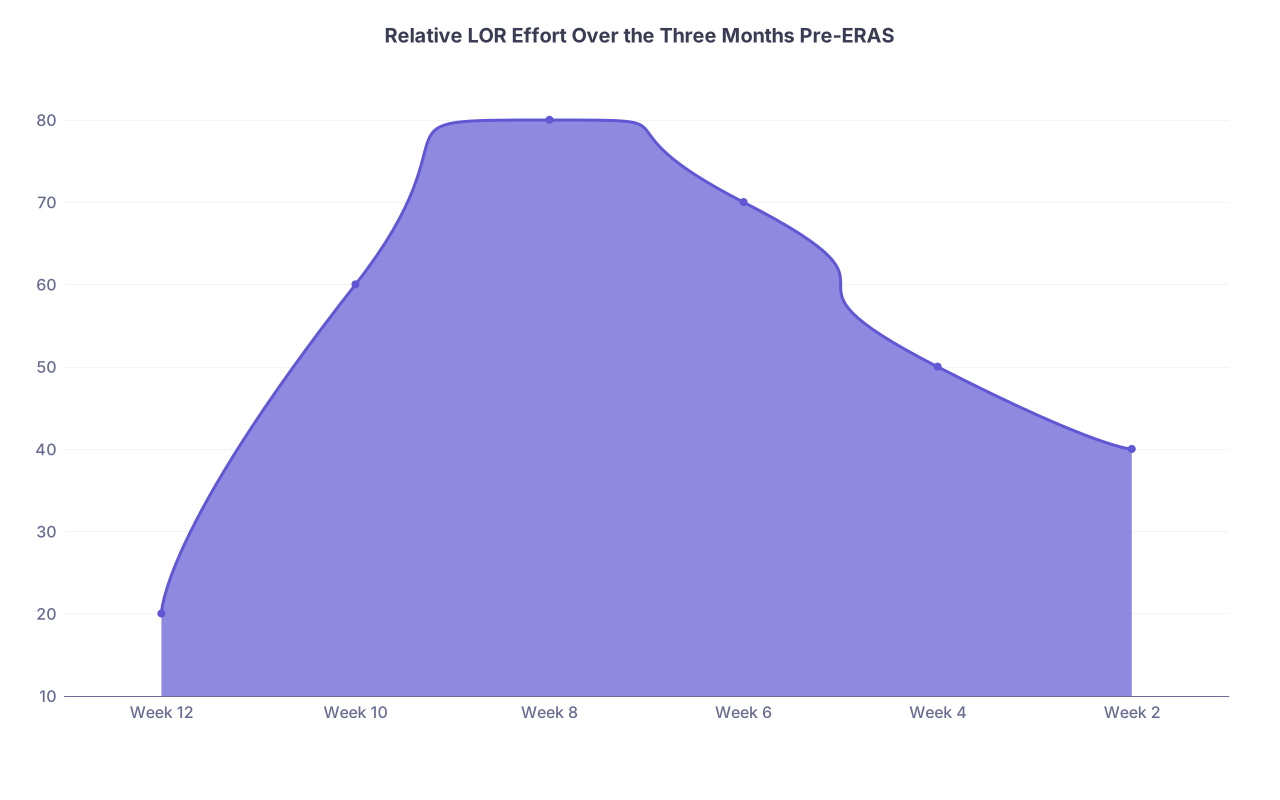
| Category | Value |
|---|---|
| Week 12 | 20 |
| Week 10 | 60 |
| Week 8 | 80 |
| Week 6 | 70 |
| Week 4 | 50 |
| Week 2 | 40 |
Month 2 (8–5 Weeks Before ERAS): Materials, Details, and Gentle Pressure
Now the ERAS clock feels real. Letter writers are getting hit from every direction. At this point you should be making their job so easy they almost feel guilty not finishing your letter early.
Week 8: Prepare LOR Packets for Each Writer
You’re not sending yet, you’re building.
For each writer, draft a concise, tailored packet. One document (PDF or Word) is fine; include:
Cover page summary (1 page max):
- Your name, email, phone, ERAS ID (if you have it yet; if not, leave a placeholder).
- Specialty: “Applying to: Internal Medicine, Academic-focused programs”
- Target program types: “University-based programs in Northeast / Midwest.”
- One short paragraph: your story into that specialty.
Bullet highlights relevant to that specific writer:
- For a sub-I attending: 5–7 bullets of things they actually saw:
- “Managed 8–10 patients daily on the wards.”
- “Took the lead on family meetings for complex discharge cases.”
- “Intern-level call performance on night float.”
- For a research mentor:
- Projects, your role, outcomes (posters, manuscripts, QI outcomes).
- For a sub-I attending: 5–7 bullets of things they actually saw:
Your CV. Clean, up to date, no obvious errors. If your CV is a mess, you fix it now, not in September.
Draft personal statement or at least a solid outline. It doesn’t have to be perfect, but they should see:
- Why this specialty
- What kind of resident you want to be
- Any big themes (academic career, rural practice, etc.)
You can re-use 70–80% of the packet across writers, but those bullet points must be customized.
Week 7: Send Materials and Set Clear Deadlines
This is the “materials go out” week. At this point you should have sent every committed writer:
- Your packet
- A clear deadline
- A reminder of how ERAS works
Sample email:
Dear Dr. Smith,
Thank you again for agreeing to write a strong letter of recommendation for my residency applications in [Specialty]. I’ve attached a brief packet with:
- My updated CV
- A one-page summary of my goals in [Specialty]
- Specific rotations and cases we worked on together that were especially meaningful to me
ERAS opens for application submission on [date]. To give you plenty of time and to make sure everything is uploaded smoothly, I’m aiming to have all of my letters in by [internal deadline 2–3 weeks before ERAS submission].
Once ERAS opens for letter entry, I’ll send the official request through the system with your name and email.
Thank you again for your support—please let me know if I can provide anything else that would be helpful.
Best,
[Name]
Notice: You gave a target date that is earlier than the actual chaos.
Week 6: Confirm They Received Everything and Address Questions
This week you’re doing quiet damage control.
At this point you should:
Check your email tracking sheet. For each writer:
- Did they receive your packet?
- Did they reply at least once after the initial “yes”?
Send short confirmation notes if you haven’t heard back:
Dear Dr. Smith,
I just wanted to confirm you received my ERAS letter packet from last week. No rush at all—just making sure it didn’t get lost in your inbox.Thanks again for your support,
[Name]Clarify any logistics questions. Common issues:
- “Do I upload directly, or send it to you?”
Answer: Direct upload through ERAS, never to you. - “Do I need to address it to specific programs?”
Answer: Usually “To the Program Director” is fine unless a program states otherwise.
- “Do I upload directly, or send it to you?”
If someone sounds confused or overwhelmed, offer:
“I’m happy to send step-by-step instructions for the ERAS LOR portal once it opens.”
You’re the project manager here. Own that role.
Week 5: Identify Weak Links and Activate Backup Plans
At this point you should know which writers are solid and which are risky.
Ask yourself:
- Has anyone gone radio silent for more than 3–4 weeks?
- Did anyone mention long travel, sabbaticals, or being away during August?
- Does any writer seem likely to send something at the last minute—or not at all?
If so, this is the week you:
Quietly approach 1–2 backup attendings.
- Especially those with more recent contact:
- Recent elective
- Another sub-I
- Another strong evaluator from your core specialty
- Especially those with more recent contact:
Ask directly and honestly:
“I have a few letters already, but given how busy everyone is around ERAS season, I’d really appreciate having another strong letter from someone who’s worked with me more recently. Would you feel comfortable writing one?”
Do not over-collect. ERAS has letter limits; 4 is plenty for almost everyone. But having a fifth writer in case one fails to upload? Completely reasonable.
Month 3 (4 Weeks to ERAS): Execution, Uploads, and Firefighting
This is where people get burned. Letters that “are done” suddenly… aren’t. Someone’s assistant is out. Portals glitch. You’re going to avoid that.
Week 4: ERAS Opens – Send Official LOR Requests
Once ERAS allows you to enter letter writers, you move fast. At this point you should:
Enter every letter writer into ERAS within a few days of opening.
- Names, titles, accurate email addresses.
- Designate each letter with a clear description (e.g., “Internal Medicine – Subinternship, Dr. Smith”).
Assign letters to your specialty programs logically.
- Most of your letters can go to all programs.
- If you have a research-heavy letter, maybe you only assign it to academic programs or those with strong research emphasis.
Email each writer the moment you send the ERAS request:
Dear Dr. Smith,
I’ve just sent the official ERAS letter of recommendation request to your email. The system should allow you to upload the letter directly.My goal is to have all letters uploaded by [internal deadline], ahead of when I plan to certify and submit my application.
Please let me know if you run into any trouble with the portal—I'm happy to track down instructions or contact my school if needed.
Thank you again,
[Name]Update your tracking sheet with:
- “ERAS request sent” date
- Any replies
Week 3: Status Check and First Real Reminder
At this point you should have at least 1–2 letters already uploaded or with clear confirmation they’re nearly done.
Actions this week:
Log in to ERAS and check LOR status.
- Which letters:
- Requested but not uploaded
- Uploaded and complete
- Which letters:
Send polite but direct reminders to those not yet uploaded.
Example:
Dear Dr. Smith,
I hope your week is going well. I just wanted to check in about the letter of recommendation I requested through ERAS. I’m planning to finalize and submit my application on [date], and I’m hoping to have all of my letters in by [internal deadline].If there’s anything I can do to make the process smoother (re-send the link, send portal instructions, etc.), I’m happy to.
Thank you again for your time and support,
[Name]If a writer hasn’t even acknowledged multiple emails by now, mentally treat that letter as unreliable and move your backup writer from “possible” to “must-get.”
Week 2: Hard Deadline Push and Emergency Planning
This is the most stressful week for a lot of people. It doesn’t have to be for you if you’ve followed the timeline, but you still need to be assertive.
At this point you should:
Have at least 3 letters uploaded. If you don’t, you’re in red-alert territory.
Send more direct, respectful reminders to missing letters.
Dear Dr. Smith,
I wanted to follow up once more about my ERAS letter of recommendation. I’m planning to submit my application on [date], and programs will begin downloading applications soon after.If you’re still able to complete the letter, having it uploaded by [specific date this week] would be incredibly helpful. If your schedule has changed and you’re no longer able to write it, I completely understand—please just let me know so I can adjust my plans.
Thank you again,
[Name]-
- If it’s clear a writer won’t come through:
- Email your backup attending immediately.
- Be honest: “One of my previously confirmed letters may not be able to be completed in time; would you still be able to write one if I send you materials today?”
- If it’s clear a writer won’t come through:
Decide your non-negotiable minimum.
- You need at least 3 letters for a credible ERAS app to most specialties.
- If that means swapping a weaker but reliable writer for an MIA big name, do it.
Final Week Before Submission: Last Checks and Lock-In
You’re almost at ERAS submission. At this point you should be verifying, not improvising.
5–7 Days Before Submission
Log in to ERAS and confirm:
- All expected letters are uploaded and showing as “Received.”
- Each letter is assigned correctly to the right programs.
- No writer is duplicated under slightly different names (this happens).
Make final assignment decisions.
- If you have 5 letters uploaded, decide which 3–4 each program will see.
- For community programs:
- Prioritize clinical letters from people who saw your work ethic and reliability.
- For big academic programs:
- PD/chair + strong sub-I letters + possibly research.
Don’t tinker endlessly. Over-optimizing which letter goes to which program usually adds more stress than benefit. Strong, coherent set of 3–4 > clever micro-customization.
2–3 Days Before Submission
Final sanity check with your advisor or dean.
- Show them:
- Your list of writers
- Letter types (sub-I, PD, research)
- Which programs get which combinations
- Show them:
Do a quick gratitude pass.
- Prepare a simple thank-you email template you’ll send after submission.
- If you’re not completely under water, hand-written notes later are a nice touch. But not required.
Post-Submission: Don’t Disappear on Your Writers
After ERAS is in and letters are all uploaded, your job is not totally done.
- Send a short thank-you email within a week of submitting.
- When interviews or Match results come in, update your writers. They like to know their effort mattered.
- These people will help you again—for fellowships, jobs, future positions—if you treat them like long-term colleagues, not one-time vending machines.
One-Page Timeline Snapshot (3 Months → ERAS)
To tie it all together:
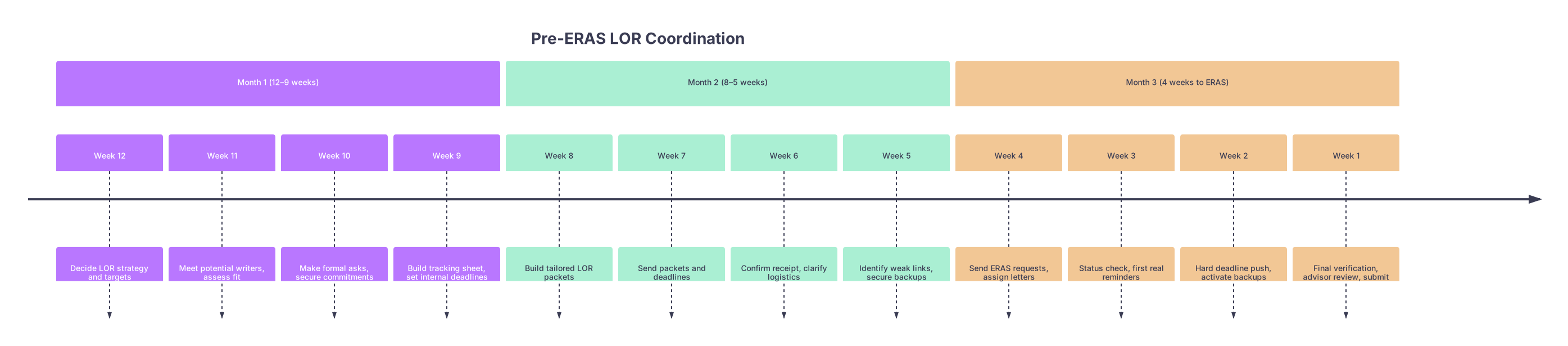
| Period | Event |
|---|---|
| Month 1 (12–9 weeks) - Week 12 | Decide LOR strategy and targets |
| Month 1 (12–9 weeks) - Week 11 | Meet potential writers, assess fit |
| Month 1 (12–9 weeks) - Week 10 | Make formal asks, secure commitments |
| Month 1 (12–9 weeks) - Week 9 | Build tracking sheet, set internal deadlines |
| Month 2 (8–5 weeks) - Week 8 | Build tailored LOR packets |
| Month 2 (8–5 weeks) - Week 7 | Send packets and deadlines |
| Month 2 (8–5 weeks) - Week 6 | Confirm receipt, clarify logistics |
| Month 2 (8–5 weeks) - Week 5 | Identify weak links, secure backups |
| Month 3 (4 weeks to ERAS) - Week 4 | Send ERAS requests, assign letters |
| Month 3 (4 weeks to ERAS) - Week 3 | Status check, first real reminders |
| Month 3 (4 weeks to ERAS) - Week 2 | Hard deadline push, activate backups |
| Month 3 (4 weeks to ERAS) - Week 1 | Final verification, advisor review, submit |
Strip It Down: What Actually Matters
If you remember nothing else from this three-month countdown:
- Ask early, and ask for a strong letter explicitly. Weak or late letters hurt more than no letter.
- Run LORs like a project, not an afterthought. Tracking sheet, internal deadlines, backups. You’re managing busy attendings’ chaos.
- Make it stupidly easy for writers to help you. Tailored packets, clear deadlines, polite reminders, and follow-through.
Do those three things on the timeline above, and your letters won’t be the reason you lose spots in the Match.


