
The fastest way to irritate residency programs during interview season is to spam them with “updated” letters of recommendation.
You need to be strategic. And you need to be on a timeline.
Below is a concrete, time‑based guide to when you can safely send new LORs, when you should, and when it becomes annoying or risky.
Big Picture: The Calendar You Are Actually Operating On
Let me anchor you in the real cycle first. Programs make decisions on a clock. Your letters need to fit that clock, not your anxiety.
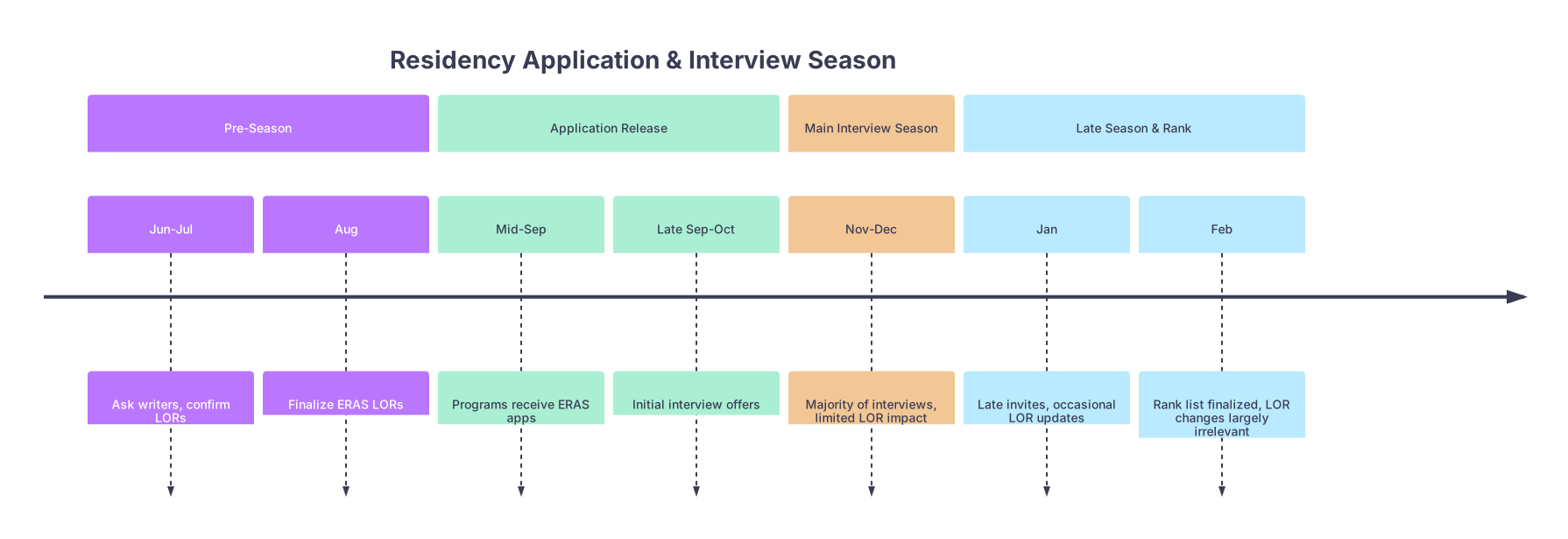
| Period | Event |
|---|---|
| Pre-Season - Jun-Jul | Ask writers, confirm LORs |
| Pre-Season - Aug | Finalize ERAS LORs |
| Application Release - Mid-Sep | Programs receive ERAS apps |
| Application Release - Late Sep-Oct | Initial interview offers |
| Main Interview Season - Nov-Dec | Majority of interviews, limited LOR impact |
| Late Season & Rank - Jan | Late invites, occasional LOR updates |
| Late Season & Rank - Feb | Rank list finalized, LOR changes largely irrelevant |
Broad rules before we zoom into month‑by‑month:
Before ERAS submission (June–September):
- Add as many strong, specialty‑relevant letters as you can. Safely. No program is annoyed by this.
First wave review (late September–October):
- New letters can matter for programs that have not screened you yet.
- For programs that already invited or rejected you, the impact is low.
Main interview season (November–December):
- New letters almost never change invitations.
- They sometimes influence ranking at places where you already interviewed.
Rank list phase (January–February):
- New letters are nearly worthless.
- Exceptions: late switch of specialty, major new performance, or a PD‑to‑PD email.
Now let us walk through the timeline in detail.
June–Early September: Pre‑ERAS – Build the LOR Arsenal
At this point you should be collecting and finalizing letters, not “updating” anything.
June: Decide What Letters You Actually Need
You should:
- Decide on your primary specialty and any backups (e.g., IM + prelim surgery).
- Map letters required:
- 3–4 in your chosen specialty (e.g., IM: 2–3 IM faculty, 1 subspecialist is fine).
- 1–2 from other fields if needed (sub‑I, research PI, or meaningful longitudinal mentor).
- Identify “must‑have” writers:
- Clerkship director
- Sub‑I attending
- Program director (if they know you well enough)
- Research mentor who can comment on your work ethic and reliability
At this stage, sending anything to programs is pointless. Your only job is to get letters into ERAS.
July: Ask and Lock In Writers
At this point you should:
- Ask explicitly for strong letters:
- “Would you feel comfortable writing me a strong letter of recommendation for internal medicine residency?”
- Give each writer:
- Your CV
- Personal statement draft
- ERAS experiences list
- A short paragraph reminding them of specific patients/projects you worked on together
Timing strategy:
- Ask for letters in July.
This gives writers 4–8 weeks. They are busy. You are not their only applicant.
When to think about “future” updates:
- If you are starting a sub‑I in August with a high‑profile attending, plan for that letter to replace a weaker generic one later.
- Do not promise programs that an “amazing upcoming letter” is coming. No one wants that email.
August–Early September: Finalize Before ERAS Submission
By now you should:
- Have at least 3 letters assigned to your main specialty in ERAS.
- Preferably 4, so you can mix and match per program.
Key point:
- Once ERAS opens for editing but before programs see applications, you can:
- Add new letters
- Reassign which letters go to which programs
- Quietly improve your application without annoying anyone
You should not be sending programs separate emails or PDFs. Everything goes through ERAS.
Mid‑September: Application Release – The Last “Quiet Update” Window
ERAS typically releases applications to programs around mid‑September.
Critical nuance:
- Programs do not read all ERAS files on day one. Many are staggered.
- That means a late‑September letter may still be in time for first‑pass review at many places.
At this point you should:
- Ensure all ready letters are:
- Uploaded by writers
- Assigned to the correct programs
- If a writer is delayed but confirmed:
- Let it upload when it is ready
- Assign it immediately in ERAS
- No need to email programs unless:
- It is a very high‑impact letter (PD, chair, nationally known name), and
- The program clearly lists they review updates
What is “safe” now?
- Safe and useful: Adding a new, strong specialty‑specific letter in ERAS and assigning it.
- Unnecessary: Emailing programs just to say: “I have added another letter to ERAS.”
- Annoying: Asking programs if they will re‑review your file because a new letter appears.
Late September–October: First Wave of Interview Offers
This is the period where everyone panics about letters. Here is what actually happens.
Programs typically:
- Run an initial screen with:
- Board scores
- MSPE / transcript
- Core letters (often just 2–3, not all 4)
- School reputation, research, red flags
By the end of October, many programs have:
- Invited 60–80% of the candidates they will ever invite.
- Soft‑rejected a chunk of the pool without formally rejecting them.
At this point you should ask three questions for each potential new letter:
Is this letter significantly better or different than what I already have?
- New sub‑I letter saying “top 5% of students I have worked with” → strong yes.
- Generic “good team player” letter from another undistinguished attending → weak.
Will it realistically be uploaded by early–mid October?
- If the letter will not appear until November, its impact on interview invitations is minimal.
Is it from someone whose name or role carries real weight?
- Program director, department chair, division chief, big‑name researcher in that field.
If the answer is yes to 1 and 2 (and ideally 3), you can safely:
- Have the writer upload the new letter to ERAS.
- Assign it to programs quietly.
- Skip sending blast emails.
When is it reasonable to notify a program?
- You are on their waitlist / hold (they told you explicitly).
- It is a top‑choice program for you.
- The new letter is:
- From a PD or chair, or
- From a sub‑I where you crushed it, and
- Uploaded by early October.
Then a short, focused email is acceptable:
Subject: Application Update – New Letter of Recommendation
Dear Dr. X / Residency Selection Committee,
I remain very interested in [Program Name]. Since my application was submitted, I have completed a sub-internship in [specialty] with [Dr. Y, Title], who has now uploaded a letter of recommendation to ERAS on my behalf.
Thank you for your consideration.
Sincerely,
[Name, AAMC ID]
Do not attach the letter. Do not ask them to confirm receipt.
November–December: Main Interview Season – LORs as Rank Boosters, Not Invite Triggers
By November, most of the interview calendar is already in motion. The role of new letters changes.
Reality:
- Invites: Mostly decided.
- Ranking / internal advocacy: Ongoing at programs where you interview.
At this point you should treat new LORs differently depending on your situation.
Scenario 1: You Already Have Interviews Lined Up
For programs you are already interviewing with:
- A strong new letter can:
- Slightly improve how they view you on their rank list.
- Give interviewers new talking points.
- It will almost never:
- Create a new interview slot out of thin air.
- Transform you from backup list to invite at a fully booked program.
Safe approach:
- Have the new letter uploaded to ERAS. Assign to all programs in that specialty.
- Do not email every program about it.
- One exception: If you have a huge name letter (department chair, national figure) that uploads close to an interview date, you can mention it briefly in a pre‑interview communication:
“A brief note: A new letter from [Dr. Famous Chair] was recently uploaded to ERAS after the conclusion of my sub-internship at [Institution]. I look forward to discussing the experience during my interview.”
Short. No attachment.
Scenario 2: You Are Short on Interviews
This is where people are tempted to carpet‑bomb programs with updates. That usually backfires.
At this point you should:
- Prioritize realistic targets:
- Your home program
- Away rotation sites where you worked
- Programs where you have geographic ties
- Ask yourself:
- “Is this letter from someone this program actually knows or respects?”
When to send an update email:
- The new letter is from:
- A PD, chair, or core faculty at that same institution, or
- A PD/chair at a peer or better‑known institution in the same region/specialty.
- You have not been formally rejected.
- You are willing to accept that it may change nothing.
Content of your email should:
- Be under 150 words.
- Mention:
- Your continued strong interest.
- The new letter by name.
- One concrete reason you fit their program (ties, clinical fit, research focus).
And then stop. No repeated follow‑up.
January: Late Interview Opportunities and Strategic Updates
By January:
- Some programs still scramble to fill late cancellations.
- Some are doing second‑look‑style assessments.
- Rank list discussions are starting.
At this point, new LORs have niche but targeted value.
You should consider sending LOR updates only in these cases:
You changed or crystallized specialty focus late.
- Example: You applied broadly in IM but recently completed a Cards‑heavy sub‑I and now are clearly IM‑focused with a high‑impact letter.
- Programs that were on the fence may take a second look.
You had a major performance turnaround or remediation success.
- A PD letter after successful remediation of a professionalism or academic issue can reassure programs.
- This absolutely justifies a short update to programs aware of the concern.
You have a very strong institutional advocate.
- E.g., Your PD emails another PD directly and attaches a letter.
- That carries far more weight than you sending “an updated letter” yourself.
What is safe:
- Uploading the new letter to ERAS and assigning to programs.
- A targeted update email to a small list of programs (5–10), not 40+.
What is no longer useful:
- Sending minor, generic letters from people who barely know you.
- Emailing programs you never had any meaningful link to, asking them to review your “updated file.”
February: Rank List Finalization – Stop Chasing Letters
By February, for 95% of programs:
- Rank lists are finalized or nearly finalized.
- New letters are background noise.
At this point you should:
- Stop trying to add new LORs for the current cycle.
- Focus on:
- Thank‑you notes (if you send them).
- Clarifying genuine preference in a respectful way (without “I will rank you #1” spam to multiple places).
- Mental health and planning for SOAP as a backup.
New LORs might still matter if:
- You think you may enter the next cycle (SOAP or reapply). In that case:
- Use late sub‑Is and rotations to collect powerful letters for the future, not to patch a nearly completed process.
Safe vs Risky LOR Updates by Time and Type
Here is a quick snapshot to keep the timeline straight.
| Period | Safe & Helpful Use | Usually Useless or Risky |
|---|---|---|
| Jun–Early Sep | Adding strong core letters via ERAS | Emailing programs about pending letters |
| Mid–Sep–Oct | New sub-I / PD letters quietly assigned | Mass emails asking for re-review |
| Nov–Dec | Quiet uploads; rare targeted rank updates | Expecting new invites from minor letters |
| Jan | Targeted updates for big changes/advocacy | Generic letters from peripheral attendings |
| Feb | Prep for future cycles, not current one | Any “new LOR” emails for this Match |
Letter Types: Which Are Worth Sending Late?
Not all letters are created equal. Timing matters, but so does who is writing.
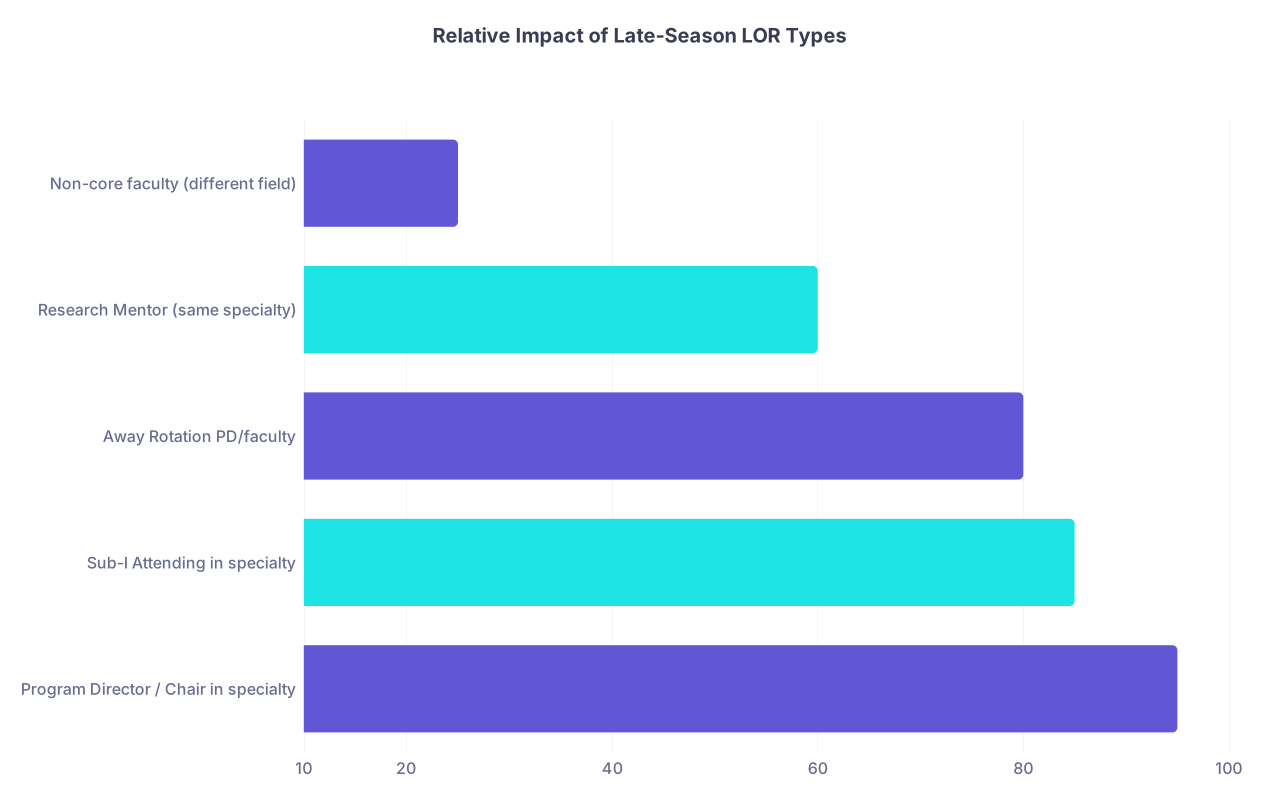
| Category | Value |
|---|---|
| Program Director / Chair in specialty | 95 |
| Sub-I Attending in specialty | 85 |
| Away Rotation PD/faculty | 80 |
| Research Mentor (same specialty) | 60 |
| Non-core faculty (different field) | 25 |
Rough hierarchy for late‑season usefulness (November onward):
Program Director / Department Chair in the specialty
- Especially if they know other PDs.
- Those letters can still matter in November–January.
Sub‑I or acting internship attending in the specialty
- Detailed, comparative, “top X%” language is powerful.
- Useful through October, sometimes November.
Away rotation faculty or PD
- Signals performance outside your home environment.
- Good for programs in the same region or academic tier.
Research mentor in the same specialty
- Helps more for academic programs and research‑heavy candidates.
- Less persuasive for pure community programs.
Random non‑core faculty letter (different field, limited contact)
- Almost never worth a late‑season push.
Day‑By‑Day Logic When a New Letter Appears
Let me walk you through what you should do the day a new letter hits ERAS, depending on the date.
If It Appears in Late September
At this point you should:
- Assign it immediately to:
- All programs in that specialty.
- Make no announcements.
- If it is a PD/chair letter and the program is a top choice:
- Consider a short, single email as described earlier.
If It Appears in Late October
At this point you should:
- Assign it to all programs.
- Identify:
- Programs where you are on “hold” or “alternate list” (if known).
- Your absolute top 5–7 programs without invites.
- For those programs only:
- Consider 1 update email tying the new letter to your continued interest.
If It Appears in Late November or December
At this point you should:
- Assign it to:
- All programs still pending.
- All programs where you already interviewed.
- Do not expect new interviews from it.
- For programs where you interviewed and felt a strong fit:
- Optionally reference the new letter in a brief post‑interview thank‑you or interest email.
If It Appears in January
At this point you should:
- Assign it to programs for completeness and for future cycles.
- Limit update emails to:
- Programs where there is a meaningful relationship, or
- A major change being clarified (e.g., remediation completed, new PD advocacy).
Visual: How LOR Impact Drops Over Time
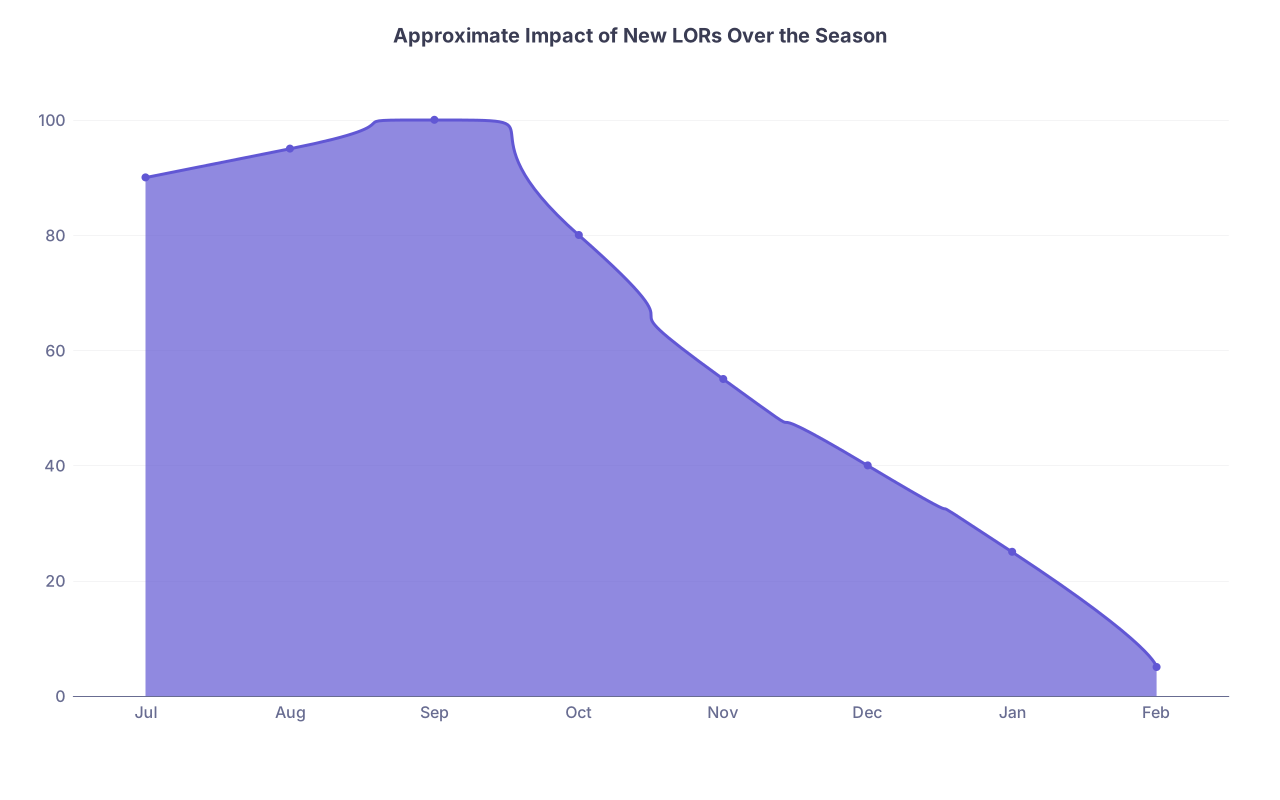
| Category | Value |
|---|---|
| Jul | 90 |
| Aug | 95 |
| Sep | 100 |
| Oct | 80 |
| Nov | 55 |
| Dec | 40 |
| Jan | 25 |
| Feb | 5 |
You see the trend:
- Peak value: Before and at application release.
- Good value: Through October.
- Diminishing value: November–January.
- Almost no value: February for the current cycle.
Final Checklist by Phase
Pre‑Submission (June–early September)
At this point you should:
- Lock in:
- 3–4 high‑quality letters in your main specialty.
- Ensure:
- Letters are uploaded and assigned in ERAS before release.
- Avoid:
- Emailing programs about letters. None of them care yet.
Application Release to Late October
At this point you should:
- Add:
- Any new strong sub‑I or PD/chair letter as soon as it is uploaded.
- Consider:
- Targeted update emails for truly high‑impact letters to a small list of programs.
- Avoid:
- Multiple follow‑ups or attachments of the letter itself.
November–December (Interview Season)
At this point you should:
- Treat new LORs as:
- Rank‑polishers, not interview generators.
- Quietly:
- Assign them in ERAS.
- Sparingly:
- Reference them in communication with programs where you interviewed and felt a strong fit.
January–February (Rank List Phase)
At this point you should:
- Stop chasing minor letters.
- Use any new, major letter primarily for:
- Programs with a direct connection or major concern to address.
- Planning ahead for SOAP or a future reapplication.
Core Takeaways
- Letters matter most before ERAS release and through October. After that, they are marginal upgrades, not magic keys.
- Upload quietly, email selectively. Assign new LORs in ERAS; notify only a small, strategic subset of programs when the letter is genuinely high‑impact.
- Stop when the cycle has moved on. By January–February, focus on interviews, fit, and future planning, not squeezing in one more letter.