
You did not match. Or you matched prelim only and the PGY‑2 spot never materialized. Your ERAS token for the new cycle is sitting in your inbox, and you are staring at last year’s letters section thinking, “Do I really have to redo all of this?”
Yes. You do. If you reapply with the same weak or generic letters, you are telling programs nothing has changed. In a reapplicant year, your LORs are one of the few parts of your file that can show real growth.
Here is how to overhaul your letters of recommendation month by month, and then week by week as deadlines get close.
Big Picture: What This Year’s LOR Strategy Must Accomplish
Before we get chronological, you need the target.
By the time ERAS opens, your LOR portfolio should:
- Replace at least half of last cycle’s letters with new or significantly updated ones.
- Add at least one letter that directly addresses improvement, resilience, and performance since the last application.
- Include at least two letters from the specialty you are applying to (three if you are going into something competitive).
- Eliminate any letter that was:
- Generic (“pleasure to work with…” and nothing specific)
- Written by someone who barely knew you
- From an irrelevant or marginally related rotation
- From someone known to write weak letters at your institution (every program has one)
At this point you should accept a simple fact: programs care less that you are a reapplicant and more about whether your current attending would go to bat for you today.
Month 0: Right After You Learn You Did Not Match (March)
You are raw. You are angry, embarrassed, or just numb. That is normal. Use a few days to regroup. Then:
Week 1: Autopsy of Last Year’s Letters
You cannot fix what you refuse to dissect.
At this point you should:
List every LOR from last year
- Who wrote it
- What rotation
- Date written
- Specialty relevance
Get qualitative feedback
- If you know a mentor or PD you trust, ask bluntly: “Can you review my ERAS application and tell me if my letters were strong, average, or weak?”
- I have watched PDs literally say, “This letter is fine but tells me nothing” and that is the kiss of death. You need that kind of honesty.
Decide which letters are dead
- Kill letters from:
- Non‑core specialties unrelated to your field (e.g., dermatology letter for FM application)
- Attendings who barely knew you (“He was punctual and professional…”)
- Anyone who might have written a lukewarm letter (slow response, hedged when you asked)
- Kill letters from:
You can reuse a strong letter from last year if the writer will update it and explicitly reference your progress. But “just reusing” without updating? Lazy. Programs will notice the date.
Months 1–2: April–May – Build the LOR Recovery Plan
This is planning and positioning season.
Step 1: Map Your Clinical Exposure for the Year
At this point you should create a calendar of where you will be:
- Post‑match clinical job? (Prelim year, research year, hospitalist scribe, etc.)
- Audition rotations / new sub‑internships?
- Home institution electives?
- Observerships (for IMGs)?
Your goal is timing: you need attendings to see your best work before ERAS LOR deadlines.
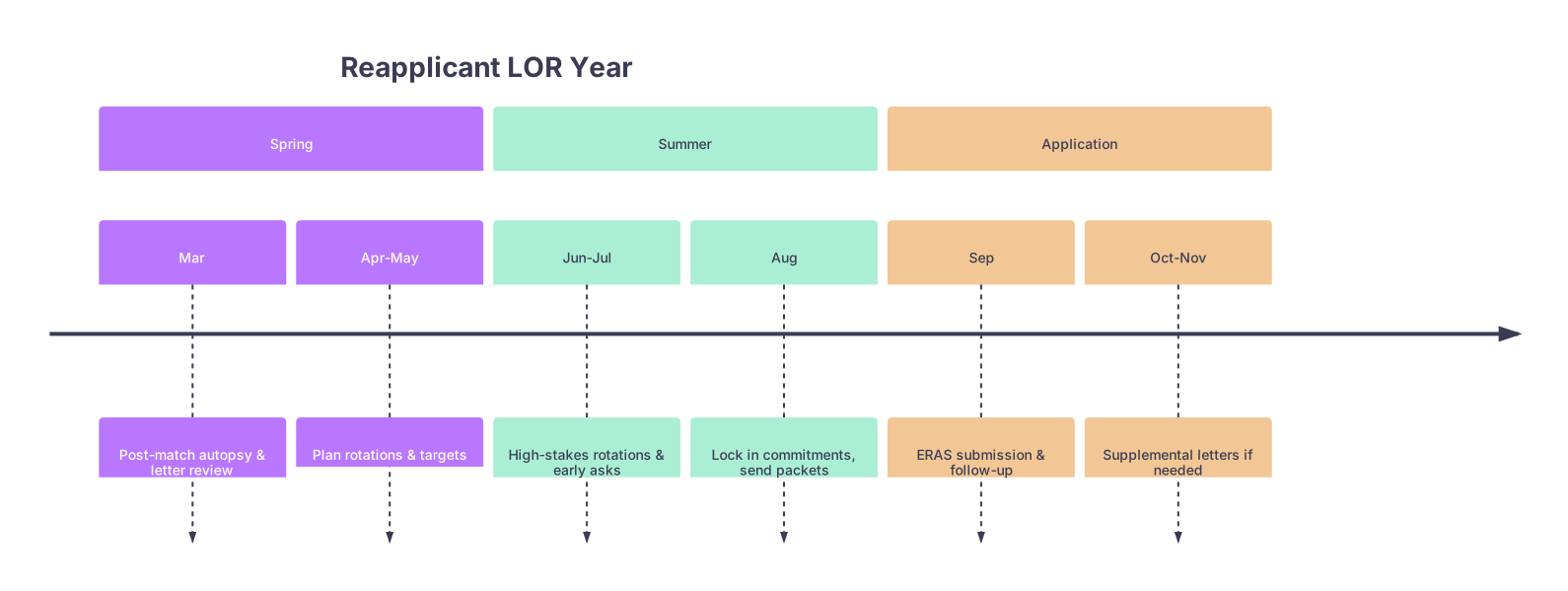
| Period | Event |
|---|---|
| Spring - Mar | Post-match autopsy & letter review |
| Spring - Apr-May | Plan rotations & targets |
| Summer - Jun-Jul | High-stakes rotations & early asks |
| Summer - Aug | Lock in commitments, send packets |
| Application - Sep | ERAS submission & follow-up |
| Application - Oct-Nov | Supplemental letters if needed |
Step 2: Decide Your Letter Portfolio Mix
Target by specialty competitiveness:
| Specialty Type | Total LORs | Specialty LORs | “Growth / Improvement” LORs |
|---|---|---|---|
| Less competitive (FM, IM, Peds) | 3–4 | 2–3 | 1 |
| Moderately competitive (EM, OB/GYN, Psych) | 4 | 3 | 1 |
| Competitive (Derm, Ortho, ENT, Rad Onc) | 4 | 3–4 | 1–2 |
You want:
1–2 anchor letters
- From recognized faculty in your specialty
- See you consistently and can compare you to peers
1 growth / redemption letter
- From someone who can explicitly talk about:
- How you responded to not matching
- How your clinical skills matured
- How you stepped up in your current role (prelim, research, etc.)
- From someone who can explicitly talk about:
Optionally, 1 non‑specialty letter
- Medicine letter for EM applicant, or vice versa
- Shows you are broadly solid, not one‑note
Step 3: Identify Targets and Gaps
By end of May you should have:
- A list of 3–6 attendings you want as potential letter writers this year.
- Notes on:
- What setting you will work with them in.
- What you need to show them to earn a strong letter (ownership, reliability, specific skills).
- A clear gap list, for example:
- “Need at least one new core specialty letter from a different site.”
- “Need a letter that explicitly addresses my improved communication and autonomy since last cycle.”
Months 3–4: June–July – High‑Stakes Rotations and Early Asks
This is where most reapplicants either fix their LOR problem or cement a second failed cycle.
On Every Rotation: Behave Like You Are Already a Resident
At this point you should be doing the things attendings actually write about:
- Showing up early, leaving late when needed.
- Volunteering for admissions and procedures.
- Calling consults yourself (appropriately).
- Anticipating plans, not just recording them.
I have seen attendings change “solid, quiet student” to “one of the best I have worked with in the last few years” in a letter because the student took one week to flip the switch.
Timing the Ask
You want to ask near the end of a rotation, while you are fresh in their mind but before you disappear.
Target:
- 2–3 weeks into a 4‑week rotation if it is going well.
- End of the second week of a 2‑week EM shift block.
Your script, simplified:
“Dr. Patel, I am reapplying to internal medicine this year. I did not match last cycle and have been working hard to strengthen my application. I have really valued working with you and was wondering if you would feel comfortable writing a strong letter of recommendation for my ERAS application.”
The keyword is “strong.” If they hesitate, downgrade, or deflect, move on. A mediocre letter is worse than none.
Month 5: August – Lock In Commitment and Send LOR Packets
By early August, you want most of your letter commitments secured.
At this point you should:
1. Confirm Every Verbal Agreement in Writing
Send a concise email:
- Thank them.
- Remind them of your specialty and reapplicant status.
- Attach your LOR packet.
That packet should include:
- CV (updated, clean).
- Personal statement draft (even if not perfect).
- ERAS experiences list.
- One‑page “LOR cheat sheet” with:
- Bullet points of cases or moments you shared with them.
- Specific traits you hope they can comment on (clinical reasoning, leadership, growth after not matching).
- Any program types you are targeting (academic vs community, region).
Do not write them a letter to sign. That is lazy and usually obvious. Give them ammunition, not a script.
2. Decide What to Do with Old Letters
You have three options:
- Retire – bad or generic letters. Do not include them.
- Update – strong writer, but letter is dated.
- Reuse – rare, but acceptable if the letter is outstanding and clearly enthusiastic (and was recent, e.g., written the prior fall).
If updating:
- Email the writer:
“I am reapplying this year and would be very grateful if you could update my prior letter to reflect what I have done since we last worked together. I am attaching a brief update with my recent work and responsibilities.”
Make it easy for them to mention new roles, research, or improved performance.
Month 6: Early September – ERAS Opens: Final LOR Alignment
ERAS opens. You will be tempted to submit on day one with whatever letters exist. That is how reapplicants sabotage themselves.
Align Letters to Programs (Within Reason)
At this point you should:
- Designate your default 3–4 letters that will go to almost all programs.
- Identify if you need program‑type tailored mixes, for example:
- Academic IM programs: 3 IM letters + 1 research letter (if strong).
- Community EM programs: 2 EM letters + 1 IM letter.
Do not go insane micro‑optimizing letter combinations for every single program, but do use basic logic.
Check the Actual Upload Status
Log in and verify:
- Which letters are uploaded vs “not received.”
- That each letter is correctly labeled (Specialty, writer role).
- That dates make sense (this year, not three years ago).
If a key letter is still missing by mid‑September, you follow up.
Your follow‑up email is short and direct:
“Dear Dr. Chen,
I hope you are well. I wanted to gently follow up regarding the ERAS letter of recommendation you kindly agreed to write on my behalf. Applications open shortly, and I would be extremely grateful if you were able to upload it this week. Please let me know if there is anything else you need from me.
Best, …”
If they still do not upload after one reminder, assume it is not coming and adjust. You cannot stake your match on someone who never finds the time.
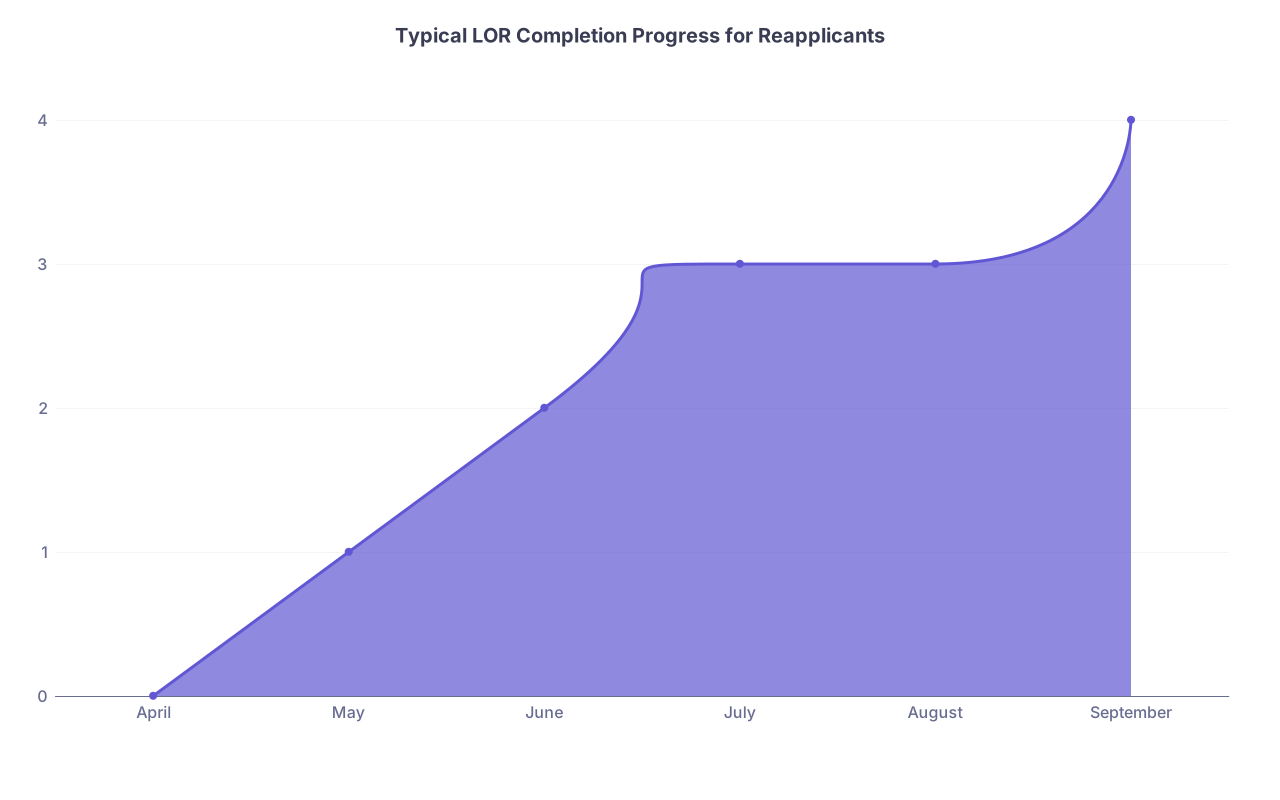
| Category | Value |
|---|---|
| April | 0 |
| May | 1 |
| June | 2 |
| July | 3 |
| August | 3 |
| September | 4 |
Weeks Before and After ERAS Submission: Micro‑Timeline
You are now in the critical 4–6 week window around submission.
3 Weeks Before Submission
At this point you should:
- Have at least 2 core specialty letters uploaded.
- Know exactly which letter is your “growth / resilience” letter.
- Retire every letter that is:
- Vague.
- Irrelevant to your specialty.
- From someone whose name carries no weight and whose content is generic.
If you are short one letter, consider:
- A chief resident or APD letter if they know you very well.
(Yes, residents can write impactful letters if they have worked closely with you and the department culture supports it.)
Submission Week
- Submit with 3 strong letters if the 4th is still pending. Do not delay submission for one missing letter.
- As new letters upload, assign them to programs as appropriate.
October–December: Supplemental and Targeted Letters
You are not done after you submit.
At this point you should use the fall strategically:
1. New Rotations = New Opportunities
If you are on a new high‑yield rotation (e.g., another IM month, EM at a busy site, subspecialty that overlaps your field) and:
- You crush it.
- The attending clearly respects you.
Then you ask for a mid‑cycle letter. This can help:
- Programs that screen later.
- Waitlist situations where PDs re‑review files.
You email programs that have not rejected you yet:
“I wanted to share an updated letter of recommendation from my recent rotation at [Hospital], where I have been able to take on increased responsibility in [X]. I have attached it to my ERAS application.”
Not every program will care. Some will. You are playing the odds.
2. PD‑to‑PD Advocacy
If you are in a prelim year or structured transitional role, one of the strongest moves is:
- Having your current PD or APD email a PD at a program where you have a realistic shot.
This is not technically an LOR, but it functions like one. It is short, and behind the scenes. If your current PD believes in you, ask directly:
“Would you feel comfortable reaching out to a few program directors on my behalf this fall if I give you a targeted list?”
If they say yes, you have a major advantage that most reapplicants never use.
Common Reapplicant LOR Mistakes – And When They Appear
I see the same errors every year. They have clear time‑points attached:
- March–April mistake – Refusing to look at last year’s letters and just “trying again.” Programs are not blind. They remember repeat files that have not changed.
- June–July mistake – Waiting until the last day of a rotation to ask for a letter. Attending says yes but forgets your name a week later, writes a cardboard letter.
- August mistake – Not sending a LOR packet. Expecting attendings to remember your complex backstory as a reapplicant.
- September mistake – Submitting late because you are “waiting on one more letter.” That last letter rarely outweighs the penalty of a delayed application.
- Fall mistake – Failing to add any new letters from your current year work, so your application looks frozen in time at last cycle.
You avoid all of them by respecting the timeline and actually treating LORs as a year‑long project, not a last‑minute chore.
Quick Reality Check: What Makes a Good Reapplicant Letter?
Let me be blunt. A good reapplicant LOR does three specific things:
Anchors you against peers
“Among the residents and sub‑interns I have worked with in the last few years, [Name] is in the top 10–15%.”Shows real growth
“Following a disappointing Match outcome, [Name] joined our service and has demonstrated significant growth in clinical reasoning and independence…”States a clear, positive endorsement
“I would be delighted to have [Name] in our residency program and recommend them to you without reservation.”
If your letters read like: “They were punctual, professional, and pleasant to work with,” you are done. That is code for “nothing special.” Your entire year’s strategy is built around avoiding that sentence.
Final Step: What You Should Do Today
Not tomorrow. Today.
- Open a blank document titled “Reapplicant LOR Plan.”
- Make three sections:
- Old Letters (keep / retire / update)
- Target Letter Writers This Year
- Timeline (month‑by‑month)
- List every letter from last cycle and mark each one: KEEP, UPDATE, or KILL.
- Then send one email to a mentor or PD asking directly:
“Can you give me honest feedback on the strength of my letters from last year and help me plan my LOR strategy for this cycle?”
That starts the overhaul. Everything else is just following the timeline you build from there.