
The worst gap years are wasted on generic “happy to recommend” letters. You’re taking time off; your letters should become weapons, not participation trophies.
You want exceptional residency letters of recommendation. That means you need time, strategy, and a very deliberate year. I’m going to walk you through exactly how to use a gap year to turn decent LORs into the kind that make PDs stop scrolling in ERAS.
We’ll go chronologically: from 12 months before ERAS submission through the week your letters are uploaded. At each point, I’ll spell out what you should actually be doing—not vague “network more” fluff.
Month 0–1: Clarify Your Story Before You Do Anything Else
At this point you should not be blasting out emails for research or jobs. First you need a story.
Residency programs hate confusion. A gap year with no clear purpose reads as, “I did not match and wandered around.” Your LOR strategy has to match a coherent narrative.
In the first 2–4 weeks, sit down and answer these, on paper:
- What specialty are you actually targeting?
- If you’re still deciding between, say, IM and EM, fine—but pick a primary target for now.
- Why are you taking a gap year?
- Did not match? Needed more US clinical experience (USCE)? Pivoting specialties? Burnout? Visa issues?
- What “LOR assets” do you already have?
- Any strong letters from 4th year?
- Any attending who said, “I’d be happy to write for you” and meant it?
- Where are your glaring gaps?
- No letters in your chosen specialty?
- Only weak “student was pleasant” type letters?
- All letters from a single institution?
Write a one‑paragraph answer to: “By next ERAS cycle, I want PDs to see me as…”
Example: “A resilient, team‑oriented prelim surgery resident with strong OR performance and clear growth during the gap year.”
Everything you do next should feed that sentence.
Month 1–2: Design Your Gap Year Around Letter Writers
Now you build the environment where strong LORs are even possible.
At this point you should be choosing gap‑year roles based on access to strong attendings, not just “sounds impressive.”
You’re looking for roles that check at least two of these boxes:
- Direct, repeated interaction with attendings or senior faculty
- Opportunities for them to observe your clinical thinking or work ethic
- At least 3–6 months of consistent work
- Something that aligns with your target specialty
High‑yield gap year setups for LORs:
| Role Type | LOR Strength Potential |
|---|---|
| Dedicated research fellow | Very High |
| Full-time clinical research coordinator | High |
| USCE observership with hands-on exposure | Moderate–High |
| Paid clinical job (scribe, MA in specialty clinic) | Moderate–High |
| Random non-clinical job unrelated to medicine | Low |
If you already have a gap year job:
- Audit it for LOR potential.
Are you working directly with any physicians who can credibly write? If not, you may need to adjust roles or add something (e.g., part‑time research, extra clinic days).
If you don’t have anything lined up:
- In this 4–6 week window, prioritize finding:
- A research position in your chosen specialty at an academic center
- Or a USCE/clinical role where attendings actually see you work
Do not just grab any job to “fill the year” and assume letters will magically be great. They won’t.
Month 2–3: Choose Your Target Letter Writers (On Purpose)
By the end of Month 3, you should know exactly which 4–6 people you’re trying to convert into letter writers over the year.
Target mix (adjust for specialty/IMG status, but this is a solid base):
- 2 letters in your chosen specialty
- 1–2 from people who know you extremely well (could be another specialty or research)
- 1 “anchor” letter if possible (program director, department chair, or nationally known faculty), but only if they actually know your work
At this point you should:
Make a short list of potential writers:
- Attending you work with daily on research
- Clinic preceptor you’re shadowing/scribing for
- Faculty mentor from prior rotations who’d recognize your name
- New attendings you’ll be starting with soon
Start interacting like someone who’s intentionally building relationships:
- Show up early, leave late.
- Ask thoughtful questions about patient care or study design—not about “how do I get into residency” every day.
- Follow through on small tasks fast. People remember the “they had that done 2 hours later” person.
Start a “LOR notes” document:
- Every couple of weeks, jot down specific things you did with Dr. X:
- “Led chart review for CHF readmission project”
- “Stayed late to help with backlog of notes”
- “Presented at journal club, gave EBM critique of trial”
- These become gold when you eventually send letter‑support packets.
- Every couple of weeks, jot down specific things you did with Dr. X:
Month 3–6: Make Yourself Letter‑Worthy (Day‑to‑Day Actions)
Now we’re in the grind. This is where most people drift. You won’t.
At this point you should be manufacturing evidence your writers can use.
Think like this: Every week, what did I do that a letter writer could reasonably remember and praise?
Weekly Targets (Repeat for 12+ Weeks)
Aim for at least one concrete, observable behavior each week that fits one of these:
- Clinical reasoning:
- Present a patient concisely and suggest a plan
- Ask for feedback and adjust
- Work ethic:
- Take extra call/clinic sessions
- Volunteer for less‑glamorous tasks (discharge summaries, follow‑up calls)
- Ownership:
- Follow a patient’s course over several visits
- Update the team without being prompted
- Team behavior:
- Help interns/residents with scut that frees up cognitive bandwidth
- Communicate clearly with nursing staff and appreciate them
And then, crucially: make those actions visible to your target letter writers.
Not performative. Just not invisible.
Example:
You stayed two extra hours to finish data cleaning on a study. Send a short “all done, here’s what I found” email to your PI, with clear bullet points. That email may literally end up quoted in your letter.
Mid‑Point Check: Are You on Their Radar?
Around Month 4–5:
- Ask for performance feedback from your top 2–3 potential writers.
- “Dr. Patel, I’m hoping to become truly competitive for IM this cycle. Could you give me honest feedback on how I’m doing and what I should improve over the next few months?”
- Listen. Fix what they mention.
Then, three weeks later, show visible improvement.
You’re doing two things here:
- Signaling that you care about growth (PDs love this).
- Giving them a story arc: “She sought feedback and improved rapidly.”
Month 6–8: Convert Relationships into Explicit LOR Commitments
By this point, if you’ve done your job, at least 2–3 attendings should know your name, your work, and your goals.
Now it’s time to actually ask.
When to Ask
- 6–10 weeks before ERAS opens or
- As soon as you’ve worked closely with them for at least 2–3 months
Do not wait until “closer to ERAS” if the attending is about to move, go on sabbatical, or rotate away from you.
How to Ask (Exact Language)
In person first, if possible. Then follow up by email.
You say something like:
“Dr. Lopez, I’ve really appreciated working with you these past few months, especially on the CHF readmissions project and in clinic. I’m applying to internal medicine this upcoming ERAS cycle and would be honored if you’d feel comfortable writing me a strong letter of recommendation.”
The word strong matters. It gives them a graceful exit if they can’t.
If they hesitate, or say something vague like “Sure, I can write something,” watch their face. If the energy is lukewarm, say:
“I really appreciate your honesty. I want to make sure my letters are as strong as possible, so I completely understand if you’d rather not.”
Then don’t use them. A bland letter is worse than no letter in a competitive field.
What to Send Once They Say Yes
Within 24–48 hours, send a letter support packet. Keep it sharp:
- Updated CV
- Your ERAS personal statement draft (or at least a short “career goals” paragraph)
- A 1–page bullet list:
- Projects/patients you worked on together
- Specific strengths you hope they’ll highlight (not commands—requests)
- Any context about your journey (reapplicant, IMG, career change)
You’re not writing the letter for them. You’re jogging their memory.
Month 8–10: Align Letters With Your Application Strategy
At this point you’re in the ERAS build‑out window. Letters are now part of a bigger system.
You should decide which letter goes to which program (if you’re applying to more than one specialty or significantly different tiers of programs).
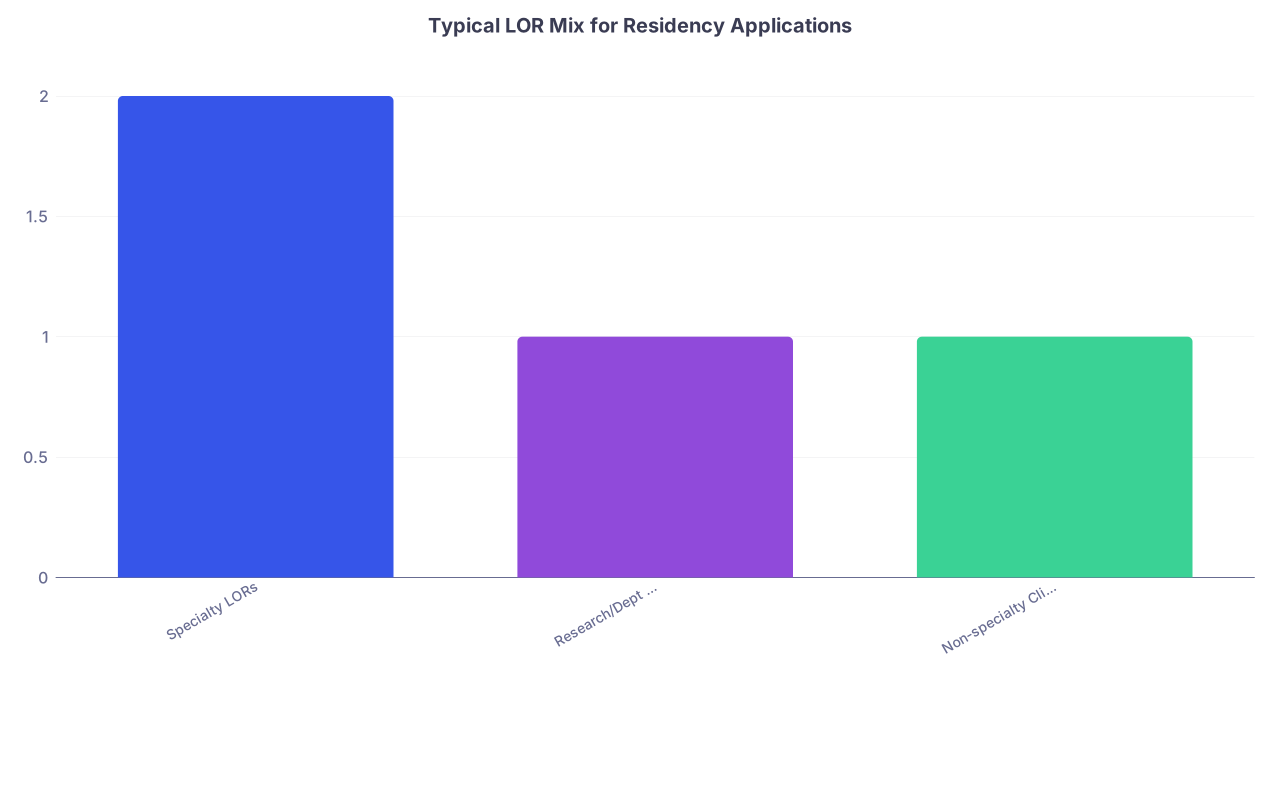
| Category | Value |
|---|---|
| Specialty LORs | 2 |
| Research/Dept LOR | 1 |
| Non-specialty Clinical LOR | 1 |
For Single‑Specialty Applicants (e.g., all IM)
Your goal:
- 3–4 letters total
- At least 2 from core specialty attendings
- 1 can be research in that specialty if it clearly describes you clinically or intellectually
Assign in ERAS:
- Same 3–4 letters to all programs is usually fine
- If you have a truly big‑name letter, you might prioritize using it for more competitive programs, but do not overthink this
For Dual‑Specialty or Pivot Applicants
Example: You failed to match into ortho and are now pivoting to IM.
At this point you should:
- Get fresh, explicit IM letters during gap‑year USCE/research.
- Use old ortho letters only if they emphasize universal traits: work ethic, teamwork, reliability—and do not paint you as “future great orthopedic surgeon.”
Split your letter sets:
- IM programs: 2–3 IM letters + 1 “general” or research letter
- Ortho programs (if you’re re‑applying): mostly ortho letters + 1 gap‑year letter showing growth
Month 10–12: Manage Uploads, Gaps, and Timing
Now the anxiety part: Will my letters arrive on time?
At this point you should be tracking your letters like a project manager, not just hoping things work out.
Create a simple tracker (spreadsheet or notes app) with:
- Letter writer name
- Type (Specialty, Research, Other)
- Date requested
- Date ERAS instructions sent
- Date they confirmed
- Date uploaded (ERAS shows this)
Set soft internal deadlines:
- Ask for letters: at least 4–6 weeks before you want to submit ERAS
- Send a gentle reminder 2 weeks before your target date if not uploaded
- Send a firmer check‑in 1 week before if still pending
Sample reminder email:
Dear Dr. Singh,
I hope you’re well. I wanted to check in regarding the letter of recommendation for my internal medicine residency application. ERAS opens for submission on [date], and I plan to submit my application that week.If you’re still able to complete the letter, I would be very grateful if it could be uploaded by [date]. Please let me know if you need any additional information from me.
Thank you again for your support,
[Your Name]
If they miss that by several days and are unresponsive, you need a backup. This is why earlier in the year you targeted 4–6 potential writers, not exactly 3.
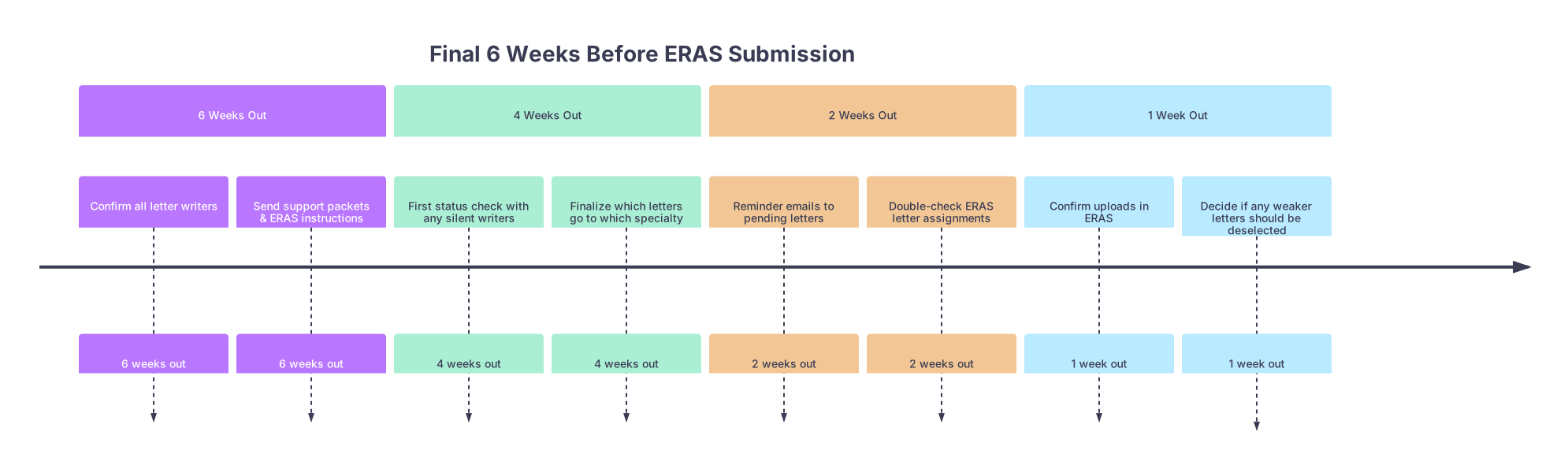
Week‑by‑Week: Final 6 Weeks Before ERAS Submission
Here’s what the final stretch should look like if you’ve done the year correctly.
| Period | Event |
|---|---|
| 6 Weeks Out - Confirm all letter writers | 6 weeks out |
| 6 Weeks Out - Send support packets & ERAS instructions | 6 weeks out |
| 4 Weeks Out - First status check with any silent writers | 4 weeks out |
| 4 Weeks Out - Finalize which letters go to which specialty | 4 weeks out |
| 2 Weeks Out - Reminder emails to pending letters | 2 weeks out |
| 2 Weeks Out - Double-check ERAS letter assignments | 2 weeks out |
| 1 Week Out - Confirm uploads in ERAS | 1 week out |
| 1 Week Out - Decide if any weaker letters should be deselected | 1 week out |
6 Weeks Before Submission
At this point you should:
- Have asked all letter writers
- Have sent every support packet
- Have ERAS account set up and know how to assign letters
4 Weeks Before Submission
You should:
- Check ERAS for which letters have actually appeared
- Nudge anyone who hasn’t uploaded
- Decide if any surprising “yes” writers (people suddenly enthusiastic) should be added
2 Weeks Before Submission
At this point you should:
- Make hard calls:
- If you suddenly have 5 letters, which 3–4 are strongest?
- Drop any generic, impersonal ones if you know another is better
- Confirm you’ve assigned letters appropriately for:
- Any specialty splits
- Any programs where you want a specific letter (e.g., from a known alum)
Week of Submission
You submit even if 1 letter is still pending—as long as you already have at least 2–3 uploaded. Programs understand letters can trickle in.
Do not delay your entire application for one slow attending. That’s how people lose interview spots.
Day‑Level: What A Strong Gap‑Year LOR Arc Actually Looks Like
Let me give you a concrete scenario so you can see how this plays out.
Month 1–2
You start as a research fellow in cardiology. First week, you’re learning the EMR. By week 3, you’re showing up 15 minutes early, reading about your patients, and asking your PI (Dr. Chen) specific questions about trial design.
Month 3–4
You’re the person who always sends concise, clear project update emails. Dr. Chen starts cc’ing you on more senior threads. You ask for feedback and get told you talk too fast in presentations. You slow down, practice, improve, and 3 weeks later give a rock‑solid journal club.
Month 5–6
Dr. Chen has seen you stay late for patients who needed extra counseling. You remind him about a follow‑up echo someone almost forgot. You’re basically acting like a junior resident in clinic.
You ask: “Would you feel comfortable writing a strong letter for my IM application?” He says yes—quickly.
Month 7–10
You keep working. You finish a poster or abstract with him. He sees your persistence. He also now clearly knows:
- Your story (didn’t match, needed USCE)
- Your growth
- Your career goal (cardiology fellowship someday)
When he writes, he doesn’t write, “X is pleasant and hardworking.” He writes:
“Over the past 10 months, I have watched X evolve from a quiet observer into a core member of our cardiology clinic team. She independently followed a panel of complex heart failure patients, consistently anticipated next steps in management, and eagerly sought feedback. She stayed late without being asked to ensure patients fully understood medication changes, and she rapidly integrated feedback on her presentation skills. I would rank her in the top 5% of gap‑year fellows I have worked with over the past decade.”
That is what you’re building toward.
FAQ (Exactly 2 Questions)
1. I did not match and feel embarrassed asking for letters—how direct should I be with potential writers during my gap year?
Be more direct than you’re comfortable with. Attendings are not stupid; they know why most people take gap years. Early in the relationship, once you’ve proven you’re reliable, say something like: “I didn’t match last cycle and I’m using this year to become someone programs are excited to take. I’d really appreciate honest feedback on where I’m strong and where I need to improve.” That line does two things: it disarms the awkwardness and shows you’re not in denial. When it comes time to request a letter, remind them how they’ve seen you grow—this gives them a clear narrative instead of forcing them to guess.
2. Is it better to have a famous but generic letter or a lesser‑known attending who knows me well?
Take the lesser‑known attending almost every time. Program directors read thousands of letters; they can smell name‑dropping fluff instantly. A generic big‑name letter that says, “I worked with the applicant briefly and found them to be pleasant” is practically a negative. A detailed letter from Dr. Nobody that clearly describes how you think, how you work on a team, and how you improved over 6–12 months will do more for your file than a celebrity signature. Use the big name only if that person has actually seen you work closely and is willing to go specific and strong.
Open a blank note on your phone right now and create a list titled “Target Letter Writers – Gap Year.” Put 3–5 names on it, even if they’re just guesses. That’s your hit list. Tomorrow, make sure your actions give at least one of those people a concrete reason to remember you positively.