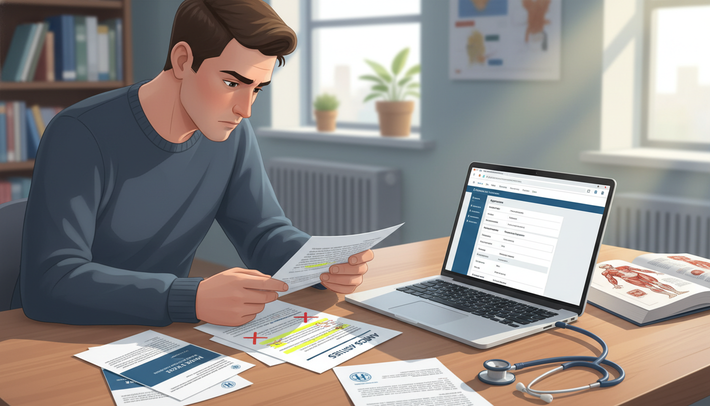
You submit your secondaries. Finally. You tell yourself you're done for the night.
Then, because your brain is rude, it immediately produces a new problem.
A PI emails that your abstract was accepted. Your volunteer coordinator promotes you to shift lead. Your paper moves from "submitted" to "published online." Or maybe it's less dramatic: you've added 30 more clinical hours and now you're staring at your inbox wondering if this is the update that changes everything.
So you do what applicants do. You open the school portal. Then your email. Then the SDN thread. Then your email again, like it personally owes you an explanation.
Here's the reality: admissions committees do not receive your update like an emergency page. No one is slamming a red button and yelling, "Stop the presses, this applicant got more shadowing hours." Most updates enter a system. They get logged, attached, screened, and reviewed according to timing and workflow. Boring, yes. But true.
And that's exactly why this matters.
If you're trying to decide whether to send an update, or you've already sent one and are now overinterpreting the lack of response, you need a clearer picture of what actually happens behind the scenes. Not the fantasy version. The real one. What gets read. What gets filed. What gets ignored. And what actually has a shot at helping.
Let's kill the biggest myth first: your update usually does not go straight into the hands of a full admissions committee the minute you hit send.
At most schools, the first stop is administrative. Admissions staff receive the update, log it, and attach it to your file. That's the normal workflow. It might be uploaded to your portal, dropped into your record in the admissions system, or flagged for later review depending on how that office runs. Glamorous? No. But that's what usually happens.
Next question: who actually reads it?
Usually not everybody. Admissions staff may screen it first. If the update is routine, it may simply be added to the file without fanfare. If it's substantial, staff may flag it for a reviewer, interviewer, dean, or committee member depending on where you are in the process. That's the key point applicants miss: updates are often reviewed in context, not in isolation.
If your file is actively under consideration, your update has a better chance of being seen by someone who can use it. If your file is sitting untouched in a giant completed-app pile, your update may just wait there until the file comes back up. Not ignored. Just not acted on yet.
I've seen applicants assume that because they sent an update on Tuesday, a committee must have weighed it by Friday. That's not how most offices work. Schools are managing thousands of files. Your email joins a system. It doesn't jump the line because you used the phrase "I wanted to express continued interest."
There are usually four outcomes:
- It gets logged and simply noted
- It gets attached to the official review packet
- It gets flagged because it's genuinely significant
- It changes nothing at all
That last one is common, and it doesn't mean you made a mistake sending it. It just means not every update moves a decision.
Timing matters more than applicants want to admit. If your file is complete and waiting for first review, a meaningful update can shape how you're first seen. If you're on hold, it can strengthen the case for reconsideration. If your file was already reviewed months ago and the school is nearly done interviewing, the exact same update may have almost no practical effect.
Same update. Different moment. Totally different result.
That's why obsessing over whether "they read it" isn't the right question. The better question is: was my file in a position where this update could actually be used?
What kinds of updates matter, and what usually gets ignored
Here's the simplest rule I use: send updates that add new information with real weight. Don't send updates that are just more of the same.
Good updates usually look like this:
- A new publication, especially if it's accepted or published
- A major award or scholarship
- A meaningful promotion at work
- A new leadership role with actual responsibility
- Completion of a degree milestone, thesis, or master's program
- A substantial new clinical or research responsibility
- Significant service work that clearly changed your level of impact
Bad updates? Usually these:
- "Just wanted to let you know I've now completed 18 more volunteer hours"
- One quiz grade disguised as an academic breakthrough
- Generic "still interested" emails with no new content
- Repeated check-ins every few weeks
- Tiny activity changes that don't alter your candidacy
This is where applicants get tripped up. They confuse effort with relevance.
Yes, adding more hours may reflect commitment. But if your application already showed sustained clinical exposure, another small batch of hours doesn't change the story. It's just more bricks on a wall you've already built. Adcoms care most when an update changes how they understand your readiness, impact, or trajectory.
A publication can matter because it validates scholarly work at a higher level. A promotion can matter because it shows trust, leadership, and performance. A major service initiative can matter because it demonstrates initiative beyond box-checking.
But "I continue to be passionate about medicine" is not an update. It's wallpaper.
If you're unsure whether something is worth sending, ask yourself this: Would a reviewer understand me differently after reading this? If not, don't send it yet.
And stop sending updates every few weeks just to feel in motion. That's anxiety management, not strategy. Schools can smell the difference.
How an update can affect an interview, hold, waitlist, or acceptance decision
Let's be realistic. A strong update can help. It cannot perform CPR on a dead application.
Where updates help most is in the gray zone. That's the land of "maybe." Maybe interview. Maybe hold. Maybe waitlist movement. Maybe one more look. If your application was already credible and the committee needed another reason to feel confident, a meaningful update can be useful.
Common situations where it can matter:
- You're on hold pre-interview: a real update can push your file back into consideration.
- You're on the waitlist: an update can reinforce continued growth and fit.
- You're being compared with similar applicants: a stronger recent achievement can break a tie.
- The school is still actively interviewing: timing is still on your side.
What it usually can't do:
- Fix weak academics
- Erase a poorly written application
- Overcome professionalism concerns
- Manufacture fit where none exists
- Turn a thin clinical profile into a mature one overnight
That's the hard truth. Applicants often send updates like they're tossing a rope to a committee that already passed on them. Sometimes the committee wasn't rejecting you. They just weren't convinced enough yet. In that case, an update can help. But if your file has major structural problems, another letter about your enthusiasm isn't saving it.

Context also changes everything. A December update at a school still building interview days can matter. A March update at a school that's nearly full may get read with polite indifference. Not because your accomplishment is bad. Because the process has momentum and limited seats.
So here's the practical rule: send updates when they strengthen an application that already has a legitimate shot. Don't send them hoping for a miracle. That's how people talk themselves into over-emailing schools that were never one generic note away from saying yes.
How to send an update that actually gets used
If you're going to send an update, make it easy to process. Adcoms are busy. Staff are busy. Nobody wants your three-paragraph emotional monologue about destiny.
Use a clean structure:
- State the new development
- Explain why it matters
- Connect it to your preparation for medical school
That's it. Short. Concrete. Useful.
A good update sounds like this:
Dear Admissions Committee,
I wanted to share a meaningful update to my application: I have been promoted to lead medical assistant at City Health Clinic, where I now train new hires and coordinate patient flow during evening shifts. This role has expanded my responsibility in direct patient care and strengthened my ability to work calmly in high-volume clinical settings. The experience has reinforced my readiness for the collaborative, service-focused demands of medical training.
Done. Efficient. No begging.
A weak update sounds like this:
I remain extremely interested in your prestigious institution and would be honored beyond words to be considered. Since submitting, I have continued to deepen my passion for medicine and have gained additional exposure that confirms my dream.
That says almost nothing. It's fluff wearing a blazer.
Here are the logistics that matter:
- Follow the school's instructions first. Always.
- Use the portal if the school prefers portal uploads.
- If email is appropriate, send it to the correct admissions contact.
- Use a clear subject line, like: Application Update – [Your Full Name] – [AMCAS ID]
- Keep it to one page or less
- Include accurate dates, titles, and outcomes
- Don't CC five people in the office like you're launching a campaign
My practical checklist:
- One meaningful update
- One page max
- Specific details
- No inflated language
- No emotional pleading
- No "just checking whether you received this and whether it changed my status" follow-up three days later
That's another mistake applicants make. They turn a decent update into an annoying sequence. The first email was fine. The second one made you look needy. The third one made people tired.
If you already sent an update, what to do next
Now the part nobody likes: wait.
Do not assume that lack of response means lack of impact. Many schools will not confirm receipt. Many won't tell you whether the update changed anything. Some will quietly place it in your file and that's the end of the visible process from your side.
So if you've already sent one, here's what to do:
- Leave it alone
- Keep building your application
- Stay professional
- Send another update only if something truly substantial happens
Not "I added 12 more hours." Not "I wanted to reaffirm my strong interest again." Not "just circling back." That's how applicants slide from proactive to irritating without realizing it.

I've seen people send four, five, six updates because silence made them panic. Bad move. It doesn't make you look committed. It makes you look like you don't understand how admissions works.
The calmer reality is this: your short, relevant update may already be sitting exactly where it needs to be, waiting for the next review point. That's normal. That's not failure. That's just process.
So stop refreshing for hidden meaning. If the update was strong, concise, and timely, you've done your job.
The bottom line
After you submit, updates don't enter some magical fast lane. They usually get logged, attached to your file, and reviewed when workflow and timing allow. That's the real process.
The updates that matter are the ones that add meaningful new information. A publication. A promotion. A significant leadership or clinical milestone. Not routine hour creep. Not generic interest emails. Not panic disguised as professionalism.
And yes, a good update can help. Especially if your file is active and the school is still making decisions. But it works best as reinforcement, not rescue.
If you're in this situation, the move is simple: send fewer updates, make them better, and stop expecting instant feedback. That's how you help your application without becoming the applicant everyone in the office remembers for the wrong reason.