
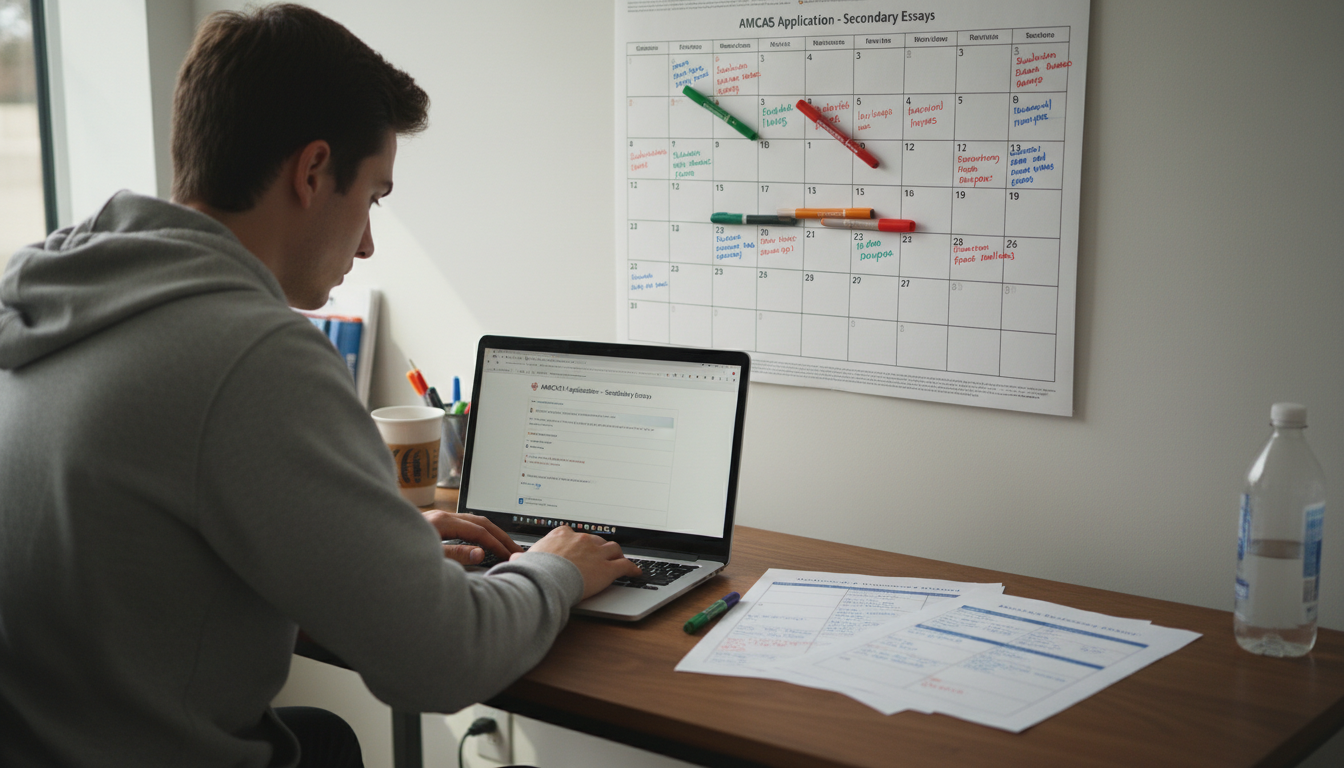
Most applicants treat secondary essays like a sprint; the successful ones treat them like a military campaign.
Secondary essay season is not simply “write fast and submit early.” It is a 4–8 week period that can make or break your cycle. At this point, speed without structure is dangerous. Structured speed wins.
Below is a week‑by‑week, then day‑by‑day framework starting from your first secondary invite to your last submission. Assume a typical applicant with:
- 20–30 MD and/or DO schools
- Working or doing research 20–40 hours/week
- Goal: Submit every secondary within 7–10 days of receipt, with a hard upper limit of 14 days
Week 0: Pre‑Season (The 7–10 Days Before Your First Secondary Arrives)
At this point you should be preparing the battlefield before the first “You have a new secondary application” email lands.
Your goals this week:
- Build your infrastructure.
- Pre‑draft high‑yield content.
- Block your time before life fills it for you.
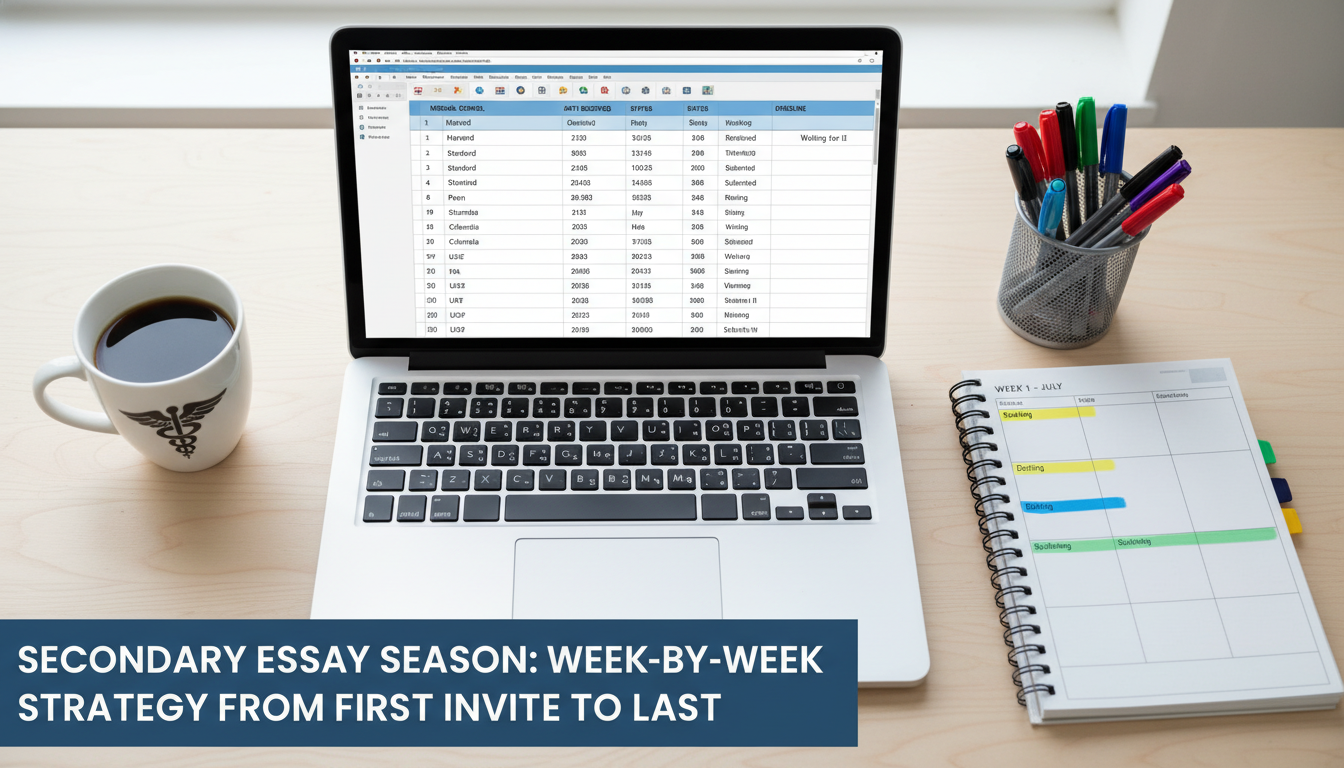
1. Set up your secondary command center (1 day)
Create a single, centralized tracking system. Either:
- A spreadsheet (Google Sheets, Excel, Notion) with columns for:
- School
- Date secondary received
- Deadline
- Total word count
- Required essays (titles / prompts)
- Status (Not started / Drafted / Edited / Submitted)
- Portal login + notes
- Or a Kanban board (Trello, Notion board) with:
- Lists: “Received,” “Drafting,” “Editing,” “Ready to Submit,” “Submitted”
- Cards: One per school, with prompts inside
At this point you should also:
- Turn on email filters/labels (“AMCAS”, “AACOMAS”, “Secondary”) so nothing gets buried.
- Create a folder structure:
- /Secondaries
- /School_Name_1
- /School_Name_2
- /Secondaries
- Decide on your file naming convention:
SchoolName_PromptKeyword_Draft_v1.docx
2. Collect and categorize last year’s prompts (1–2 days)
Most schools recycle or slightly tweak prompts. Use crowdsourced prompt databases (e.g., Student Doctor Network, Reddit r/premed secondaries compilations) from last cycle.
Create a document with common prompt types:
- “Why this school?” (150–500 words)
- “Why medicine?” or “Autobiographical statement” (500–1000 words)
- “Diversity” (250–500 words)
- “Adversity / Challenge” (250–500 words)
- “Failure / Growth” (250–500 words)
- “Most meaningful clinical experience” (250–500 words)
- “Gap year / Academic break / Red flags” (short responses, sometimes required)
- “COVID‑19 impact” (still appears at some schools)
At this point you should be spotting patterns. You are not writing 50 completely unique essays. You are writing:
- 4–6 core narratives
- Then tailoring each to different prompts and schools
3. Pre‑draft your core essays (3–4 days)
Aim to create modular, re-usable content before the chaos begins.
Write rough but complete versions of:
Extended “Why Medicine” narrative (800–1000 words)
- Your story, different from your personal statement: more detail on specific experiences, motivations, and future goals.
Diversity statement (400–500 words)
- Background, identity, experiences, or perspectives that shape how you will contribute to a class and to patients.
Adversity / failure story (400–500 words)
- One substantial challenge + what changed in your behavior and thinking.
Clinical or service experience (400–500 words)
- Patient interaction or longitudinal service with clear impact and reflection.
Preliminary “Why this type of school” paragraphs (250–300 words each):
- Research‑heavy academic center
- Primary care / community‑oriented school
- Mission‑driven (rural health, underserved, osteopathic)
These will not match any single school perfectly. That is fine. They are raw material.
4. Time‑block your secondary season (1 day)
At this point you should be assigning your most alert hours to writing.
- Decide your weekly writing hours:
- Example: 2 hours before work on weekdays + 4 hours each weekend day = ~18 hours/week.
- Pre‑block in your calendar:
- “Secondary Deep Work” sessions (no phone, no email)
- Fixed review slots (e.g., Sunday evenings to polish and submit)
If you are working full‑time, be honest: Are you willing to do 6–7 weeks of 60–70 hour work + application weeks? Build in 1–2 “lighter” days each week to prevent burnout.
Week 1: First Wave of Secondaries (Days 1–7 After First Invite)
The floodgates open. At this point you should be prioritizing and building momentum, not chasing perfection.
Day 1–2: Intake and triage
Log everything the same day it arrives.
- Enter:
- Date received
- Deadline
- Number and length of essays
- Note any auto‑secondary schools (everyone with a verified primary gets one) vs. screened schools (more selective).
- Enter:
Prioritize by 3 factors:
- Hard deadline (some give 2 weeks, some 4–8 weeks).
- School priority (your “A‑list” choices).
- Total writing load (5 short answers vs 1 long essay).
Create a Week 1 target list, such as:
- Must complete: 3 schools (soonest deadlines + top choices)
- Nice to complete: 1–2 additional if time allows
Day 2–3: Draft your first complete set (School #1)
At this point you should be aiming to finish your first school within 3 days of receipt. This sets your pace.
Process for each prompt:
- Paste the exact prompt and word limit at the top of your document.
- Map it to your pre‑drafted content:
- “Describe how your background and experiences will contribute to our diverse community.”
→ Use your diversity core essay, trim to limit, then add 1–2 school‑specific sentences.
- “Describe how your background and experiences will contribute to our diverse community.”
- Draft quickly, aiming for:
- 120–150% of word limit on first pass (so you can cut).
- When done with all prompts for that school:
- Take a 12–24 hour break from that set to clear your head.
Day 3–4: Edit and submit School #1; start School #2
Editing checklist (30–60 minutes per essay):
- Check: Does this answer the entire prompt?
- Cut fluff: Empty phrases like “ever since I was young” or “I have always wanted.”
- Replace generic language with specifics:
- “I am interested in research” → “I want to explore outcomes research in chronic kidney disease, building on my work with Dr. X.”
- Proof for:
- Typos
- Sentence-level clarity
- School name errors (no “I am excited to attend Duke” in your Emory essay)
At this point you should submit School #1 by Day 4 at the latest, then:
- Move immediately to drafting School #2.
- Re-use and adapt content from School #1 where appropriate.
Day 5–7: Build daily rhythm
Aim for a daily target, not a vague “write secondaries”:
Example weekday schedule:
- 6:30–8:00 am – Draft one essay or two short answers.
- 7:00–8:00 pm – Edit yesterday’s drafts + finalize one essay.
By the end of Week 1, target:
- 3–4 schools drafted
- At least 2 submitted
Week 2–3: Peak Production Phase
By now you probably have 10–20 secondaries in your queue. At this point you should be operating on a clear weekly plan and strict turnaround times.
Weekly goals (for each of Weeks 2 and 3):
- Submit 5–7 schools per week if you applied broadly (25–30 schools).
- Maintain a 7–10 day turnaround from receipt to submission for each school.
Weekly structure
Monday: Planning + Light Drafting
At this point you should be:
- Reviewing your tracker:
- Identify all schools whose deadlines are within the next 14–21 days.
- Mark top priority schools with color or a star.
- Creating a target list:
- Example: “This week: Submit University of Michigan, NYU, Rush, VCU, and 2 DO schools.”
Use Monday evening for:
- One lighter school (few questions) or
- One long essay draft for a major school
Tuesday–Thursday: Heavy drafting and revising
Ideal pattern:
- Morning session:
- Draft 1–2 full essays for School A.
- Evening session:
- Edit and polish School B from previous day.
- Submit if fully polished.
At this point you should be batching similar prompts:
- Write all “Diversity” essays for 3 schools in one batch.
- Then all “Adversity” essays.
- Then “Why this school” essays.
This reduces cognitive switching and speeds you up significantly.
Friday: Submission + Tidy‑up
By Friday evening you should aim to:
- Submit 2–3 schools that are in late editing stage.
- Clean up your tracking sheet:
- Move completed schools to “Submitted.”
- Recalculate how many remain and which are critical.
Daily 3‑Block Writing Template (Weeks 2–3)
Use this to structure any high-intensity writing day.
Block 1 (60–90 minutes): New drafting
- Choose one school.
- Tackle the longest or hardest prompt first.
- Use a timer (Pomodoro style: 25 min work / 5 min break) to prevent drift.
Block 2 (45–60 minutes): Recycling and tailoring
At this point you should be efficiently re‑using your work:
- Pull a relevant existing essay.
- Adapt:
- Change focus to match new prompt’s emphasis (e.g., more service‑oriented).
- Insert school‑specific details:
- Curricular features: “Patient‑centered Longitudinal Experience,” “College System,” “Problem‑Based Learning.”
- Programs: free clinics, global health tracks, rural rotations.
- Values: service, research, primary care.
Block 3 (30–45 minutes): Micro‑edits + submissions
- Last‑pass editing:
- Remove repetition across essays for the same school.
- Fix sentence variety and rhythm.
- Submit 1 school if possible.
Repeat this 3‑block template 3–5 days per week, depending on your schedule.

Week 4–5: Late‑Wave Secondaries and Burnout Management
By this point, you should have:
- Submitted most high-priority schools.
- A smaller but still nontrivial pile of remaining secondaries.
- Noticeable fatigue.
Secondary season is a marathon with sprints built inside it. Burnout at Week 4 is common.
Reassessment session (start of Week 4)
Spend 60–90 minutes doing a full review:
- Count remaining secondaries.
- Classify each school:
- Tier 1: Dream + realistic targets.
- Tier 2: Reasonable fits but not top choice.
- Tier 3: Low yield or low interest (e.g., geographic mismatch, very low interview probability).
At this point you should be honest about your capacity. If you are overwhelmed:
- Drop or delay Tier 3 schools.
- Protect quality for Tier 1 and 2.
Adjusting your pace
If you have:
- >10 schools left: maintain a 4–6 per week submission goal.
- 5–10 schools left: aim for 3–4 per week, focus on strength of each submission.
- <5 schools left: 1–2 per week is acceptable, but keep to the 14‑day receipt rule.
Burnout‑specific tactics
- Shift to shorter daily blocks.
- 2 × 45‑minute sessions instead of 2‑hour marathons.
- Rotate task types.
- One day: mostly editing.
- Next day: mostly new drafting.
- Use strict shutdown times.
- Stop by a set hour (e.g., 9:30 pm) even if not finished. Protect sleep. Poor sleep makes writing inefficient.
At this point you should protect your ability to think clearly. Sloppy, rushed essays with clichés and vague “service” language start appearing when you are exhausted.
Week 6 and Beyond: Stragglers, Special Cases, and Cleanup
Not everyone’s timeline matches neatly. Some secondaries:
- Arrive late (August or even September).
- Have unusual formats (video responses, timed essays).
- Require update essays if you completed new experiences.
Handling late-arriving secondaries
At this point you should assess each new invite quickly:
- Check the calendar.
- If it arrives very late (e.g., October) and you are MD‑only, research the school’s historic interview timeline. Some may have few spots left.
- Decide quickly.
- Either commit to a high‑quality submission within 7 days.
- Or consciously choose to let it go, rather than submit something weak and rushed.
Special formats strategy
- Video responses:
- Practice 3–5 common questions aloud:
- “Why this school?”
- “Tell us about a challenge.”
- “How do you handle conflict?”
- Outline mental bullet points, not scripts (scripts sound robotic).
- Practice 3–5 common questions aloud:
- Timed written responses:
- Do 2–3 practice rounds before the real thing.
- Focus on clear structure:
- 1–2 sentence thesis
- 2–3 key points
- 1 sentence wrap‑up
Final cleanup (when everything is submitted)
At this point you should shift from production to monitoring:
- Verify in each portal that:
- Secondaries show as “Complete” or “Submitted.”
- Letters of recommendation are received (especially for schools using their own portals).
- Fees are paid and cleared.
- Create an interview tracking tab:
- Date complete
- Date of interview invite (if any)
- Interview date
- Post‑interview status
This will matter in the next phase: interview season.
Day‑By‑Day Micro‑Checklist (Reusable for Any Week)
When you sit down each day during secondary season, run this checklist:
Before writing (5–10 minutes)
- Open your tracker.
- Choose one priority school for today.
- Read every prompt for that school once without typing anything.
During writing
- Start with the longest or hardest prompt.
- Use a timer (25 minutes on, 5 minutes off).
- Keep a “scraps” section at the bottom of your doc for phrases you cut but might reuse elsewhere.
After writing (10–15 minutes)
- Quick pass for:
- Word count compliance.
- Obvious typos.
- School name correctness.
- Update your tracker:
- Change status to “Drafted” or “Edited.”
- Add a target submission date.
At this point your process becomes mechanical in a good way. You reduce decision fatigue and mental overhead.
Common Timing Scenarios and How to Adjust
Scenario 1: Working 40+ hours/week + 25 schools
- Realistic target:
- 3–4 schools per week for 6–7 weeks.
- Strategy:
- Reserve early mornings for writing before work exhausts you.
- Use weekends for longer essays and heavy editing.
Scenario 2: Research / lighter job + 30+ schools
- Realistic target:
- 5–7 schools per week.
- Strategy:
- Two writing blocks per day.
- Aggressive reuse of modular essays.
Scenario 3: Reapplicant with strong existing content
- Realistic target:
- Faster initial ramp because many themes already exist.
- Strategy:
- Spend more time on:
- “What has changed since your last application?”
- Demonstrating growth, new activities, improved metrics.
- Spend more time on:
Mini Quality Checklist (Use Before Every Submission)
At this point you should never click “Submit” without confirming:
Prompt alignment
- Every part of the question is answered.
- No irrelevant tangents.
Specificity
- At least 2–3 concrete school‑specific details in each “Why this school” essay.
- Concrete roles and actions in stories (“I called the patient’s daughter,” “I managed the EMR inbox”).
Reflection
- You show what you learned, not just what you did.
- You connect experiences to how you will behave as a future physician.
Tone
- Confident but not arrogant.
- Honest about challenges without oversharing or dramatizing.
Technical
- Correct school name (and no copy‑paste misfires).
- Within character / word limits.
- Formatting not broken by portals (paste into text-only editor first if needed).
FAQ (Exactly 2 Questions)
1. How late is “too late” to submit a secondary and still be competitive?
Aim for within 7–10 days of receipt for most schools. Submitting after 14 days begins to erode your timeliness advantage, especially at rolling MD programs. However, a strong secondary at 16–21 days is often better than a rushed, generic one at 5 days. For secondaries arriving very late in the season (September or later), research each school’s interview season; if they have already issued large numbers of interviews, you may accept that your odds are lower and either still submit a high‑quality packet or strategically let it go.
2. How many secondary applications is “too many” if I want to maintain quality?
For most applicants with substantial time commitments (work, research), 20–25 schools is a realistic upper bound for consistently strong secondaries. Very high‑stat applicants sometimes apply to 30+ schools, but they usually (1) have more free time, (2) write quickly, and (3) plan extremely well. If you notice your essays becoming repetitive, thin on detail, or rushed, reassess your list. It is better to send 20 well‑crafted, timely secondaries than 35 mediocre ones submitted late.
Key points to carry forward:
- At each stage, know exactly which schools you are targeting that week and track everything.
- Pre‑draft reusable core essays before the season peaks; then adapt, do not reinvent.
- Protect both speed and quality by using structured daily blocks and by being willing to drop low‑priority schools if necessary.


