
Only 27% of matriculants had what admissions committees classified as a clearly “spiky” or focused narrative—yet those same “spiky” applicants were overrepresented among MD-PhD admits, research-track programs, and top-20 schools.
That single statistic kills one of the biggest myths in premed culture: that being an “all‑rounder” is the gold standard, and that a focused narrative is some risky gamble.
Let’s dissect what the data and real committee behavior actually show—and why “well‑rounded” is one of the most misunderstood concepts in medical school admissions.
The Myth of the Perfect ‘All‑Rounder’
The conventional script goes like this:
Get a 3.8+, strong MCAT, research, clinical volunteering, shadowing, leadership, community service, maybe a hobby or two, and package it as a “balanced” story.
That advice sounds safe. It’s also incomplete.
Here’s what the numbers and outcomes suggest:
- The AAMC data repeatedly show that beyond academic thresholds, differentiation happens in experiences and narrative, not just volume of activities.
- At many schools, 30–50% of applicants meet the basic academic cutoffs but still get no interview. Why? Their applications blend into a mass of interchangeable “good at everything” files.
- Meanwhile, applicants with slightly lower metrics but a compelling, coherent trajectory (e.g., 3.6 GPA, 512 MCAT, deep longitudinal commitment to one domain) often outperform their “perfect” peers in interview invites.
The myth:
“Committees want all‑rounders: a long list of medium‑depth accomplishments across many domains.”
The reality:
Committees want classes that are well‑rounded—made up of individuals who are often quite focused.
(See also: Is Research Mandatory for Non-Academic MD and DO Programs? The Facts for insights on research expectations.)
Medical schools are not assembling 150 clones who all did 200 hours of hospital volunteering, 1 year of generic lab research, some campus leadership, and “enjoy hiking and playing the piano.”
They are building a team.
What Committees Actually See When They Read “All‑Rounder” Files
Let’s walk through how an “all‑rounder” application often looks from the other side of the table.
You have:
- Major: Biological Sciences
- GPA: 3.85
- MCAT: 516
- Activities:
- 200 hours hospital volunteering
- 100 hours shadowing in 3 specialties
- 1 year basic science lab, one poster
- 1 leadership role in a premed club
- 1 semester tutoring
- Some short‑term community service, often fragmented (15 hours here, 20 there)
- Hobbies: “running, reading, traveling”
On paper, this is a strong, “balanced” applicant.
Now imagine reading 200 versions of that in one week.
Without a strong narrative thread, this profile becomes generic. The file is “good enough,” but there’s no clear answer to the most important evaluative question:
“If we admit this person, what are we likely getting—over time—as a physician and colleague?”
Committees look for signals of:
- Direction or emerging identity (not rigid specialization, but some directional pull)
- Follow‑through and depth (sticking with something long enough to actually matter)
- Unique contribution to the class climate, local community, or future field
A laundry list of mid‑depth involvement across ten areas often fails all three.
Focused Narratives: Not Narrow, but Coherent
Here is where premeds confuse “focused” with “boxed in.”
A focused narrative doesn’t mean you’ve chosen cardiology at 19 and everything you do must scream “future interventional cardiologist.” It means:
- Your activities, interests, and reflections cluster around a few core themes.
- Those themes are clearly visible in your personal statement, activities, secondaries, and interviews.
- The reader can describe you in one sentence that is specific, not generic.
Example 1 – Research‑focused but human:
- 2.5 years in one lab with increasing responsibility
- 1 first‑author poster, 1 middle‑author publication
- Summer research program (e.g., SURF, NIH SIP)
- Teaching assistant in a stats or methods course
- Clinical volunteering and shadowing, but strategically chosen in areas related to the research interest
- Community engagement that reflects understanding of the patient population your research affects
Reader’s mental summary:
“Research‑driven student with clear interest in neurodegeneration, strong longitudinal lab work, and a realistic understanding of clinical impact.”
Example 2 – Community health‑focused:
- 3‑year involvement with a free clinic, taking on coordinator responsibilities
- Health education workshops for local immigrant communities
- Spanish language development with practical use in clinical settings
- Modest research on health disparities or implementation science
- Shadowing physicians working in safety‑net systems
Reader’s mental summary:
“Service‑oriented applicant with serious, hands‑on experience in community health and a credible commitment to underserved care.”
Notice something: these people still have “rounded” experiences—research, clinical work, service—but there’s a through line. That through line is what most so‑called “all‑rounders” lack.

The Data Signals: Who Actually Stands Out?
We don’t have randomized controlled trials on narrative focus, but we do have strong correlates.
Look at three groups:
MD‑PhD (MSTP) candidates
- Extremely “spiky”: heavy research, often at the expense of other activities.
- They are still admitted disproportionately to top institutions, despite often having fewer clinical hours than the average MD applicant.
Service‑heavy applicants with moderate stats
- Longitudinal, high‑impact involvement in one or two service settings often overcomes slightly weaker GPAs or MCATs, especially at mission‑driven schools (e.g., UC Riverside, Cooper, Morehouse, University of New Mexico).
- These schools repeatedly state—publicly—that long‑term commitment to underserved communities matters more than having “one of everything.”
Non‑traditional applicants
- Career‑changers with a decade in nursing, teaching, tech, or the military rarely have “all‑rounder” premed portfolios.
- What they do have is a cohesive professional story and clear motivation for medicine. They punch above their “numbers” in interview yield.
Common thread across all three: not a broad, symmetric profile, but clarity of identity and trajectory.
Where ‘All‑Rounder’ Actually Makes Sense—and Where It Backfires
There is a place for breadth. A big one, actually. The problem is not breadth itself; it’s unguided, unprioritized breadth.
Breadth is helpful for:
Early exploration (freshman/sophomore years)
You truly do not know what kind of work or populations resonate with you. Sampling widely is rational.Demonstrating adaptability and curiosity
Schools do want to see that you’re more than a single‑track worker who only exists in the lab or clinic.Showing you understand medicine is multidisciplinary
Behavioral health, social determinants, policy, technology—some breadth hints at your ability to operate in a complex system.
But here’s the catch:
By late junior year and application cycle, you’ll be judged on what you committed to, not everything you tasted.
The problems with the “maximalist all‑rounder” mindset:
You dilute depth.
Doing 8–10 things at 3–4 hours per week each almost guarantees you never take on meaningful responsibility anywhere.You sabotage your letters.
Shallow involvement = shallow letters. One strong, detailed letter from a mentor who has seen your growth for 2–3 years beats three generic “pleasure to have in the lab/clinic” notes.You create a fuzzy story.
Your personal statement becomes a montage instead of a narrative. It reads like a CV in paragraph form rather than a trajectory.You burn out pre‑med, not build pre‑med.
Many students grind through four years of “checklist optimization” only to hit M1 feeling exhausted and identity‑less.
The healthier and more strategic model: broad early, focused later.
Building a Focused Narrative Without Pigeonholing Yourself
You do not need to “pick a specialty” to build a coherent story. You only need anchoring themes.
Some high‑yield themes that show up repeatedly in successful files:
- Health equity and underserved care
- Mental health and stigma reduction
- Education and mentorship in health contexts
- Technology, data science, and clinical innovation
- Public health, systems, and policy change
- Global health and cross‑cultural care
- Basic or translational science in a disease area
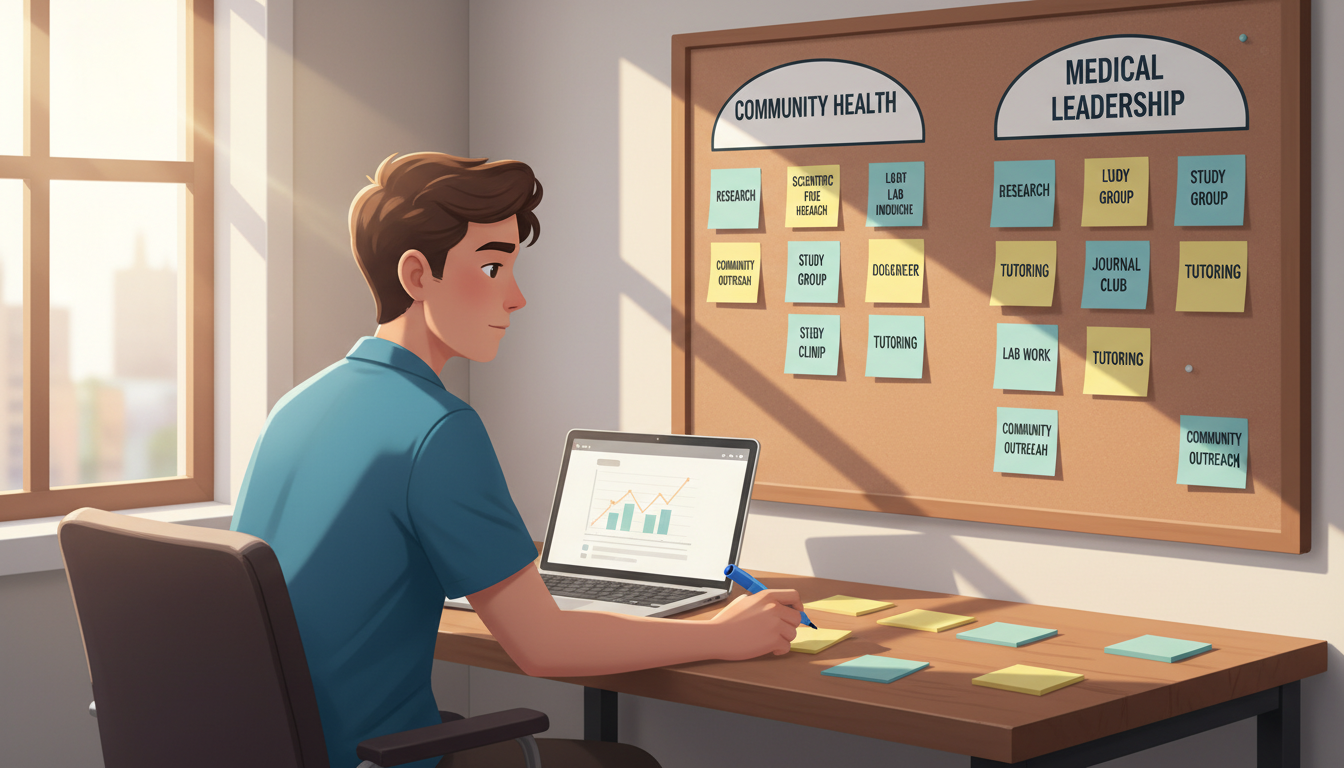
Here’s how you turn themes into narrative:
Pick 1–2 themes that you genuinely care about.
Not what you think adcoms want. What you are willing to spend actual time on.Align 2–4 of your most time‑intensive activities with those themes.
These become your “signature” experiences (research project, community work, clinical setting, capstone).Let other activities be supporting, not random.
A side interest in the arts? Fine. Tie it into communication, empathy, or understanding patient narratives if relevant. It does not all have to “match,” but the core should.Reflect consistently.
Your personal statement, most meaningful activity descriptions, and secondary essays should all echo similar lessons, values, and directions.Stay open about the endpoint.
You can be “interested in health systems and population health” without declaring “I will be an academic internist hospitalist specializing in X.” Focus on process and trajectory, not titles.
How to Salvage a ‘Messy’ or Overly Broad Application
If you’ve already done “all the things,” you’re not doomed. You just can’t present them as equal.
Three steps:
Choose your pillars.
From your entire activities list, identify 3–5 that:- Represent the most hours, and
- Involved real responsibility, and
- Changed how you think about medicine or patients
These become your core narrative pillars.
Reframe the rest as context, not core.
Short‑term or low‑impact roles can be framed as:- Exposure opportunities
- Initial explorations that led you toward your core theme
- Ways you built complementary skills (communication, teamwork, cultural humility)
Write like a focused applicant.
Your personal statement shouldn’t list every category of thing you did. It should follow a small number of threads through your best experiences and reflections.
From the committee’s perspective, your application becomes:
“This person explored broadly but ultimately committed deeply to X and Y.”
That reads as mature and intentional, not scattered.
Common Misconceptions That Keep Premeds Stuck
Let’s knock down a few persistent myths.
Myth 1: “If I focus too much on one area, schools will think I’m narrow and not adaptable.”
Reality: If you’ve done the baseline clinical and shadowing work, focus reads as commitment, not rigidity. Committees know your interests will evolve.
Myth 2: “Top schools only want super‑human all‑rounders.”
Reality: Look at top‑20 student profiles. You’ll see:
- Research powerhouses
- Community advocates
- Policy geeks
- Artists with strong community projects
They’re not all everything. They’re strong in different directions.
Myth 3: “The safest move is to look like everyone else, just slightly better.”
Reality: That’s the surest way to end up in the giant middle pile of “solid but indistinguishable.” Safety in medical admissions often comes from distinctiveness plus competence, not anonymity.
Myth 4: “My narrative must match a specific school mission statement.”
Reality: Trying to contort yourself to each school’s branding language looks fake. Focus instead on an authentic core narrative; then selectively highlight alignment where it’s real.
FAQs
1. Do I need a focused narrative if I’m still genuinely undecided about what I care about most?
No, you don’t need a fully crystallized “brand.” You do need evidence of depth somewhere. Even if you’re undecided about themes, pick 1–2 activities to double down on for the next 12–18 months. Depth itself is a theme: it shows you can commit, persist, and grow. Your application can honestly say, “I explored widely, but here’s where I leaned in hardest and what I learned from that.”
2. Can too much focus hurt me if I later change paths in medical school?
Admissions committees expect you to change. Your focused narrative is not a contract; it’s a snapshot of how you’ve engaged with the world so far. A student deeply involved in oncology research may end up in psychiatry. What matters is the transferable skills and mindset: curiosity, rigor, empathy, follow‑through. No one will accuse you of bait‑and‑switch for evolving interests.
3. How do I know if my narrative is too scattered?
Test it on someone who doesn’t know you well. Ask them, after reading your personal statement and activities section, “How would you describe what I care about?” If they answer with vague terms like “helping people,” “science,” or “healthcare in general,” your narrative is too diffuse. If they can say something specific—“community mental health,” “neuroscience research with real clinical implications,” “improving access for immigrant families”—you’re on the right track.
4. What if my main focused area isn’t obviously ‘medical’ (e.g., music, engineering, debating)?
That can be a strength. A deep, sustained commitment in a non‑medical domain can still form the backbone of a compelling narrative, if you:
- Articulate the skills and perspectives you’ve developed, and
- Show how you’ve begun to connect them to health or patient care (even in small ways).
The key is not that everything was medical from day one, but that you can meaningfully bridge who you’ve been with the physician you’re becoming.
5. Should I avoid starting any new activities late in the game to keep my narrative focused?
Not necessarily. Starting something new as a junior or even senior can make sense if:
- It clearly builds on an existing theme in your application, or
- It fills a genuine gap (e.g., you lacked any direct patient contact).
What you should avoid is short, opportunistic, box‑checking additions that don’t fit your story and won’t have time to mature. One well‑chosen late activity with clear purpose is far better than three rushed ones you can barely explain.
Key takeaways:
- “All‑rounder” is overrated at the individual level; schools build well‑rounded classes from many focused people.
- Depth plus coherent themes beats a maximalist checklist of shallow roles.
- You do not need a rigid career plan—just enough focus that a reader can clearly see who you are becoming and why medicine makes sense for you.