You are staring at the TMDSAS portal. The “Personal Characteristics” and “Optional” essays are done. But this one box—“Briefly discuss any unique circumstances or life experiences that are relevant to your application which have not previously been presented”—is bothering you.
You do have significant experiences. You are just not sure how to structure them so they read as purposeful rather than chaotic.
You are also very aware that TMDSAS schools read this prompt differently from AMCAS “most meaningful experiences.” Texas committees use it to fill gaps, cross‑check your file, and understand context. If you treat it like another generic personal statement, you will waste one of the few places where you can precisely control how your life story is interpreted.
Let me break this down specifically.
(See also: How to Classify Borderline Activities in AMCAS Experience Categories for more details.)
1. What This TMDSAS Essay Actually Does (and Does Not Do)
Before structure, you need role clarity. TMDSAS has multiple written components, and each one has a job. When you mix jobs, you dilute impact.
For TMDSAS, you typically have:
- Personal Statement (why medicine, core narrative)
- Personal Characteristics essay
- Optional essay
- “Unique circumstances or life experiences” prompt (often called the significant experiences essay, even though TMDSAS does not label it that way)
This “unique circumstances” space is not:
- A second personal statement
- A summary of everything already in your activities section
- A place to randomly stack hardship anecdotes
It is:
- A contextual lens: Why does your file look the way it does?
- A clarifier: What about your life fundamentally shaped how you show up as a candidate?
- A corrective: Where might your numbers or trajectory be misinterpreted without explanation?
TMDSAS schools (UTSW, McGovern, Long, Dell, BCM through TMDSAS, etc.) are used to Texas applicants with complex stories: working through college, military service, immigration, family obligations, rural background, career changes. They look here for:
- Educational disruptions
- Socioeconomic context
- Significant caregiving or work responsibilities
- Geographic limitations
- Health challenges
- Legal or institutional issues (when relevant and appropriate)
- Major life pivots that shaped timing, grades, or opportunities
Your structure must therefore do three things very cleanly:
- Identify the core circumstance or set of related experiences
- Show how they impacted your path, performance, and choices
- Map that directly to the app they are reading now (your readiness, perspective, and motivation)
If your essay does not explicitly connect to your current application, it will feel like background noise.
2. Decide Your Strategy: Single Anchor vs Thematic Cluster
Before you think paragraph-by-paragraph, you need a macro-structure: are you writing about one major experience/circumstance, or a coherent set?
Strategy A: Single Anchor Experience
Use this when:
- One experience or circumstance clearly dominates your trajectory
- That single factor explains multiple parts of your file
Examples:
- A chronic health condition that disrupted semesters and shifted your perspective on patient care
- Four years as the primary caregiver for a parent with advanced illness
- Active-duty military service before college
- Fleeing a conflict zone or major immigration-related disruption
This structure is clean, narrative, and tightly focused. You can go deeper into how it shaped you and your application outcomes.
Strategy B: Thematic Cluster of Related Circumstances
Use this when:
- You have several experiences that are individually smaller but collectively defining
- They share a clear theme: e.g., financial constraint, geographic isolation, first-gen status combined with work responsibilities
Examples:
- Working 30 hours/week across multiple low-wage jobs + limited transportation + supporting younger siblings
- Transferring from community college + commuting 2 hours/day + no premed advising infrastructure
- Moving between several schools because of parental job instability and housing insecurity
The critical point: a cluster essay is not a list. It is one through-line illustrated by several concrete touchpoints.
If you find yourself trying to squeeze “being an RA,” “playing club soccer,” “researching in a lab,” and “losing my grandfather” into the same essay, you likely need to narrow. TMDSAS readers do not want a scrapbook.
3. The Core Structural Template That Works
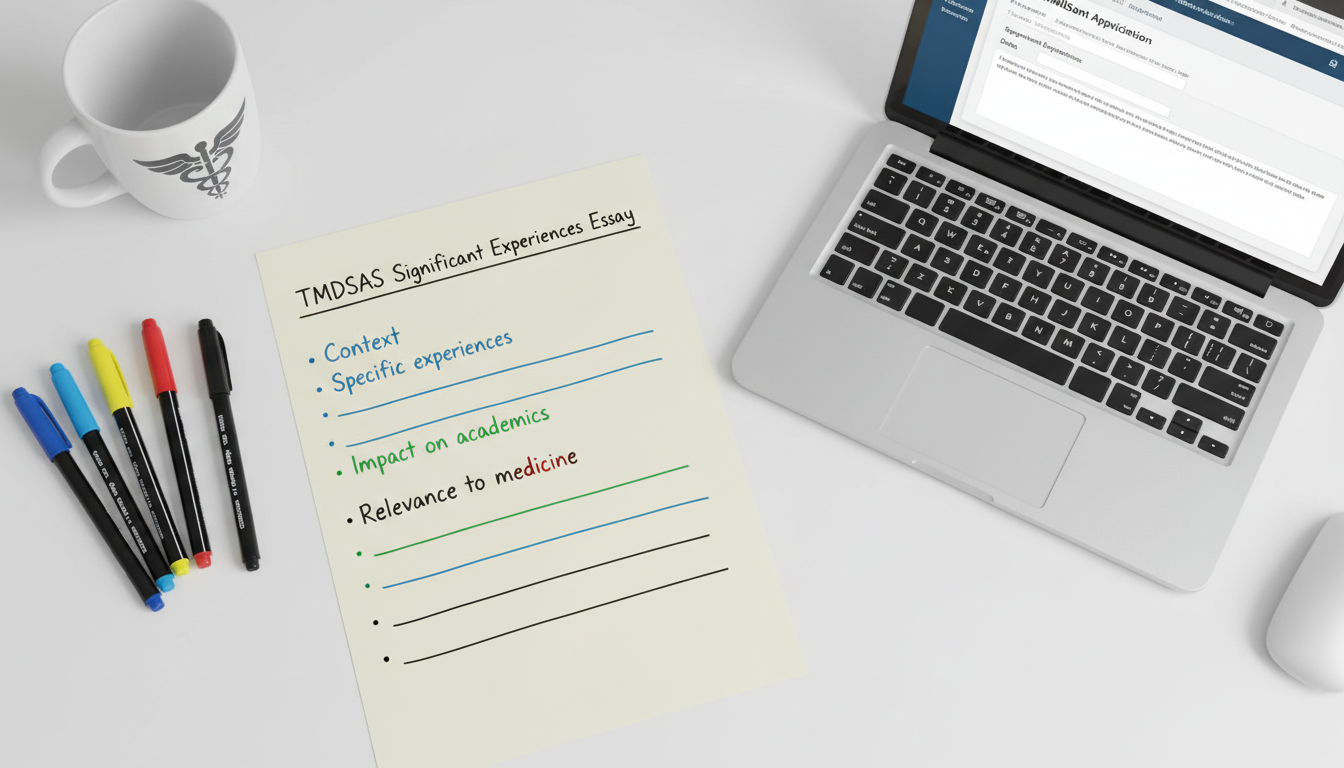
Now for the blueprint. Regardless of whether you choose a single anchor or a thematic cluster, a strong TMDSAS significant experiences essay can be built around a 4-part architecture:
- Context Snapshot (Opening) – 1 short paragraph
- Specific Manifestations (Body A) – 1–2 paragraphs
- Impact on Academic/Professional Trajectory (Body B) – 1–2 paragraphs
- How You Show Up Now / Relevance to Medicine (Closing) – 1 paragraph
Let us walk through each part in detail.
3.1 Context Snapshot (Opening)
Goal: Ground the reader quickly. They need to know what “world” you grew up or operated in before they evaluate the details.
Characteristics:
- 3–5 sentences
- Direct, specific, not dramatic for its own sake
- Oriented around setting rather than “lessons”
Example for a caregiving anchor:
During my sophomore year of college, my mother was diagnosed with metastatic breast cancer. As the oldest child in a single-parent household in Laredo, I took on the role of coordinating appointments, managing her medications, and caring for my two younger siblings. This shifted my daily life from a typical full-time student experience to one built around treatment schedules, late-night ER visits, and constant financial calculations.
What this does:
- Establishes time frame
- Defines roles/responsibilities
- Signals geographic and socioeconomic context
- Invites the reader to understand later GPA trends or activity choices through this lens
Avoid:
- Vague openings like “Growing up, I faced many challenges that shaped who I am today.”
- Starting with abstract values (“Resilience and determination have always guided me…”) instead of concrete circumstances.
Your first paragraph should make an adcom nod and say: “Got it. This is the frame.”
3.2 Specific Manifestations (Body A)
Goal: Make the circumstance real and non-generic. Two applicants can both say “I worked during college,” but the lived reality can be night-and-day different.
Characteristics:
- 1–2 paragraphs, each with clear, concrete detail
- Focus on actions and logistics: time, responsibilities, constraints
- Still minimal on “reflection” language
Example for a work/financial cluster:
By the end of my first year at UTSA, my father’s hours at his refinery job were cut, and I began working 25–30 hours per week at a grocery store to contribute to rent and utilities. My shifts were typically 4 p.m. to midnight, followed by a 45-minute bus ride home. I scheduled my classes between 8 a.m. and 2 p.m. so that I could work evenings and weekends. During exam weeks, I sometimes studied in the break room on my 15-minute breaks.
Note what is happening:
- The reader can visualize the schedule
- You are not just asserting “I had to work”; you are showing how that constrained your time and energy
For a thematic essay, you might briefly sketch two or three manifestations under one theme:
Limited transportation also shaped the opportunities I could pursue. Without a car, I relied on a two-bus route that did not reach the hospital where many of my peers volunteered. Instead, I sought opportunities within walking distance, such as volunteering at a neighborhood clinic and later serving as a medical translator at a community health fair held at my church.
Now a Texas adcom sees:
- Why you do not have 300+ volunteer hours at a major academic center
- That you still found ways to engage clinically under real-life constraints
Avoid:
- Narrating every emotional detail
- Inserting “this taught me…” reflections after every sentence; save that for later sections
3.3 Impact on Academics and Trajectory (Body B)
This is where you deliberately link circumstances to the pattern of your application.
You are not making excuses. You are aligning:
“This thing happened” → “Here is how it actually shows up in my record” → “Here is how I responded and improved.”
Two subcomponents:
- Candid description of impact
- Evidence of adaptation and upward movement
Example addressing GPA:
These responsibilities affected my academic performance most noticeably during my second year. That fall, when my mother’s chemotherapy was intensified and her hospitalizations became more frequent, my GPA that semester dropped to a 2.8, with a C in Organic Chemistry I. During that time, I regularly left campus early to relieve my aunt at the hospital and often studied in waiting rooms or at my mother’s bedside.
Then, immediately, adaptation:
Once my mother’s condition stabilized and my siblings became more independent, I was able to redistribute my time. I sought tutoring through the student success center, changed my work schedule to daytime weekend shifts, and retook Organic Chemistry I, earning an A. My GPA over the last four semesters, while continuing to work part-time, has been 3.7.
What you have accomplished:
- You preempt the “what happened here?” question
- You show a trajectory, not a static snapshot
- You demonstrate how you problem-solve under constraint
For a non-GPA impact (e.g., fewer research hours):
Because I commuted from rural East Texas and needed to return home most weekends to help on our family’s cattle ranch, I was unable to participate in year-round campus research like many of my peers. Instead, I focused on intensive summer opportunities that did not require staying late into the evenings, such as the 10-week NIH STEP-UP program, where I completed a full-time research project in a structured setting.
Again, direct alignment:
- Constraint → Adapted strategy → Concrete alternative experiences
Avoid:
- Blaming others or exaggerating hardship
- Leaving major anomalies unexplained when they are clearly connected to what you just described
If there is a disciplinary action, transfer, or withdrawal linked to your circumstances, this is often the best place for a concise, fact-based explanation that you then expand on (if needed) in the appropriate disclosure section.
4. Tie It Back to Medicine Without Sounding Manufactured
The final paragraph is where many applicants slip into cliché. They suddenly pivot from a very grounded story to “These experiences have taught me empathy, resilience, and compassion, qualities that will make me a better physician.”
That line does not hurt you, but it does not help you either. Committees have read it thousands of times.
You want a specific and credible bridge: how does what you lived through inform the way you will train and practice in Texas, in real settings?

4.1 Make the Connection Concrete
Instead of:
These challenges showed me the importance of empathy and resilience, traits that will be important as a physician.
Try something like:
Navigating my mother’s cancer treatment while balancing school and work has given me a detailed understanding of how fragile a family’s stability can be when illness strikes. I have seen how appointment times, transportation logistics, and medication costs can determine whether a plan is realistic for a working single parent. As a physician, particularly in Texas where many patients face similar constraints, I will be attuned to asking not only “What is the best medical option?” but also “What is feasible for this family’s reality?”
Or from the financial/work background:
Working long hours in low-wage jobs while staying on the premedical track has made me acutely aware of how intimidating the healthcare system can feel to those juggling multiple responsibilities. It has also made me more intentional in mentoring first-generation students at UTSA who are considering medicine but unsure how to navigate it. In medical training, I will bring that same practical mindset to advocating for patients whose lives outside the hospital are as complex as their diagnoses.
Notice the pattern:
- Very little abstract vocabulary
- Heavy emphasis on observed realities and future behaviors
You are not just saying “I am resilient.” You are demonstrating how that resilience will show up in specific, patient-centered decisions.
4.2 Keep the Ending Clean
One solid paragraph is enough. Do not expand into a second personal statement. Do not re-summarize your entire life story.
A good rule of thumb: If your last paragraph could appear unchanged in another applicant’s essay, it is probably too generic. Add one sentence that ties it uniquely to your path or geography (“in the Rio Grande Valley,” “for patients in West Texas who drive hours to be seen,” “first-generation families like my own in Houston’s East End,” etc.).
5. Calibrating Depth: How Personal Is “Too” Personal?
TMDSAS invites discussion of “unique circumstances,” which sometimes include very sensitive experiences: abuse, mental health crises, family legal issues, substance use, trauma.
There is no universal red line, but there are structural principles that keep your essay professional, not confessional.
Ask yourself three questions:
- Does this experience directly help an adcom interpret my academic record or trajectory?
- Can I discuss it in a grounded, stable way that centers growth and current functioning?
- Am I focusing on what I did, not just what happened to me?
If you cannot satisfy those, consider either:
- Choosing a different primary circumstance, or
- Narrowing the description and focusing on downstream effects (moves, financial disruption, gaps) rather than graphic or deeply intimate details.
For example:
Instead of:
Growing up with a verbally and physically abusive parent caused me deep trauma and made it impossible to focus on school.
A more structured, application-relevant framing:
During high school and my early college years, instability at home, including episodes of domestic conflict, led to multiple moves and periods where I lived with extended family. This affected the consistency of my academic environment and contributed to lower grades during my first three semesters. After connecting with campus counseling and moving into independent housing, I was able to create a stable routine, which is reflected in my academic improvement over the last two years.
You have:
- Signaled seriousness without detailing harm
- Anchored the story in academic impact and recovery
- Demonstrated insight and current stability
Texas schools are not looking to disqualify applicants for having complex lives. They are trying to understand whether you have processed those experiences and built sustainable coping and support structures.
6. Common Structural Mistakes (and How to Fix Them)
Let us dissect patterns that repeatedly weaken TMDSAS significant experiences essays and how structure can correct them.
Mistake 1: Chronological dumping
Example pattern:
- “I was born in X… In middle school… In high school… In college…”
Why this fails: It reads like an autobiography instead of a focused response. There is no clear hierarchy of importance.
Fix: Decide on 1 anchor or 1 theme. Filter every sentence through: “Does this serve my anchor or explain a visible aspect of my application?”
Mistake 2: Reflection without evidence
Example:
Working through college taught me resilience and time management. I learned to care for others and developed a strong work ethic.
There is no structure of proof here.
Fix: Rebuild: concrete → impact → reflection.
I worked as a medical assistant 25 hours per week during my junior and senior years, charting vitals, rooming patients, and calling in prescriptions. Balancing this with upper-level biology courses meant completing most of my studying between 9 p.m. and midnight. That routine forced me to develop precise planning habits and to prioritize consistently, skills I expect to rely on heavily during residency.
Mistake 3: Floating hardship with no link to the application
Example:
Growing up low-income meant we often worried about having enough food and could not afford new clothes.
Important life fact, but not yet structurally relevant.
Fix: Tie to your academic/experiential record.
Growing up low-income meant we often worried about having enough food and could not afford new clothes. During my first two years at Texas Tech, this translated into taking on multiple part-time jobs and sometimes delaying textbook purchases until I had saved enough, which affected my performance in early science courses. These pressures also motivated me to apply for merit scholarships and seek financial literacy resources, which allowed me to reduce my work hours and focus more fully on my upper-level coursework, reflected in my GPA trend.
Mistake 4: Overcrowding unrelated themes
Example:
- One paragraph on being first-gen
- One on sports injuries
- One on losing a grandparent
- One on a mission trip
No single arc.
Fix: Choose the theme that:
- Explains the most about your file, or
- Would be most misunderstood without your voice
Then build around that exclusively. The other experiences can live in activity descriptions or interviews.

7. Practical Drafting Workflow for Precision
You now have the architecture. Here is how to actually build your essay without getting lost.
Step 1: Do a “constraint inventory”
On a blank page, list:
- Major time commitments outside academics (hours/week, duration)
- Significant disruptions (illness, moves, caregiving, deployments, etc.)
- Structural limitations (transportation, rural location, lack of advising)
- Financial realities (work load, dependency, family obligations)
Then, mark which ones:
- Overlap in time
- Explain a visible pattern in your app (GPA trends, activity choices, time gaps)
This will usually point toward your anchor or theme.
Step 2: Write a 5-sentence context paragraph
Do not overthink style. Fill in:
- Where you were (geography/institution)
- Who was involved (family, self)
- What changed or what reality you lived inside
- Timeline (semester, year, age range)
- One or two key responsibilities or conditions
Once it exists, ask: “If I were an adcom, what parts of this applicant’s record would I now interpret differently?”
That question will guide your Body B.
Step 3: Bullet your specific manifestations
Under your context, create 3–5 bullet points like:
- “Worked 25-30 hours/week at H-E-B, evenings and weekends”
- “Commuted 90 minutes each way from rural home to UT Austin”
- “Coordinated translation for Spanish-speaking family during clinic visits”
- “Moved 4 times in 3 years due to housing insecurity”
Later, each bullet can expand into 1–3 sentences. This keeps your essay tied to concrete details.
Step 4: Map to actual transcript / experiences
Next to each bullet, write:
- “Explains: second-year GPA dip”
- “Explains: fewer research hours during school year”
- “Explains: late start to clinical volunteering”
Now you are structurally aligning narrative with the data TMDSAS schools see.
Step 5: Draft your impact and adaptation paragraphs
Using that map, write:
- 1 paragraph on how the circumstances affected academics or experiences
- 1 paragraph on how you adjusted, with specific actions and outcomes
Stay chronological within this section, but do not start repeating your entire life history.
Step 6: Close with a grounded relevance paragraph
Answer 2 questions directly in your final paragraph:
- “Because of these experiences, what do I understand about patients or trainees that I would not otherwise?”
- “How will that specifically change the way I learn or practice medicine in Texas settings?”
Keep it under 6–7 sentences.

8. Brief Example Skeletons (Without Full Prose)
To make structure tangible, here are 3 high-level outlines.
Example 1: Primary Caregiver Anchor
Context snapshot:
Single-parent household in El Paso; mother’s advanced diabetes and kidney disease; applicant becomes de facto adult during late high school and early college.Specific manifestations:
- Managing medications, appointments, dialysis schedules
- Caring for younger sibling’s school logistics
- Part-time CNA job to supplement income
Impact on academics/trajectory:
- Explains lower early GPA and part-time enrollment one semester
- Gradual GPA recovery after securing home health support
- Limited research but extensive clinical exposure via CNA work
Relevance to medicine:
Insight into chronic disease management, health literacy, and family burden; intention to work in Texas border communities with similar profiles.
Example 2: Rural Background + Commuting + Limited Opportunities (Thematic Cluster)
Context snapshot:
Grew up in a town of 2,000 in West Texas; first in family to attend college; commuted to Texas Tech from home.Specific manifestations:
- 60-mile one-way commute; used time constraints
- No local hospitals; shadowing limited to a small clinic
- Internet/technology limitations affecting early coursework
Impact on academics/trajectory:
- Explains why clinical hours are mostly with one provider
- Explains late exposure to research (summer REU far from home)
- Shows improvement after moving closer to campus junior year
Relevance to medicine:
Understanding barriers rural Texans face; desire to return as a physician addressing access gaps in similar communities.
Example 3: Nontraditional Applicant with Career Change
Context snapshot:
Initially pursued oil and gas engineering; worked 5 years in industry around Houston before pivoting to medicine.Specific manifestations:
- Full-time employment while taking post-bacc prerequisites at night
- Financial responsibility for family; could not reduce work hours
- Minimal daytime shadowing due to schedule; focused on weekend clinical volunteering
Impact on academics/trajectory:
- Early undergraduate GPA lower; post-bacc trend strong and recent
- Gap between graduation and application; filled with specific, meaningful experiences in healthcare adjacent roles
Relevance to medicine:
Brings operations and systems-thinking mindset; understands working adults’ constraints; motivated to improve safety and process flow in clinical environments, particularly in large Texas health systems.
9. Key Takeaways
- Treat the TMDSAS significant experiences / unique circumstances essay as a context and clarification tool, not a second personal statement.
- Use a deliberate 4-part structure: context snapshot → specific manifestations → impact on academics/trajectory → concrete relevance to medicine.
- Anchor everything in visible application realities and specific, future-facing insight so that committees can see not just what happened to you, but how you think, adapt, and will practice within Texas medicine.