
The confusion around AMCAS experience categories is not a small detail—it is one of the most common ways strong applicants present themselves poorly.
Most borderline activities are not actually confusing once you understand how the AAMC thinks about purpose vs setting. The problem is that premeds try to classify by location (“I was in a clinic, so it must be clinical”) instead of by what they were actually doing and what they were learning.
Let me walk through this systematically and then attack the gray areas one by one.
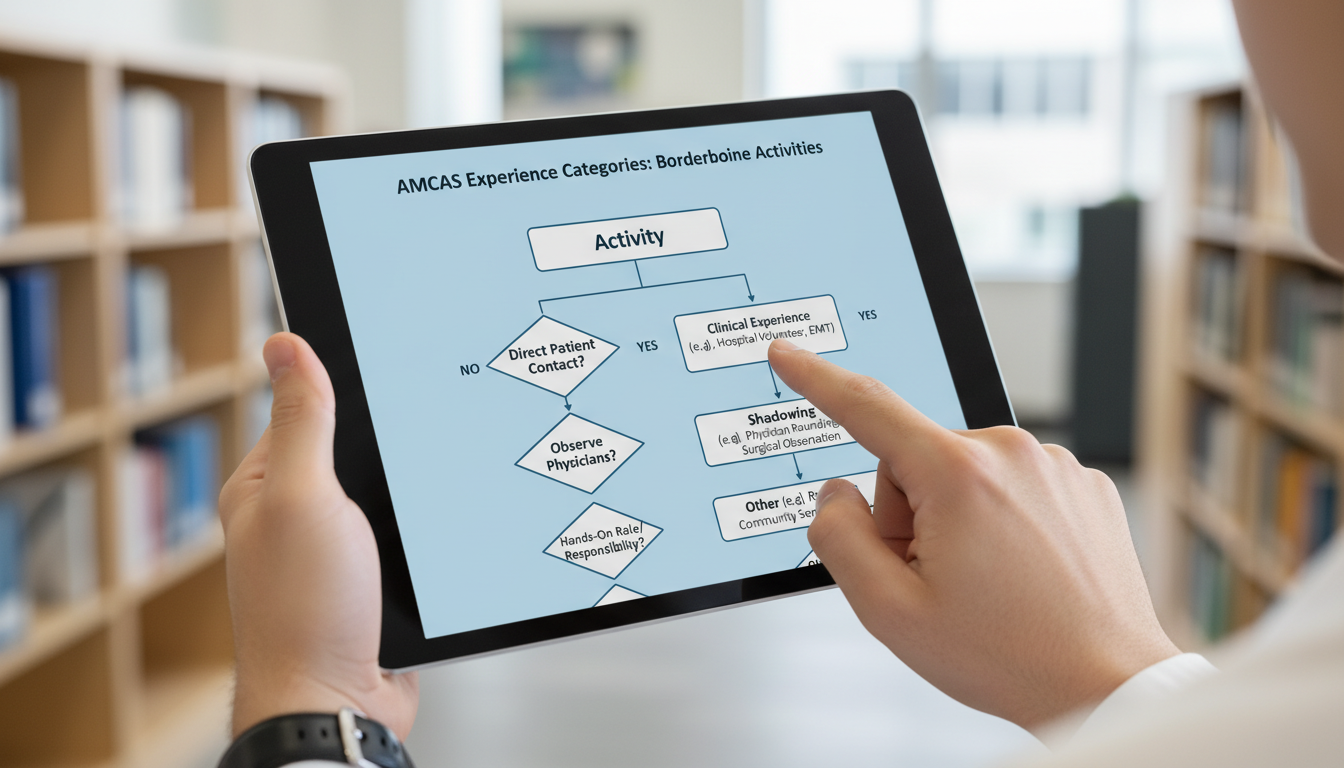
The Core Principle: Classify by Primary Function, Not Location
The single most useful rule for AMCAS experience categories:
You classify by what you were primarily doing and learning, not where you were standing.
That means:
- A hospital gift shop volunteer is usually Community Service / Volunteer – Not Medical/Clinical, not clinical.
- A paid medical assistant in an outpatient dermatology office is Medical/Clinical Experience, even though you are paid.
- A faculty-led bench research role in a hospital-based lab is almost always Research/Lab, not clinical.
(See also: Detailing Employment and Non-Traditional Work on AACOMAS Effectively for more insights.)
AMCAS does not care as much about:
- Whether you were paid or unpaid
- Whether you wore scrubs
- Whether the building had “Hospital” or “Clinic” on the door
AMCAS (and admissions committees) care about:
- Were you directly exposed to patient care?
- Were you generating or applying new knowledge?
- Were you serving a community or population?
- Were you teaching or leading others?
Once you anchor to that framework, borderline activities become much easier to classify.
Step 1: Know the High-Yield AMCAS Categories
There are 18 official AMCAS “Experience Types,” but for premed purposes, the high-yield ones where confusion happens are:
- Community Service / Volunteer – Medical/Clinical
- Community Service / Volunteer – Not Medical/Clinical
- Medical/Clinical Experience
- Research/Lab
- Leadership – Not Listed Elsewhere
- Teaching/Tutoring/Teaching Assistant
- Paid Employment – Not Military
- Physician Shadowing/Clinical Observation
- Extracurricular Activities
- Honors/Awards/Recognitions
- Conferences Attended
- Presentations/Posters
Everything else is used relatively rarely.
The trick is learning when an activity moves from one to another—especially for:
- Clinical vs non-clinical volunteering
- Shadowing vs clinical
- Research vs clinical
- Leadership vs generic extracurricular
- Teaching vs leadership vs employment
Let’s break down the borderline cases you actually wrestle with when filling out AMCAS.

Step 2: Clinical vs Non-Clinical – The Hard Line You Cannot Ignore
Most confusion stems from the word “clinical.” Students often over-label things as clinical to make their application sound stronger. Adcoms see through that quickly.
What actually counts as clinical?
Activities are Medical/Clinical (either as “Community Service – Medical/Clinical” or “Medical/Clinical Experience”) when:
- You have meaningful exposure to the patient’s experience of illness or health care, and
- Your role is integrated into the care environment, usually involving:
- Direct patient contact (not just proximity)
- Interaction that matters to the patient’s visit, comfort, or understanding
- Observation of clinical reasoning, communication, or procedures
Common examples that clearly count as clinical:
- Hospital volunteer who:
- Escorts patients to imaging, surgery, or appointments
- Brings blankets, water, or meals and spends time talking with patients
- Assists staff with patient-centered tasks (transport, discharge instructions support)
- Free clinic volunteer doing:
- Intake history (under supervision)
- Vitals collection
- Patient education or navigation
- Scribe in ED or outpatient clinic:
- Real-time documentation of patient encounters
- Direct exposure to physician-patient interaction and decision-making
- Medical assistant:
- Rooming patients, vitals, EKGs, assisting in procedures
These could be entered as:
- “Community Service / Volunteer – Medical/Clinical” if unpaid
- “Medical/Clinical Experience” if paid or structured employment
(There is flexibility—both are acceptable. The description will make the clinical nature clear.)
What is not clinical, even if it occurs in a hospital?
Borderline but usually not clinical:
- Front desk receptionist checking in patients but having no meaningful interaction beyond basic demographic questions and handing forms
- Hospital gift shop worker
- Volunteer who only does:
- Filing
- Stocking supply rooms
- Delivering mail or specimens
without interacting with patients or families in any meaningful way
- Laboratory work in a hospital basement far removed from patient care
These are better as:
- Community Service / Volunteer – Not Medical/Clinical (if volunteer, serving the institution or community)
- Paid Employment – Not Military (if a job)
- Research/Lab (if primarily research-oriented)
A simple test:
If a patient remembers you as part of their care experience, it is likely clinical. If they barely register you or never meet you, it is not.
Step 3: Shadowing vs Clinical Experience – Do Not Blend Them
AMCAS has a dedicated category:
- Physician Shadowing/Clinical Observation
Use this when your primary role is passive observation. You are not responsible for tasks that affect patient care. You are primarily watching and learning.
Examples:
- Standing in exam rooms observing a pediatrician see patients
- Following an orthopedic surgeon through clinic and OR days
- Observing ICU rounds without performing tasks
Many students try to label intensive shadowing as “Medical/Clinical Experience” to make it sound more substantial. That is unnecessary and can look disingenuous. Adcoms understand that 60–100 hours of well-structured shadowing across specialties is valuable and expected.
What about “shadowing plus” roles?
Some roles begin as shadowing and then evolve:
- Scribing + shadowing
- Shadowing in a free clinic, then doing basic vitals
- Shadowing that includes patient interviews under supervision
How to classify:
- If you were primarily observing:
→ Use Physician Shadowing/Clinical Observation - If you were primarily performing defined tasks in patient care:
→ Use Medical/Clinical Experience or Community Service – Medical/Clinical
You can mention the observational aspects in the description even if you choose a clinical category. The category should reflect what you spent most of your time doing.
Do not split one continuous role solely to squeeze more categories (e.g., “Pre-med clinic volunteer – 30 hours shadowing, 20 hours clinical” in two separate entries) unless the duties were clearly distinct and occurred in different phases.
Step 4: Research vs Clinical – The Hospital Lab Trap
Research is its own powerhouse category on AMCAS:
- Research/Lab
A common mistake: “I worked in a hospital, therefore it must be clinical.”
Not necessarily.
When is it clearly Research/Lab?
Use Research/Lab when:
- Your primary goal was generating new knowledge
- You were:
- Designing experiments
- Running assays
- Analyzing data
- Managing databases
- Writing abstracts or manuscripts
- Patient interactions, if any, were minimal or procedural (consent forms, surveys, basic measurements for a study)
In this case:
- Even if you recruited patients on inpatient wards, it is still research, not clinical experience. Your goal was the study, not their care.
When can research genuinely be considered clinical?
Rare, but possible in clearly hybrid roles. Examples:
- Clinical research coordinator in an oncology clinic who:
- Follows patients longitudinally
- Attends clinic visits
- Coordinates care around trial protocols
- Is deeply embedded in the care team
Here you have two choices:
- Classify as Research/Lab
- Focus your description on study design, data, protocols, regulatory work.
- Classify as Medical/Clinical Experience
- Focus your description on patient interactions, counseling, longitudinal relationships.
What you should not do:
- Duplicate the same role twice with minimal differentiation
- Call it “Research” in one entry and “Clinical” in another with overlapping hours
If the role is truly 50/50, choose the category that:
- Best matches what you learned and what you want schools to notice about this experience
- Aligns with how your mentor or PI would describe your position
Step 5: Leadership vs Extracurricular vs Employment
Another frequent gray zone involves campus organizations and jobs.
Leadership – Not Listed Elsewhere
Use Leadership when your primary function was:
- Setting direction
- Managing teams
- Coordinating logistics or operations
- Representing a group or cause
Examples:
- President of Pre-Health Society who:
- Ran meetings
- Delegated tasks
- Organized physician panels and MCAT workshops
- Founder of a new community outreach program
- Captain of a sports team where you:
- Conducted practices
- Mediated conflicts
- Interfaced with coaches and administration
Strong leadership entries focus on:
- Scope of responsibility
- Decision-making
- Problems you solved
- How you influenced people or systems
When is it just Extracurricular?
Use Extracurricular Activities when:
- You were a member, not a leader
- Your main role was participating (e.g., attending meetings, playing on the team)
- You did not have distinct supervisory or organizational duties
A common mistake:
- Labeling simple club membership as “Leadership” because you had an informal influence
- Overstating “leadership” when you were one of several event planners with minimal independent responsibility
If you were the Volunteer Coordinator for a club and:
- Assigned shifts
- Tracked hours
- Liaised with partner organizations
That can be solidly Leadership.
If you occasionally helped set up events but had no formal role:
- That belongs under Extracurricular Activities.
Employment vs Leadership vs Teaching
A paid job in which you supervised others may straddle categories:
RA (Resident Assistant) in a dorm:
- Could reasonably be Leadership – Not Listed Elsewhere
- Or Paid Employment – Not Military
- Pick one. Then describe both the employment and leadership aspects in the narrative.
Paid TA / Tutor:
- Best as Teaching/Tutoring/Teaching Assistant
- Mention that it was paid in the description.
The guiding principle:
What was the most defining function of that role?
That is your category.
Step 6: Teaching, Mentoring, and Advising Roles
Teaching deserves its own category because admissions committees value it highly:
- Teaching/Tutoring/Teaching Assistant
Use this when:
- Your primary activity was explaining, instructing, or coaching individuals or groups
- Content could be academic (organic chemistry), clinical (patient education), or skills-based (lab techniques)
Examples:
- Undergraduate TA for General Chemistry lab
- MCAT tutor for a commercial company or campus program
- Peer mentor who ran structured study sessions
- Volunteer ESL teacher at a community center
What about informal mentoring?
- If it was structured, recurring, and educational in nature, it can fit here:
- Example: Mentor in a pipeline program for underrepresented pre-health students where you ran monthly workshops and one-on-one advising.
- If it was mainly social or supportive without a clear educational component, consider:
- Extracurricular Activities
- Or fold it into a broader leadership description if tied to a leadership role.

Step 7: Community Service – Medical vs Non-Medical
This is where many borderline decisions occur, especially for premeds who diversify their service.
Community Service / Volunteer – Medical/Clinical
Use this for unpaid service that:
- Is clearly in a health care context
- Provides exposure to patient experiences or health-related needs
Examples:
- Free clinic volunteer taking vitals
- ED volunteer visiting patients and families, helping with comfort items
- Hospice volunteer providing companionship
- Vaccination clinic volunteer helping guide patients through the process
Community Service / Volunteer – Not Medical/Clinical
Use this for meaningful service that:
- Addresses non-medical needs (social, educational, economic, environmental)
- Occurs outside a formal health care setting, or within it but not involving patient care
Examples:
- Homeless shelter volunteer
- Food pantry or soup kitchen
- Habitat for Humanity builds
- Tutoring underserved K–12 students (can alternatively be Teaching/Tutoring, but many use non-clinical service)
- Organizing community drives, outreach events not directly tied to health
Borderline example:
- Volunteering at a senior center doing social activities (bingo, crafts, conversation)
- This can be either:
- Community Service – Not Medical/Clinical, focusing on social support
- Or Medical/Clinical if the center is clearly a long-term care facility and activities are integrated into patient care
- In practice, adcoms do not obsess over this line if your explanation is honest and coherent.
- This can be either:
The real mistake is calling all health-adjacent things “clinical” to inflate your clinical hours. A balanced application usually has:
- Some clearly clinical service
- Some clearly non-clinical service
Both matter.
Step 8: Handling Truly Borderline Mixed Activities
Some roles do not fit neatly into one box. That is reality. AMCAS forces a single category per experience.
Here is a disciplined way to handle mixed activities.
Step A: Calculate the time distribution
Estimate how your hours actually broke down:
Example: Hospital volunteer role
- 60%: Stocking rooms, transporting supplies
- 40%: Talking with patients, assisting with comfort measures
Example: Pre-health club presidency
- 50%: Organizing meetings and events (leadership)
- 30%: Volunteering at health fairs (service)
- 20%: Shadowing events (observation)
Step B: Ask: “What would an honest one-sentence description be?”
- “I helped manage a team and coordinate events for premed students.” → Leadership
- “I spent most of my time doing logistics in a hospital plus some patient contact.” → Likely non-clinical service, unless patient interaction was deeply meaningful
- “I mainly ran experiments and occasionally saw patients for recruitment.” → Research
Step C: Choose the category that matches that sentence
Then in your experience description, you can:
- Briefly acknowledge the secondary elements
- Emphasize the primary function
Example entry for the hospital volunteer:
- Category: Community Service / Volunteer – Not Medical/Clinical
- Description:
“As a volunteer in the XYZ Hospital support services program, I assisted staff by stocking supply rooms, transporting equipment, and maintaining unit organization. I occasionally delivered comfort items to patients and their families, which gave me brief but meaningful opportunities to observe how small gestures can ease the anxiety of hospitalization.”
This is more honest—and more effective—than forcing it into the “clinical” box.
Step 9: Special Problem Cases and How to Classify Them
Let me run through specific borderline scenarios that repeatedly cause confusion.
1. EMT / First Responder
- Category: Medical/Clinical Experience
Even though this is outside a hospital, it is unmistakably clinical:
- Direct patient care
- High acuity situations
- Often life-saving interventions
You may mention leadership (e.g., shift lead), but do not reclassify it as Leadership.
2. Medical Mission Trips / Global Brigades
You must be especially careful here.
If your “clinical” role was:
- Taking vitals under supervision
- Helping with pharmacy or patient flow
- Translating in clinical encounters
→ You can generally classify as Community Service – Medical/Clinical.
If your trip was mostly:
- Touring facilities
- Handing out hygiene kits
- Observing physicians
→ Consider a mix depending on what you actually did:
- Physician Shadowing/Clinical Observation
- Community Service – Not Medical/Clinical
Avoid exaggeration. Foreign settings do not magically convert observational or minimal-contact roles into robust clinical experience.
3. Health-related Peer Education Programs
Examples:
- Campus sexual health peer educator
- Mental health peer advocate
- Nutrition educator for lower-income families
Best categories depend on structure:
- If you are mainly teaching workshops, giving presentations, or running small groups:
- → Teaching/Tutoring/Teaching Assistant
- If the focus is on community outreach and service:
- → Community Service – Not Medical/Clinical
The fact that the topics are “health-related” does not necessarily make them “clinical.”
4. Hospital Volunteer – Only Transporting Patients
If you spent most of your time:
- Wheeling patients to imaging, surgery, or discharge
- Introducing yourself, confirming identity, explaining destination
- Answering basic questions and offering comfort
This can legitimately be argued as Community Service – Medical/Clinical. You are clearly part of the patient’s care experience, and your interactions matter.
Document that in the description:
- Mention specific conversations
- What you observed about fear, relief, or communication
- How you learned to interact with vulnerable, sick, or anxious individuals
5. Working as a CNA in a Nursing Home
- Category: Medical/Clinical Experience
Even though technically “long-term care,” CNAs:
- Perform direct patient care
- Assist with ADLs
- See the chronic realities of illness and aging
Adcoms see this as strong, gritty, real clinical exposure.
6. Administrative Roles in Clinics
Positions like:
- Front desk check-in staff
- Billing assistant
- Scheduling coordinator
These are usually Paid Employment – Not Military (or community service if unpaid).
They are health-care-adjacent, but not clinical.
In your description you can:
- Note your exposure to the health system
- Highlight appreciation for access issues, insurance confusion, no-shows
- But do not classify as clinical unless your duties extend well beyond the front desk.
Step 10: Strategy: How to Balance Your Overall Experience Profile
Classification is not just about honesty. It is also about signal management.
Medical schools scan AMCAS for patterns:
- Do you have sustained clinical exposure? (not just a 1-week trip)
- Do you have real service to communities?
- Have you engaged in research (for research-heavy schools)?
- Have you demonstrated leadership and teaching potential?
When choosing categories in borderline cases:
Safeguard integrity.
Never misclassify purely to “pad” clinical hours. Adcoms are very good at spotting inflation.Look for natural balance. For example:
- If you already have 2–3 strong, clearly clinical experiences (MA, scribe, hospice):
- You do not need to stretch another semi-clinical activity into the clinical category.
- If you are light on non-clinical service:
- Classify borderline hospital support work as non-clinical service where honest.
- If you already have 2–3 strong, clearly clinical experiences (MA, scribe, hospice):
Use descriptions to convey nuance.
The category is a headline. The description is where you prove the value.
Final Calibration Check: Three Questions for Every Borderline Activity
Before finalizing a classification, ask:
What did I actually do most of the time?
Not what you wish you had done. What your hours really looked like.What did this experience primarily teach me?
About patients, science, communities, teamwork, leadership?If a skeptical adcom read only my category and first two sentences, would they agree this classification is reasonable?
If the answer is “they might roll their eyes,” change it.
Key Takeaways
- Classify experiences by primary function, not building or job title; honesty plus clear descriptions are more impressive than category inflation.
- Distinguish sharply between shadowing vs clinical, research vs clinical, and leadership vs extracurricular; ambiguity here makes applications look unsophisticated.
- Use borderline experiences strategically but ethically to create a balanced profile across clinical, non-clinical service, research, leadership, and teaching without splitting or duplicating roles.