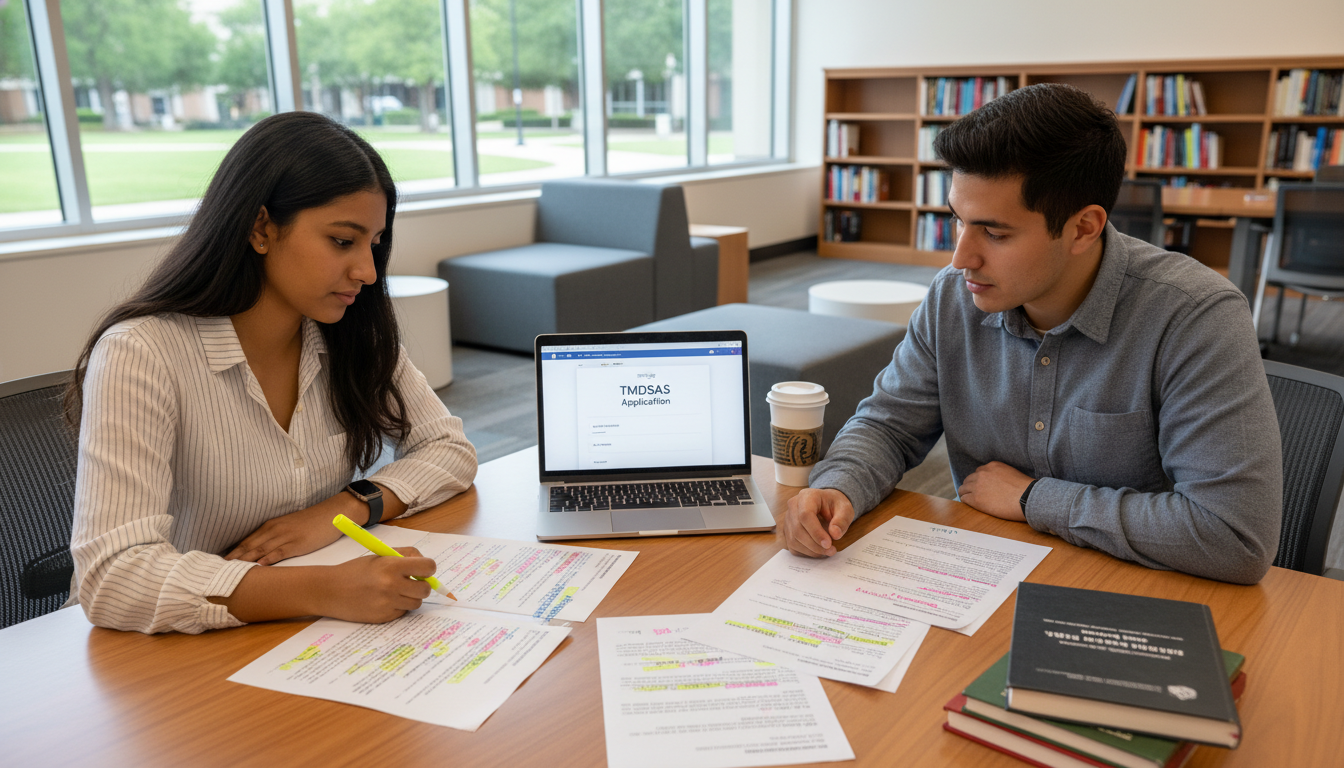
It is late June. Your TMDSAS primary application clocks in at 89% complete. You have your stats entered, activity descriptions written, optional essay roughed out. But there is one box still empty: the TMDSAS Personal Characteristics Essay.
You know the prompt is only 2,500 characters. You know Texas schools actually read this thing. But when you stare at the blank screen, everything sounds either cliché, performative, or like a diversity statement you think they want to hear.
Let me break this down specifically: what the Personal Characteristics Essay is, how Texas adcoms use it, and concrete structures and examples to help you write one that actually stands out without sounding contrived.
1. What TMDSAS Is Really Asking in This Essay
Here is the exact TMDSAS prompt for the Personal Characteristics Essay (they tweak wording slightly year to year, but the core is stable):
“Learning from others is enhanced in educational settings that include individuals from diverse backgrounds and experiences. Please describe your personal characteristics (background, talents, skills, etc.) or experiences that would add to the educational experience of others.”
On the surface, this looks like a generic “diversity essay.” It is not. For Texas schools, this essay functions like a multi‑tool:
- Context provider – Explains who you are beyond GPA/MCAT and whether you understand your own background and identity.
- Peer impact predictor – Helps schools imagine you in a small‑group PBL session, anatomy lab, or clinical team. What do you bring that changes the group dynamic?
- Self‑awareness check – Screens for emotional maturity, insight, and the ability to connect your story to others’ learning rather than just your own hardship or achievements.
- Fit with mission – Texas schools are unusually explicit about serving diverse and often underserved populations. This essay helps them gauge alignment with that reality.
(See also: Mastering AMCAS ‘Most Meaningful’ Entries for more details.)
Key conceptual shift:
They are not just asking, “How are you different?”
They are primarily asking, “How will who you are help other students learn better?”
Every strong essay does two things:
- Describes concrete personal characteristics or experiences.
- Makes an explicit bridge: “Here’s how those traits/experiences would impact my classmates’ learning environment.”
If you miss that second piece, you sound like a biography, not a contributor.
2. Common Mistakes That Flatten This Essay
Before building a strong structure, you need to know what to avoid. Most TMDSAS Personal Characteristics Essays fall into 4 predictable traps.
2.1 The Generic Identity List
“I am a first‑generation, low‑income, Hispanic woman in STEM.”
Then the essay stops at labels.
What goes wrong:
- Identity is stated but not explored.
- No specific stories to make the background feel real.
- No clear connection to how this identity changes the educational environment for peers.
Identity is relevant. Labels alone are not sufficient.
2.2 The “Hardship Dump” with No Arc
“I grew up poor, my family struggled, I worked multiple jobs…” and the essay stays in descriptive mode.
The problem is not talking about hardship. The problem is:
- No processing: what did you learn about yourself and others?
- No movement: how did these experiences shape how you interact in groups or understand patients?
- No forward link: how will those lessons show up in medical school settings?
Without that, you risk sounding like you think suffering alone is an automatic asset.
2.3 The Skills/Activity Resume
“In my free time, I play the violin, run marathons, and do research.”
This reads like repackaged activity descriptions. There is no through‑line, no insight, no sense of what being a violinist or runner actually does to your mindset, empathy, or communication style.
You can absolutely mention these things. But not as a list. You must interpret them.
2.4 The “What I Learned About Patients” Essay
This one sounds like a mini personal statement:
“I volunteered at a clinic for uninsured patients and learned about health disparities.”
This is subtly off‑prompt. The question is not:
- What you learned about others
- How patients impacted you
The question is:
- What about you will impact your classmates’ learning
You can reference clinical or volunteering work, but the center of gravity must be on your personal characteristics, not the patients’ situations.
3. Building a Strong TMDSAS Personal Characteristics Essay: Core Framework
Given the 2,500 character limit (roughly 400–450 words), you need structure.
Here is a simple but effective 4‑part framework tailored to TMDSAS:
- Anchor identity / context (1 short paragraph)
- Zoom into 1–2 defining experiences or traits (2 paragraphs)
- Connect explicitly to peer learning / classroom environment (1 paragraph)
- Forward‑looking synthesis (1 short paragraph)
Let’s unpack each component with concrete examples.
4. Step 1: Anchor Your Identity with Precision
You have 3–5 sentences to answer: “Who are you, and what lens do you see the world through?”
Strong opening anchoring:
- Is specific but not overloaded with labels.
- Often combines background with a key tension or contrast.
- Avoids grandiosity or vague claims.
Example openings (you would not use all of these, obviously):
- “I grew up translating medical bills and IEP meetings for my deaf parents in the Rio Grande Valley. Before I understood what ‘health literacy’ meant, I had lived the consequences of its absence.”
- “I am a non‑traditional applicant who spent five years as a high school science teacher on the east side of San Antonio. Every day in my classroom forced me to translate complex ideas into stories my students could own.”
- “My childhood moved between Army bases in Germany, El Paso, and rural Oklahoma. The constant shifting taught me to read new environments quickly and find common ground with classmates who had nothing obvious in common with me.”
Notice what these do:
- They locate the writer in a specific geography or role.
- They hint at skills (translation, teaching, adaptability) without listing them.
- They create curiosity; the reader wants the next layer.
What to avoid here:
- “Since I was young, I have been exposed to diversity in many forms.” (Too vague.)
- “I come from a diverse and unique background that will help others learn from my experiences.” (Tells rather than shows.)
Anchor first. Then zoom.
5. Step 2: Choose 1–2 Defining Experiences or Traits
You cannot cover your entire life. You must be selective.
Good guiding question:
If my classmates understood just two things about how I became who I am, what would help them learn from me the most?
Common high‑yield themes for TMDSAS:
- Language and translation roles (for family, at work, in community)
- Socioeconomic navigation (working through school, managing instability)
- Non‑traditional paths (military, teaching, other careers)
- Rural / small‑town experiences (especially in Texas)
- Disability or chronic illness (self or immediate family)
- Deep cross‑cultural exposure (migrating, border communities)
- Unique communication roles (debate, teaching, coaching, mediation)
- Faith or community structures (when they shape how you relate to others, not just beliefs)
You want to:
- Tell 1–2 short, concrete micro‑stories.
- Pull out 1–3 personal characteristics those experiences built.
- Use specific sensory or situational details, not generic statements.
Example paragraph (shortened for space):
“By thirteen, I was the primary interpreter for my parents at clinics and school meetings. I remember sitting in an ENT office in McAllen, watching the physician rush through an explanation of my mother’s surgery while my dad nodded, clearly not understanding. Translating in real time, I had to decide what to simplify, what to emphasize, and when to interrupt for clarification. Those visits honed my ability to pause fast‑moving conversations, name the confusion in the room, and rebuild explanations in language my parents could truly own.”
What personal characteristics are being demonstrated here?
- Comfort interrupting hierarchy when clarity is missing.
- Real‑time translation of complex information.
- Sensitivity to the emotional undercurrent (father nodding without understanding).
Then you name them explicitly in a follow‑up sentence or two:
“That role shaped me as someone who listens for what is not being said, who notices when agreement is performative rather than real. It also taught me that understanding depends as much on cultural and emotional context as on vocabulary.”
Now the adcom is not guessing; you have interpreted your experience.
6. Step 3: Make the Explicit Bridge to Educational Impact
This is where many applicants fail. They tell an interesting story and assume the “impact on peers” is obvious.
You need to draw that line for the reader.
Explicit bridging language you can adapt:
- “In a medical school classroom, this would translate into…”
- “Among my peers, I tend to be the person who…”
- “In small‑group settings, I use these skills to…”
- “For my classmates, this means they would have a peer who…”
Example bridge using the previous interpreter story:
“In a small‑group case discussion, I am usually the first to pause and ask the quiet student to share what they are thinking, or to restate a complex explanation in plainer terms. My background as a family interpreter would allow me to help classmates notice when a patient—or a peer—is nodding along without true understanding, which deepens the group’s ability to communicate across literacy and language differences.”
You have now directly answered:
How do your personal characteristics “add to the educational experience of others”?
A second example from a non‑traditional teacher:
“As a former high school teacher, I instinctively break down pathophysiology into analogies and scaffolds. In problem‑based learning, I would be the classmate who can reframe a dense lecture into a visual or story that makes sense for someone struggling, and who is comfortable giving and receiving feedback from peers without defensiveness.”
Make this bridge explicit at least once. Twice is acceptable if both connections are distinct and specific.
7. Step 4: Forward‑Looking Synthesis (Closing Paragraph)
Your last 3–5 sentences should:
- Pull together the traits you have demonstrated.
- Reaffirm your orientation toward others’ learning, not just your own narrative.
- Point toward how you will function in the future clinical learning environment.
You do not need a grand finale. You need clarity.
Example closing:
“Collectively, these experiences have made me a careful listener, a translator across cultures and education levels, and someone who is comfortable naming confusion in high‑stakes settings. In medical school, I hope to be the peer who asks the question others are afraid to ask, who can help bridge between classmates from rural and urban Texas, and who can make complex material more accessible for the group. I look forward to learning from my peers’ backgrounds with the same humility I brought to my family’s kitchen‑table conversations, where every story required slowing down and listening closely.”
Notice: no dramatic flourish. Just a clean synthesis and forward projection.
8. How This Essay Should Differ from Your Personal Statement and Optional Essay
TMDSAS asks for three substantial written pieces:
- Personal Statement (5,000 characters) – “Why medicine?” narrative.
- Personal Characteristics Essay (2,500 characters) – Who you are / what you add to peers’ learning.
- Optional Essay (2,500 characters) – Context, hardships, or additional information.
You must avoid redundancy while letting these essays illuminate different angles of you.
8.1 Personal Statement vs Personal Characteristics Essay
Personal Statement:
- Center: Your motivation and path to medicine.
- Focus: Experiences that confirmed or shaped your desire to be a physician.
- Audience lens: “Do I believe this person understands what a medical career entails and is prepared for it?”
Personal Characteristics Essay:
- Center: Your identity, traits, and the way you operate in groups.
- Focus: How your background, skills, and experiences will influence the learning environment for others.
- Audience lens: “What would this person be like as a classmate in our small group, lab, and clinical teams?”
Concrete example of differentiation:
- Personal Statement: You discuss working in a free clinic and the moment you realized you wanted to advocate for the uninsured Latina women you served.
- Personal Characteristics Essay: You highlight how growing up as the oldest daughter in a Spanish‑speaking household made you a cultural and linguistic bridge, and how that shows up when classmates struggle with communicating across language barriers.
Same life domain. Different emphasis and function.
8.2 Optional Essay vs Personal Characteristics Essay
The TMDSAS optional essay prompt focuses on additional information, challenges, or barriers that are not fully coded elsewhere.
Use:
Optional Essay for:
- Academic disruptions.
- Major life events (illness, caretaking, migration, disasters).
- Explaining context for lower grades, leaves, or atypical timelines.
Personal Characteristics Essay for:
- How those same situations changed your traits and how you operate with others.
- Concrete ways your classmates’ education will be enriched because of how you grew through those challenges.
If you describe the same hardship in both essays, the angle must be distinct:
- Optional: “Here is why my sophomore year GPA dipped; I was working 30 hours per week and caring for a sick grandparent.”
- Personal Characteristics: “Balancing work, school, and caretaking taught me how to prioritize under pressure and recognize burnout in myself and others. In group settings, this translates into being sensitive to overextension and modeling sustainable work habits.”
9. Concrete Mini‑Outlines You Can Adapt
Sometimes it is easier to see structures than abstract principles. Here are three skeletons for different applicant profiles.
9.1 First‑Generation, Low‑Income Texas Applicant
Paragraph 1 (Anchor):
- Where you grew up (e.g., colonias in South Texas, Dallas public housing, rural Panhandle).
- Brief mention: first in family to pursue college, parents’ occupations.
- One sentence hinting at your “translator / navigator” role.
Paragraph 2 (Experience 1):
- Specific scene: working during high school or college, or helping family navigate systems (FAFSA, healthcare, legal).
- What this taught you about systems, power, or persistence.
- Explicit characteristics: resilience, resourcefulness, responsibility at a young age.
Paragraph 3 (Experience 2):
- Academic setting where you bridged between peers from different backgrounds (tutoring, study groups, mentoring).
- How you made others more comfortable or successful.
- Difference between how you see opportunity vs how some peers see it.
Paragraph 4 (Bridge):
- Direct statements: how you will show up in TMDSAS schools’ classrooms.
- Example: helping peers understand patients from low‑income backgrounds, modeling questions to uncover hidden barriers, or normalizing asking for help.
- Synthesis sentence referencing Texas contexts if authentic (rural/urban disparities, border health, etc.).
9.2 Non‑Traditional Applicant (Teacher, Military, Career‑Changer)
Paragraph 1:
- One‑sentence summary of prior career and years in it.
- Quick contrast: how that role sharpened certain interpersonal or leadership skills.
- One specific anecdote teaser (e.g., “standing in front of 32 tenth‑graders at 7:30 AM…”).
Paragraph 2:
- Micro‑story from that role that demonstrates your communication, conflict resolution, or team coordination.
- Explicitly name traits (patience with learners, comfort with feedback, managing diverse personalities).
Paragraph 3:
- How these traits show up in your academic or premed life (study groups, mentoring younger students, leading organizations).
- Example of shaping a group’s culture, not just your own performance.
Paragraph 4:
- Bridge to medical school: your comfort with teaching peers, giving/receiving constructive criticism, or leading under uncertainty.
- Emphasize how your maturity stabilizes and enriches a cohort that includes students straight from undergrad.
9.3 Applicant with Bilingual / Cross‑Cultural Background
Paragraph 1:
- Where you grew up and languages you speak.
- One sentence showing how switching languages was part of daily life.
Paragraph 2:
- Scene of misunderstanding or miscommunication you helped navigate (clinic, school, store, work).
- What you noticed about body language, tone, or cultural assumptions.
- Traits: heightened attunement to nonverbal cues, perspective‑shifting, cultural humility.
Paragraph 3:
- Example of helping peers navigate cross‑cultural situations (shadowing, volunteering, tutoring ESL students).
- Describe how you explain cultural concepts to those unfamiliar, without shaming or stereotyping.
Paragraph 4:
- Bridge: in a Texas medical school with diverse classmates and patients, you will:
- Help peers practice Spanish or avoid “Spanglish” pitfalls with patients.
- Translate cultural contexts in case discussions.
- Normalize asking questions about culture respectfully.
10. Style, Tone, and Technical Details Specific to TMDSAS
10.1 Tone Calibration
Aim for:
- Reflective, not dramatic.
- Humble, not self‑erasing.
- Clear, not overly literary.
You are writing for busy physicians and admissions staff who might be reading 80 of these in a day. Respect their time by being concrete and direct.
Avoid:
- Overly poetic metaphors that obscure meaning.
- Jargon‑heavy sociological language unless you use it sparingly and define it through example.
- Self‑congratulation. Confidence is fine; hero narrative is not.
10.2 Character Count Strategy
You have 2,500 characters including spaces.
- Draft long first (700–800 words).
- Revise down aggressively, cutting filler words and side tangents.
- Aim for ~400–450 words final.
Hard decisions you will have to make:
- Choosing one strong anecdote rather than three weaker ones.
- Letting some parts of your background go untouched in this essay because they are in your personal statement or activities.
- Cutting hedging phrases (“I think,” “I believe,” “in many ways,” “I feel that”).
10.3 TMDSAS‑Specific Considerations
Since all public Texas schools share this application:
- You are writing for a mix of missions: rural‑focused (Texas Tech Health Sciences Center), urban underserved (UTMB, McGovern, Long School of Medicine), research‑heavy (UT Southwestern), new schools (UTRGV, TCU if using TMDSAS that year).
- You do not need to tailor to one school. Instead, emphasize traits that travel well across these settings:
- Working with diverse populations.
- Adaptability to new environments.
- Comfort with collaborative learning.
- Awareness of Texas’ health landscape if you genuinely have that perspective.
Do not name any one school in this essay. Save school‑specific tailoring for secondaries.
11. Workflow for Drafting and Refining
A practical, stepwise approach:
- Freewrite 10 minutes on “Times I impacted how a group learned” – do not censor, list scenes.
- Circle 2–3 that feel most distinct and most “you.”
- Draft your anchor paragraph describing your background and lens succinctly.
- Write 1 paragraph per chosen scene, focusing on:
- What happened.
- What you did.
- What this reveals about your traits.
- Add the explicit bridge paragraph: “In a medical school setting, this means…”
- Write a short closing that ties traits together and looks forward.
- Cut for character count:
- Remove repetition.
- Replace vague adjectives with specific descriptions.
- Ensure at least one explicit “impact on peers’ learning” sentence remains.
Have one or two trusted readers who understand medical admissions read specifically for:
- Clarity of what traits you bring.
- Whether the connection to peers’ learning is clear.
- Whether anything sounds performative or like “what they want to hear” instead of your actual voice.
Avoid over‑editing with seven different people. That often sands off your individuality.
12. FAQs
Q1: What if I do not feel “diverse” or do not have a dramatic background?
You do not need a dramatic story. Focus on how you interact in groups and what life experiences shaped that. Maybe you grew up in a stable middle‑class home in Plano but spent years leading a Special Olympics team, or you are the sibling of a child with autism and have developed unusual patience and observation skills. The essay is about personal characteristics and their impact, not competing in a hardship Olympics.
Q2: Can I reuse content from my AMCAS or AACOMAS “disadvantaged” or diversity essay?
Parts, yes. But you must adapt it to the TMDSAS prompt’s emphasis on the educational experience of others. If your other essay focuses mainly on what you went through, modify it to show how those experiences shape what you contribute to classmates’ learning and group interactions.
Q3: Is it risky to talk about sensitive topics like mental health, disability, or immigration status?
It depends on how you frame it. If you choose to share, focus on:
- What you learned about yourself and others.
- How it shaped stable, durable traits.
- How you are functioning now (especially with mental health).
You are not obligated to disclose any diagnosis or legal status. You can describe context and traits without revealing every detail.
Q4: Should I explicitly mention Texas or Texas communities in this essay?
Only if it is authentic. If your background is rooted in Texas—rural practice, border communities, Houston’s immigrant neighborhoods—brief references can help readers see your lived familiarity with the populations they serve. If you are from out of state, do not force Texas references. Focus instead on characteristics that will travel well into any diverse, collaborative learning environment.
Key takeaways:
- Treat the TMDSAS Personal Characteristics Essay as a “how I will be as a classmate” essay, not a second personal statement.
- Use 1–2 specific experiences to reveal concrete traits, then explicitly connect those traits to how you enhance peer learning.
- Be selective, precise, and honest. Depth on a few well‑chosen characteristics will stand out more than a broad, generic list.