It is a Sunday night. Your AMCAS activities section is open in one tab, your old clinic schedules and pay stubs in another, and a blank Word document sitting in the middle of your screen. You have 1,500+ hours as a scribe, another 800 as a medical assistant, and a patchwork of per‑diem shifts in urgent care, primary care, and orthopedics.
(See also: Mastering AMCAS ‘Most Meaningful’ Entries for tips on documenting experiences.)
You know you did a lot. You are not sure how to present it without looking repetitive, disorganized, or like you are playing games with the hour counts.
This is where most strong clinical applicants stumble: not on what they did, but on how precisely they document it.
Let me break this down specifically.
1. First Principles: How Admissions Committees Read Your Clinical Work
Before deciding how to document scribing, MA work, or other clinical jobs across services, you need to understand how an application reader will look at it.
They care about three things:
Exposure
- How many hours, over how long, in what settings?
- Did you “live” in the clinical environment or just visit it?
Functions and progression
- What were your core tasks?
- Did your role evolve (more responsibility, new skills, training others)?
Breadth and depth of context
- Which patient populations?
- Which specialties and acuity levels (ED vs dermatology vs urgent care)?
- Any insight into teams, systems, or healthcare delivery?
Your documentation strategy should exist to answer these questions clearly, not to “game” the system or maximize line counts.
Key rule:
If experiences are fundamentally the same role (same employer, same job title, same skill set), but spread across multiple locations or services, you generally document them as one combined activity. You then use the description to articulate the variety within that umbrella.
2. Understanding the Application Platforms: Constraints and Levers
Different platforms have different character limits and structures. Your strategy shifts slightly depending on what you are using.
AMCAS (MD)
- Up to 15 experiences, with:
- 700 characters for standard activities
- 1,325 characters for up to 3 “Most Meaningful”
- No separate “position vs location” fields across multiple roles under one entry, so you must structure variety inside the description.
- Activities are tagged: clinical, nonclinical, employment, research, etc.
AACOMAS (DO)
- Similar general concept, but:
- Different character limits
- Slightly different categorization (e.g., Healthcare Experience vs Patient Care Experience)
TMDSAS (Texas schools)
- Fewer structured activity slots, more narrative description.
- Often better to combine similar jobs more aggressively and explain categories in the narrative.
The principles below will be AMCAS‑oriented but apply equally to AACOMAS and TMDSAS with slight adaptation.
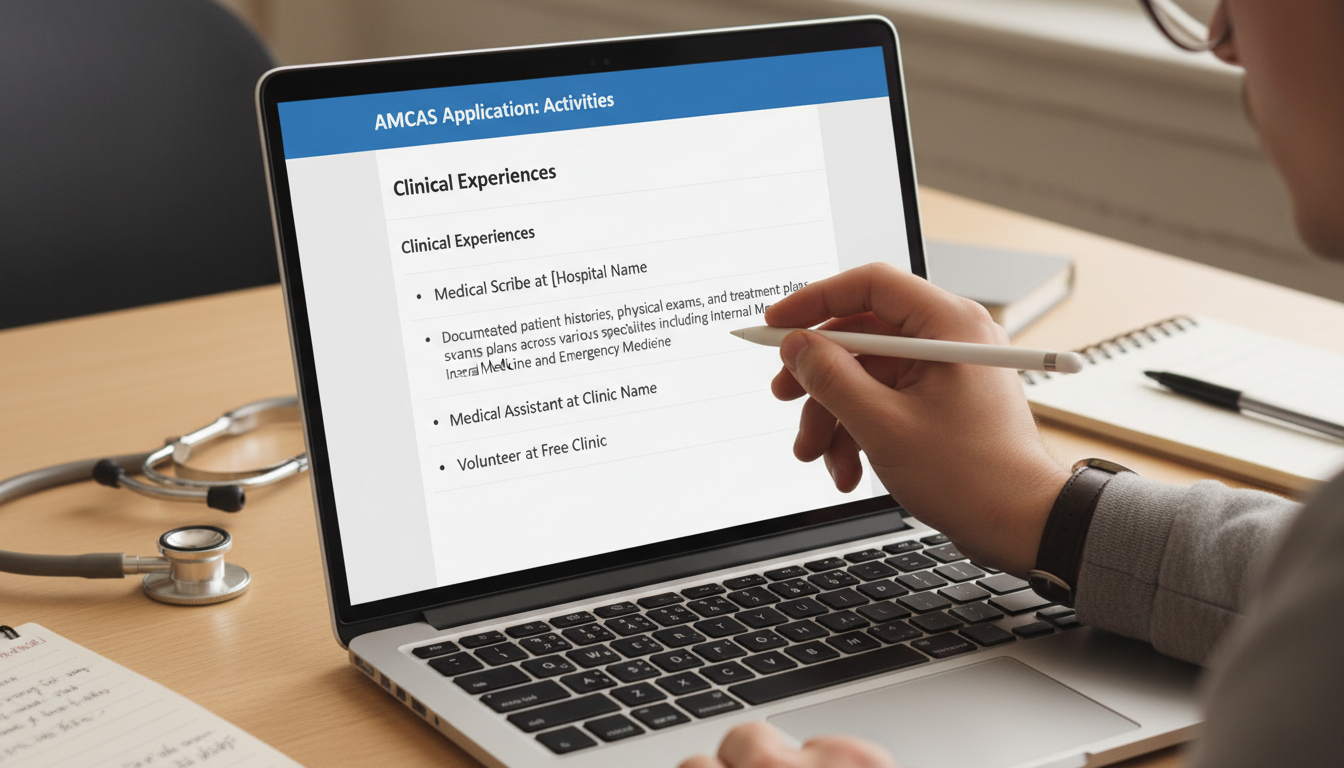
3. Scribing Across Multiple Specialties or Sites
Scribing is one of the most fragmented clinical experiences: students often work in EDs, clinics, and hospital floors, across different providers and even different specialties.
The key distinction:
Are these roles same employer / same position / overlapping skill set, or genuinely different jobs?
Scenario A: Same company, different specialties (e.g., ScribeAmerica; ED + cardiology clinic)
Example profile:
- 600 hours: ED scribe, community hospital
- 400 hours: Cardiology clinic scribe, same vendor
- 250 hours: Inpatient cardiology consult service, same vendor
These share:
- The same job title
- Similar documentation responsibilities (HPI, ROS, PE, MDM, orders)
- Same overarching skill set: real‑time charting, seeing physician thought processes
Best approach: One combined entry
Title:
“Medical Scribe – Emergency Medicine and Cardiology”
Organization Name:
“ScribeAmerica (Community Hospital & Cardiology Associates)”
Experience Type:
- AMCAS: “Paid Employment – Medical/Clinical” or “Clinical Experience” (either is defendable; I usually recommend “Employment – Medical/Clinical” for paid scribing)
Hours and dates:
- Start: 06/2022
- End: 08/2024 (or “Present” if still working)
- Total Hours: Sum across all services (e.g., 1,250)
Description structure (critical):
You have 700 characters (or 1,325 if Most Meaningful). Use a structured mini‑outline, not a wall of text.
Example:
Worked 1,250 hours as a scribe through ScribeAmerica across emergency medicine and cardiology.
Emergency Department (600 hrs): Documented HPI, ROS, exam, MDM, and procedures for high-acuity patients in a community ED. Observed triage decision-making, rapid stroke and sepsis evaluations, and high-volume workflow.
Outpatient Cardiology (400 hrs): Charted for new and follow-up visits, focusing on heart failure, arrhythmias, and ischemic disease. Saw longitudinal management, medication titration, and shared decision-making.
Inpatient Cardiology Consults (250 hrs): Assisted with daily consult notes and follow-ups. Gained exposure to complex comorbidities, interdepartmental communication, and discharge planning.
Notice:
- One entry
- Sub-bullets by setting with hours labeled
- Clear sense of scope and evolution without needing multiple lines
Scenario B: Different employers / very different role expectations
Example:
- 500 hours: ED scribe, vendor‑based, mostly documentation
- 300 hours: Physician’s private practice “scribe” but also doing front desk, rooming patients, vitals, EKGs (this is effectively MA‑level care)
Here, the second is functionally a hybrid scribe/MA job, more direct patient care. Splitting can be justified because the second role crosses into hands-on clinical work.
How to document:
Entry 1 – ED Scribe
- Title: “Medical Scribe – Emergency Department”
- Type: Paid Employment – Medical/Clinical
- Focus on documentation, exposure to acute care, teamwork.
Entry 2 – Clinical Assistant / Scribe
- Title: “Clinical Assistant / Medical Scribe – Internal Medicine”
- Type: Clinical Experience – Paid
- Describe patient-facing tasks: vitals, rooming, EKGs, occasional phone follow-up.
You are not splitting just to increase entry count. You are splitting because the nature of your work and degree of patient contact differed substantially.
4. Medical Assistant (MA) Work Across Multiple Services or Clinics
MA roles are highly variable and can become messy quickly if you do not standardize how you talk about them.
The principles are similar:
- Combine when role, employer, and level of responsibility are essentially the same.
- Split when the skill set and responsibilities differ meaningfully.
Scenario C: One job, rotating across services
Example:
You are hired by a large multispecialty clinic. Over two years you:
- Start in family medicine, 10 months
- Float occasionally to pediatrics
- Later move into orthopedics as your primary clinic
- Same employer, same job title, same HR position
Core functions: rooming, vitals, in-basket messages, simple procedures, documentation.
Best approach: One combined MA entry
Title:
“Medical Assistant – Family Medicine, Pediatrics, and Orthopedics”
Organization:
“Northside Multispecialty Clinic”
Type:
Paid Employment – Medical/Clinical or Clinical Experience
Description strategy:
- Open with global summary.
- Break down by service line, including time or hours distribution.
- Highlight scope of practice and responsibility.
Example:
Worked 1,800 hours as a full-time MA at a multispecialty clinic. Responsibilities included rooming patients, obtaining vitals, medication reconciliation, point-of-care testing, vaccinations, and EHR documentation.
Family Medicine (900 hrs): Managed a broad panel across the lifespan. Coordinated chronic disease follow-up visits, annual wellness exams, and same-day urgent complaints. Learned to distinguish issues manageable outpatient vs requiring ED transfer.
Pediatrics (300 hrs): Floated 1–2 days/week. Assisted with well-child checks, developmental screenings, vaccine counseling, and acute visits for infections/asthma.
Orthopedics (600 hrs): Transitioned to orthopedics full time. Prepared patients for joint injections and minor procedures, handled post-op visits, and reinforced rehab and activity-modification plans.
Same role. Multiple settings. One entry.

Scenario D: Different MA roles in meaningfully different environments
Example:
- 900 hours: MA in an outpatient primary care clinic
- 700 hours: MA in an urgent care with higher acuity, procedures, and on-site imaging
- Different employers, different workflows, one is more akin to ambulatory ED-lite
You can reasonably differentiate:
- Outpatient primary care MA
- Urgent care MA (higher acuity, rapid turnover)
Document as two entries because this tells a richer story of your clinical exposure.
Entry 1 – MA, Primary Care
- Emphasize continuity, chronic disease management, patient rapport over time.
Entry 2 – MA, Urgent Care
- Emphasize triage, rapid assessment, procedures, exposure to undifferentiated complaints.
Again, your justification for splitting is about qualitative difference, not just “I want more lines.”
5. Other Clinical Jobs: CNA, ER Tech, Phlebotomist, Patient Care Tech
These roles follow the same logic, but there are a few typical pitfalls.
When to combine
Combine multiple assignments into a single entry if:
- Same hospital or health system
- Same job title
- Duties are 80–90% overlapping
- Locations differ (e.g., med-surg vs ortho floor) but core functions are stable
Example:
Patient Care Technician – Community Hospital (Med-Surg, Ortho, and Telemetry Units)
Then in the description:
- Global summary of PCT responsibilities
- Brief unit-specific notes with estimated hours or % of shifts on each unit
When to split
Split if:
- You have one role heavily focused on one type of clinical population (e.g., NICU) and another on a very different one (e.g., adult oncology, hospice)
- Or one role is technically different: CNA in long-term care vs ER Tech in ED
In those cases, separate entries allow you to demonstrate breadth of patient populations, disease acuity, and care settings.
6. Combining vs Splitting: Decision Framework
To avoid overthinking every job, use this decision tree:
Same employer and HR position?
- Yes → continue to 2
- No → strongly consider separate entries, unless one role is extremely minor
Same job title and similar day-to-day functions?
- Yes → usually combine
- No → consider split if function changes (e.g., scribe vs MA-like hybrid)
Would splitting tell a meaningfully different story about your exposure or responsibility?
- Yes → split
- No → keep as one; use description to show variety
Would splitting create 2–3 nearly identical entries (“Scribe – ED A”, “Scribe – ED B”)?
- Yes → almost always combine into one “ED Scribe – multiple sites”
- No → proceed based on qualitative differences
Do you have enough activity slots?
- If you are running out of AMCAS/AACOMAS slots, you must combine more ruthlessly
- If you have extra slots, you still should not artificially split, but you can separate truly distinct roles more comfortably
7. Calculating and Presenting Hours Across Services
Sloppy hour accounting undermines credibility. You want your numbers to feel plausible and traceable.
Stepwise method
Collect data:
- Pay stubs
- Scheduling software screenshots
- Email confirmations with assigned shifts
- Approximate shift frequency if exact data are unavailable
Estimate hours-by-location:
- For each site or service, estimate average weekly hours × number of weeks
- Document assumptions for yourself in a separate file (not submitted, but for your own consistency)
Sanity checks:
- Compare total weekly work hours vs semester credit load.
- Ensure your total hours across all activities do not exceed what is humanly feasible.
Translate into application:
- AMCAS asks for total hours per activity
- If one activity covers multiple services, report the combined total
- Inside the description, you can state approximate distribution:
- “Approx. 700 hrs ED, 400 hrs clinic, 200 hrs inpatient”
Forward vs completed hours
- For ongoing clinical jobs, AMCAS allows you to project future hours until the matriculation year.
- Keep projections conservative and grounded in actual schedules (e.g., “10 hrs/week for 30 weeks”).
Example:
Total 1,500 hrs (1,200 completed, 300 anticipated through 05/2025 at ~10 hrs/week).
8. Writing Activity Descriptions That Capture Complexity Without Chaos
Once you decide how to group experiences, the quality of your description determines whether the reader understands your cross-service work.
Structural template for multi-service entries
Use a three-part structure:
1–2 lines: Global summary
- Role, total scope, overall environment
2–4 lines: Service-specific breakdown
- Subheadings or bold service names with hours or approximate proportion
- Concrete functions, population differences, acuity
1–2 lines: Reflection or insight (optional, but recommended for clinical)
- What you learned about patients, systems, or yourself
Example for a combined scribe entry (Most Meaningful):
Completed 1,450 hours as a medical scribe across emergency medicine and hospital medicine at a safety-net hospital. Documented real-time patient encounters and orders in the EHR, allowing physicians to focus on the bedside.
Emergency Department (950 hrs): Charted for attendings and residents seeing high-volume undifferentiated complaints. Observed triage prioritization, rapid stroke and sepsis evaluations, and complex disposition decisions for uninsured patients.
Hospital Medicine (500 hrs): Joined daily rounds on medicine floors. Prepared admission H&Ps, progress notes, and discharge summaries. Saw how social barriers, polypharmacy, and limited outpatient access extend hospital stays.
These experiences shifted my view of clinical work from a single visit to an entire system—how documentation, communication, and follow-up determine whether an ED visit solves a problem or begins a cycle of readmissions.

Tactical writing tips
- Use specific verbs: documented, roomed, triaged, reconciled, assisted with procedures.
- Name 2–3 concrete conditions or procedures: chest pain workups, laceration repairs, COPD exacerbations, joint injections.
- Show variance in acuity: stable clinic follow-ups vs undifferentiated ED arrivals.
- Avoid generic filler: “I learned the importance of teamwork” with no specifics.
9. Handling Overlap Between Scribing, MA Work, and Other Clinical Roles
Many applicants have stacked clinical roles:
- You started as a scribe
- Later added MA work
- Maybe added a CNA job in summers
The question: How to avoid sounding repetitive?
Strategy 1: Differentiate by type of involvement
- Scribing → observational + cognitive exposure to clinical reasoning and documentation
- MA/CNA/Tech → direct patient contact, procedures, logistics of care
- Volunteer patient interaction → often more relational, less technical, sometimes with vulnerable populations
Make sure each activity description emphasizes different:
- Skill sets
- Perspectives on care
- Types of responsibility
Strategy 2: Timeline coordination
If your roles overlap in time, you can still list them separately. Just ensure:
- Your total weekly work load (summed across roles) remains realistic.
- Your narrative in secondary essays or interviews can explain how you balanced them.
Example rough breakdown:
- 2021–2022: Scribe, 12–16 hrs/week during school, 30–35 hrs/week summers
- 2023: Transitioned from scribe to MA, 18–20 hrs/week during school
- 2024: Per-diem CNA shifts on weekends, 8–12 hrs/week
You do not need to explain exact scheduling in the activity description, but having a consistent internal record helps during interviews.
10. Common Mistakes When Documenting Clinical Work Across Services
A few patterns repeatedly weaken otherwise strong clinical portfolios.
Mistake 1: Artificially splitting identical roles
Example:
- “Scribe – ED Hospital A”
- “Scribe – ED Hospital B”
- “Scribe – ED Hospital C”
Each with 300–400 hours and nearly identical descriptions. This wastes space and irritates readers.
Fix: One entry: “Medical Scribe – Emergency Departments (multiple community hospitals)” with site-specific details inside.
Mistake 2: Hiding variety inside vague language
Example:
I worked in various departments and saw a wide range of conditions.
This tells the reader nothing. Name the departments. Name a few condition categories. Clarify your role.
Mistake 3: Overstating responsibilities
Especially for MA- and scribe-type roles. If you “assisted with procedures,” admissions readers want to know whether that meant:
- Handing supplies and documenting, or
- Actually performing injections, suturing, or medication administration
Be precise and honest. Overclaiming is a fast track to credibility loss in interviews.
Mistake 4: Ignoring non-patient-facing but clinically relevant work
Some scribes and MAs also:
- Managed in-basket messages
- Coordinated referrals
- Helped with prior authorizations
- Managed room turnover and infection control protocols
You should mention this, especially if you saw how administrative burdens shape patient care. It helps admissions understand your systems-level perspective.

11. Putting It All Together: A Concrete Example Portfolio
Consider this hypothetical applicant:
- 900 hrs: ED Scribe (3 community hospitals, same vendor)
- 600 hrs: Outpatient family medicine MA
- 350 hrs: Patient Care Tech on med-surg floor
- 150 hrs: Hospice volunteer
A coherent documentation plan:
Activity 1 – Medical Scribe – Emergency Departments (Most Meaningful)
- Combined across 3 hospitals
- Describes high-acuity exposure, physician reasoning, documentation
Activity 2 – Medical Assistant – Family Medicine Clinic
- Describes rooming, chronic disease management, vaccinations, continuity
Activity 3 – Patient Care Technician – Med-Surg Unit
- Highlights hands-on care, ADLs, monitoring, teamwork with nurses
Activity 4 – Hospice Volunteer
- Emphasizes long-term relational presence, end-of-life perspectives
Each role is differentiated by type of responsibility and care environment. There is no unnecessary splitting by site for the scribe job, and the narrative of growth in clinical exposure is very clear.
12. What This Looks Like Over Time
In your premed and early medical school preparation phases, you are not just accumulating hours; you are building a coherent clinical story.
If you:
- Choose roles thoughtfully
- Track your hours and settings accurately
- Learn to combine and differentiate experiences strategically
Then by the time you sit down with AMCAS or AACOMAS open on your screen, you will not be paralyzed by how to document cross-service work. You will already have a structure:
- A core entry for each type of role (scribe, MA, tech, volunteer)
- Within each, a clear mapping of which services, how many hours, and what you actually did
From there, secondary essays and interviews become an extension of this structure, not a salvage operation.
With these foundations in place, you are positioned to use your clinical work as evidence—not just that you have been in hospitals and clinics—but that you understand how care is delivered in different settings. The next step is learning how to translate these same experiences into compelling personal statements and secondary responses. That, however, is a separate part of your journey.