
The biggest AMCAS mistake is not a bad essay or a weak activity description. It is a broken timeline.
Students with 3.9 GPAs and 520 MCAT scores sabotage their cycle simply by submitting late or in a chaotic rush. If you want maximum interview invites, you must treat your AMCAS submission as a months‑long project with clear checkpoints.
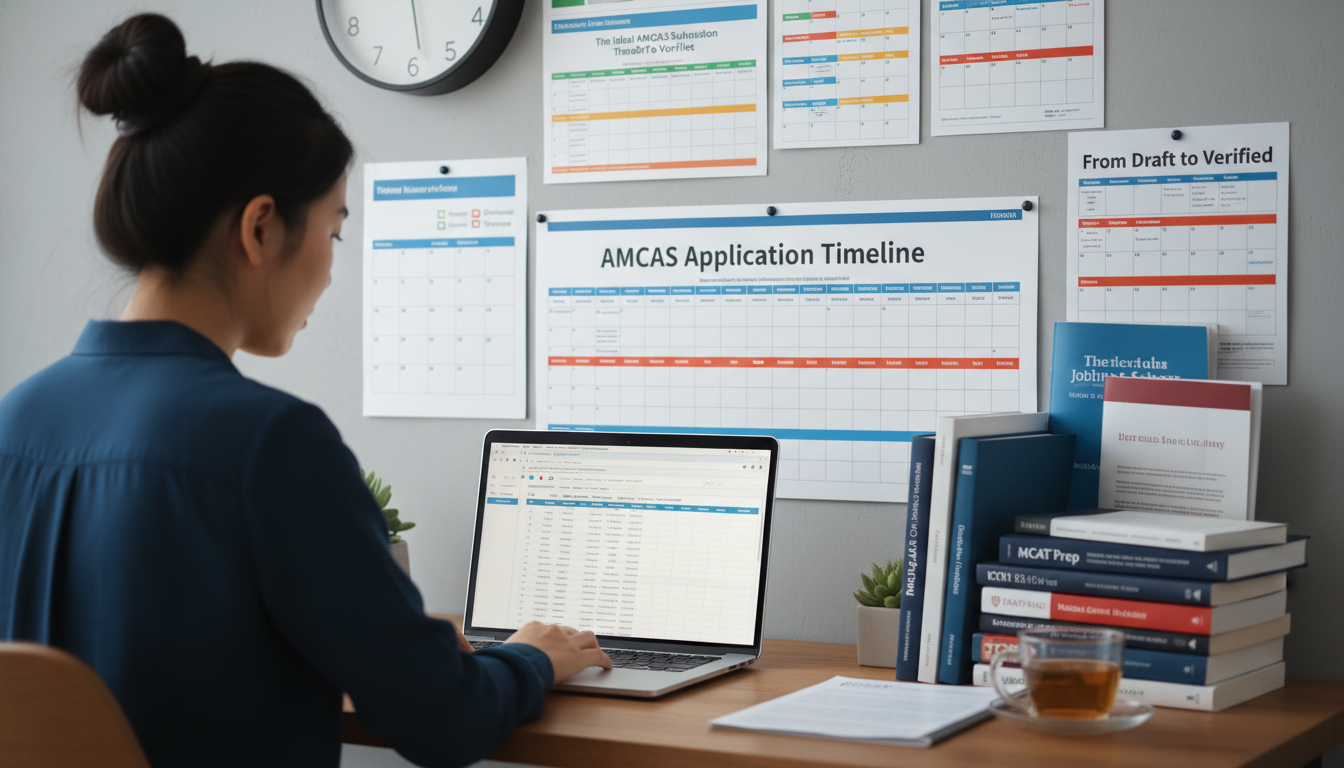
Below is your step‑by‑step, time‑stamped roadmap: when to brainstorm, when to request letters, when to lock your personal statement, and exactly what should be done by each month and week.
12–10 Months Before Submission: Foundation and Strategy (July–September, Year Before You Apply)
At this point you should not open AMCAS. You should be building the foundation that makes the application itself straightforward.
July–August: Clarify Your Application Profile
By late summer:
- Confirm your target application year and intended matriculation year.
- Decide if you are:
- Traditional applicant (applying end of junior year)
- Gap year applicant
- Reapplicant
In these 4–8 weeks, you should:
Audit your stats
- Calculate both:
- Cumulative GPA
- Science GPA (BCPM)
- Compare to ranges for schools of interest:
- Example: Many MD schools aim for ≥3.6 cGPA and ≥3.5 sGPA.
- If your GPA trends upward, note the turning point semester. You will reference this later in secondaries or interviews.
- Calculate both:
Assess MCAT status
- If you have not taken it:
- Choose a test date no later than early April of your application year.
- If you have taken it:
- Decide whether a retake is necessary based on school medians (e.g., 510 vs schools where median is 515+).
- If you have not taken it:
Rough school list planning
- Begin a preliminary list of 20–30 MD schools (and DO if applicable).
- Sort by:
- Median GPA/MCAT
- In‑state vs out‑of‑state friendliness
- Mission fit (research‑heavy, primary care, underserved focus)
You are not submitting anything yet. You are making strategic decisions that will drive the rest of the year.
September: Activity Inventory and Reflections
By the end of September, you should have a complete master list of experiences.
Create a single document (spreadsheet or text) with:
- Every clinical, research, shadowing, leadership, teaching, and nonclinical volunteer experience
- Dates, hours, supervisor names and contact info
- Bullet points of:
- What you did
- What you learned
- Specific impactful moments
At this point you should:
- Aim for at least:
- 150+ hours of clinical exposure (scribing, EMT, MA, hospital volunteering, etc.)
- 50+ hours of shadowing across at least 2 specialties
- Ongoing nonclinical service with a clear population (homeless shelter, tutoring, crisis line)
If you are short in any category, you still have several months to shore it up before AMCAS opens.
9–7 Months Before Submission: Letters, MCAT, and Early Drafting (October–December)
This is the quiet but critical phase. You build the components that other people control: letters and scores.
October: Letter of Recommendation Planning
By mid‑October, you should:
- Identify 4–6 potential letter writers:
- 2 science faculty (preferably who know you well from smaller classes or research)
- 1 non‑science faculty
- 1–2 additional writers:
- PI or research mentor
- Clinical supervisor
- Long‑term volunteer coordinator
End of October–early November, you should:
Ask in person or via video when possible
- Use language like:
- “Would you feel comfortable writing a strong letter of recommendation for my medical school application?”
- Use language like:
Provide a letter packet
- CV or activity list
- Unofficial transcript
- Draft of your personal statement themes (even if not fully written yet)
- Deadline for letter upload:
- Ask for letters to be completed by April 1.
Clarify logistics
- Whether your school has:
- Committee letter
- Letter packet
- Individual letters only
- How and where letters will be uploaded:
- AMCAS Letter ID forms
- Pre‑health office portals
- Whether your school has:
At this point you are setting expectations. Late letters are a major factor delaying verification, so you front‑load the process now.
November: Personal Statement Concept Work
You should not be writing full polished paragraphs yet. Instead, focus on:
- 2–3 page “brain dump” of:
- Clinical moments that changed you
- Longitudinal commitments
- Academic turning points
- Personal challenges relevant to your journey
By the end of November:
- Narrow to one core narrative arc, such as:
- “Longitudinal service with refugees guided me toward primary care.”
- “Engineering research shaped the way I think about problem‑solving in medicine.”
Once you have an arc, you are ready for structured drafting in January.
December: MCAT Checkpoint and Winter Adjustments
At this point you should:
- Take a full‑length MCAT practice test under timed conditions if you are testing in spring.
- Based on your score trajectory:
- ≥515 this early: you may be on track for more competitive schools.
- 505–510: consider if your goals align with those score ranges; adjust school list strategy if needed.
- <505: you may need a longer prep runway and possibly delay the application year.
You also:
- Confirm winter break plans:
- Extra hours in clinical or volunteering
- Dedicated writing time for application components
6–4 Months Before Submission: Drafting and MCAT Execution (January–March)
Now the timeline tightens. The quality of your writing and test performance here strongly shapes the cycle.

January: First Full Personal Statement Draft
By mid‑January, you should have a complete first draft of your personal statement (5,300 characters).
Process for this month:
Week 1–2
- Convert your November concepts into a structured narrative:
- Hook: a specific, vivid moment (not a cliché about “always wanting to be a doctor”).
- Middle: arc showing growth across experiences.
- Conclusion: present self and future orientation.
- Convert your November concepts into a structured narrative:
Week 3
- Let the draft sit for 3–4 days.
- Re‑read for:
- Clarity
- Redundancy
- Overused transitions
- Tighten sentences and remove vague claims.
Week 4
- Share with 2–3 trusted readers:
- Pre‑health advisor
- Mentor or faculty member
- One non‑science reader (for clarity, not content)
- Share with 2–3 trusted readers:
By the end of January, you should have at least one revised version based on early feedback.
February: Activities Section Rough Draft
By the end of February, you should have:
- Draft text for all 15 AMCAS activities slots, even if you will not use all 15.
- This includes:
- 700‑character descriptions for each entry
- 3 “Most Meaningful” essays (up to 1,325 characters each)
Week‑by‑week breakdown:
- Week 1
- List every possible activity.
- Prioritize longitudinal and impactful experiences.
- Week 2–3
- Draft descriptions using:
- 1–2 sentences on what you did (roles and responsibilities).
- 2–3 sentences on impact and reflection.
- Draft descriptions using:
- Week 4
- Select your 3 Most Meaningful:
- Typically: 1 clinical, 1 service or leadership, 1 research or other defining experience.
- Expand each with a deeper story and reflection.
- Select your 3 Most Meaningful:
At this point you should also be deep into MCAT prep if your test is in March/April. Protect your study time and avoid overcommitting to new activities.
March: Second‑Round Revisions and MCAT Final Prep
During March:
Personal statement:
- Complete second and third revision cycles.
- Focus on:
- Eliminating repetition between PS and activities.
- Clarifying your unique contribution or perspective.
Activities:
- Get at least one person to review for:
- Clarity
- Jargon
- Outcome focus (what changed because you were there?)
- Get at least one person to review for:
MCAT wise:
- If testing in March:
- Final 4–6 weeks should mirror test conditions.
- Multiple full‑lengths with thorough review.
- If testing in April:
- March is your high‑yield content consolidation month.
By the end of March you should be confident that your written core (PS + activities) is 70–80% of the way to final.
3–1 Months Before Submission: AMCAS Preparation and Finalization (April–May)
This is where many applicants fall behind. You will not.

Early April: MCAT, Transcripts, and Letters
By the first week of April, you should:
Take the MCAT (if you have not already)
- A mid‑April test date still works, but earlier is better for having scores in hand by June.
Request official transcripts
- From every post‑secondary institution you attended:
- Community college
- Study abroad programs (if graded by a U.S./Canadian institution)
- Graduate coursework
- Send transcripts to AMCAS as soon as the cycle opens (early May), but have your requests prepared now.
- From every post‑secondary institution you attended:
Confirm letter status
- Check in politely with letter writers:
- Remind them of your target completion date (April 1–30).
- Provide AMCAS Letter IDs or committee letter details if your school uses them.
- Check in politely with letter writers:
At this point you should also be doing a final school list refinement:
- Categorize schools into:
- Reach
- Target
- Safety/“foundation” schools
- Aim for a final list in the 18–25 range, unless advised otherwise.
Late April: AMCAS Account and Data Organization
When AMCAS opens for viewing (typically late April):
- Create or log into your AMCAS account.
- Populate:
- Biographical information
- Schools attended
- Coursework (have transcripts or unofficial copies in front of you)
- Set up a spreadsheet or document tracking:
- Schools applied to
- Secondaries received
- Deadlines
- Submission dates
By the end of April, your goal:
- All biographical and coursework sections drafted in your own document ready to paste into AMCAS once it opens for entry.
- Personal statement extremely close to final (minor polishing only).
May: AMCAS Opens and You Move Fast, Not Rushed
AMCAS usually opens for data entry in early May and starts allowing submission in late May/early June.
Week 1–2 of May: Data Entry
At this point you should:
Enter:
- All coursework exactly as it appears on transcripts.
- Every experience and its corresponding dates and hours.
- Your finalized personal statement text.
Double‑check:
- Course classification (BCPM vs non‑BCPM)
- Repeated vs original courses
- Study abroad details
Do not hit submit yet. You want at least one full, slow review pass after a few days away from the screen.
Week 3 of May: Comprehensive Review
During this week:
- Review the entire application line by line:
- Typos
- Inconsistencies in dates or hours
- Duplicate content between PS and activities
- Ask a trusted mentor or advisor to spot‑check:
- Personal statement
- Activities
- School list for realism
If MCAT scores from a spring test are not yet back:
- You can still submit AMCAS now.
- AMCAS will update your application automatically when scores arrive.
Week 4 of May: Target Submission Window Opens
AMCAS typically begins accepting submissions in the final week of May.
Your goal as an “ideal timeline” applicant:
- Submit in the first 3–7 days of the submission window.
Why this matters:
- Verification is first‑come, first‑served.
- Submitting in late May or very early June generally yields verification by mid‑ to late June, just as schools start receiving applications.
Submission to Verification: The Quiet but Crucial Wait (June–July)
Once you submit, your primary application enters the AMCAS verification queue. This stage is often misunderstood.
Early June: Submitted and Waiting
If you followed the ideal timeline:
- Your AMCAS is submitted by early June at the latest.
- Transcripts have already arrived at AMCAS.
- Letters are at least mostly uploaded, but lack of letters will not delay verification. Missing transcripts will.
At this point you should:
- Begin pre‑writing secondary essays as soon as secondary prompts from previous years become available.
- Start with:
- “Why our school?” essays for your top 5–7 programs.
- Diversity/identity essays.
- “Challenge/failure” reflections.
Treat this like another full‑time project. Secondary turnaround speed (7–14 days) is nearly as important as early AMCAS submission.
Late June: Expected Verification Timeframe
For applicants who submitted in late May or the first days of June:
- You will often be verified in:
- 2–4 weeks early in the cycle,
- stretching to 4–6+ weeks later in the summer.
You will receive an email notification when:
- AMCAS verification is complete.
- Your application becomes available to medical schools (usually late June for the earliest batch).
By the end of June, you want:
- Verification completed or well underway.
- A bank of polished secondary essay drafts that only require school‑specific tailoring.
After Verification: Secondary Flood and Interview Preparation (July–August)
Verification is not the finish line; it is the gate opening.
Early July: Secondary Season Peaks
Around this point:
- Schools begin sending secondary invitations, often within days of receiving your primary.
- Some schools automatically send secondaries to all verified applicants; others prescreen.
Your goal:
- Return each secondary within 7–10 days of receipt.
- Longer than 2 weeks consistently can place you at a disadvantage relative to earlier responders.
Day‑by‑day process once secondaries start:
- Day 1
- Read prompts carefully.
- Match them with your pre‑written essay bank.
- Day 2–3
- Draft or adapt responses.
- Keep a document with:
- Word/character limits
- School‑specific content you want to mention
- Day 4–5
- Revise and proofread.
- Day 6–7
- Final check, then submit.
At this point you should also begin light interview prep:
- Build a list of:
- 10–12 core personal stories (for MMI and traditional interviews).
- Times you showed teamwork, conflict resolution, leadership, resilience.
Late July–August: Early Interview Invitations
If you have followed an ideal timeline:
- Early interview invitations may begin arriving late August into September.
- Your early, polished, and timely application positions you at the front of the queue.
By the end of August, you want:
- All secondaries submitted.
- A robust set of practiced answers to:
- “Tell me about yourself.”
- “Why medicine?”
- “Why our school?”
- Ethical and behavioral scenarios.
Quick Timeline Snapshot: Month‑by‑Month
- July–September (Year −1): Clarify profile, collect activities, begin reflection.
- October: Secure letter writers.
- November: Personal statement concepts.
- December: MCAT diagnostic and plan.
- January: First full personal statement draft.
- February: Activities section drafted.
- March: Major revisions; MCAT ramp‑up.
- Early April: MCAT (ideally), transcript and letter logistics final.
- Late April: Biographical/coursework draft ready.
- May: Enter data into AMCAS; final revisions; submit in late May/early June.
- June: Verification in progress; pre‑write secondaries.
- July–August: Secondary blitz; early interview prep.
Today, take out a calendar and block actual dates for each of these checkpoints—then pick one concrete task (drafting your activity list, emailing a potential letter writer, or scheduling a practice MCAT) and complete it before you go to bed.


