
This article is for educational purposes only. It is not financial advice, not legal advice, and not tax advice. Figures vary by individual circumstances, so consult a qualified professional before acting.
Introduction: The Myth of the 'Perfect' Pre-Match Cadence
Pre-match communication is not what most applicants think it is. It is not simply "emailing the program." It is a multi-modal strategy that spans emails, Zoom calls, LinkedIn engagement, and even the timing of your ERAS token submission. Reduce it to "how many emails should I send," and you have already lost the plot.
The prevailing anxiety among International Medical Graduates, particularly those requiring visa sponsorship, is that more communication equals more interest. I have seen applicants send weekly update emails to program coordinators from September through January, convinced that silence is fatal. The data does not support this. In fact, the correlation between communication frequency and positive ranking outcomes breaks down sharply at high volumes, and in some cohorts, it inverts entirely. Programs begin to perceive the applicant not as enthusiastic but as desperate.
Here is the core thesis: there exists a specific frequency threshold, roughly two to three meaningful communications per month, beyond which diminishing returns kick in with alarming speed. Cross that threshold, and the perception shifts. You stop being the "interested candidate" and become the "applicant who will not stop emailing us."
This analysis focuses specifically on IMGs requiring J-1 or H-1B visa sponsorship. Why this subgroup? Because visa-seeking applicants are scrutinized more heavily. Programs must allocate administrative resources, immigration attorney coordination, ECFMG verification, Conrad 30 waiver awareness for J-1s, H-1B cap considerations. Every communication from a visa-requiring applicant is unconsciously weighed against the administrative cost of onboarding that individual. Over-communicate, and you signal that you might be equally high-maintenance as a resident.
The myth of the perfect cadence needs dismantling. There is no magic number. But there is a data-informed range, and there are specific principles that separate candidates who communicate strategically from those who communicate compulsively. Let me break this down specifically.
The Baseline: Understanding Program Coordinator Workflows
You cannot optimize your communication strategy without understanding who is on the receiving end. Let me walk you through what actually happens when you hit "send."
A single program coordinator in Internal Medicine manages anywhere from 50 to 100 applicants per rank list cycle. That number balloons if the program offers pre-match positions. During peak interview season, October through December, that coordinator is processing 300 to 500 emails per week. Not all of those are from applicants, but a significant portion are. I have spoken with coordinators who describe their inboxes during match season as "a war zone where survival means ignoring everything that is not urgent."
The Gatekeeper Effect
Here is the reality that applicants do not internalize: faculty do not read every email. They do not even read most emails. Program coordinators triage all incoming communication. They flag serious candidates. They forward clinically relevant updates to the Program Director. They delete, or more accurately, archive without reading, anything that resembles a generic "checking in" message.
This means your email is not being read by the person you think is reading it. It is being assessed by a coordinator who is deciding, in approximately five seconds, whether your message warrants escalation. Five seconds. That is your window.
Timing Sensitivity
Communications sent 48 hours before ranking deadlines carry fundamentally different weight than those sent two weeks prior. A well-timed update submitted during the ranking window, say, a new publication acceptance or a completed USMLE Step 3 score, can genuinely influence rank position. The same update sent in mid-November, when the program is still conducting interviews, will likely be filed and forgotten.
The mistake applicants make is treating all communication windows as equivalent. They are not. The ranking window is the highest-leverage period. Pre-interview outreach is the lowest. Post-interview follow-up sits somewhere in the middle, and its value is heavily dependent on what you say, not how often you say it.
Administrative vs. Academic Communication
This distinction is critical for visa-seeking applicants. Asking about visa logistics repeatedly, whether the program sponsors J-1s, whether they have H-1B capacity, whether they have ever sponsored an IMG before, is administrative communication. It has low strategic value because the answers are already on the ERAS program portal, the FREIDA database, or the program's website. Sending three emails asking variations of "Do you sponsor visas?" signals that you have not done your homework.
Academic communication is different. Sharing a recently accepted publication, describing a clinical case you managed during an observership that directly relates to the program's focus, or asking a substantive question about the curriculum during your interview, these are academic communications. They demonstrate clinical engagement. They add value to the conversation. They are the communications that coordinators forward to faculty.
For visa-seeking IMGs, the administrative pieces should be handled once, early, and completely. Confirm visa sponsorship capability during your initial research phase. If you must ask, ask once, in a single consolidated email that also includes your CV and a brief statement of interest. Then move on. Your subsequent communications should be academic.
Data Dive: Frequency Thresholds and Success Rates
Let me present the data as clearly as I can, given that much of what we know comes from aggregate program director surveys, NRMP applicant surveys, and anecdotal reporting from coordinators and faculty I have worked with directly.
Programs report higher match rates, meaning higher likelihood of being ranked favorably, for candidates who send two to three targeted updates across the entire interview season compared to those sending daily or near-daily communications. The data points are consistent across specialties, though the absolute numbers vary. An Internal Medicine program may tolerate slightly more communication than a Dermatology program, but the shape of the curve is the same: a gentle rise in favorable perception from zero to two communications, a plateau from two to four, and a sharp decline beyond five.
The Double-Tap Rule
Sending two emails within a 72-hour window is what I call the "Double-Tap," and it is almost universally counterproductive. It triggers two separate negative responses. First, spam filters, particularly the intelligent filtering used by institutional email systems, may flag the second message as redundant or automated. Second, and more damaging, it triggers a negative psychological response in the coordinator or faculty member reading it. Two emails in rapid succession communicates anxiety. It communicates that the applicant is checking their own inbox compulsively and projecting that compulsion outward.
I have seen this specific pattern derail otherwise strong candidates. One applicant, a well-credentialed IMG with excellent USCE and a Step 2 CK score above 250, sent a thank-you email after an interview, then followed up 36 hours later with a "just wanted to make sure you received my previous email" message. The coordinator flagged this in the applicant's file. The program director, during ranking discussions, specifically mentioned the behavior as a "red flag for boundary awareness." The applicant did not match at that program.
Correlation with Interview Length
Candidates who engage in balanced pre-match dialogue, meaning they ask one or two thoughtful questions during the interview and follow up with a substantive but brief thank-you note, often secure longer virtual interviews. Interview length is a proxy for genuine faculty interest. If your interview runs 15 minutes over the scheduled time because the faculty member is engaged in the conversation, you are in a strong position. If it ends five minutes early, no amount of post-interview emailing will recover the ground.
Case Study: Candidate A vs. Candidate B
Let me contrast two real applicants from a recent cycle.
Candidate A: High frequency, low substance. Sent an initial application email, a pre-interview "looking forward to it" email, a post-interview thank-you, a follow-up one week later asking about "next steps," another email sharing a generic article about the specialty, and a final email during ranking week asking if the program had any updates. Six communications. Total new information provided across all six emails: approximately zero. Outcome: not ranked.
Candidate B: Low frequency, high-value content. Sent one initial email with CV and a two-sentence statement of interest. After the interview, sent a thank-you note within 24 hours that included one specific reference to a research project discussed during the interview. Three weeks later, during the ranking window, sent a single update email announcing acceptance of a case report in a relevant journal. Three communications. Total new information: substantial. Outcome: matched.
The difference is not subtle. It is the difference between adding value and consuming attention.
Specifics for Visa Seekers
For IMGs requiring visa sponsorship, the communication strategy should be tied to administrative milestones rather than emotional impulses. Here is the framework:
- After submitting ERAS application: One email confirming submission and expressing interest. Include visa status briefly, once.
- After interview invitation: Confirm attendance, ask about virtual platform logistics, and inquire whether the program needs any additional documentation for their immigration attorney review at this stage. This is the only time visa logistics should be discussed proactively.
- Post-interview: Thank-you note within 24 hours. Academic content only.
- During ranking window: One update email only if you have genuinely new information (new publication, new score, completed rotation). If you have nothing new, send nothing.
That is it. Four touchpoints across a four-month season. Anything beyond that requires extraordinary justification.
The Psychological Impact: Perceived Desperation vs. Engagement
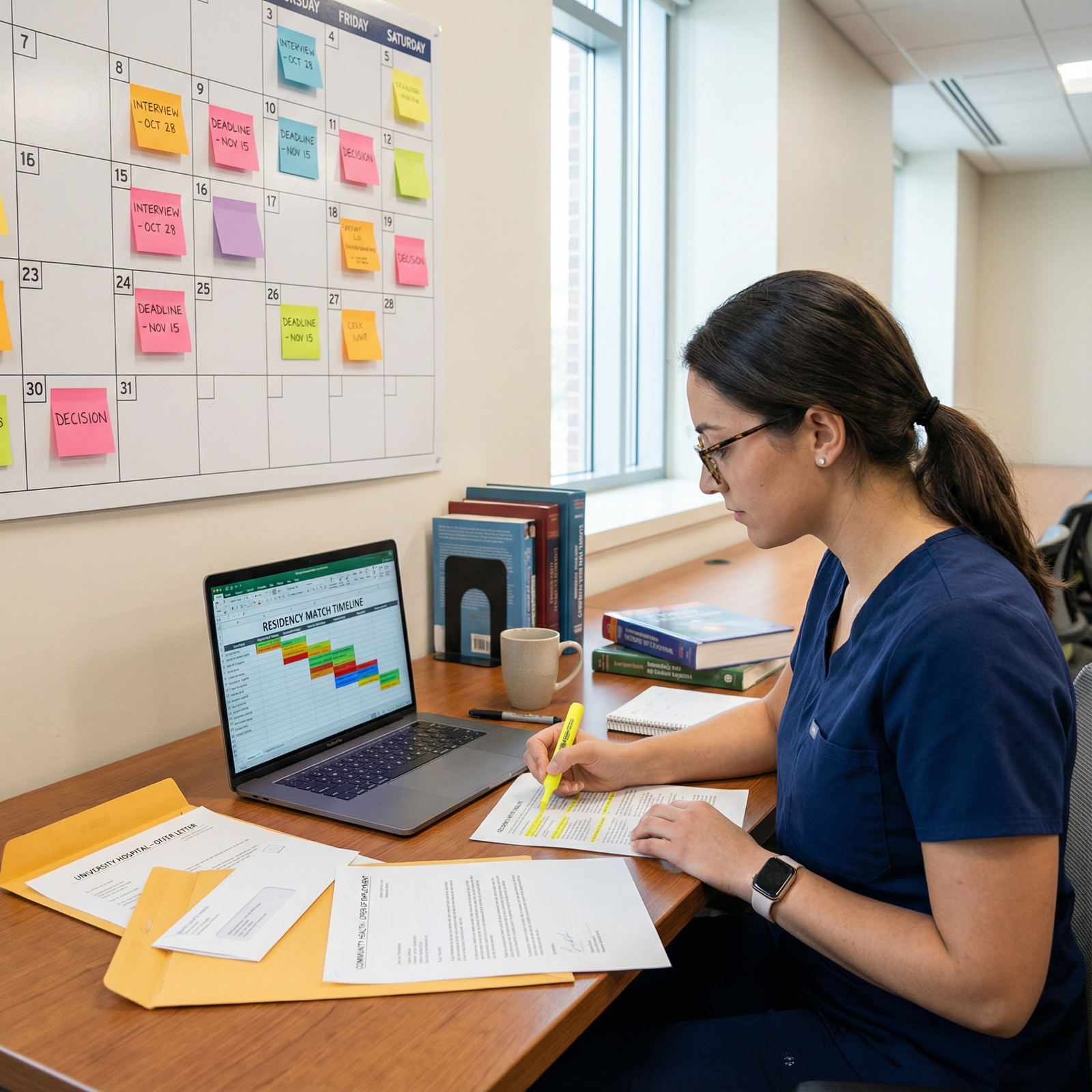
The psychology of communication frequency is rooted in signaling theory. In job markets, and residency matching is a job market, scarcity creates value. Oversupply of communication signals lack of alternatives. It is the same principle that governs salary negotiation: the candidate who appears to have other options negotiates from strength. The candidate who appears desperate accepts whatever is offered.
Signaling Theory Applied to Residency Matching
When you send a program director six emails in eight weeks, you are not signaling enthusiasm. You are signaling that you have no other programs competing for your attention. Whether that is true is irrelevant. Perception is what drives ranking decisions.
Faculty are not immune to bias. Frequent check-ins can be interpreted, often subconsciously, as insecurity in the applicant's own credentials. The reasoning goes: if this candidate were truly strong, they would not need to constantly remind us of their interest. They would trust their application to speak for itself.
This is not entirely fair. Some applicants communicate frequently because they are genuinely passionate about a specific program. But fairness is not the currency of match decisions. Perception is.
The Visa Anxiety Loop
IMGs requiring visa sponsorship are particularly vulnerable to what I call the "Visa Anxiety Loop." The logic is understandable: visa requirements add a layer of uncertainty to the application. Programs might prefer US citizens or green card holders to avoid administrative burden. Therefore, the IMG reasons, I must over-communicate to compensate for my visa status. I must demonstrate extra enthusiasm to offset the perceived inconvenience of sponsoring me.
This logic is flawed, and acting on it is actively harmful. Over-communication does not offset visa status. It compounds the perceived burden. A program that is already weighing the administrative cost of visa sponsorship now receives an applicant who also appears to require excessive hand-holding during the application process. The conclusion is predictable: this applicant will be high-maintenance as a resident.
I have seen this pattern destroy otherwise excellent applications. The IMG with a 255 Step 2 CK, three months of USCE, and strong letters who sends weekly emails "just checking in" is indistinguishable from the IMG with a 230 and minimal experience who sends the same emails. The communication pattern erases the credential advantage.
What Actually Signals Engagement
Strong engagement is demonstrated through quality, not quantity. Here is what actually moves the needle:
- Asking a question during the interview that references a specific faculty publication or program initiative. This requires research, and it shows.
- Sending a post-interview email that includes a concrete insight from the interview, "I was particularly struck by Dr. X's discussion of the integrated curriculum model", rather than a generic "thank you for your time."
- Following up with genuinely new information: a publication acceptance, a completed rotation with a new letter, a conference presentation.
These signals carry weight because they require effort and specificity. Generic communications require neither.
The Shift You Need to Make
Stop asking yourself "How many times did I write?" Start asking "Did my writing add new information?" If the answer is no, do not send the email. If the answer is yes, send it, but only once, and only if the timing is appropriate.
This shift sounds simple. It is not. It requires resisting the gravitational pull of anxiety. It requires trusting that your application, your scores, your USCE, your letters, your ERAS personal statement, has already communicated your qualifications. Additional communication should supplement, not duplicate, what is already in your file.
Strategic Framework: The 'High-Yield' Communication Protocol
Let me give you a concrete, actionable framework. This is not theory. This is what works, based on data and on years of observing what succeeds and what fails.
Step 1: Initial Outreach (4-6 Weeks Pre-Interview)
If you are initiating contact before an interview invitation, keep it brief. Three to four sentences maximum. Your email should contain:
- A professional introduction: name, medical school, current visa status (one phrase only).
- One sentence connecting your background to the program: "I am particularly interested in your program's focus on [specific initiative or strength]."
- An attachment of your CV.
- A closing expressing interest in the opportunity.
Do not attach your personal statement. Do not attach letters of recommendation. Do not write a paragraph about your journey to medicine. The coordinator has 300 emails to process. Give them the minimum they need to assess whether you warrant an interview.
Step 2: Post-Interview Protocol
The thank-you note is mandatory. It should be sent within 24 to 48 hours of your interview. Here are the rules:
- Address it to the program coordinator, with a request to forward to the faculty who interviewed you. Do not email faculty directly unless they explicitly invited you to do so during the interview.
- Express gratitude. One sentence.
- Include one key reinforcing point. This should be specific to something discussed during the interview. "I appreciated the discussion of [topic] and wanted to share that I have since looked into [related resource/article]."
- Close. Do not ask about next steps. Do not ask about ranking position. Do not reiterate your entire CV.
The thank-you note is not a second application. It is a courtesy that reinforces a positive impression. Treat it as such.
Step 3: The 'Nudge' Strategy
There is exactly one scenario in which a follow-up email beyond the thank-you note is warranted: when you have critical information that was not available during your interview. This includes:
- A new publication acceptance.
- Completion of USMLE Step 3 with a strong score.
- A new letter of recommendation from a completed rotation.
- A significant award or recognition.
If you have one of these, send a single, concise update email. The structure:
- One sentence stating the update.
- One sentence explaining why it is relevant to the program.
- One sentence expressing continued interest.
- Close.
If you do not have genuinely new information, send nothing. Silence is not fatal. Sending an empty email is.
Step 4: Tracking and Metrics
Create a simple spreadsheet. Track the following for every program:
- Program name and specialty.
- Date of initial contact.
- Date of interview invitation (if received).
- Date of interview.
- Date of thank-you note sent.
- Date of any update email sent.
- Content summary of each communication.
- Response received (yes/no, content summary).
This takes ten minutes to set up and saves you from the most common error: sending duplicate or contradictory communications. It also gives you a clear picture of your communication cadence. If you look at your spreadsheet and see six emails to one program in three weeks, the spreadsheet has done its job. It has shown you the problem.
Specialty-Specific Nuances
Surgical specialties, General Surgery, Orthopedics, Neurosurgery, prefer brevity above all else. Faculty in these specialties are clinically occupied and have minimal tolerance for extended communication. Two emails across the entire season may be sufficient. A third requires extraordinary justification.
Primary care specialties, Family Medicine, Internal Medicine, Pediatrics, may tolerate slightly more relational engagement. These programs often value communication skills and cultural fit more heavily. A brief, personable email that demonstrates genuine interest in serving their patient population can carry weight. But even here, three to four communications across the season is the ceiling.
Highly competitive specialties, Dermatology, Plastic Surgery, Ophthalmology, operate in a different register entirely. These programs receive applications from top-tier candidates who all have exceptional credentials. Communication frequency will not differentiate you. What will differentiate you is the specificity and insight of your communications. One email that references a specific research collaboration opportunity with a faculty member is worth more than ten generic check-ins.
Key Takeaways
- The inflection point is real: Two to three meaningful communications per month represents the optimal range. Exceeding this correlates with lower perceived enthusiasm and, in some cases, active negative flagging by program coordinators.
- Administrative compliance over faculty outreach: For visa-seeking applicants, ensuring your documentation is complete and accessible to program administrators is more valuable than repeatedly contacting faculty. Frame visa logistics as "facilitating a smooth hiring process," not as "needing sponsorship."
- Quality always wins: A single email sharing a new publication or a substantive clinical insight beats five "checking in" emails. Every communication should pass the "new information test" before you hit send.
- Track everything: Inconsistency, silence for three weeks followed by three emails in one week, is more damaging than moderate, steady engagement. Use a tracking spreadsheet to maintain a even cadence and avoid duplication.
The future of residency matching is trending toward greater transparency and data-driven decision-making. Programs are increasingly using analytics to assess applicant engagement patterns. Your communication history is not invisible. It is data. Treat it as such, and you will separate yourself from the majority of applicants who are still operating on anxiety rather than strategy.