
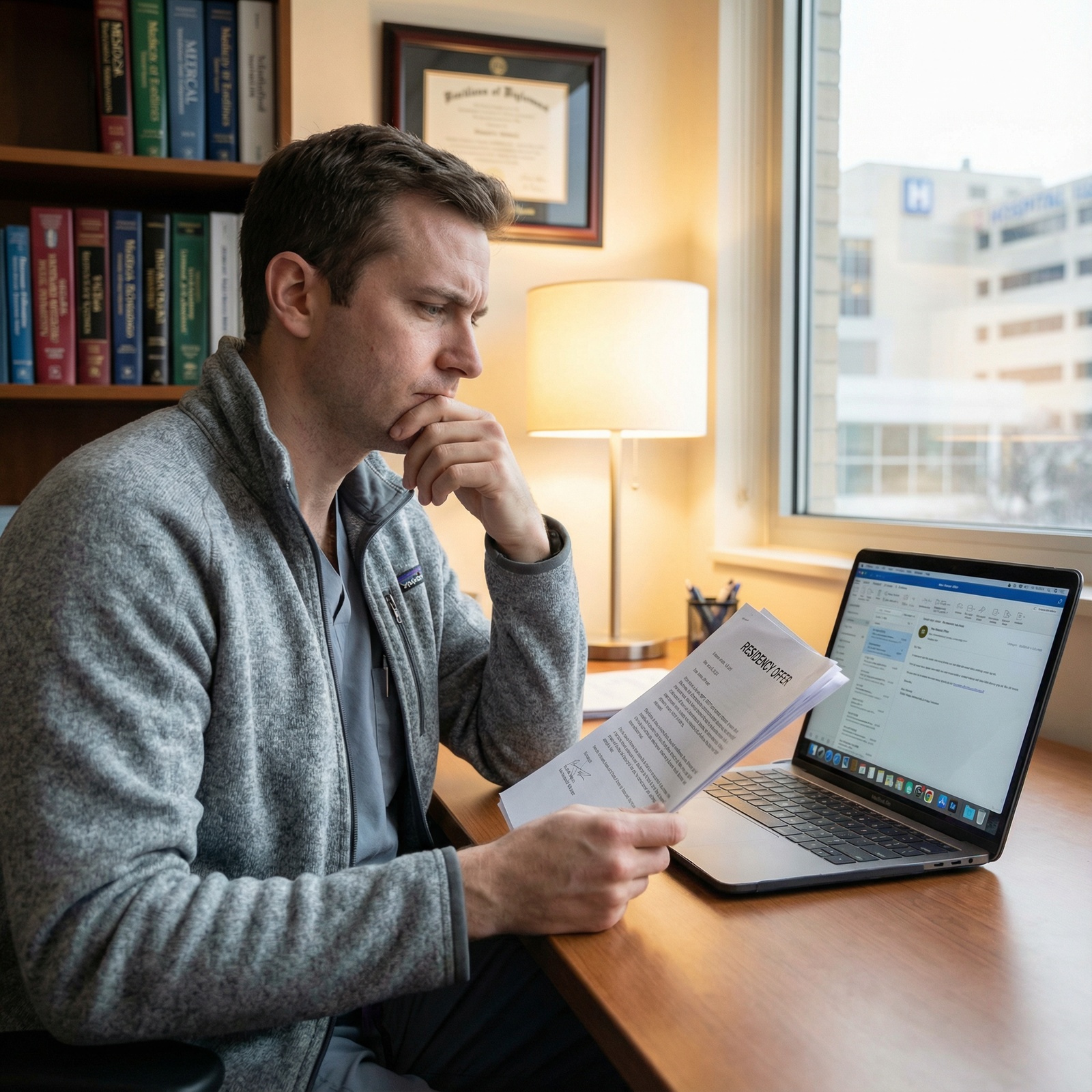
The email arrives at 2:47 p.m. on a Tuesday. You're in the cafeteria pretending to eat a sad salad. Subject line: Pre-Match Offer. Your heart does the thing. You read the first paragraph twice, and for about eleven glorious seconds you feel pure, weightless relief. Somebody wants you. You might actually have a job.
Then you hit the second paragraph: "We ask that you confirm your acceptance by withdrawing from your remaining scheduled interviews."
And your brain, my brain too, because we clearly have the same model, immediately starts sprinting through the disaster reel.
I've lived this exact moment. Got my pre-match call in a hospital stairwell, sat down on the steps, and had a full meltdown over a good-news email. Here's everything I wish someone had told me while I stress-ate pretzels and drafted and deleted four different replies.
The Panic Attack: When the Phone Rings with a Pre-Match Offer
The weird thing about a pre-match offer is that the anxiety doesn't go down when the good news arrives. It spikes. The relief and the dread show up in the same envelope, and your nervous system can't tell them apart.
Here's roughly what the inside of my head sounded like, in case yours sounds the same:
"If I say I want to keep my other interviews, they'll think I'm not interested. They'll rescind. Offers get rescinded all the time, right? I read that somewhere. They'll tell the other programs I'm difficult. Programs talk. PDs all know each other, there's probably a group chat and I'm the topic tonight. This is a loyalty test and I am failing it in real time."
Maybe your version is slightly different. Maybe yours also includes the part where you never match anywhere and end up explaining to your family why you have a medical degree and no future. Mine did.
Here's the reframe that finally got my shoulders down from around my ears: this request is not a test of your character. It's a scheduling question. A program with more good applicants than spots is asking, "Should we hold this seat for you, or offer it to the next person?" That's it. That's the whole email. It's administrative, not personal, no matter how personally your panic wants to take it.
Myth vs. Reality: The "Nuclear Option" Fear
Let me state the myth plainly, because I believed it with my whole chest: declining to withdraw from other interviews is the nuclear option. Do it and the offer evaporates, your name gets a little black mark, and every PD within a hundred miles somehow knows you're "not a team player."
Now the reality, which I have since confirmed with an advisor, two residents, and one extremely patient associate dean who I made swear it was true twice:
Programs are not sitting around waiting to be offended by you. They are over-subscribed. They have far more applicants they'd happily rank than they have spots, and their only real problem is arithmetic, ten chairs, fifty people circling. When you say "I need to keep my other interviews," nobody clutches their pearls. They look at their list and move their eyes down one line.
Is there risk? Sure. But it's not the risk you're imagining. The risk isn't that they rescind out of spite or blacklist you. The risk is simpler and more boring: while you deliberate, they may offer the seat to someone who says yes faster. That's not punishment. That's just a seat getting filled, which is the program's entire job.
And here's the part that took me the longest to actually believe: the true worst-case scenario isn't a polite "no." It's silence. Ghosting a program, leaving their email on read for a week because you're scared, is the one move that genuinely reads as unprofessional. A gracious decline reads as honest. Vanishing reads as a red flag.
Professionalism isn't obedience. Nobody's grading you on how fast you comply. They're noticing how you communicate under pressure, and a candidate who responds promptly, warmly, and honestly is exactly the kind of resident they want, even when the answer is "not yet."
I've watched this play out in real life. My classmate Devon declined to withdraw from three interviews after a pre-match offer and told the PD exactly that. The PD's response was, and I quote: "Completely understand. The offer stands through Friday. Either way, you were a joy to interview." Not a blacklist. A deadline. Civility. Wild.
The Process: How Programs Handle Over-Subscribed Interviews
The picture that finally calmed me down was imagining the other side of the email.
Here's what I was picturing: the PD hovering over their phone, refreshing their inbox, personally wounded with every minute I didn't reply.
Here's what's actually happening: the PD sent fifteen versions of that email. Yours is one of them. When your response comes back, they glance at it, update a spreadsheet, an actual spreadsheet, I've seen one, it has color coding, and their coordinator is already dialing the next candidate. You were never the main character of their Tuesday. And honestly? That's the most reassuring thing I've learned in this entire process.
The offer doesn't have a self-destruct timer wired to the withdrawal question. It stays valid until they hear from you, and what they need is simply something. Yes, no, or "I need 48 hours" all keep you alive in their system. Only nothing kills it.
Look at that flowchart for a second. Two of the three endings are completely fine for you, and the only bad one is the one where you freeze and say nothing. Your anxiety will insist that all roads lead to doom. The actual process disagrees: respond, and you stay in the game no matter which answer you give.
The Data: Why Programs Ask (and Why It's Safe)
Once I understood the numbers, the withdrawal request stopped looking sinister and started looking obvious.
Ten spots. Fifty people they'd genuinely be happy to train. That gap is the entire reason the email exists. Programs aren't asking you to withdraw because they want a declaration of undying love. They're asking because unfilled spots are a crisis for them, a program that scrambles or goes unfilled loses funding, loses coverage, loses face with the GME office. They are, in a very real sense, more scared of this process than you are.
Which means a clear, fast, honest answer from you is a gift, even when the answer is no. If you won't commit, your decline frees them to move down the list and lock in someone who will. Coordinators I've talked to are blunt about this: the applicants who drive them up the wall aren't the ones who decline. They're the ones who disappear.
And statistically, your anxious brain is pricing in way more danger than exists. Most pre-match offers get accepted, programs know this, and a polite "I need to honor my other interviews" is a routine email during interview season. Routine. Not a scandal, not a story they tell at conferences, not a mark in some permanent record. Just Tuesday.
Action Plan: How to Say "No" Without Losing Your Mind
Okay. Deep breath. Time to turn all of that into an actual email you can send.
The golden rule is three words: polite, brief, grateful. That's the whole formula. Where applicants go wrong, where I nearly went wrong, is over-explaining. Don't write four paragraphs apologizing. Don't confess your entire rank-list strategy. Don't say "I'm so so sorry" three times. Excessive apologizing reads as guilt, guilt reads as "I'm doing something shady," and you're not doing anything shady. You're a candidate with options. That's allowed.
If you're interested in the offer but not ready to withdraw, here's the soft no, the one I actually sent, lightly cleaned up so you can steal it:
"Dear Dr. [Name], Thank you so much for this offer, I'm genuinely honored, and your program remains one of my top choices. I have interviews already scheduled that I feel I need to honor, so I'm not able to withdraw my remaining applications right now. If there's a timeline by which you'd need my final decision, please let me know and I'll make sure you have it well before then. Thank you again for your consideration."
That's it. Warm, honest, zero groveling, and it asks the one practical question that matters: what's my deadline?
If you're truly torn and just need to think, buying time is completely legitimate: "I'm very interested and want to give your offer the careful consideration it deserves. Could I confirm my decision by Thursday?" Naming a day is the key. An open-ended "I'll get back to you" is just ghosting with extra steps.
And if you've already decided this program isn't it? Decline the offer itself, cleanly: thank them, say you're pursuing other options, wish them well. Takes ninety seconds. Frees the seat for someone who wants it. Everyone survives.
One more thing, and I will die on this hill: send the email today. Not tomorrow, not "after I think about it for a week." Every hour of silence is the only thing in this entire situation that can actually hurt you.

Closing: Breathe and Trust the Process
So here's your reminder, the one I literally taped above my desk during interview season.
You got this offer because a program read your application, met you, and decided you were worth committing to early. That fact does not change because you wrote a polite email. It doesn't change because you asked for 48 hours. It doesn't change because you have other interviews, which, reminder, they already assumed, because every competitive applicant has other interviews.
The catastrophe your 3 a.m. brain is selling, the rescinded offer, the blacklist, the career over before it started, is fiction. The real worst case is a mildly awkward email exchange. That's it. You can survive a mildly awkward email exchange. You survived organic chemistry, Step exams, and getting pimped on rounds. This is one email.
Handle it with grace, hit send, and go lock down your spot.
Key Takeaways
- Declining to withdraw is a routine administrative reply, not a betrayal, programs hear it every single season.
- Programs are over-subscribed; a polite "no" just moves their eyes one line down the list.
- Ghosting is the real offer-killer. Silence, not honesty, is what reads as unprofessional.
- You owe no one an apology for having other interviews. Options are the sign of a strong candidate.
- Professionalism is measured by how you communicate, not how fast you comply.