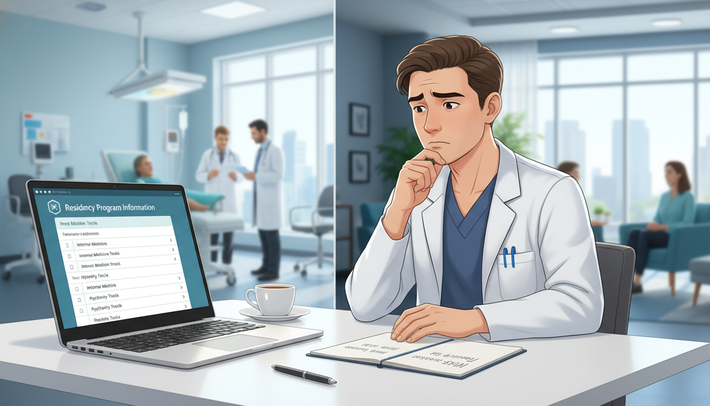
You open the email.
For half a second, your brain catches on the word Congratulations like that's supposed to make everything okay. Then you see the program name. The one from the whispered warning lists. The one residents talked about with that weird, careful tone people use when something is bad enough to be dangerous. The one where someone said, "If you end up there, just keep your head down and survive."
And your stomach drops.
I've seen this exact panic. Not abstractly. Real people. Match Day group chat goes silent. A classmate smiles for the photo, then throws up in the bathroom ten minutes later. Someone calls their mentor and says, voice shaking, "Did my life just get ruined?" That's the fear. Not disappointment. Doom. Like your career got decided by one cursed PDF and now every fellowship door is closing before you've even shown up for intern orientation.
That fear is powerful. It's also sloppier than it feels.
Because here's my position, clearly: matching at a malignant program is awful, unfair, and potentially harmful. But no, it does not mean your career is over. It means your training environment may be hostile. It means you need a strategy earlier than other people do. It means you may have to protect yourself in ways that shouldn't be necessary. All true. But "career death sentence"? No. That's the anxiety talking in all caps.
For a deeper look at how fellowship match lists can mislead applicants, read more on how program directors view these outcomes and whether they truly signal program quality: (See also: Myth vs Reality: Does a Strong Fellowship Match List Actually Mean a Good Residency Program?)
What matters now is separating the horror-movie version in your head from the actual risk. Your story did not end on Match Day. If anything, this is the chapter where you stop being naive and start being tactical.
The Scenario: Your Worst Match Day Comes True
The first emotional mistake is assuming that because the program has a bad reputation, every bad outcome becomes inevitable.
That's not how this works.
A malignant program can absolutely make residency harder. Sometimes much harder. The hours may be worse, the feedback may be dysfunctional, and the leadership may act like resident suffering is a personality test. I'm not going to sugarcoat that. Some programs really do run on intimidation, chaos, and the lazy excuse that "we're just preparing you for real life." That line is nonsense. Abuse is not rigor. Humiliation is not education.
But your brain, in panic mode, tends to skip steps. You hear "malignant" and translate it into:
- I'll never become competent.
- I'll never get good letters.
- I'll fail boards because I'll be too exhausted to think.
- No fellowship will touch me.
- Employers will assume I'm damaged goods.
- I'm trapped forever.
That spiral feels logical at 2:13 a.m. It usually isn't.
What's real? A bad program can threaten your well-being, your confidence, and in severe cases, your ability to stay in training. That's serious. But it does not erase your talent, your work ethic, or your future options. I've watched residents come out of rough programs and still land fellowships, attending jobs, chief years, research roles, and academic appointments. Not because the program helped them. Because they learned how to build a career despite it.
That distinction matters. A lot.
You don't need false reassurance. You need accurate reassurance. This is scary. It may be one of the hardest professional situations you ever face. But hard is not over. Toxic is not terminal. And one match result, even a miserable one, doesn't get to write your entire 40-year biography.
Myth vs Reality: Defining the Beast
Let's kill the dumbest myth first.
Myth: a malignant program just means the standards are high and you're not tough enough.
No. Absolutely not.
That idea survives because medicine has a weird addiction to glorifying misery. If residents are crying in stairwells, missing meals, getting screamed at on rounds, and being punished for asking for help, some attending somewhere will call it "old-school excellence." Please. That's not excellence. That's institutional failure with a superiority complex.
A demanding but healthy program feels hard in a very specific way. You work a lot. You're pushed clinically. People notice mistakes. Expectations are high. But there is still teaching. Feedback is specific. Seniors protect juniors when things go sideways. Attendings may be intense, but they want you to improve, not collapse. You leave tired, not systematically degraded.
A malignant program is different. The culture itself is the problem.
It often looks like this:
- Public shaming disguised as "feedback"
- Unclear expectations followed by punishment
- Favoritism and retaliation
- Work hour violations everyone pretends not to see
- Residents afraid to report concerns
- Leadership protecting abusers
- High attrition or "mysterious" transfers
- Board prep treated like a personal hobby rather than a training priority
That's malignancy. Not high standards. Not grit. Dysfunction with a badge on.
Recognizing the difference matters because your response should be different too. If a program is merely tough, you adapt and grow. If it's truly malignant, you don't waste energy trying to win moral approval from a broken system. You protect yourself. You build external support. You stop expecting fairness from people committed to being unfair.
That doesn't mean becoming paranoid. It means getting clear-eyed. Residents get hurt when they keep telling themselves, "Maybe if I just work harder, they'll finally treat me normally." Sometimes they won't. Some places feed on vulnerability. Brutal sentence. Also true.
If you matched somewhere malignant, the goal is not to romanticize survival. The goal is to identify the beast correctly so you can stop blaming yourself for getting bitten.
The Reality Check: Data Over Fear
The anxiety spiral says this: No fellowship will ever want me if my residency has a toxic reputation.
Reality is less dramatic and more boring. Which, honestly, is good news.
Most residents from rough programs still graduate. Most graduates still get jobs. Many still match into fellowship. Not always their dream fellowship at their dream institution, no. A malignant program can narrow options, especially if it sabotages research time, mentorship, or letters. But narrowed is not erased. There's a huge difference between "harder path" and "career extinction," and anxious applicants blur that line constantly.
The biggest real risk is not permanent stigma. It's attrition.
That's the part people don't say loudly enough. The true danger of a malignant program is that it can grind people down to the point that they leave, get terminated, take prolonged leave, or suffer enough psychologically that career planning becomes secondary to just getting through the week. That's why mental health isn't some soft side quest. It's infrastructure. If the environment breaks you, your CV won't matter.
But if you stay functional and keep building objective evidence of competence, the program's culture does not define you nearly as much as you fear.
What actually carries weight?
- Board scores
- In-training exam performance
- Procedural and clinical competence
- Research output
- Presentations
- Strong letters, especially from outside your immediate chain of command
- Reputation among faculty who actually know your work
These things travel. Rumors don't always.
I've seen fellows from ugly residencies match because they had strong Step 3 or specialty boards, a couple of solid publications, and one mentor at a national meeting who said, "This resident is outstanding." That matters. A lot. Program reputation is real, but it is not magic. It doesn't vaporize your accomplishments.

Also, fellowship directors and employers are not idiots. Many of them know exactly which programs are dysfunctional. Sometimes a resident coming out of one of those places gets more credit for surviving with strong performance. Quietly, of course. No one says it in the brochure. But people know.
Does this mean you should relax? Honestly, no. Complacency is a bad idea. If you're at a malignant program, you need to be more deliberate than your peers at supportive places. You have less room for drift. But you are not disqualified from a good career.
The fear says, "This name on my badge follows me forever."
It doesn't.
For a while, yes, it matters. Then your fellowship matters. Then your first attending job matters. Then your clinical reputation matters. Then the people hiring you care about whether you're dependable, competent, collegial, and board-certified. Residency becomes part of your backstory, not the whole plot.
The Survival Playbook: Proactive Damage Control
If you match at a malignant program, sentimentality is useless. Strategy wins.
Here's the playbook I'd want you to have on day one.
First: treat board prep like career insurance. Not optional. Not something you'll "get to later." A high score is one of the few things a toxic program can't argue with. If your specialty has a major board exam, in-training exam, or Step 3 that still matters for your path, protect that study time viciously. Study on lighter rotations. Study on post-call days when you can. Use question banks during dead hospital pockets instead of doom-scrolling in the resident lounge while someone complains about parking. Glamorous? No. Effective? Yes.
Second: build external mentors early. You need people outside the local power structure. Old med school faculty. Research mentors. Faculty from conference workshops. Attendings at affiliated sites who aren't marinated in the same toxic culture. National society connections. These people can advise you, advocate for you, and write letters that aren't contaminated by local politics.
Third: document ugly behavior carefully. Not because documentation fixes everything. It doesn't. But if things get abusive, your memory alone won't protect you. Keep factual records: dates, times, witnesses, what was said, how it affected patient care or your training, whether duty hour violations occurred. No emotional essays. Just clean notes. If you ever need to go to the ombudsperson, GME office, ACGME, or legal counsel, specifics matter.
Fourth: know the rules better than the people breaking them. Read your institution's resident handbook. Know reporting pathways. Know ACGME requirements relevant to supervision, duty hours, leave, due process, and evaluation. Toxic programs thrive when residents assume they have no rights. That assumption is their favorite weapon.
Fifth: plan your exits without acting reckless. This includes fellowship, transfer, and in severe cases, temporary medical leave or formal reporting. Transfers do happen, but they're not common and they're not easy. Open positions are limited. Program directors talk. So don't build your whole survival plan around escape. Build it around competence, documentation, and optionality.
Here's how I'd structure it:
Defensive moves
- Keep records
- Build mental health support
- Learn institutional and ACGME policies
- Avoid unnecessary conflict
- Identify safe faculty and senior residents
Offensive moves
- Crush exams
- Publish or present something every year if possible
- Collect strong letters from credible people
- Attend conferences and network like your future depends on it, because sometimes it does
- Develop a niche interest that makes you memorable
And one more thing. Maybe the most important thing.
If the environment is harming your mental health badly enough that you're becoming depressed, panicked, numb, or unsafe, getting out is not failure. It's not weakness. It's not "letting them win." Extraction is a win if staying is destroying you. Medicine is full of martyrs who were praised right up until they broke. Don't volunteer for that role. It's a scam.
The Long Game: Reclaiming Your Career Narrative
The best antidote to Match Day doom is time. Not passive time. Built time.
Right after residency, your program name feels enormous. It's on every application. Every introduction. Every awkward conversation with people who know the rumors. I get why that feels crushing.
But careers move. Fast.
Once you land a fellowship, that becomes the headline. Once you get your first attending job, that becomes the new signal. A few years later, people care where you work now, whether you're board-certified, whether colleagues trust you, whether patients do well under your care. The residency name fades into background noise unless you keep emotionally living there.
I've watched this happen over and over. By three to five years out, the alleged permanent stain is mostly gone. Administrators hiring attendings are not sitting around gossiping about your intern year call schedule from half a decade ago. They care about your current references, your productivity, your professionalism, and whether you seem like someone who can do the job without creating chaos.
So reclaim the narrative aggressively:
- Don't let a toxic program become your identity.
- Don't overexplain it in every interview.
- Don't apologize for where you trained.
- Do talk about what you built, learned, and achieved.
- Do emphasize resilience without sounding broken.
- Do keep moving toward better environments.
Your career is too long to hand over to one bad institution.
Yes, malignant programs can wound people. Some deeply. I won't insult you by pretending otherwise. But they do not own your future unless they convince you to stop building one. That's their real power. Not the name. The demoralization.
Don't give them that.
You may have matched badly. You may have to fight harder than you should. You may spend three years learning medicine and unlearning someone else's cruelty at the same time. That's real. But your career is not over. Not even close. Keep your standards high, your records clean, your mentors close, and your sense of self out of their hands.
You can survive this. More than that, you can outgrow it.