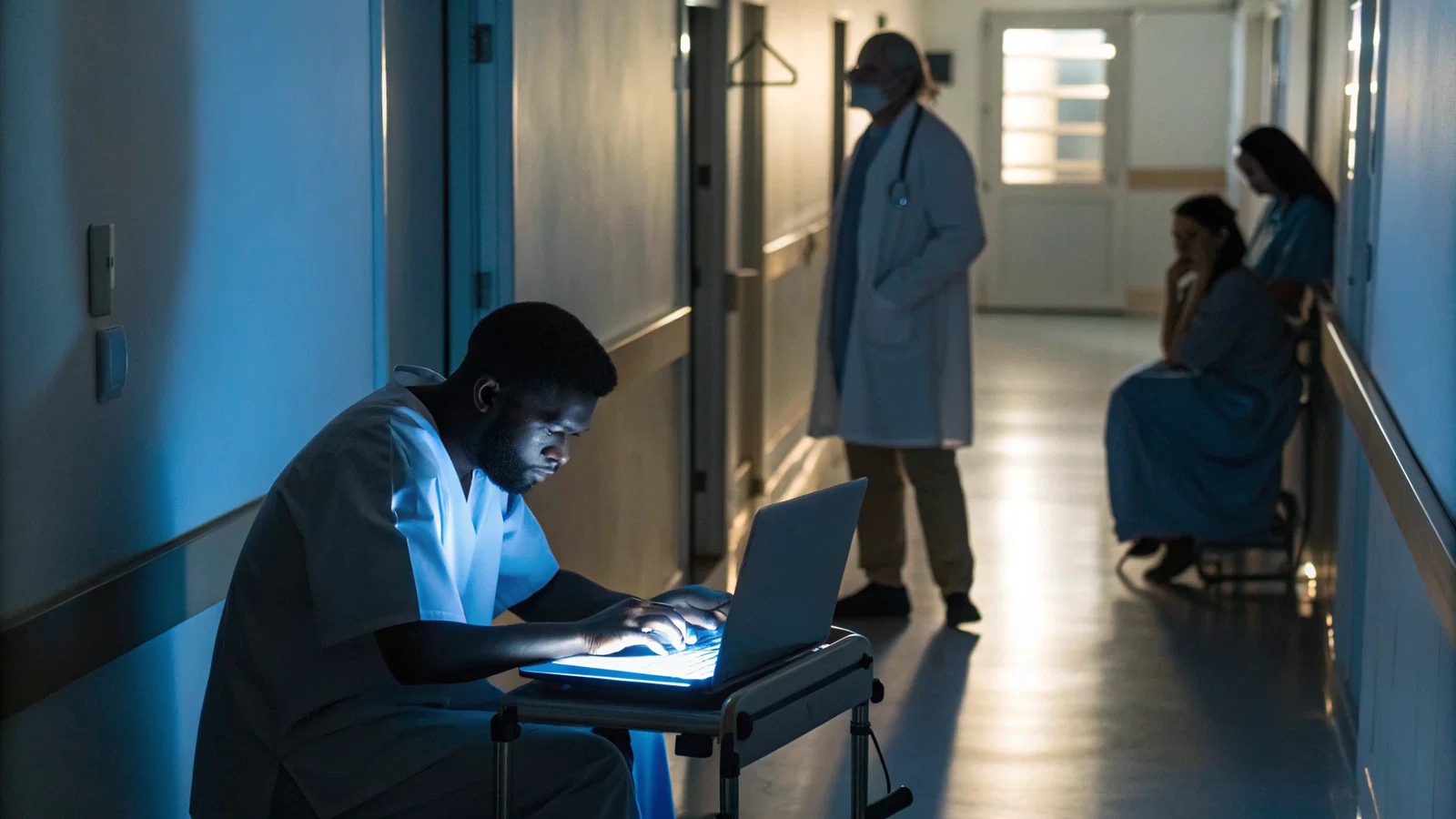
The False Shortcut: A Scenario in the Admissions Office
The applicant sat across from two admissions officers. Her application was polished. Her hours were impressive. She'd logged 3,000 hours "in a clinical setting" and attached a letter from her supervisor praising her speed, accuracy, and work ethic.
Before you finalize your list of hours, review how to categorize scribe versus shadowing roles to avoid common pitfalls.
Then one committee member leaned forward and asked a simple question: "Tell me about a specific patient encounter you observed. What was the differential diagnosis the physician was working through?"
Silence.
Not because she'd never been in a clinic. She had. She'd been there for years, but mostly at the second monitor, transcribing the note the physician had already mentally formed, entering orders, clicking through templated phrases while the real medicine happened on the other side of the room.
Her letter of recommendation opened with: "Jordan is an excellent typist who anticipated physician documentation needs and rarely required correction."
I've seen this exact scenario play out in admissions reviews. It doesn't matter that the applicant was physically present, wasn't in the exam room, and worked hard. The committee wasn't looking for a résumé line. They were looking for evidence of clinical exposure, and they found none.
Here's the red flag: when your LOR talks about your charting speed but your personal statement talks about "patient care," a careful reader notices the mismatch. The letter wins. The letter is what the recommender actually witnessed.
Don't make this mistake. Proximity to the EHR is not proximity to patient care. Shadowing a scribe can give you extraordinary visibility into workflow, but workflow is not medicine. And admissions committees know the difference.
The Fundamental Difference: Clinical Judgment vs. Documentation Efficiency
The physician's job is to make a decision under uncertainty. They hear a 58-year-old with three months of fatigue and shortness of breath and construct a differential: anemia? Heart failure? Occult malignancy? Thyroid disease? They weigh red flags, decide what to rule out, determine what can safely wait, and then explain a plan to a frightened human being while managing the family's questions in the hallway.
Before you finalize your primary clinical hours, it is helpful to review how program directors read shadowing experiences on your application to better align your presentation with their expectations.
If you are struggling to differentiate your experience, research if shadowing clinical experience alone is enough for your medical school application.
That is clinical reasoning. It has depth, uncertainty, consequence.
The scribe's job is different, and valuable, but different. The scribe captures the encounter. Templates. Prior problem lists. Medications reconciled. HPI paragraphs formatted to the organization's liking. Order entry. Charge capture. Inbox messages routed to the right person before the clinic door closes.
Documentation efficiency is a real skill. It keeps the clinic running. But it is not the same as clinical apprenticeship.
Here's the comparison that matters:
A physician shadow yields:
- Observation of differential diagnosis formation
- Listening to how physicians deliver bad news
- Watching how uncertainty gets communicated
- Exposure to clinical decision-making under real constraints
- A recommender who can actually evaluate your clinical maturity
Always ensure you understand the myth vs reality regarding shadowing residents versus attending physicians to confirm who your primary mentor should be.
A scribe shadow yields:
- Observation of note construction and data capture
- Insight into workflow bottlenecks and burnout drivers
- Familiarity with EHR mechanics
- A recommender who can evaluate your administrative reliability
- No direct evidence that you can handle the cognitive demands of medicine
The mistake isn't working as a scribe. The mistake is presenting hours accumulated in a documentation role as though they were hours accumulated learning to be a doctor.
The Perception Gap: How Admissions Committees View Scribe-Only Experiences
Let's talk about the "Administrative Bias." When a committee sees scribe hours, they don't think, "Impressive." They think, "Which parts of this involved the patient?"
I've reviewed enough premed applications to know the mental checklist that runs in an interviewer's head. It's fast, sometimes under thirty seconds per file.
Clinical insight and communication dominate. Clerical skill barely registers. That's not a conspiracy. It's a simple fact about what medical training demands and what makes a candidate compelling.
The dangerous framing error is this: listing a job as if it were a clinical role. "Clinical Experience: 2,500 hours as a medical scribe." An experienced reader will mentally translate that to "2,500 hours of data entry with physician supervision." If you don't translate it yourself, the committee will do it for you, and their version won't flatter you.
The "padding" red flag. Application reviewers are specifically trained to spot inflated hours. Ten thousand hours in a clinic that means typing for 4,000 and listening for 6,000 is not the same claim as 10,000 hours of clinical shadowing. Don't let the number do work your reflection can't support.
The letter problem. A scribe supervisor can write a strong letter about you. Reliable. Detail-oriented. Good with charting templates. But when admissions asks, "How would you assess this applicant's clinical insight and bedside manner?" the supervisor has to pause. They weren't in the room when it mattered, not in the sense that matters.
That gap between what your letter can prove and what the committee needs is exactly where applications get flagged.
Strategic Pivot: Converting Clerical Hours into Clinical Value
Good news: if you've already been a scribe, this isn't fatal. It's fixable. You just have to stop leading with the job title and start leading with the medicine.
Step 1, Audit what you actually observed. Make a list of every moment you witnessed a physician reason through a clinical problem: a physician debating whether a chest pain warranted urgent imaging; a resident catching a medication interaction on the med list; a doctor explaining a terminal diagnosis to a family; a provider deciding not to order a test and explaining why. That list is your actual clinical exposure. Count it. It's probably smaller than you feared, and much more useful than your total hours.
Step 2, Reframe the role, honestly. Instead of "2,500 hours of clinical experience as a scribe," write something like: "Working alongside a physician in a busy outpatient setting, I observed how clinical decisions are translated into actionable documentation. This proximity gave me unusual visibility into the cognitive handoffs between exam room and chart, and clarified my conviction that I want training in the clinical reasoning itself, not only the record of it."
Note what that does. It uses the experience honestly, extracts the insight, and positions the limitation as motivation rather than a hole.
Step 3, Deliberately seek the physician-facing minutes. If you currently scribe, ask to follow the physician into the exam room for a portion of the shift. Ask to attend the physician's inbox review. Ask to observe a case conference. You don't need to abandon the job. You need to redirect your attention from the monitor to the patient.
Step 4, Get a letter from someone who saw the medicine. Approach the physician directly, not your scribe supervisor, and ask whether they'd be willing to write about your clinical curiosity and your observations. Brief them with two or three specific moments you remember. Specificity is the raw material of a good letter.
Step 5, Document it separately. Once you secure genuine clinical shadowing, list it separately. "Shadowed Dr. [Name], Internal Medicine, 40 hours, focusing on patient history, differential diagnosis, and shared decision-making." Now your file contains both administrative fluency and demonstrated clinical exposure. That's a much stronger package than either one alone.

Summary: Protecting Your Professional Identity
Here's the blunt version: the path of least resistance is usually the path to a mediocre application.
Admissions committees are not looking for someone who can type quickly. They're looking for evidence of the physician mindset, curiosity, diagnostic instinct, empathy under pressure, and the ability to sit with a problem that doesn't resolve neatly. System familiarity is a supporting credential. It's not an identity.
And don't be fooled into thinking that because you're physically in a medical building, you're accumulating medical experience. Presence is not participation. A thousand hours watching a physician work is worth less than forty hours in which you observed and understood why the physician did what they did.

Final warnings before you file:
- Don't let someone else's label become your story. If you call yourself "clinically experienced" and all you can describe is charting, you've misrepresented your application, and someone will notice.
- Don't bury a weak LOR and hope nobody asks. They ask.
- Don't confuse a busy clinic with a learning environment. Volume of hours isn't depth of observation.
- Don't wait until interview season to fix this. Start now, seek physician shadowing this month, build the clinical hours that actually count, and request a letter from someone who watched you engage with the process of healing.
Your professional identity as a future physician should be built on the parts of medicine that require a human being. Not the parts that require a keyboard.