Doctors are constantly judging shadowing students, and almost none of the rules they use are ever spoken out loud.
You think you’re there to “observe medicine.” They’re deciding, within the first ten minutes, whether you’re someone they’d hire, write a strong letter for, or quietly warn colleagues about. Harsh? Maybe. True? Absolutely.
Let me walk you through what really happens on the other side of the white coat, and the shadowing etiquette doctors expect—but will never explain to you directly.
What Happens Before You Even Arrive
There’s a whole pre-game you never see.
When your email lands in a physician’s inbox, they’re scanning it in less than 15 seconds, asking three questions:
- Do you respect my time?
- Are you a professionalism risk?
- Will you make my day harder or easier?
If they say yes to at least two of those, you get the shadowing spot.
What they expect—long before you show up—looks like this:
- Your email is short, respectful, and specific. Not a personal statement, not your life story.
- You confirm the day before without sounding needy.
- You’ve already done basic research on what they do so they don’t have to explain what “interventional cardiology” is.
(See also: How Attendings Decide Who Gets Invited Back After Shadowing for more details.)
Here’s what they’ll never say out loud but absolutely notice:
- You show up 10–15 minutes early, not right on time. “On time” reads as borderline late in clinical culture.
- You don’t bring your parents, friends, or a “ride” into the clinic. If someone drove you, they wait outside or leave.
- Your email signature and voicemail are professional. Many attendings will Google you or call if something changes. If your voicemail says “Yo you know what to do, leave a message,” that’s already a strike.
By the time you walk through the clinic or hospital doors, they already have an opinion of your professionalism. Your behavior that day either confirms it—or reverses it, which is much harder.
How You Look: The Unspoken Dress Code
No one will hand you a dress code sheet. But every attending has a silent standard they expect you to magically know.
The default, unless explicitly told otherwise, is: cleaner and more formal than you think.
What they actually mean when they say “business casual”:
- For all genders: Closed‑toe shoes. No sneakers unless they’re plain, clean, and clearly intentional. No sandals. No Crocs.
- Clothes that you could wear into a residency interview and not get side‑eyed.
- No loud patterns, no giant logos, no leggings-as-pants, no jeans.
- Long hair tied back in clinical environments (especially in procedural, OR, or emergency settings).
- Jewelry minimal. Perfume/cologne effectively zero.
Many attendings will never tell you that your outfit is a problem. They’ll just decide not to invite you back.
I’ve sat in workrooms and heard verbatim:
“The student came in ripped jeans and a hoodie. Bright kid, but no way I’m putting my name on their letter.”
If you’re unsure: err on the side of overdressed the first day. You can always dress slightly down if you notice everyone else is more casual. The reverse never goes as well.
One more quiet rule: your white coat.
If you’re a premed, do not show up wearing a white coat unless they explicitly told you to. You haven’t earned it in that environment, and most attendings see it as tone‑deaf. If you’re a med student, wear whatever is standard at that institution—but never insist on it if the doctor says, “We don’t wear coats here.”

The First 5 Minutes: How They Decide If They Trust You
Doctors decide if you’re “safe” very quickly.
Not clinically safe—you’re not touching patients—but safe in terms of confidentiality, boundaries, and not becoming a complaint.
Here’s what they’re silently scanning for in the first few minutes:
- Do you introduce yourself to staff, not just the physician?
- Do you look people in the eye without being intense?
- Do you seem calm, not hyper or over-eager?
- Do you understand HIPAA at a basic level?
The attending expects a very particular introduction from you, and they rarely script it.
When they introduce you to a patient, they’re watching your face as closely as the patient’s.
The gold standard is something like:
“Hi, I’m [First name]. I’m a premedical student shadowing Dr. X today, just observing and learning. Thank you for letting me be here.”
You say it clearly, with a small, respectful nod. You have zero disgust, surprise, or overexcited energy on your face, no matter what the patient looks like, smells like, or says.
What they do not want—but won’t always correct:
- “Hey, I’m [First name], I want to be a doctor too!” (Too self‑focused)
- “I’m basically Dr. X’s assistant today.” (No, you’re not)
- Hovering silently in the corner looking terrified and never acknowledging the patient as a person.
Another unwritten rule: when a patient walks into the room, you stand up. Every time. You don’t sit while a 90‑year‑old with a walker struggles into a chair. That small behavior tells an attending more about your respect for patients than any GPA ever will.
The Silent Rules in the Exam Room
This is where most premeds blow it, and no one tells them why.
Where you physically stand
Your physical position signals whether you “get” clinical hierarchy and patient comfort.
The safest rule:
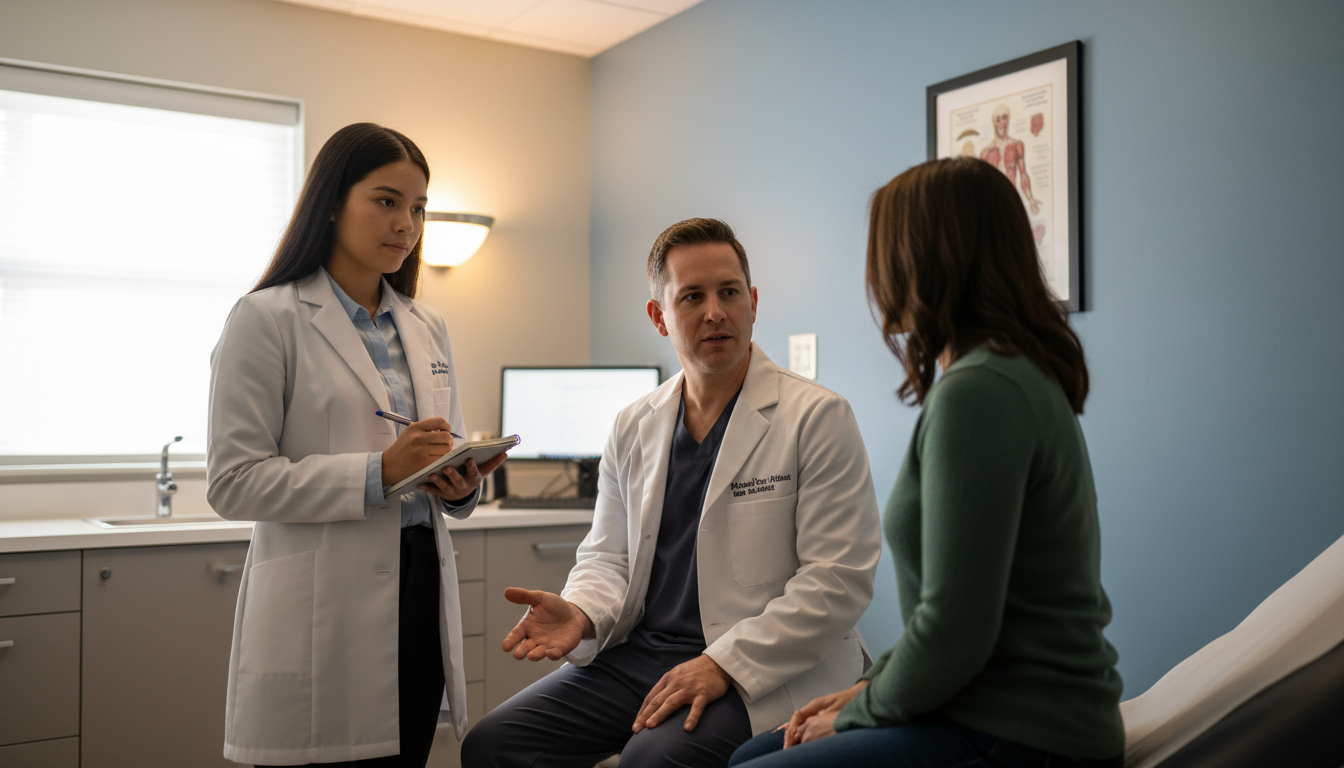
- You stand slightly behind and to the side of the physician.
- You are not between the doctor and the patient.
- You never block the door.
- You never sit in the doctor’s chair.
Do not lean on walls, counters, or equipment. You’re not at a bus stop.
In the OR or procedural area, it’s even stricter. If you lean on anything that rolls, moves, contains instruments, or touches the sterile field, you’re done. They may not invite you back, and they’ll absolutely tell others, “That student was unsafe.”
When to speak and when to be invisible
In patient rooms, attendings expect you to be 95% invisible and 5% human.
What that looks like:
- You never start the conversation.
- You never ask a question in front of the patient unless the physician explicitly invites you to, and even then you keep it brief and relevant.
- You maintain neutral, engaged body language—slight nods, eye contact with the patient when they look at you, not staring at the floor.
A question that works, if invited:
“Would it be okay if I ask one question?” (Wait for yes from both patient and doctor.)
Then something like:
“How long have you been dealing with [their symptom/condition]?” or
“How has this affected your day‑to‑day life?”
What doesn’t work:
- “So what meds are you on?” (Redundant, intrusive, not educational at your level.)
- “Do you smoke/drink?” (Feels like an interrogation out of nowhere.)
- Anything that sounds like a checklist.
If you’re not explicitly invited to ask anything, you don’t. You observe, you listen, you learn how a real encounter flows.
The patient opt‑out that no one explains
Attorneys and hospital admin are obsessed with one thing: consent and privacy.
Here’s what actually happens behind the scenes. Before you walk into an exam room, many attendings will say something like:
“This is [Your Name], a premed student who’s here to observe today. Is it okay if they stay for the visit?”
The part you don’t see is how they interpret your reaction.
If the patient hesitates or says no, your job is dead simple:
You leave immediately, with zero visible disappointment, and you say something like:
“Of course, thank you.”
The physician is watching your face. If you look annoyed, roll your eyes internally, or show visible frustration, they’ll mentally file you under “does not respect boundaries.”
You don’t get graded on how many rooms you enter. You get graded on whether they’d want you in front of their malpractice lawyer.
Talking to the Doctor: Interest Without Clinging
Let’s talk about the hallway conversations, the in‑between time. This is where letters of recommendation are born.
What attendings expect—but rarely spell out—is a very particular rhythm.
They want you to:
- Be curious, but not constantly talking.
- Ask questions, but after encounters, not during.
- Signal engagement, not desperation.
Here’s the insider trick: great questions sound like you were actually paying attention.
For example, after leaving a room:
Instead of:
“What specialty should I choose?” (Too broad, about you.)
Try:
“You mentioned starting that patient on a second medication for their blood pressure. What makes you choose that one over increasing the first one?”
You’re asking about their thinking, not just the facts. That’s what wins them over.
They also expect you to read their body language. If they’re speed‑walking, checking their watch, or looking stressed, that’s not question time. You walk quietly, keep up, and stay out of the way.
In a quieter moment—walking between clinics, waiting for labs, eating a quick snack—that’s when you can ask one or two bigger questions:
- “What do you wish premeds understood about this specialty before they commit to it?”
- “What surprised you about your day‑to‑day life as an attending compared to residency?”
Those questions tell them you’re thinking beyond just getting in somewhere.
One more unspoken expectation: when they’re writing a note, answering pages, or on the phone, don’t talk. Silence is not awkward in medicine; it’s often the only calm in a 12‑hour day.
Phones, Notes, and the Devices That Get You Blacklisted
You will not get a second chance if you mishandle your phone.
Almost every attending has the same unspoken rule: if you pull your phone out in front of a patient for anything other than a clearly defined clinical reason, they mentally cross you off.
Even if it’s to “take notes.” Even if you “just wanted to Google that medication.”
Here’s the safe hierarchy:
- Best: small paper notebook and pen in your pocket. You jot down key words between patients, not during. Never write while the patient is talking about something emotional or serious.
- Acceptable: Nothing in your hands, you write your reflections that night while it’s still fresh.
- Risky: Phone in your hand, even if the screen is off. It just looks wrong.
Doctors are protecting themselves. They can’t prove to a patient or administrator that you weren’t texting, taking photos, or recording. So they prevent the possibility by expecting you not to have your phone out.
If you absolutely must check your phone—for an emergency text, a ride, etc.—you step away from clinical areas and do it quickly, then put it away before you re‑enter anything patient‑facing.
And no photos. Ever. No selfies in the hallway. No pictures of your badge. No “day in the life shadowing Dr. X” Instagram shot with anything in the background that looks like a hospital. Many institutions explicitly forbid it; even where they don’t, attendings consider it a liability.
How to Handle Gross, Emotional, or Intense Moments
Here’s a truth most premeds never hear: attendings are watching your face more than your brain when something intense happens.
They want to know: can you handle this world without making it about you?
When you see your first procedure, wound, code, or trauma, they expect three things:
- You do not narrate your reaction out loud.
- You do not faint into anything important.
- You do not look entertained.
If you start to feel dizzy or light‑headed, tell the nurse or doctor quietly, “I’m feeling a bit lightheaded, I’m going to step out for a moment.” Then leave the room quickly and safely.
They’d much rather you excuse yourself than become a safety risk around sharp instruments and bodily fluids.
For emotional moments—breaking bad news, end‑of‑life discussions, crying families—you’re not the main character. You don’t monopolize the physician afterward with, “That was really hard for me to see.” Save that for your reflection that night, or for a mentor later.
What you can ask, at an appropriate time:
“How do you handle conversations like that, emotionally, over the long term?”
or
“Is there anything you’d want a student to notice about how you approached that conversation?”
You’re acknowledging the weight of what happened without centering yourself. That’s the professional stance they’re hoping to see.

The End of the Day: The Moment Most Students Waste
The last five minutes with an attending are more important than the first five. That’s when they decide how they’ll remember you.
What doctors expect—but rarely articulate—is a clean, professional closing.
You do three things:
You thank them sincerely, but briefly.
“Thank you again for letting me shadow today; I really appreciated seeing how you handled [specific type of case or situation]. It gave me a much better sense of [specialty/clinic].”Specific > generic. “Thanks for letting me watch” is forgettable.
You ask if it’s okay to follow up.
“Would it be alright if I email you in a few months with any questions as I continue exploring medicine?”Most will say yes. That gives you a bridge for future contact, including letters later, if appropriate.
You leave when they’re done.
If they say, “You can head out, I’m going to be finishing some notes,” you don’t linger with more stories or questions. You respect the stop.
What they’re watching for at the end:
- Do you seem entitled to anything? (A letter, a connection, a job.)
- Do you leave things tidy? If you used a chair, push it back. If you were in a physician workroom, you don’t leave trash.
- Do you try to “sell yourself” awkwardly? The worst move is: “Do you think you could write me a strong letter for medical school?” after one day. You might get a letter, but it’ll be lukewarm at best.
A better long‑game: shadow a bit more if possible, follow up with thoughtful questions over time, show that you’re genuinely engaged with the field, then ask when they actually know who you are.
One last unwritten expectation: you send a brief thank‑you email within 24 hours. Three sentences is plenty. Again, specific, not generic.
That email often goes straight into the mental folder labeled “future letter writer candidate.”
The Things That Quietly Get You Invited Back (or Silently Blacklisted)
Let me spell out, from faculty meetings and hallway chatter, the behaviors that stick.
Attending comments you’ll never hear directly, but they say to each other:
“She didn’t say a word to the nurses all day.”
Translation: lacks respect for team.“He kept standing in the doorway and never moved when people tried to get by.”
Translation: poor spatial awareness and situational sense.“She asked really insightful questions about why I chose certain treatments.”
Translation: this one thinks like a future clinician.“He kept checking his phone; I don’t care how smart he is, I’m not taking that risk.”
Translation: professionalism red flag.“She handled that bad smell like it was nothing, just kept paying attention.”
Translation: emotionally and physically durable in a clinical environment.
Shadowing isn’t graded on a rubric, but it is judged. Constantly. Soft factors, micro‑behaviors, split‑second impressions—that’s what shapes how these doctors talk about you later, when someone asks, “Would you write for this student?” or “Is this someone we’d want in our program?”
You’re not just learning medicine. You’re auditioning for it.
FAQs: Shadowing Etiquette Doctors Expect but Never Explain
1. Is it okay to decline entering a room if I’m uncomfortable with the case (e.g., sensitive exams)?
Yes, but how you do it matters. Before the day starts, tell the physician quietly if there are types of encounters you’d rather skip—pelvic exams, psychiatric evaluations, etc. Frame it as, “If there are any sensitive exams where my presence might be uncomfortable for the patient, please feel free to have me sit out; I want to be respectful.” Do not announce discomfort in front of the patient; that puts everyone in an awkward position.
2. How many days of shadowing with one doctor is “enough”?
From an insider perspective, one day gives them a first impression; 3–5 days lets them actually see your consistency; 10+ scattered over weeks or months is when they start to feel they truly know you. For letters, most attendings feel best writing for students they’ve seen repeatedly over time—not just a single eight‑hour snapshot.
3. Can I bring a coffee, water bottle, or snack while shadowing?
A closed water bottle tucked away is usually fine. Walking into patient rooms with a giant iced coffee in your hand is not. You’re not on a casual campus tour. Eat before, hydrate between clinics or during breaks, and always prioritize patient perception: if it might look unprofessional to someone sick in a gown, don’t carry it in front of them.
4. What should I do if I accidentally break an etiquette rule (like speaking out of turn or standing in the way)?
Correct immediately and don’t over‑apologize. If someone says, “Can you step back?” you say, “Of course,” move, and mentally note that boundary. If you realize later you interrupted the physician, a simple, “I realized I spoke over you earlier; I apologize, I’ll be more mindful,” shows maturity. What alarms attendings isn’t one mistake, it’s defensiveness or repetition.
5. How honest should I be about not understanding something during shadowing?
Very honest—but with timing. Do not interrupt patient care to say, “I don’t know what that means.” Jot down the term, then ask between patients: “You mentioned [term] earlier; I’m not familiar with that yet, could you explain briefly?” Attendings are far more impressed by a student who admits gaps and asks targeted questions afterward than one who pretends to understand everything and never engages.
With these unspoken rules on your radar, you’re not just another shadow in the doorway—you’re someone a physician can trust, remember, and eventually advocate for. Once you’ve mastered this level of etiquette, the next step is learning how to turn these shadowing experiences into compelling stories on your applications and in your interviews. But that’s a conversation for another day.