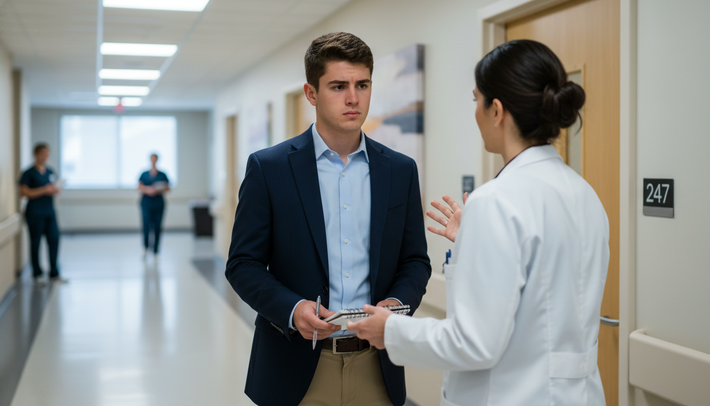
The way most premeds approach a second shadowing experience wastes 80% of its potential value.
You do one day. You trail behind the physician. You nod, smile, maybe ask a few questions. Then you repeat the same script with another doctor and call it “more hours.”
That is not how serious applicants operate.
(See also: How to Turn a One‑Day Shadow into a Long‑Term Mentorship for more details.)
If you have already shadowed once, your next step is not “do more of the same.” Your next step is to deepen the experience so it transforms from “I followed a doctor around” into “I learned to think, observe, and act like a member of the care team.”
Here is how to convert your second (and third) shadowing experiences into something that actually moves the needle for your application and your development.
1. Upgrade Your Goal: From “Hours” to “Outcomes”
Most students track shadowing in terms of hours. Admissions committees care about something else: What did this change about you?
Before you schedule your next shadowing day, define three concrete outcomes you want by the end of this experience. Examples:
- “Be able to explain, in detail, what happens during a new patient visit in outpatient internal medicine.”
- “Identify at least 5 specific ways physicians collaborate with nurses, techs, and other team members.”
- “Develop one clear story of an impactful patient interaction that I directly observed and reflected on.”
Write these outcomes down. Literally, on paper or in a notes app.
Then structure everything else in this article around them: preparation, questions, reflection. Your goal is no longer “log 8 more hours” but “walk away with specific, discussable experiences and insights.”
Action step:
- Before contacting the physician, draft:
- 3 learning outcomes
- 5–7 targeted questions (aligned with those outcomes)
- 1–2 skills you want to practice (e.g., note-taking, clinical observation, professional communication)
2. Prep Like You Are Joining The Team, Not Visiting a Museum
Your first shadowing experience probably felt like a tour. The second must feel more like day one of a rotation.
A. Do focused clinical prep (not generic science review)
You do not need to memorize pathology textbooks. You do need enough context to follow what is happening and ask good questions.
Research the specialty and setting:
- If you are shadowing:
- Family medicine / primary care: Learn the typical structure of an office visit (HPI, ROS, PE, assessment and plan). Read up on:
- Hypertension
- Type 2 diabetes
- Hyperlipidemia
- Well visits and vaccinations
- Emergency medicine: Review:
- Triage levels
- Chest pain evaluation basics
- Trauma vs medical complaints
- Surgery: Understand:
- Pre-op evaluation
- Sterile field basics
- PACU (post-anesthesia care unit) workflow
- Pediatrics: Review:
- Well-child visits
- Growth charts
- Common infections (otitis media, URIs)
- Family medicine / primary care: Learn the typical structure of an office visit (HPI, ROS, PE, assessment and plan). Read up on:
You are not trying to impress the physician with knowledge. You are trying to avoid being mentally lost all day.
Action step (90–120 minutes prep):
- Google: “day in the life [specialty] resident” and “common conditions in [specialty].”
- Write a one-page “cheat sheet”:
- 5 common complaints
- 3 common tests or procedures
- 3–5 common medications
- Bring that sheet (paper or digital) for quiet moments.
B. Clarify expectations before you arrive
This is where almost everyone fails. They show up with no defined role.
Send an email 4–7 days before shadowing:
Dear Dr. [Name],
Thank you again for the opportunity to shadow you on [date]. I wanted to briefly confirm logistics and expectations so I can be as prepared and helpful as possible.
- Planned time: [start–end]
- Location: [clinic / hospital and specific department]
- Attire: [confirm white coat or not; business casual vs scrubs]
- Participation: Would you prefer that I mainly observe quietly, or is it acceptable for me to ask brief questions between patient encounters?
I am especially interested in learning more about [specific aspect: e.g., how you navigate complex chronic disease management / how you communicate difficult news].
Thank you again for your time,
[Your Name]
You have just:
- Signaled professionalism
- Clarified your level of interaction
- Given the physician a focus for teaching
C. Build a personal “observation framework”
Most students watch shadowing like a movie. You will watch it like a scientist.
Create a simple framework in your notebook with 4 headings:
- Clinical reasoning
- Communication
- Team dynamics
- Systems / logistics
Under each, leave space for bullets. Your task during shadowing: Fill the boxes with concrete observations.
Example bullets:
- Clinical reasoning: “Dr. S asked specifically about red-flag symptoms for back pain (saddle anesthesia, incontinence).”
- Communication: “Used teach-back method: ‘Can you tell me in your own words how you will take this medication?’”
- Team dynamics: “Nurse’s assessment subtly changed the plan – MD adjusted diuretics after hearing home weights.”
- Systems: “Delay in imaging because machine overbooked; physician openly apologizes and explains constraint.”
You are now watching with intent, not passively absorbing.

3. Change How You Behave During Shadowing
The second time you shadow, your behavior must differentiate you from a nervous first-timer.
A. Master the micro-professional behaviors
These sound trivial. They are not.
- Arrive 10–15 minutes early. Use the time to:
- Introduce yourself to front desk staff
- Learn where to stand, sit, and store your things
- Wear the right thing. When in doubt:
- Closed-toe shoes
- Neutral, clean, pressed clothes
- Avoid strong fragrances
- Introduce yourself clearly and consistently:
- “Hello, my name is [First Name]. I am a premedical student shadowing Dr. [Name] today.”
- Where you stand:
- Never between the physician and the patient
- Do not lean on counters or equipment
- In the OR: never turn your back into the sterile field; stay where the circulating nurse tells you
You want staff to forget you are a student and instead think “part of the environment and not a distraction.”
B. Ask better questions at the right times
You already know to “ask questions.” That is not enough. You need to ask targeted questions that:
- Connect to what you observed
- Show you are thinking about the bigger picture
- Respect time pressure
Good times to ask:
- Walking between patient rooms
- During charting if the physician seems unhurried
- At lunch or after the shift
Examples of deepening questions:
- Clinical reasoning:
- “You ordered a CT rather than an MRI for that patient with abdominal pain. What key factors drove that decision?”
- “When you see a patient with multiple complaints, how do you decide what to prioritize in a 15-minute visit?”
- Communication:
- “You shifted your tone noticeably with the anxious patient. How do you decide how much reassurance versus directness to use?”
- “You used a lot of analogies with that patient who had limited medical background. How did you choose them so quickly?”
- Systems:
- “I noticed you mentioned insurance coverage when choosing a medication. How often does that change your ideal plan?”
Avoid:
- Questions you could have googled
- Interrupting patient encounters
- Making the physician repeat the same explanation multiple times without demonstrating you processed it
If the day is busy, say:
“I have a few questions building, but I want to be respectful of your time. Is there a better point today when I could ask you some of them?”
You have demonstrated awareness and professionalism.
C. Learn to read the room
This is one of the most underrated skills.
- If a patient starts crying → stop taking notes, direct your attention respectfully to them, maintain appropriate facial expression
- If you sense tension (bad news, conflict, complex discussion) → minimize movement, no whispering, no phone use
- If the physician seems rushed and stressed → reduce non-essential questions and focus on sharp observation
You are training the same situational awareness you will need on clinical rotations.
4. Turn a One-Off Day Into a Long-Term Mentorship
Shadowing is often treated as a checkbox. Instead, treat this second experience as a tryout for a mentor-mentee relationship.
A. Signal that you are serious
Your actions over the day should say:
- “I prepared.”
- “I am reflecting.”
- “I care about medicine beyond the application.”
Strategies:
- Reference prior learning: “In my last shadowing experience in family medicine, most patients had chronic disease follow-ups. Here, in EM, it feels like the focus is very different. How did you decide between these specialties?”
- Connect what you are seeing to your own questions: “I am still trying to understand how physicians handle uncertainty. Today I noticed…”
You become memorable because you are thinking, not just logging.
B. Ask for feedback, not a letter (yet)
End of day or via follow-up email within 24 hours:
“Dr. [Name],
Thank you again for allowing me to shadow you today. I learned a great deal, especially about [specific points].
As I am early in my journey, I would appreciate any brief feedback you may have about how I approached today – either things I did well or specific ways I could improve as I continue to shadow and pursue medicine.”
Two things happen:
- You get actionable advice.
- You signal maturity and growth orientation.
Important: Do not ask for a letter of recommendation after a single day unless the physician enthusiastically insists they would gladly write one. Your goal first is an ongoing relationship.
C. Convert shadowing into a longitudinal connection
If the day goes well, you can say near the end:
“I have found this experience very valuable. If your schedule permits, would it be possible to shadow you again in a few months, or even on a different type of day (e.g., clinic vs inpatient)? I would like to see how your work varies in different settings.”
Then, send a follow-up email:
- Thank you + key learning
- Request for a second experience
- Ask if you can stay in touch with occasional questions as you progress
Now you are positioning this physician as:
- A future recommender
- A long-term mentor
- A resource for specialty and career decisions
5. Build a Reflection System That Feeds Your Application
This is where most premeds extract almost zero value: they do not process what they saw in a structured way.
Your second shadowing experience should feed:
- Personal statement
- Work & Activities entries
- Secondary essays (“describe a clinical experience…”)
- Interview answers (“tell me about a time…”)
A. Do a same-day debrief (30–45 minutes)
The day you shadow, before sleeping, answer in writing:
- Top 3 moments that stood out.
- One patient story you will remember:
- What was the context?
- What did the physician do/say?
- How did it affect you?
- One thing that surprised you about:
- The physician’s role
- The team
- The health system
- One challenge you saw the physician face, and how they responded.
- How this experience affected your view of:
- The specialty
- Your fit for medicine
Do not skip. By next week, details will blur.
B. Create a “shadowing log” with more than dates and hours
Instead of a simple spreadsheet, build a log with columns such as:
- Date
- Physician / specialty / setting
- Hours
- 2–3 key activities observed
- 1 patient or situation that impacted you (de-identified)
- 1 professional behavior you noticed (e.g., how they handled disagreement with a colleague)
- 1 question you still have
Example entry:
- Date: 03/15/2025
- Physician: Dr. Chen, Internal Medicine – Academic clinic
- Activities: Chronic disease follow-ups; new CHF diagnosis; multi-morbidity in elderly patient
- Impactful situation: 72-year-old with CHF + CKD, Dr. C negotiated realistic medication plan factoring in financial constraints and pill burden.
- Professional behavior: When pharmacy called about formulary restrictions, Dr. C calmly re-evaluated options, kept patient’s priorities central, never expressed frustration in front of patient.
- Outstanding question: How do internists avoid burnout when so many patients have complex, chronic issues with social barriers?
This type of log is gold when drafting applications.
C. Extract 2–3 “application-ready” stories
From your second (and later) shadowing experiences, you want a few deeply described, not vague, stories.
Look for stories that highlight:
- Ethical tension
- Communication challenges
- System limitations
- Human connection
- Intellectual excitement
Example transformation:
- Weak: “I saw that doctors work with diverse patients and must communicate clearly.”
- Strong: “During one visit, a Spanish-speaking patient with uncontrolled diabetes struggled to understand why her insulin regimen changed again. The physician paused, brought in a medical interpreter, sat down at eye level, and used a visual chart to compare her blood sugars before and after the last adjustment. Only after asking her to explain the plan back in her own words did they finalize the regimen. Watching that process showed me that patient understanding is not automatic; it is deliberately tested and built.”
You now have an actual narrative, not a cliché.

6. Strategically Diversify and Sequence Future Shadowing
You have already shadowed once. You are about to deepen a second experience. How do you plan the next steps so this builds a coherent story rather than a random checklist?
A. Think in terms of contrast and continuity
You want:
- Continuity: multiple encounters in one setting to appreciate patterns and build relationships.
- Contrast: different specialties/settings to broaden perspective.
Good progression patterns:
Primary care → Specialty clinic → Hospital
- Understand care across the continuum
- Example: Family medicine clinic → Cardiology clinic → Inpatient cardiology consults
Outpatient → Inpatient → Emergency
- See acuity spectrum and care transitions
- Example: Outpatient endocrinology → Inpatient medicine → Emergency department
Adult → Pediatric → Geriatric focus
- Understand how age shapes communication, decision-making, ethics
When you request new shadowing, you can frame it:
“I have spent time in outpatient family medicine and internal medicine clinic. I would like now to understand how care looks in an inpatient setting, particularly how hospitalists coordinate with primary care physicians. Would it be possible to shadow you on service for a day?”
This shows intentional planning.
B. Use each new experience to test specific questions about fit
Stop treating shadowing as passive exposure. Treat it as data collection for career decisions.
Before each new experience, write down three career questions you want to test. Examples:
- “Do I prefer acute care or longitudinal relationships?”
- “How do I feel about frequent difficult conversations?”
- “Do I enjoy procedures or primarily cognitive work?”
After the day, answer those questions honestly. Your personal statement will write itself when you have years of these micro-assessments documented.
C. Integrate shadowing with other clinical experiences
Deepened shadowing is powerful, but it is not enough by itself.
As you advance:
- Pair shadowing with:
- Clinical volunteering (e.g., ED ambassador, hospice, clinic assistant)
- Scribing
- Medical assistant jobs (if training and time allow)
Use shadowing to:
- Understand physician perspective
- See how teams function Use other roles to:
- Interact directly with patients
- Practice communication
- Experience health care from different angles
In interviews, you can say:
“Through shadowing, I saw the physician’s decision-making. Through my role as a clinic volunteer, I experienced how those decisions affect patient flow and patient understanding. Together they have given me a more complete view of how care actually happens.”
That level of integration comes from deliberately deepening each experience, not hopping randomly.
7. Common Mistakes in “Second Round” Shadowing and How to Fix Them
To keep this solution-oriented, here are specific problems and protocols.
Problem 1: “I felt like I was just in the way again.”
Fix protocol:
- Before the day, email to clarify role and appropriate times for questions.
- On arrival, ask directly: “Where would you like me to stand or sit during encounters so that I am least disruptive?”
- Between patients, ask: “Is there anything I can do that would be helpful or would you prefer I just observe quietly?”
- Be hyper-aware of space and workflow; watch how nurses and residents position themselves.
Problem 2: “I did not understand most of what was going on.”
Fix protocol:
- Tighten your pre-shadow prep (the 90–120 minute focused review).
- During encounters, listen for:
- Chief complaint
- One or two key questions the physician asks
- The plan as it is explained to the patient
- After the visit, ask: “Could you briefly walk me through your thinking for that patient? What were you considering at first and how did you narrow it down?”
- At home, look up:
- Every diagnosis you heard more than once
- Any unfamiliar tests/procedures that recurred
Problem 3: “I did not build any real connection with the doctor.”
Fix protocol:
- Share a concise origin story when you first meet: “I am a junior at [School], majoring in [X], currently exploring [Y]. I am especially curious about [Z] in medicine.”
- Ask one or two questions about their journey:
- “What surprised you most when you started residency?”
- “Has your view of your specialty changed over time?”
- Follow up with a specific thank-you email that references:
- A case they discussed with you
- A piece of advice they gave
- One thing you plan to do differently because of them
- A few months later, send a short update:
- “I applied to these clinical roles… Your comments about [topic] shaped my decision.”
You are converting a transactional encounter into a relationship.
Key Takeaways
- Treat your second shadowing experience as an upgrade: move from counting hours to deliberately chasing learning outcomes, stories, and insight.
- Prepare, behave, and reflect like a junior member of the team, not a tourist—structured prep, targeted questions, and systematic reflection will separate you from the crowd.
- Use each deepened experience as a building block for mentorship, specialty exploration, and eventual application narratives, rather than isolated “shadowing days” with no coherent arc.