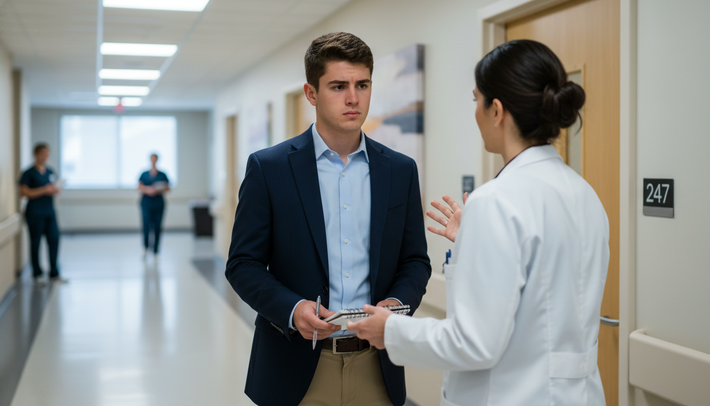
Only 18% of matriculants report any physician shadowing before college, yet premed forums make it sound like you are behind if you are not in scrubs by age 15.
Let’s dismantle that.
The “start shadowing in 9th grade or you’re doomed” narrative is one of the most persistent, anxiety‑fueling myths in the premed world. Parents email doctors asking if their 14‑year‑old can shadow. High schoolers agonize over whether they’ve “lost their chance” because they didn’t get into some medical pipeline program.
(See also: Do You Really Need Hospital Shadowing? What Evidence Suggests for more details.)
Here’s what admissions committees actually care about—and how early high school shadowing fits into that picture (spoiler: it mostly doesn’t).
The Myth: Early Shadowing Proves You’re More Committed
The common story goes like this:
- Myth: The earlier you start shadowing, the better you look.
- Corollary myth: Committees will be impressed that you started in 9th or 10th grade because it shows lifelong passion for medicine.
- Forum version: “My cousin got into [insert name-brand med school] and she’d been shadowing since middle school.”
Reality check: the data and the actual behavior of admissions committees do not support this.
Look at the AAMC Matriculating Student Questionnaire (MSQ). Matriculants report a wide range of total clinical exposure hours, but there’s no “bonus category” for “started early in high school.”
Why? Because:
- Many schools tell you explicitly: they only count experiences after high school graduation (or after age 18).
- The primary goal of shadowing isn’t to impress anyone—it’s to help you understand what physicians really do.
- Maturity, reflection, and pattern of behavior in college carry more weight than fuzzy memories from when you were 15.
Committees are not flipping to page two of your application to see if you shadowed as a sophomore in high school. They’re asking a different question: “By the time this person applied to medical school, do they show convincing, informed exposure to patient care and physician life?”
Not: “Did they start before they finished algebra?”
What Committees Actually Look For in Clinical Exposure
Let’s get blunt. When adcoms, advisors, and physicians talk among themselves, here’s what tends to matter when they evaluate clinical exposure:
- Timing relative to application
- Depth of engagement
- Reflection and insight
- Consistency over time
They are trying to answer:
- Does this person actually know what they’re getting into?
- Have they seen enough of real medicine—its bureaucracy, emotional load, and tradeoffs—to make an informed decision?
- Did they show up once for 10 hours or did they sustain involvement over months/years?
Shadowing at 15 usually fails that test for one simple reason: you aren’t developmentally in the same place. Most high schoolers can’t yet process what burnout, malpractice risk, family-sacrifice, and emotional trauma in medicine really mean. That is not an insult. It’s a developmental reality.
So when a committee sees:
“Shadowed Dr. Smith (family friend) for one week in 10th grade,”
it often reads as:
- Parent‑arranged exposure.
- Limited insight at the time.
- Not especially predictive of how you’ll engage in college or as a medical student.
In contrast, 100–150 hours of shadowing and/or clinical volunteering during college, coupled with sharp reflections in your essays and interviews, is worth vastly more—even if your first exposure to medicine was at age 19.
The Fine Print: How Applications Treat High School Experiences
Here’s the part most premeds never read carefully.
AMCAS (MD) and AACOMAS (DO)
- Many medical schools explicitly say they do not consider activities performed before college.
- Some secondaries state: “Please include experiences from college and beyond,” or “Do not include high school activities unless extraordinary.”
- Advisors at places like the University of Michigan and Johns Hopkins have publicly stated that high school items are usually ignored unless they continued into college or are qualitatively unique (national athlete, started a substantial nonprofit, etc.).
So where does high school shadowing end up?
- Often, nowhere. It doesn’t get listed.
- Or it’s briefly mentioned in a personal statement as the spark, not as core clinical evidence.
- Or it sits on your CV but is not used as a major piece of your argument for being prepared for medicine.
Contrast that with college experiences. They are:
- Logged with dates, hours, and supervisor names.
- Evaluated for impact and reflection.
- Used as evidence of adult responsibility and informed choice.
That’s why an applicant who started serious shadowing after sophomore year of college but has 120+ hours across multiple specialties is often viewed more favorably than someone waving a “shadowing since age 14” banner but with minimal meaningful, recent involvement.
What Early High School Shadowing Is Actually Good For
Now, don’t misread this: early exposure is not “bad.” It just doesn’t do what people claim it does.
Here’s what early high school shadowing can genuinely help with:
Personal career exploration
You might discover, “I actually hate blood,” or “I’d rather work on the tech side,” or “I love the clinic environment.” That’s valuable—but it’s valuable to you, not primarily to admissions.Context for later decisions
When you choose college courses or majors, having seen clinical life can anchor your decisions. Maybe you double major in Spanish because you saw language barriers in clinic. That’s worthwhile.Motivation to pursue more serious experiences later
The early exposure might push you to seek a real, sustained clinical role in college (scribe, EMT, MA, hospital volunteer).A story seed, not the main story
A brief anecdote from 10th grade can be chapter one of your narrative—if you show that your adult experiences built on it. If you stop at chapter one, that’s where the story dies.
Where it’s not as useful:
- As primary “clinical hours” on your med school application.
- As the thing that “separates” you from other applicants.
- As proof of lifelong passion that magically compensates for weak college‑level engagement.

How Committees Really React to Early Shadowing Claims
Here’s how early high school shadowing typically reads to people on the other side of the table.
Scenario 1: The “I’ve Wanted This Since I Was 8” Applicant
Personal statement:
“I knew I wanted to be a doctor when I was 8. I began shadowing in 9th grade and that experience cemented my passion for medicine…”
Committee reaction:
- Mild eye‑roll at the “since I was a child” line (they’ve seen that sentence thousands of times).
- Curiosity about what you did recently, not what you felt as a child.
- They scan your activities list: Do you have sustained, adult‑level clinical roles?
If your recent experiences are robust, your early shadowing becomes mostly harmless background color. If your recent experiences are thin, your early shadowing reads as compensation and weakens your argument: “You had 8–10 years of supposed interest and this is all you did once you were old enough to act on it?”
Scenario 2: The Parent‑Engineered Track
Applicant:
- Shadowed a parent’s colleague in 10th grade.
- Did a prestigious‑sounding high school “pre‑med camp.”
- Has weak or generic college clinical experiences (e.g., 40 hours of hospital volunteering with little responsibility).
Committee reaction:
- Smells heavily parent‑driven.
- Raises questions: Does this person independently seek experiences? Or do they just follow a script?
- The early shadowing does not rescue the weak adult track record.
Scenario 3: The Late Bloomer with Strong College Experiences
Applicant:
- Did no shadowing in high school.
- In sophomore year of college, starts as a hospital volunteer, then becomes a scribe, then shadows several specialties intentionally.
- Writes clearly about the downsides of medicine: documentation burden, emotional fatigue, schedule constraints.
Committee reaction:
- This looks like a mature, data‑driven career decision.
- Lack of high school shadowing is irrelevant; the adult record is what matters.
- This kind of applicant often feels more genuine and grounded.
The pattern is consistent: high school shadowing is neither necessary nor sufficient. It’s background noise unless you convert early curiosity into serious adult engagement.
The Hidden Risks of Chasing Early Shadowing
There are also non‑obvious downsides to the “start as early as possible” obsession.
Risk 1: Ethical and legal gray zones
Hospitals and clinics are increasingly strict about:
- HIPAA and patient privacy
- Infection control
- Liability around minors in clinical spaces
Many health systems flat‑out prohibit high school shadowing except through structured programs. When people sneak high schoolers into clinics as “observers,” they sometimes dance around institutional rules.
That does not impress anybody on a committee.
Risk 2: False sense of security
High school shadowing can create an illusion of preparedness:
“I’ve been doing this for years” → “I don’t need that much more in college.”
Then people end up with:
- 20–40 shadowing hours in college.
- Minimal longitudinal patient contact.
- Shaky ability to discuss the current healthcare landscape.
You do not get “credit rollover” from 10th grade.
Risk 3: Box‑checking mentality
Starting early can trap you in a mindset:
- “I need X specialty on my list.”
- “I should shadow a surgeon, a pediatrician, and an internist by the end of high school.”
You start building a portfolio instead of building understanding. Committees can smell portfolio building. It shows up as shallow reflections and generic “I just want to help people” language.
How to Use Early Shadowing the Smart Way
If you already have high school shadowing—or you’re considering it—here’s how to make it actually work for you.
1. Treat it as exploration, not a credential
Ask yourself:
- What surprised me?
- What parts of the day actually appealed to me (not just what I thought would appeal)?
- What did I not like?
Write those down for yourself. Not for the application. You are building an internal database of career signals, not padding a CV.
2. Use it to guide college decisions
Let early experiences inform:
- What kind of clinical roles you pursue in college (ER scribe vs. long‑term care volunteer vs. MA in a clinic).
- What populations interest you (rural vs. urban, underserved vs. specialty clinics).
- What non‑clinical skills you might want to develop (language, public health, data science).
3. Build the real evidence later
By the time you apply to medical school, you should aim for:
- Meaningful clinical exposure in college (often 100+ hours between shadowing, scribing, EMT, MA, etc.).
- Some continuity—e.g., working in one setting for 6–12+ months.
- Mature insights about physician lifestyle, frustrations, and tradeoffs.
Your high school shadowing becomes a footnote: “My first real glimpse of medicine occurred in high school, but it wasn’t until I began working as an ED scribe during college that I understood…”
That’s enough.
4. Don’t stretch it past its actual impact
If you barely remember what you saw at 15, don’t turn it into a 3‑paragraph epic in your personal statement. Committees can tell when you’re inflating something minor into Something Profound.
Mention it briefly if it was genuinely formative, then move on to your adult experiences. Those are what will carry the argument.

If You Never Shadowed in High School
Let’s be absolutely clear: you are not behind.
Here’s what committees will not do:
- They will not reject you for failing to shadow at 16.
- They will not assume you are less committed than the person who did.
- They will not ask, “Where are your high school experiences?” on secondaries or in interviews.
What they will do is look closely at:
- How you used your college years.
- Whether you showed initiative once you had adult autonomy.
- Whether your clinical exposure is deep enough and recent enough to anchor an informed decision.
There are plenty of students at top med schools (Penn, UCSF, Duke, etc.) who never stepped inside a clinic until they arrived on campus as undergrads. Their applications were not weaker for it.
Key Takeaways
- Early high school shadowing is neither required nor heavily valued by most committees. It can help you explore, but it rarely moves the admissions needle by itself.
- Adult, college‑level clinical experiences dominate committee decisions. Timing, depth, consistency, and reflection matter far more than whether you started at 15.
- Use early exposure as a starting point, not a trophy. Let it guide stronger, more intentional involvement in college—but do not mistake it for “proof” of commitment on its own.