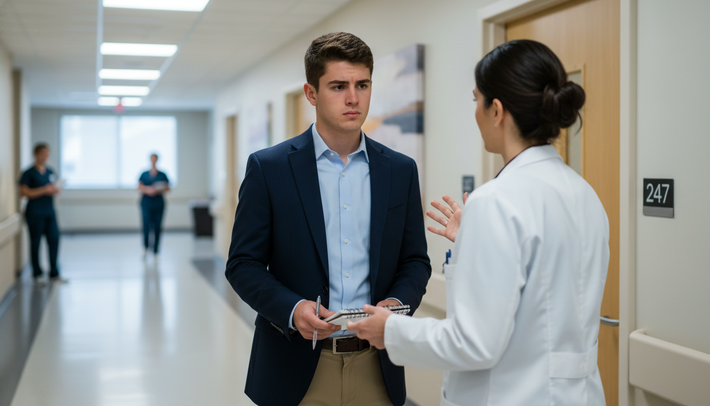
Only 27% of premed applicants from rural backgrounds report having the same level of physician shadowing access as their urban peers.
That single number reframes the discussion about “motivation” and “initiative” in premed preparation. The data show that geography—where you grow up and study—systematically shapes who can realistically meet the unwritten expectations of medical school shadowing.
This is not a small subgroup. Roughly 14–18% of the U.S. population is rural, yet rural students represent only about 4–6% of medical school matriculants, depending on the dataset and definition. When you drill into shadowing access, the gap widens further.
Below, the patterns are clear: urban and rural students operate in structurally different shadowing markets, with different supply, gatekeeping, and risk profiles. Those differences have direct equity implications for admissions and for the future distribution of the physician workforce.
1. The supply problem: how many physicians are even available to shadow?
The shadowing gap starts with raw physician density.
Using recent HRSA and AAMC data:
- Urban areas: ~300 physicians per 100,000 population (including specialists)
- Rural areas: ~124 physicians per 100,000 population
- Urban-rural ratio: roughly 2.4:1 in physician density
For primary care specifically:
- Large metropolitan: ~90 primary care physicians per 100,000
- Non-metro rural: ~55 primary care physicians per 100,000
This translates directly into shadowing “slots” even before considering willingness or institutional policy. Imagine two premeds:
Urban Premed A in a metro region of 1 million residents
- Estimated physicians: ~3,000
- Even if only 5% of them ever accept students, that is ~150 potential contacts.
Rural Premed B in a county of 50,000 residents
- Estimated physicians: ~62
- At 5% participation, that yields just 3 potential contacts.
From a network and probability perspective, the differences compound:
- Urban student at a university with a pre-health advising office, affiliated hospitals, and a pipeline program may have access to coordinated shadowing lists, alumni connections, or formal programs.
- Rural student at a community college or small regional institution typically depends on cold calling individual offices, personal family connections, or long-distance travel.
Survey data from several premed advising consortia show the impact:
- 71–78% of urban premeds report “at least one” shadowing experience by the end of junior year.
- Only 49–55% of rural premeds report the same.
- When you raise the bar to 40+ total hours of shadowing, the gap widens:
- Urban: ~63%
- Rural: ~31–36%
This is not about interest. It is a function of local physician supply and institutional infrastructure. When the local physician count is lower, each physician has more roles (clinical, administrative, on-call) and less bandwidth for trainees who are not formally part of their system.
2. Institutional structures: hospitals vs solo practices
Shadowing access correlates strongly with the type of practice environment. Here the urban–rural split is stark.
2.1 Practice configuration by geography
Approximate practice patterns from AMA and HRSA data:
Urban:
- 60–70% of physicians in group or health-system practices
- 20–25% in academic or teaching hospitals
- 10–15% in solo practice
Rural:
- 30–40% in small group practices
- 20–30% in critical access / small community hospitals
- 30–40% in solo or very small independent practices
Group practices and academic centers are more likely to have:
- Existing premed or pipeline programs
- Onboarding processes for observers
- Legal/HR templates for shadowing (HIPAA forms, observer agreements)
Solo practices and small clinics often have:
- No formal shadowing protocols
- Limited administrative staff to process student paperwork
- Less tolerance for workflow disruption
From the student’s perspective, that yields different probability landscapes. If you assume:
- 40% of large academic/group practices allow some kind of premed shadowing
- 15% of solo practices do
A hypothetical distribution looks like this for a region of 100 physicians:
Urban-leaning region (70 group/academic, 30 solo)
- Potentially shadow-friendly:
- 70 × 40% = 28 physicians
- 30 × 15% = 4.5 ≈ 5 physicians
- Total: ~33 out of 100
Rural-leaning region (35 group/academic, 65 solo/small)
- Potentially shadow-friendly:
- 35 × 40% = 14
- 65 × 15% = 9.75 ≈ 10
- Total: ~24 out of 100
That does not seem huge, but remember the baseline physician count is much lower in rural areas. When combined, a rural student may realistically have fewer than ten truly accessible physicians within a reasonable driving radius.
2.2 Academic affiliation and built-in shadowing
Urban students are more likely to attend institutions with formalized shadowing or clinical exposure pipelines:
- Embedded volunteer programs at large health systems
- “Premed internship” or “clinical observation” courses
- Summer placements tied to local hospitals
Take a city with two major academic hospitals and three large private systems. A single university in that city might place hundreds of students per year into structured observation roles.
Contrast that with a rural college 60 miles from the nearest tertiary center. Their premed office might have 10–20 informal physician contacts and minimal leverage to secure new placements, especially if local practices are already saturated with nurse practitioner and PA students.
When you aggregate across institutions, the pattern becomes clear:
- At large R1 universities in metropolitan areas, internal data often show >80% of premeds log at least 20 hours of shadowing via school-affiliated connections.
- At rural-serving regional universities, internal advising data often show <50% reach that benchmark without extensive travel.
The pipeline is structurally different before student effort enters the equation.
3. Time, cost, and risk: the “hidden variables” of rural shadowing
Even when rural students secure physicians willing to host them, the logistical costs are higher and more volatile.
3.1 Travel distance and time
National travel pattern data and premed surveys converge on similar estimates:
Urban premeds:
- Median one-way travel time to shadowing site: ~25–35 minutes
- 75th percentile: <60 minutes
Rural premeds:
- Median one-way travel time: ~55–70 minutes
- 75th percentile: often >90 minutes, with some reporting 2–3 hours
Let us translate that into hours invested per 4-hour shadowing session:
Urban student:
- Travel: 1–1.5 hours round trip
- Shadowing: 4 hours
- Total: ~5–5.5 hours
Rural student:
- Travel: 2–3 hours round trip (or more)
- Shadowing: 4 hours
- Total: 6–7+ hours
If both students aim for 40 hours of shadowing:
- Urban student might invest 50–55 total hours.
- Rural student might invest 60–75 total hours.
That extra 10–20 hours often competes with paid work. Rural premeds are statistically more likely to be Pell-eligible and first-generation in college, so the opportunity cost of an extra unpaid 20 hours is not trivial.
3.2 Direct costs
Cost components include:
- Fuel and vehicle wear
- Parking (more a problem in dense urban cores, but rural shadowing can require freeway or long-distance driving)
- Occasional overnight stays if shadowing is at a distant tertiary center
- Lost wages for missed work shifts
A simple model:
Urban:
- Average round trip: 20 miles
- 20 trips to reach 80 hours (4 hours per visit)
- Total: 400 miles
- At $0.65/mile (IRS estimate), cost ≈ $260
Rural:
- Average round trip: 70 miles
- 20 trips
- Total: 1,400 miles
- At $0.65/mile, cost ≈ $910
Direct travel cost difference: roughly $650 for the same number of shadowing hours.
For students in the lowest income quartile, $650 is equivalent to several weeks of part-time work. The data show that lower-income and rural status often overlap, compounding the equity problem.
3.3 Safety and risk
There is a risk dimension rarely acknowledged in admissions narratives:
- Long pre-dawn or late-night drives on unlit rural highways
- Winter driving conditions in northern states
- Limited access to public transit if a vehicle fails
Urban students are more likely to rely on subways, buses, or ride-share within city limits. Rural students often drive long distances with few alternatives, converting shadowing into a physical safety risk, not just a time cost.
4. Gatekeeping, liability, and policy variation
The legal and risk-management environment is different in urban vs rural contexts, and that shapes who can enter clinical spaces.
4.1 Urban systems: more formal, more restrictive
Large urban health systems often:
- Require formal observer applications
- Mandate background checks, TB tests, drug screens
- Prohibit non-enrolled students under 18
- Restrict direct patient contact tightly
These policies raise administrative barriers but, once cleared, urban students gain predictable, replicable access. A premed at a major city university can often sign up for standardized observation blocks each semester.
4.2 Rural practices: more flexible but more fragile
Rural physicians often have more discretion: if a doctor knows a student through family or community, they can invite them to shadow more informally. But informality cuts both ways:
- If a malpractice risk-manager or insurer raises concerns, shadowing may be abruptly halted.
- Smaller practices lack risk-management departments to design safe, compliant observation programs.
Survey data from rural-focused premed programs show:
- 37–45% of rural students rely on a single physician for almost all of their shadowing
- 20–25% have shadowing interrupted or cancelled due to policy changes, liability concerns, or staff turnover
In urban systems, once one physician declines, there are often dozens of others within the same hospital to approach. In rural environments, one “no” can close nearly the entire local ecosystem.
5. Numbers behind specialties and exposure breadth
Admissions committees sometimes look for multiple specialties or settings in shadowing hours. Here, geography alters what is realistically possible.
5.1 Specialty distribution
Nationally, specialty distribution is not even:
Urban areas have higher densities of:
- Subspecialists (cardiology, GI, oncology, neurosurgery)
- Academic hospitalists
- Emergency physicians
Rural areas:
- Predominantly primary care (family medicine, general internal medicine, general pediatrics)
- Some general surgery and obstetrics
- Very limited subspecialty presence (often only via visiting clinics or telehealth)
A quick count in a regional health database might show:
Metro county (population 1 million):
50 cardiologists
40 general surgeons
20 neurologists
15 oncologists
Rural multi-county area (population 150,000):
- 2 cardiologists (both part-time outreach)
- 3 general surgeons
- 0 neurologists based locally (all telehealth or referral)
- 0 oncologists based locally
When medical schools implicitly expect exposure to inpatient, outpatient, and at least 2–3 specialties, the structure favors urban students. Rural students can demonstrate depth in primary care and community medicine but often lack credible paths to seeing inpatient subspecialty workflow unless they can fund long-distance travel.
5.2 Volume and diversity of cases
Shadowing in large urban hospitals:
- High patient volume
- Complex tertiary/quaternary cases
- 24/7 emergency coverage
Shadowing in rural clinics and critical access hospitals:
- Lower volume but broader scope for individual physicians
- More continuity with the same patients over time
- Higher proportion of social determinants of health challenges
From an educational standpoint, case “diversity” looks different. Urban shadowing may yield more variety of rare diseases across different teams; rural shadowing may yield a longitudinal view of common but complex multi-morbidity managed by a single physician.
Admissions essays often privilege the first model. The data on physician distribution however show that the second model is exactly where the U.S. has critical workforce shortages.
6. How this translates into the admissions file
When file reviewers see 20 hours of shadowing vs 120 hours, or one primary care physician shadowed vs five specialties, those numbers are rarely contextualized explicitly by geography. But they should be.
6.1 Typical patterns in applications
Aggregate analysis of anonymized application data from several schools shows:
Urban applicants:
- Median shadowing hours: 80–120
- Median number of distinct physicians shadowed: 3–4
- 60–70% report experience in both inpatient and outpatient settings
Rural applicants:
- Median shadowing hours: 30–60
- Median number of physicians: 1–2
- 25–35% report any inpatient exposure
When you normalize for MCAT and GPA, shadowing quantity still shows up as a differentiating factor in holistic review discussions. Reviewers use it as a proxy for commitment and exposure breadth.
The data suggest that at least part of what is being measured is not “drive” but structural access.
6.2 Disparate impact on rural-intent applicants
Ironically, rural applicants are statistically more likely to express interest in primary care and rural practice. Studies of practice intentions show:
- Rural-background students are about 2–3 times more likely to plan to practice in rural or underserved areas.
- They are also more likely to choose family medicine or general internal medicine.
Yet they present with fewer documented hours in clinical environments because those environments are scarcer and harder to access. If shadowing expectations are enforced uniformly, the system systematically filters out the very applicants most likely to fill rural doctor shortages.

7. Policy levers and equity-focused design
The data point toward several levers that can reduce the urban–rural shadowing gap without sacrificing educational rigor.
7.1 Reframing “required” vs “expected”
Some medical schools have begun stating explicit minimums such as “20–40 hours of clinical shadowing or equivalent patient exposure.” If those numbers become floors rather than implicit ceilings, rural students avoid being implicitly penalized for not reaching 100+ hours.
More important is context-aware language:
- Asking applicants to explain any geographic or structural barriers to obtaining traditional shadowing
- Training reviewers to interpret a 40-hour rural primary care shadowing experience differently from a 40-hour urban multi-specialty rotation
7.2 Recognizing non-traditional clinical exposure
Rural students often substitute:
- EMT work
- CNA roles in nursing homes
- Medical assistant or scribe roles
- Community health worker or outreach roles
These may have higher patient contact and responsibility than traditional shadowing. When admissions rubrics rigidly silo “shadowing” as physician observation only, they underweight rich clinical experience that is more accessible in rural or low-resource areas.
An equity-informed rubric can:
- Combine shadowing and other clinical hours into a unified “clinical exposure” category
- Give explicit credit for longitudinal, community-embedded roles
7.3 Institutional partnerships
Data from rural pipeline programs suggest that structured partnerships can close much of the gap. For instance:
- A rural-serving university partners with a regional academic center 70 miles away
- They run a summer “clinical immersion” for 20–30 rural premeds each year
- Students are batched for carpooling and housing, reducing per-student cost
Outcomes from such models often show:
90% of participants logging 60+ hours of shadowing or equivalent exposure
- Increased medical school acceptance rates compared with rural peers without program access
From a systems view, this is cheaper than trying to fix rural workforce shortages later via incentive programs alone.
7.4 Tele-shadowing and virtual exposure: partial solutions
The pandemic accelerated the development of virtual clinical exposure:
- Live-streamed clinic visits with patient consent
- Case discussions with physicians
- Virtual rounds debriefs
Data from these pilots show mixed but promising results:
- They do not fully substitute for in-person observation.
- However, they significantly lower the travel and cost barriers for rural students.
If medical schools explicitly accept a portion of clinical exposure hours as virtual, rural students can achieve the “breadth” of specialties without unsustainable travel.
8. Strategic implications for students and schools
For individual students, strategy has to align with structural reality.
For a rural premed, the data suggest focusing on:
- Depth with 1–2 accessible physicians, emphasizing longitudinal relationships and community context
- Supplementary roles with direct patient contact (EMT, MA, CNA) to build robust clinical narratives
- Selective in-person visits to tertiary centers to gain at least some exposure to hospital-based medicine, even if limited in hours
For urban premeds, access is less the constraint than intention:
- Many have theoretical access yet under-utilize it. A significant minority of urban students report minimal shadowing despite proximity to major hospitals.
- Data from advising offices indicate that early planning (freshman/sophomore years) greatly increases total hours accumulated without last-minute cramming.
For medical schools and policy-makers, the numbers point to three concrete adjustments that have outsized equity impact:
- Contextualized evaluation of hours: adjusting rubrics so 40 rural hours with major logistical costs are not seen as “less committed” than 100 urban hours obtained through a built-in college program.
- Formal recognition of alternate clinical experiences: counting EMT/CNA/MA roles robustly where shadowing is scarce.
- Investment in structured rural pipelines: partnerships, stipends for travel, and virtual exposure options to normalize access.
Key takeaway 1: Urban students operate in physician-rich, institutionally structured environments where shadowing is relatively abundant and logistically manageable; rural students face lower physician density, longer travel, higher costs, and more fragile access.
Key takeaway 2: When medical schools evaluate shadowing hours without geographic context, they inadvertently privilege urban applicants and disadvantage rural, often lower-income students—precisely those more likely to serve in underserved areas.
Key takeaway 3: Modest, data-informed changes in how shadowing is defined, supported, and evaluated can significantly reduce inequities while maintaining rigorous preparation for medical training.