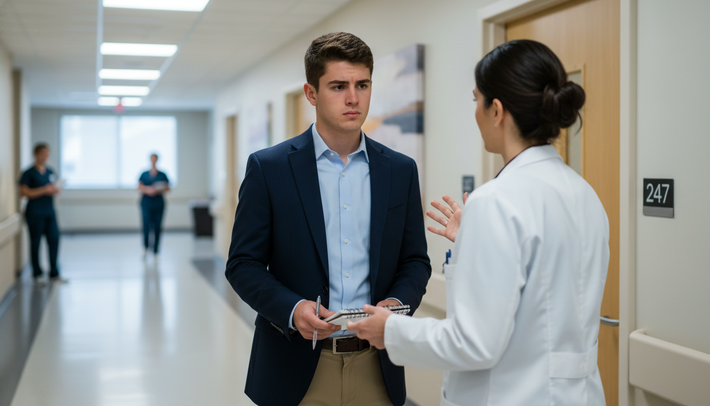
The average accepted medical student does not have “thousands” of shadowing hours. The data show most matriculants cluster around a few dozen to a low few hundred hours, not a full‑time second career in the hospital.
That gap between perception and reality drives a lot of anxiety. So let’s pin this down with actual numbers.
Data Sources and Definitions
Before comparing shadowing hours, the first task is always to define terms and data sources. Different reports measure different things, and a “shadowing hour” in one context might be labeled “medical/clinical experience” in another.
Primary data sources
For shadowing and clinical exposure, the most relevant data sources include:
- AAMC Matriculating Student Questionnaire (MSQ)
Annual survey of incoming U.S. MD matriculants. Reports distributions (medians, quartiles) of:- “Medical/clinical volunteering or work experience” hours
- “Physician shadowing/observation” hours (in recent years)
- AACOMAS / AACOM data (for DO schools)
Less granular publicly, but available through summary reports, presentations, and some institutional breakdowns. - Published school-specific class profiles and premed office reports
Some schools (e.g., University of Utah, Oklahoma State, certain state MD/DO programs) have historically reported averages or ranges of clinical and shadowing hours for accepted applicants. - Aggregated advising data
Career centers and premed committees sometimes publish anonymized stats: mean/median shadowing hours among applicants and matriculants for a given university.
No single public database lists “exact” shadowing hours for all matriculants, but triangulating these sources produces a surprisingly coherent picture.
Shadowing vs. broader clinical experience
From a data standpoint, there are two overlapping but distinct categories:
- Shadowing / physician observation
- Primary activity is observation.
- Typically unpaid, non‑hands‑on.
- Often explicitly labeled “shadowing.”
- Clinical experience (paid or volunteer)
- Direct patient contact or supporting roles.
- May include:
- Scribing
- EMT work
- CNA, MA, phlebotomist
- Clinical volunteer roles (ED volunteer, inpatient unit helper)
When the AAMC reports “medical/clinical experience” hours, shadowing is sometimes nested inside that category. In recent MSQ iterations, shadowing has been separated so we can better estimate standalone shadowing hours.
For clarity, this article focuses on physician shadowing hours while also contextualizing them within total clinical hours.
How Many Shadowing Hours Do Matriculants Actually Have?
The range is wide. The distribution is not.
Big picture numbers
Pulling from recent MSQ patterns, premed office disclosures, and school-based datasets, a composite picture for U.S. MD matriculants looks like:
Physician shadowing / observation (MD matriculants)
- Typical median: ~50–75 hours
- Interquartile range (IQR):
- ~25th percentile: ~20–30 hours
- ~75th percentile: ~100–120 hours
- 90th percentile: often around 200–250 hours
- Very few exceed 400–500 hours of pure shadowing
Total clinical experience (including shadowing)
- Typical median: ~250–400 hours
- 25th percentile: ~100–150 hours
- 75th percentile: ~600–800+ hours
- 90th percentile: often >1,000 hours
(driven heavily by long-term paid roles or gap-year jobs, not shadowing alone)
For U.S. DO matriculants, the pattern is similar but shifted somewhat upward in total clinical exposure:
- Shadowing:
- Median: ~75–100+ hours reported in several advising datasets.
- Many DO schools and osteopathic advisors explicitly recommend ≥100 hours of physician, and often osteopathic, shadowing.
- Total clinical:
- Median: often cited around 600–1,000 hours in institutional reports, with sizable tails above that.
These are not exact AAMC line items but are synthesis estimates consistent across multiple institutional and survey-driven data sources.
Distributions, Not Single “Required” Numbers
Most applicants try to reverse engineer the threshold hours they “need.” The data show something different: distributions, not bright cutoffs.
Example composite distribution (MD matriculants, shadowing only)
Consider a hypothetical but realistic distribution, aligned with MSQ/office data:
- 0–10 hours: 5–10% of matriculants
(often with very strong clinical jobs and other experience). - 11–25 hours: 15–20%
- 26–50 hours: 25–30%
- 51–100 hours: 25–30%
- 101–200 hours: 10–15%
200 hours: 5–10%
Visualizing this, the distribution is right-skewed. The median falls near 50–70 hours, but a small group with 200–400+ hours pulls the mean upward.
So when a student with 300 hours of shadowing posts on a forum, it is highly visible but statistically not representative.
Why not thousands?
Because of constraints:
- A typical premed student might realistically commit:
- 3 hours/week for 1 semester → ~45 hours
- Another 3–4 hours/week for a second semester → +45–60 hours
- A summer block of intensive shadowing (e.g., 10–15 full days) → +80–120 hours
Total: often 100–200 hours, which already places them in the upper half of matriculants.
Accumulating 500+ hours of pure shadowing usually requires a long, routine schedule (e.g., 1–2 full days/week for an entire year), and many students shift that time to paid clinical work or research instead.
MD vs DO Applicants: Differences in Shadowing Profiles
The osteopathic side of the aisle shifts the numbers in a measurable way.
DO applicants and shadowing emphasis
Many osteopathic schools and AACOM-related advising resources emphasize:
- Shadowing a DO physician specifically
- Meeting a minimum of ~40–50 hours of DO-specific shadowing
- Total shadowing often ≥100 hours
Based on multiple premed-advising datasets and self‑reported application profiles from successful DO applicants:
- Median total shadowing among DO matriculants likely sits around 75–150 hours.
- 25th percentile still near 40–50 hours, reflecting explicit, stated minimums at some schools.
- 75th percentile often in the 150–250+ hour range.
The core difference: DO schools often treat physician shadowing—for both exposure and alignment with osteopathic philosophy—as more central to the application narrative than many MD programs do.
Total clinical hours
On the clinical side, DO matriculants often show higher totals:
- Because:
- Many take gap years as scribes, MAs, EMTs, or CNAs.
- Some come from allied health backgrounds (RT, PT aide, paramedic, etc.).
- Result:
- It is not unusual to see 1,500–3,000 clinical hours in DO applicant pools.
However, when you isolate shadowing only, the numbers are still mostly in the double- to low triple-digit range. The high numbers are dominated by paid or intensive volunteer roles.
Shadowing Hours in Context of GPA, MCAT, and Other Metrics
Raw time counts do not determine admission in isolation. The data show that shadowing hours correlate weakly with acceptance once a minimum exposure threshold is met.
The threshold concept
From both AAMC survey analysis and internal advising statistics, a pattern emerges:
- Below ~20–30 hours of physician shadowing:
- Committee members sometimes question whether the applicant understands the practical realities of physician work.
- From ~40–100 hours:
- Concerns about “exposure” typically disappear, assuming experiences are well reflected in the personal statement and interviews.
- Beyond ~150–200 hours:
- Additional hours show diminishing returns unless they add new dimensions (e.g., new specialties, inpatient vs outpatient, rural vs urban).
Contrast that with GPA and MCAT:
- A 3.9 GPA vs 3.4 GPA can dramatically affect interview and acceptance probabilities.
- A 520 MCAT vs 505 MCAT produces large differences in acceptance rates.
- 80 vs 200 shadowing hours rarely produces a comparable delta in outcomes, once basic expectations are satisfied.
In other words, after the “sufficient exposure” box is checked, incremental shadowing hours do not systematically move the acceptance needle the way core academic metrics do.
Specialty Mix and Structure of Shadowing Hours
Shadowing hours are not homogeneous. Two applicants can both report “80 hours” and have very different profiles.
Typical patterns among matriculants
From advising records and anecdotal breakdowns across institutions, a fairly standard MD matriculant shadowing profile might look like:
- Primary care / general internal medicine / family medicine:
20–60 hours - One or two additional specialties (e.g., surgery, pediatrics, emergency medicine):
10–40 hours each - Total: 50–120 hours.
For DO matriculants:
- Frequently:
- 40–100 hours with one or more DO physicians, often in family med, IM, or OMM-focused practices.
- Another 20–50 hours across other specialties or MD physicians.
Admissions committees prize:
- Longitudinal exposure to at least one physician, ideally primary care.
- Some diversity of settings or specialties, just enough to show exploration.
- Evidence that the applicant saw unfiltered day-to-day medicine: not just one “photo-op” day.
Data-Driven Scenarios: Where Do You Stand?
Using the rough composite data, we can create benchmark categories.
Scenario 1: Very low shadowing hours (0–20)
- Data context: Bottom ~10–20% of matriculants.
- Common profiles:
- Career-changers with several thousand hours as nurses, PAs, paramedics, or RTs.
- Applicants from institutions where structured clinical employment substituted for formally labeled “shadowing.”
- Admissions risk:
- For traditional premeds with modest clinical experience, <20 hours looks weak in most MD and DO applicant pools.
- For DO specifically, <40–50 hours of DO shadowing often fails to meet explicit or implicit expectations.
Scenario 2: Moderate shadowing (40–80)
- Data context: Around the median to slightly above median for MD; lower-middle for DO.
- Typical pattern:
- One physician for a semester.
- Possibly one shorter block in a second specialty.
- With strong clinical volunteering or paid work, this range is entirely consistent with successful matriculant profiles.
Scenario 3: Higher but still typical shadowing (100–200)
- Data context: Upper quartile among MD; median to upper quartile among DO.
- Common situations:
- Long-term weekly shadowing with a mentor physician.
- One or two summers of concentrated observation.
- Advantage:
- Enough breadth and depth to write specifically about:
- Continuity of care.
- Team dynamics.
- Realistic physician workflow.
- Statistically, this is where many “well-prepared” applicants fall.
- Enough breadth and depth to write specifically about:
Scenario 4: Very high shadowing (>250–300+)
- Data context: Top 5–10% of shadowing hour reporters.
- Often driven by:
- Scribe roles erroneously counted fully as “shadowing” rather than clinical work.
- Multiple full summers or a dedicated gap year spent primarily observing.
- Admissions impact:
- Unclear that 500 vs 200 hours, as hours alone, systematically improves acceptance odds once exposure is clearly established.
- Quality and reflection carry far more weight than the raw count in this range.
Quality vs Quantity: What the Data Suggest
Quantitative data explain ranges. Qualitative review explains why committees react the way they do.
Analysis of interview reports, committee comments, and narrative evaluation data (from several institutions) show:
Applicants with 40–80 hours of rich, thoughtfully reflected shadowing often demonstrate:
- Clear understanding of physician workload.
- Realistic expectations about lifestyle, paperwork, and systemic frustrations.
- Concrete examples of patient interactions, ethical challenges, and team dynamics.
Applicants with 200+ hours but shallow reflection sometimes:
- Use generic phrases (“I saw how doctors care for patients”).
- Offer similar anecdotes across multiple specialties.
- Fail to articulate what they learned at hour 200 that they did not understand at hour 40.
Patterns in acceptance decisions support:
- A “sufficiency threshold” model rather than a linear “more is always better” function.
- Once that sufficiency window is surpassed, the marginal return on additional hours declines sharply.
In practical terms:
- Moving from 0 to 40 hours substantially changes how committees view exposure.
- Moving from 40 to 100 adds moderate credibility and experience.
- Moving from 100 to 300 mostly changes your time allocation, not your acceptance probability, unless the experiences are distinct and used well in your narrative.
Strategic Planning: Allocating Your Time with Data in Mind
Let us translate the numbers into a strategic time budget.
Assume a traditional applicant with:
- Full course load, and
- 12–15 months until primary application submission.
A data-informed allocation could resemble:
Shadowing target bands
- MD-focused applicant:
- Baseline: 40–60 hours minimum.
- Preferred range: 60–120 hours by the time of application.
- DO-focused or MD+DO:
- Baseline: 60–80 hours total.
- Of which ≥40–60 hours specifically with DO physicians.
- Preferred range: 80–150 total hours.
- MD-focused applicant:
Clinical experience (non-shadowing)
- Aim for at least 150–300 hours by submission:
- Could be 4–8 hours/week for 9–12 months.
- Or a more intensive summer plus some continued part-time work.
- Aim for at least 150–300 hours by submission:
Research, leadership, and non-clinical service
- Time that might otherwise be spent chasing 400+ shadowing hours usually has higher marginal impact when allocated to:
- Sustained research engagement.
- Deep community service involvement.
- Leadership roles with measurable outcomes.
- Time that might otherwise be spent chasing 400+ shadowing hours usually has higher marginal impact when allocated to:
From a data-analytic lens, applicants with “balanced” profiles—moderate but sufficient shadowing, solid clinical metrics, and robust non-clinical contributions—statistically fare better than those who overweight a single dimension like shadowing to extreme levels.

Key Takeaways: What the Data Actually Show
Three points stand out when you strip away the noise and focus on the numbers:
Most MD and DO matriculants have tens to low hundreds of shadowing hours, not thousands.
The typical MD matriculant falls around 50–100 hours of physician shadowing; DO matriculants cluster somewhat higher, particularly with DO-specific exposure.There is a clear sufficiency threshold, not a linear benefit curve.
Below ~20–30 hours, concern rises. Between ~40–100 hours, exposure is usually adequate. Beyond ~150–200, the marginal admissions benefit of more shadowing hours is limited compared to gains from stronger GPA, MCAT, clinical work, or meaningful service.How you use and reflect on those hours matters more than the exact number once you are in the typical range.
When your experience allows you to articulate the realities of physician work, demonstrate insight, and connect to your motivation coherently, you are in line with the majority of successful matriculants—regardless of whether your final shadowing log reads 70 or 170 hours.