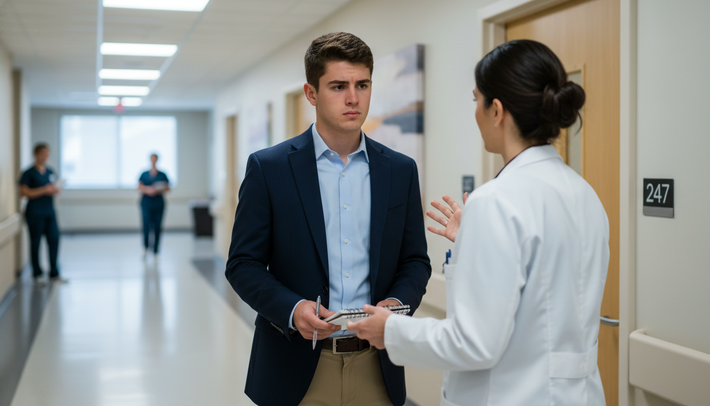
The usual premed advice about shadowing vs clinical volunteering is backwards.
Most students obsess over racking up shadowing hours while treating clinical volunteering as a generic checkbox. Admissions committees see it almost the opposite way: shadowing is necessary but shallow; clinical volunteering is where they actually learn who you are.
If you’re planning your premed years like a points game—“50 hours shadowing, 200 hours volunteering, done”—you’re playing the wrong sport.
(See also: Do You Really Need Hospital Shadowing? What Evidence Suggests for more details.)
Let’s pull apart what admissions committees really see when they look at these two types of experiences, and why “How many hours?” is a worse question than “What did I actually do and show here?”
What Shadowing Really Signals (And Why It Tops Out Fast)
Shadowing is overrated by applicants and correctly rated by AdComs.
Medical schools do want to see some shadowing. Not because it makes you “competitive,” but because it answers one non-negotiable question:
Do you at least understand, at a basic level, what a physician’s day actually looks like?
That’s it. That’s the main function of shadowing. It’s exposure, not impact.
The true value of shadowing
From the committee side, shadowing mainly documents:
- You’ve seen real clinical workflows (clinic, OR, wards).
- You understand medicine is not just “saving lives” but also documentation, phone calls, prior auths, and system friction.
- You’ve interacted with a physician mentor enough to maybe get a letter.
- You’ve witnessed how doctors communicate with patients and teams.
When someone has 0 hours of shadowing, many AdCom members quietly think: “So you want the job, but you’ve never watched anyone actually do the job?”
That’s a problem.
But here’s the part most premeds miss: once you’re past a modest threshold, more shadowing hours add almost no marginal value.
The myth of massive shadowing hours
Students routinely brag about 150–300+ shadowing hours. Committees don’t care about that number as much as you think.
Patterns you’ll hear in admissions committee meetings:
- “They’ve got 20–40 hours of solid shadowing in 2–3 settings. Good enough.”
- “This application has 250 hours of shadowing and almost no real clinical engagement. That worries me.”
- “All their clinical experience is passive shadowing. I don’t know if they can handle real patient interaction.”
Shadowing is passive by design. You’re legally and practically limited:
- You’re not placing IVs.
- You’re not independently educating patients.
- You’re not making decisions.
At best, you’re:
- Observing.
- Asking smart questions.
- Learning the culture and pace of medicine.
That’s useful. That’s necessary. But it’s not what differentiates you from thousands of other qualified applicants.
What makes shadowing actually worthwhile
Since you can’t turn shadowing into some superhero achievement, your job is to make it reflective and targeted, not just logged.
Better shadowing looks like:
- 15–25 hours with a primary care physician (outpatient, continuity, chronic disease).
- 10–20 hours in a hospitalist or inpatient setting (admissions, discharges, multidisciplinary teams).
- 5–15 hours in a specialty of genuine interest (EM, surgery, OB/Gyn, etc.).
Then, you actually think about what you saw:
- How did this change or confirm your idea of medicine?
- What surprised you about the physician’s day?
- What ethical or communication challenges did you witness?
- How did the emotional tone of clinic vs hospital affect you?
This is what you can write about meaningfully in your personal statement or secondaries. Not that you watched 47 laparoscopic cholecystectomies.
From an AdCom perspective, 20–50 thoughtful, well-used shadowing hours can beat 200 superficial hours every time.
Why Clinical Volunteering Quietly Carries More Weight
Now to the part many premeds underestimate: clinical volunteering is where committees see if you can actually function around sick, scared, or vulnerable people.
Shadowing answers: “Do you know what doctors do?”
Clinical volunteering answers: “Can you be trusted around patients and a clinical team?”
Guess which one matters more for predicting how you’ll perform in med school and beyond.
What counts as clinical volunteering
Clinical volunteering isn’t just any volunteering. AdComs are looking for direct exposure to patients or the healthcare setting where you are doing something, not just watching.
Examples that count (if done consistently and with responsibility):
- Hospital volunteer roles with direct patient contact (transport, unit ambassador, ED helper, child life assistant).
- Free clinic work: intake, vitals (if trained), translation, patient education.
- Hospice volunteering: sitting with patients, supporting families.
- EMT or scribe roles (yes, paid can count as clinical experience, but they’re similar in function to "volunteer" from an evaluation standpoint).
- Nursing home or rehab facility volunteering where you interact regularly with residents.
Compare that to shadowing: you’re on the periphery. Volunteering: you’re inside the system.
What AdComs extract from strong clinical volunteering
Volunteering lets them answer questions shadowing can’t touch:
- Can you show up reliably for months or years, not just for a few days shadowing during winter break?
- Can you handle human vulnerability without freezing or checking out?
- Do you work well with nurses, techs, front-desk staff—not just impress a single physician mentor?
- Do you step up and take on more responsibility over time?
A student with:
- 35 hours shadowing, and
- 350 hours over 2 years as a free clinic volunteer, gradually moving from check-in to health education
will almost always be seen as more clinically grounded than the one with:
- 200 hours shadowing three specialists,
- 60 hours of occasional hospital volunteering with no clear development.
The first student has lived in the clinical environment. The second has visited.
Depth beats variety almost every time
Another misconception: “I need 6–8 different clinical volunteering gigs to look well-rounded.”
Not what most committees are actually looking for.
What impresses them more:
- 1–3 long-term commitments, where:
- You increase your responsibility over time.
- You demonstrate reliability (staying semesters or years).
- You see multiple kinds of patients and situations in that environment.
For instance:
- 2 years in the same urban free clinic.
- 18 months as a hospice volunteer.
- 1 year in the ED doing patient liaison work.
That paints a picture of someone who can commit and grow. When they read activity descriptions like:
“Volunteered weekly for 2.5 years, helped implement a new patient intake script, trained newer volunteers…”
That’s gold.
Contrast that with:
“Rotated through 7 short volunteer experiences, 10–20 hours each.”
It looks like resume-stuffing and boredom.
Why clinical volunteering is a better predictor of future behavior
Medical schools know that the hardest part of training is not memorizing pathways. It’s dealing with:
- Chronic suffering that doesn’t get “fixed”
- Frustrated or non-adherent patients
- Families in crisis
- Burned-out teams
- Imperfect systems
Your clinical volunteering record gives them real behavioral data:
- Did you keep showing up once the novelty wore off?
- When things were repetitive, did you still take patients seriously?
- Did staff like working with you enough to give you more tasks?
- Can you handle seeing illness and death without turning away?
Shadowing can’t answer any of that. Clinical volunteering can.
The Real Answer: They Don’t “Prefer” One. They Expect Both—With Different Purposes.
Here’s the contrarian twist: asking “Which do AdComs value more—shadowing or clinical volunteering?” is itself the wrong question.
It’s like asking, “Does a residency program care more about USMLE scores or letters of recommendation?” They care about both, but for different reasons.
How committees actually think about the two
You’ll hear internal comments along these lines (from multiple schools, public and private, MD and DO):
- “No shadowing at all? That worries me. Do they really understand what physicians do?”
- “No substantive clinical volunteering? They might have no idea how they react around real patients.”
- “Lots of shadowing, minimal clinical involvement—that feels performative.”
- “Great clinical volunteering history, with thoughtful reflection; the shadowing is fine but secondary.”
In practice, many AdComs expect:
- Shadowing: Baseline exposure to physicians at work.
- Clinical volunteering: Evidence you can be in the trenches and not fall apart.
If they had to throw one out and still feel okay about an applicant’s readiness, they’d be far more uncomfortable throwing out the clinical volunteering.
They’ll tolerate slim but present shadowing if the clinical experience is rich and consistent. They’re much less comfortable with the reverse.
Numbers: what “enough” often looks like
These are not official cutoffs (most schools don’t publish hard numbers), but they track what many accepted students actually present:
Shadowing
- Typical competitive range: 20–60 hours
- Some strong applicants have >100, but it’s not necessary.
- Variety in settings > sheer volume.
Clinical volunteering / experience
- Strong pattern: 150–500+ hours over 1–3 years.
- Often includes a mix of:
- Volunteer hospital/clinic work
- Scribing/EMT/MA work (paid but still “clinical experience”)
- Hospice or long-term care roles
Committees are not doing linear hour-count math. They’re asking: “Does this pattern of activity convince me this person knows what they’re getting into and won’t bail once it stops being shiny?”
Shadowing alone rarely answers that. Clinical volunteering can.
How to Strategically Structure Your Experiences (Without Gamesmanship)
If you want your application to actually land with AdComs, stop thinking in terms of shadowing vs volunteering and start thinking in terms of exposure + engagement + reflection.
A sane, high-yield plan for a typical premed
Across 2–3 years, something like this is far more effective than chasing giant totals:
Shadowing (20–50 hours, targeted)
- 10–20 hours with a primary care physician.
- 10–20 hours in a hospital setting (hospitalist, ED, or a mix).
- Optional: 5–10 hours in a specialty that genuinely interests you.
Goal: Understand physician workflow, team dynamics, and daily reality.
Clinical volunteering (200–400+ hours, sustained)
- 1 primary site where you stay for 1–2+ years (clinic, hospice, hospital, nursing home).
- Optionally 1 secondary setting if it complements your interests.
Goal: Demonstrate reliability, comfort with patients, and growth in responsibility.
Reflection and integration
- Keep brief notes after shifts: memorable patients, ethical dilemmas, emotional reactions.
- Use those notes later for personal statements, secondaries, and interviews.
- Connect what you saw to why you still want to do this—especially on the bad days.
This approach aligns with how committees actually read experiences: as evidence of who you are becoming, not just what you witnessed.
Common patterns that worry committees
If your activities list looks like any of these, you’ve got work to do:
All shadowing, minimal clinical volunteering
- “Fan of medicine” more than “participant in care environments.”
Short bursts of many different clinical sites, no depth
- Signals boredom, resume-padding, or lack of commitment.
Last-minute cram
- 150 clinical hours all in the 6 months before applying; looks like a box-check scramble.
No contact with vulnerable populations
- All experiences at a boutique private clinic in a wealthy area, with no exposure to socioeconomically diverse or complex patients—suggests a narrow understanding of healthcare realities.
You can still fix many of these patterns if you recognize them early enough.
What This Means for You, Plainly
Stop trying to game what AdComs “like more” as if there’s a secret formula. There is no internal scoreboard that says:
- Shadowing hour = 1.0 point
- Clinical volunteering hour = 1.5 points
That’s fantasy.
Here’s what actually tracks with stronger outcomes and better reception:
- Use shadowing to prove you understand the physician role.
- Use clinical volunteering to prove you can function with and for patients over time.
- Use both to demonstrate reflection, maturity, and commitment.
If you’re forced to prioritize because of time, work, or family constraints, then after you’ve met a reasonable minimum of shadowing (20–40 solid hours), extra effort is almost always better spent deepening clinical volunteering, not chasing a 3-digit shadowing total.
Key Takeaways
- Shadowing is necessary but low-yield past ~20–60 hours; it proves you’ve seen physicians in action, not that you can be one.
- Clinical volunteering (or comparable clinical work) is where AdComs actually assess your reliability, empathy, and ability to function around real patients over time.
- The strongest applications don’t treat shadowing vs volunteering as a competition; they show modest, thoughtful shadowing plus deep, sustained clinical engagement that clearly changed how you think about medicine.