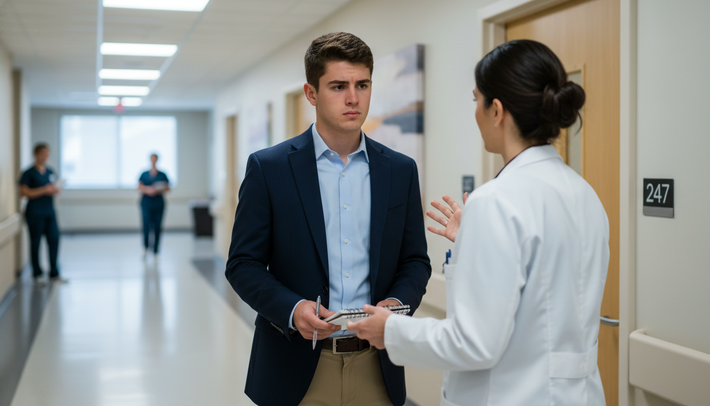
The obsession with hospital shadowing is wildly overblown. The data simply does not support the idea that a specific number of shadowing hours—or hospital-based shadowing at all—is some magic key to medical school admission.
The Myth: “You Must Have Tons of Hospital Shadowing or You’re Doomed”
Premeds talk about shadowing the way high schoolers talk about SAT prep. As if there’s a hidden threshold:
- 100 hours = competitive
- 200 hours = serious applicant
- 300+ hours = future neurosurgeon
(See also: Shadowing vs Clinical Volunteering: What AdComs Actually Value More for more details.)
Reality check: admissions committees are not sitting around saying, “Reject this person; they only shadowed 32 hours instead of 75.” They are looking for evidence that you:
- Understand what being a physician actually involves
- Have meaningful, sustained clinical exposure
- Can reflect on those experiences thoughtfully
Shadowing is one way to do that. Often not even the best way.
The loudest voices pushing “you need hospital shadowing” are usually other premeds, some private advising companies, and random Reddit threads—not actual admissions offices publishing real criteria.
What the Evidence Actually Shows About Shadowing
Let’s get away from the folklore and look at data, even if it’s imperfect.
What admissions data says (and doesn’t say)
The AAMC, AMCAS, and most schools do not list “X hours of shadowing” as a requirement. Instead, they talk about “clinical experience” or “exposure to clinical environments.”
Look at a few examples:
- University of Michigan Medical School: Emphasizes “meaningful patient exposure” and “clinical experiences” but does not mandate shadowing hours or a hospital setting.
- Harvard Medical School: Focuses on demonstrated commitment to medicine and experience with patient care and service—again, not a quota of shadowing.
- University of Utah: One of the few schools that explicitly spells out expectations—they recommend some physician-shadowing but emphasize direct patient contact and service much more strongly.
When schools do mention shadowing, it’s typically as one option under “experiences that help you learn about the practice of medicine.” They’re surprisingly agnostic about where it happens—hospital, clinic, private office, free health center, hospice, telehealth, etc.
The AAMC’s own premed guidance states that clinical exposure can include:
- Volunteering in a clinical setting
- Scribing
- Shadowing physicians
- Working as a medical assistant, EMT, CNA, etc.
Notice the pattern: shadowing is in the list, not above it.
Research on what admissions committees actually value
Surveys of admissions committee members (from sources like the AAMC and independent academic studies) consistently rank the following as high-impact:
- Longitudinal commitment to activities
- Direct patient interaction
- Evidence of altruism and service
- Capacity for reflection and maturity in personal statements and interviews
Shadowing alone—especially short-term, observer-only, passive shadowing—tends to be considered low-yield unless:
- It fills a clear gap (e.g., you had no prior clinical exposure)
- It shows exploration across different specialties/settings
- You can articulate precisely how it shaped your understanding and decision-making
Multiple faculty and deans have said publicly at premed conferences:
“I can tell when someone just followed a doctor around for hours and took nothing from it.”
The brutal truth: 50 hours of forgettable hallway-following is far less impressive than 6 months as a hospice volunteer with real patient contact and thoughtful reflection.
Hospital Shadowing vs Other Clinical Experiences: What Actually Matters
Let us dismantle the hierarchy that premed lore has created: “Hospital shadowing > all other clinical experiences.” That ranking is fiction.
Where shadowing is genuinely useful
Shadowing in any setting is valuable for:
- Observing the physician role specifically: decision-making, communication, interprofessional dynamics
- Seeing the unglamorous parts: paperwork, EMR drudgery, insurance nonsense, time pressure
- Clarifying specialty interests or ruling out poor fits
Hospital shadowing can add a few unique dimensions:
- Acute care and inpatient medicine: codes, emergencies, complex multi-team cases
- Exposure to specialties that are hospital-heavy (cards, surgery, critical care, etc.)
- Understanding hospital culture: night shifts, cross-coverage, consults, handoffs
But that doesn’t mean it’s inherently more “valid” than outpatient or non-hospital experiences.
Direct patient contact beats passive observation
Compare these scenarios:
- Applicant A: 200 hours shadowing hospitalists and surgeons; no touching patients, no speaking to them, almost no responsibility.
- Applicant B: 120 hours as a free clinic volunteer doing intake, vitals, and patient education in an underserved community. Some telehealth coordination. Occasional observation of physicians.
From an evidence-based perspective and from how many admissions committees actually talk: Applicant B usually comes out ahead.
Because Applicant B:
- Has genuine clinical involvement
- Can discuss concrete interactions with patients
- Has experience with vulnerable populations and health systems barriers
- Shows commitment to service, not just box-checking
Shadowing is easy to fake or embellish. Sustained clinical service with responsibility is harder to fake and usually more transformative.
The outpatient blind spot
Many premeds fixate on hospitals and forget that most medical care happens outpatient. Family medicine, primary care internal medicine, pediatrics, many subspecialties—these are not always hospital-centric.
Some adcom members explicitly say they like to see:
- At least some exposure to outpatient, continuity-based care
- Interaction with chronic disease management, follow-up visits, and primary care realities
If all of your experience is hospital shadowing, you might actually have a narrower view of medicine than someone who spent time in a community clinic, FQHC, or primary care setting.
Do You “Need” Hospital Shadowing Specifically?
Short answer: For the majority of schools, no. For a handful, maybe. For your own clarity, it might help—but not in the way people assume.
When hospital shadowing is close to essential
There are a few situations where hospital shadowing, or at least hospital-based clinical exposure, becomes strategically smart:
- You’re applying to schools that explicitly say they expect some hospital experience (rare, but they exist—check school websites, MSAR, and premed advising).
- You’ve never set foot in a hospital in any clinical capacity, and your entire clinical background is telehealth or office-based.
- You’re claiming strong interest in hospital-based specialties (surgery, critical care, anesthesiology) but have zero inpatient exposure.
Even then, there is usually no magic number. A small but real sample—say 20–40 hours—across a couple of hospital services can be enough to show you are not naïve about inpatient medicine.
When hospital shadowing is optional or low-yield
If you already have:
- Substantial volunteer work in a clinic or ED with patient interaction
- Employment as a scribe, MA, EMT, CNA, or similar
- Long-term service in health-related community orgs
Then hospital shadowing becomes supplemental, not central. A few shorter, targeted hospital-shadowing stints can round out your perspective, but cranking the hours up to 100+ is rarely the best use of your limited time.
At that point, the marginal benefit of yet another half-day watching pre-rounds is low compared with:
- Deepening existing roles and taking on leadership or teaching responsibilities
- Getting involved in quality improvement or research tied to your clinical work
- Expanding into underserved or structurally disadvantaged communities
What Evidence Suggests Is Actually High-Yield for Admissions
Put bluntly: medical schools care less about whether you stood in a hospital hallway and more about whether you’ve tested your motivation for medicine in the real world and learned something meaningful.
Depth over hours
Multiple admissions deans have said variations of this: they do not distinguish between 50 and 250 shadowing hours if the reflection and takeaways are shallow.
What stands out instead:
- Longitudinal involvement over many months or years
- Clear progression of responsibility
- Well-articulated lessons learned that connect to your motivations and your understanding of the physician role
You can’t buy that with more shadowing shifts.
Reflection over proximity
Being physically close to a physician doesn’t automatically mean you understand their job. The evidence that matters is in your interpretation and reflection:
- Can you discuss a challenging moment you observed, and what it taught you about uncertainty, ethics, or communication?
- Can you explain how seeing documentation, systems barriers, or insurance issues changed your view of medicine?
- Do you recognize tradeoffs physicians make daily—between thoroughness and time, between empathy and efficiency?
A smaller volume of experience that you’ve deeply processed often beats a massive log of “followed Dr. X on rounds, saw Y patients, went home.”
Diversity of settings vs. single-site saturation
Exposure to multiple settings often gives a richer, more realistic understanding of medicine than marinating in one hospital forever:
- Hospital inpatient
- Outpatient clinic or private practice
- Community health, FQHCs, free clinics, school health, mobile clinics
- Telehealth or hybrid care models
- Hospice or home health
Evidence from qualitative research on premed development suggests that seeing different settings helps students avoid idealized or distorted views of medicine—especially if their only exposure was in high-tech tertiary centers.
You do not need them all. But a mix is powerful.
How to Use Shadowing Strategically Instead of Mindlessly
If you’re going to shadow, use it as a sharp tool, not a blunt requirement.
Target your gaps
Ask yourself:
- Do I understand what inpatient medicine looks like—pace, teams, overnight issues, handoffs?
- Have I seen continuity care, not just episodic, one-time encounters?
- Have I witnessed both “routine” and emotionally charged situations (breaking bad news, end-of-life decisions, social crises)?
Then design your shadowing around genuine gaps. If you’ve only worked outpatient, then 20–30 hours on a hospital medicine service plus maybe a few OR days might be eye-opening.
Choose mentors and environments carefully
The value of shadowing is tightly linked to:
- How willing the physician is to explain, debrief, and involve you
- Whether the team culture allows for learners and questions
- Whether you’re encouraged to think, not just stand silently
A single engaged mentor in an average hospital is worth more than ten disengaged ones in a “prestige” institution.
Integrate, don’t isolate
Shadowing becomes powerful when it’s integrated with:
- Your ongoing clinical volunteering: seeing how decisions upstream affect patient experiences downstream
- Your research: tying clinical questions you see to your academic curiosity
- Your community work: connecting biological disease to social determinants and access issues
The data from admissions decisions and committee commentary points to this integrated narrative being far more compelling than a scatter of random shadowing blocks.
So, Do You Really Need Hospital Shadowing?
No, not in the rigid, fear-driven way premed culture sells it.
You need convincing, credible evidence that:
- You know what physicians actually do
- You’ve seen real patients, real suffering, and real system flaws
- You still want in—eyes open
Hospital shadowing can be one part of building that case. It is not the case itself.
If you have zero hospital exposure, get some – focused, intentional, and reflective. If you already spend hours in clinical environments with patients, stop obsessing over some mythical shadowing quota. The evidence simply does not support it.
Key takeaways:
- Most medical schools do not require specific amounts of hospital shadowing; they care far more about meaningful, reflective clinical exposure of any kind.
- Direct patient interaction and longitudinal commitment beat large numbers of passive shadowing hours almost every time.
- Use hospital shadowing surgically: to fill gaps in your understanding, not to chase arbitrary hour counts invented by anxious premed folklore.