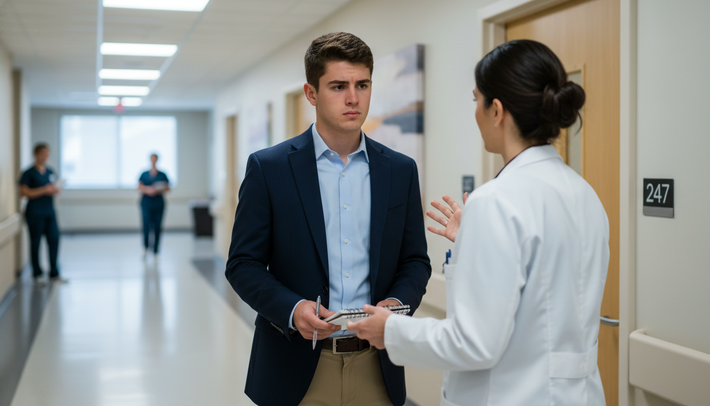
The idea that shadowing must include direct patient contact to “count” is wrong.
It is not just slightly off. It fundamentally misunderstands what shadowing is for, what medical schools evaluate, and what actually predicts whether you will like practicing medicine.
Let’s separate the myths from the data.
Shadowing vs. Clinical Experience: Two Different Beasts
The first mistake most premeds make is blending two very different categories.
- Shadowing = passive observation of a physician’s work
- Clinical experience / direct patient contact = you’re doing something for or with patients in a defined role
Medical schools do not consider those interchangeable. They serve different purposes and answer different questions:
- Shadowing answers:
“Do you know what physicians actually do all day?”
“Have you seen the reality of the job you say you want?”
(See also: Shadowing vs Clinical Volunteering for more details.)
- Clinical experience answers:
“Have you worked with sick, vulnerable people?”
“Have you shown you can handle discomfort, emotion, boredom, and stress around patients?”
So when someone says, “Your shadowing doesn’t count unless you’re interacting with patients,” they’re smashing two categories together. They’re wrong on definitions and on how adcoms think.
What medical schools actually say
Pull up the websites of schools like:
- University of Michigan Medical School
- UNC School of Medicine
- Ohio State College of Medicine
You will see language like:
“We strongly recommend applicants shadow physicians to understand the practice of medicine.”
Not:
“Your shadowing must include direct patient care.”
They usually list shadowing and clinical experience as separate bullet points or subcategories.
Admissions committees know there are privacy rules, liability policies, and institutional norms that limit what you can do. They care far more about the meaningful observation and the reflection than whether you took a blood pressure or roomed a patient.
The Core Myth: “No Patient Interaction = Useless Shadowing”
Let’s tackle the main myth head-on:
If you never touch or speak to a patient during shadowing, it doesn’t count.
False. Here’s why.
1. Shadowing is meant to be passive
By design, shadowing is observational. Many hospitals’ compliance departments explicitly forbid premeds from:
- Independently talking to patients about their care
- Performing any procedures
- Accessing the EHR
- Entering the room without the physician
Not because you’re bad. Because you’re not trained, not credentialed, and not covered by their policies like students or staff.
When you’re an M1 or M2, you’ll have structured clinical activities with supervision, liability coverage, and a defined educational role. As a premed, you’re a guest.
From a legal and ethical standpoint, strict “no direct patient contact” shadowing is standard, not defective.
2. Outcome data does not support the “contact or bust” narrative
There is no credible data showing that premeds who touched more patients during shadowing perform better in medical school, choose better specialties, or are more compassionate physicians.
What does correlate with better fit and lower attrition?
- Having realistic expectations of the profession
- Understanding day-to-day workflow, documentation, and system constraints
- Experiencing the emotional reality: uncertainty, bad outcomes, limits of medicine
You can learn those in a fully observational setting.
Some schools even emphasize this. For example, many MD and DO programs count shadowing hours without ever asking, “Did you take vitals?” They care:
- Which specialties did you see?
- What did you learn about the role?
- How did it affect your motivations and career goals?
They do not have a secret checkbox asking, “Did this applicant hold a stethoscope in a room?”

So What Does Count as Shadowing?
Let’s debunk another common misconception: that shadowing only “counts” if you’re literally following a doctor from exam room to exam room in a private practice.
Wrong again.
Legitimate shadowing formats
All of the following are typically acceptable as shadowing, even if your role is 100% observational:
- Sitting in on outpatient clinic visits with a family medicine, IM, pediatrics, OB/GYN, or specialty physician
- Observing surgeries from the corner of the OR (no touching the sterile field)
- Following inpatient rounds with hospitalists or specialists
- Observing emergency department physicians evaluate and manage patients
- Attending tumor boards, multidisciplinary rounds, or case conferences where patient care is actively discussed
- Virtual or telehealth shadowing with live patient interactions and debriefing
If you’re routinely watching a physician deliver care, and you’re allowed to be there as a learner, that’s shadowing.
You do not get bonus credit for stepping over the line into tasks you arguably shouldn’t be doing as an untrained premed.
What doesn’t count as shadowing?
Some experiences are valuable but are not “shadowing” from an adcom’s perspective:
- Scribing (that’s clinical employment, not shadowing)
- Medical assistant work (again, clinical employment)
- EMT, CNA, phlebotomy work (clinical experience)
- Volunteering on a ward doing non-clinical tasks (volunteer service)
These are excellent experiences. You want them. But you should label them correctly on your application.
Ironically, these roles usually give you more direct patient contact than shadowing ever will. The fact that they’re not called “shadowing” underlines the core point: direct contact is not what defines shadowing.
Direct Patient Contact: Where It Actually Matters
Now let’s flip the script.
While “no patient contact = bad shadowing” is a myth, the opposite myth also exists:
“If I’ve shadowed a lot, I don’t really need separate direct patient contact.”
Also wrong.
Adcoms are looking for both boxes checked
For a competitive MD or DO application, you usually need:
Shadowing (observational)
- Demonstrates understanding of physicians’ work
- Offers breadth across different settings/specialties
- Helps you speak intelligently about why medicine, and why physician vs. PA/NP/other
Clinical experience with direct patient contact
- Shows you can handle sick people, suffering, bodily fluids, and emotional situations
- Demonstrates reliability in a real role (paid or structured volunteer)
- Gives you concrete stories about comfort, communication, and resilience
Programs are not thrilled with an applicant who only ever stood in the back of a clean, quiet office and never once helped an actual human being in distress.
If they have to choose, many adcoms quietly prioritize meaningful patient contact over 200+ hours of passive, low-yield shadowing.
What qualifies as direct patient contact?
Here’s where “what counts?” really matters.
You don’t have to intubate people to show direct patient care. These all typically qualify:
- Hospital volunteer who transports patients, helps them ambulate, assists with meals, or spends time with them at bedside
- Hospice volunteer sitting with patients and families
- Clinical assistant/tech taking vitals, helping with ADLs, setting up rooms
- EMT responding to calls and interacting with patients and families
- Medical scribe who, while not touching patients, is in the room, listening to H&Ps, understanding concerns
- Camp counselor for children with chronic disease (diabetes camp, oncology camp) with regular patient/family interaction
The common denominators:
- You interact directly with patients or families
- Your role exists to support their care or well-being
- You’re part of the care environment, not just watching from behind glass

When “Too Much Contact” Becomes a Liability
One more inconvenient truth: sometimes premeds brag about “hands-on” shadowing that actually looks bad to physicians and adcoms who know the rules.
Examples:
- Giving injections while “shadowing” in a private clinic with no formal training
- Placing IVs as an unofficial assistant
- Independently collecting HPI/ROS for billing without being an employee or trained student
- Accessing EHR under someone else’s login
To a naive premed, this sounds impressive. To an experienced clinician, it sounds like:
- Scope-of-practice issues
- Liability nightmares
- Poor supervision and sketchy compliance
Adcoms are not impressed that you did nurses’ or residents’ jobs illegally in a loosely supervised back office. They’re impressed that you understand boundaries, ethics, and systems.
So no, you do not need “maximum contact” to win points. You need appropriate contact in appropriate roles.
How To Make “Low-Contact” Shadowing Actually High-Yield
If direct patient contact is not required, what is? Engagement.
Here’s what separates “I stood there and stared at a wall” shadowing from “I learned more in 10 hours than most people learn in 50.”
1. Pre-brief and debrief
Before clinic or rounds:
- Ask: “What should I watch for today?”
- Ask about common conditions or procedures you’ll see
After:
- Ask: “Can we talk about a couple of the cases? How did you think through X vs Y?”
- Clarify any workflow or ethical questions
This is how you turn observation into insight.
2. Watch more than the medicine
Yes, diagnoses matter. But medical schools already know you can memorize facts.
Pay attention to:
- How the physician handles angry or anxious patients
- How they deliver bad news or uncertainty
- How they manage time when 30 people need them at once
- How documentation, EMR clicks, and bureaucracy shape decisions
These are the realities that destroy idealized views of medicine—and they’re exactly what adcoms want to hear you’ve seen.
3. Reflect in real time
After each shadowing session, jot down:
- 1–2 memorable patient encounters (no identifying details)
- What you saw the physician do well or poorly
- How it affected your view of medicine or that specialty
When you write secondaries or interview, you’re not going to be saying, “I took a blood pressure.” You’ll be saying:
“I watched a hospitalist manage a family meeting where the patient’s adult children disagreed about code status. What struck me was how she balanced medical facts with emotions, and how much time that conversation required despite a packed list of patients. I realized that this kind of communication is unavoidable in medicine, not occasional.”
That answer is rooted in observation, not contact. And it’s far more compelling than, “I got to touch the stethoscope.”
What Admissions Committees Actually Want to See on Your Application
Strip away the noise and here’s what most schools care about, whether or not they say it explicitly.
From your shadowing experiences, they want evidence that you:
- Understand the physician’s role specifically
- Have seen the good, bad, and boring sides of the job
- Can articulate why you still want to do this, knowing the system’s flaws
- Explored more than one setting or specialty, or at least thought critically about the one you saw
From your clinical/direct patient contact experiences, they want evidence that you:
- Show up reliably and take a role seriously
- Can function around illness, disability, pain, and death without freezing or fleeing
- Have interacted with people very different from you in vulnerable moments
- Learned how healthcare teams work and communicate
Nowhere in that list is: “Touched patients during shadowing.” It just isn’t the point.
Three Things to Actually Do Next
If you want a practical checklist, here’s one that aligns with what data and adcoms really support:
Secure at least 20–40 hours of genuine physician shadowing
- Any mix of inpatient, outpatient, ED, OR
- Observation is enough; focus on learning, not tasks
Build 100–300+ hours of direct patient contact in a defined role
- Volunteer or paid: scribe, EMT, MA, hospice, tech, substantial hospital volunteer, etc.
- This is where your “hands-on” growth will be evaluated
Document and reflect intentionally
- Keep a running log: dates, settings, what you did, what you noticed
- Capture 5–10 specific stories that shaped your view of medicine and patients
- These become application gold, regardless of how often you touched a blood pressure cuff
The Bottom Line
Three key truths:
Shadowing does not require direct patient contact to “count.” It’s meant to be primarily observational; most institutions prefer it that way for legal and ethical reasons.
Direct patient interaction matters—but usually in separate clinical roles, not in shadowing itself. Adcoms expect both: observational shadowing to understand physicians’ work, and hands-on clinical exposure to show you can function around sick, vulnerable people.
Quality of engagement beats quantity of contact. You’ll get far more mileage from thoughtful observation, debriefing, and reflection than from bragging about doing procedures you weren’t trained for.
Stop chasing contact for its own sake in shadowing. Chase understanding. The rest belongs in real clinical roles, where it actually counts.