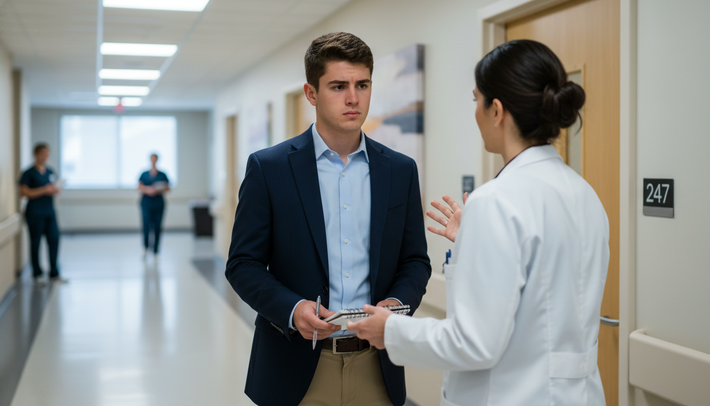
The myth that you need family connections to shadow a physician is false. What you actually need is a clear system and the discipline to follow it.
You can go from “I know zero doctors” to “I have multiple shadowing offers” in 4–6 weeks if you treat this like a structured project instead of a vague wish.
Below is a step‑by‑step, no‑excuses plan that works for students with:
- No physician relatives
- No “prestige” school
- No prior clinical experience
(See also: How to Turn a One‑Day Shadow into a Long‑Term Mentorship for more details.)
Follow the protocol. Track your numbers. Adjust intelligently. You will get a “yes.”
Step 1: Lock In Your Target and Constraints
Before blasting emails, define what you actually need. Random shadowing is inefficient.
1. Clarify your objective
Decide what “success” looks like for the next 3–6 months:
- Total hours needed:
- Community college / early premed: 10–20 hours is a solid start
- Applying this cycle: aim for 40–80 hours minimum
- Timeline:
- Deadline for having your first confirmed shadowing date
- Deadline for reaching your total hours target
Write it down:
- “I will secure my first confirmed shadowing date by: [specific date]”
- “I will complete at least [X] shadowing hours by: [specific date]”
You are not “looking for shadowing.” You are executing a defined plan.
2. Identify realistic settings
You want environments that actually allow shadowing. Prioritize:
- Community hospitals (often more flexible than large academic centers)
- Outpatient clinics:
- Internal medicine
- Family medicine
- Pediatrics
- OB/GYN
- General surgery clinic (for pre‑op/post‑op, not OR only)
- Federally Qualified Health Centers (FQHCs)
- Multi‑specialty groups (e.g., Kaiser, large regional medical groups)
Be cautious with:
- Large university hospitals with rigid volunteer systems
- Emergency departments with heavy restrictions
- Highly specialized clinics (oncology, fertility, transplant) as your first attempt
Your first goal is access and pattern recognition, not prestige.
3. Define your geographic radius
Be honest about how far you are willing to travel:
- Ideal: within 30–45 minutes
- Acceptable for rare opportunities: up to 60–90 minutes on special days
Decide your:
- “Routine radius”: where you can go regularly
- “Special radius”: where you will go for a one‑off day with a unique specialty
This informs which clinics and hospitals you target in the next step.
Step 2: Build a Targeted Physician List in 2 Days
Most students fail because they “ask around” vaguely. You are going to build a real contact list.
1. Use hospital and clinic websites
Start with:
- “Internal medicine clinic near [your city]”
- “[Your city] family medicine group”
- “[Your county] medical group physicians”
On each practice website:
- Go to “Providers” or “Our Physicians”
- Filter or scan for:
- MD or DO
- Internal medicine, family medicine, pediatrics, general surgery, OB/GYN
Create a simple spreadsheet (Google Sheets or Excel) with columns:
- Physician name
- Specialty
- Clinic/hospital name
- City
- Work email (if listed)
- Office phone
- Website contact form link (if applicable)
- Status (Not contacted / Emailed / Called / No / Yes / Maybe)
- Date of contact
- Notes
Aim for:
- 30–50 physicians on your initial list
- At least 3–4 different practice groups
- Mix of specialties (do not put all hopes on a single clinic)
2. Use health system “Find a Doctor” tools
Large systems (e.g., Sutter, Mayo, Cleveland Clinic, regional systems) often have filters:
- Select:
- “Accepting new patients”
- Specialties: Internal medicine, family medicine, pediatrics, OB/GYN
- Location within X miles of your address
These physicians are often clinically active in outpatient settings—ideal for shadowing.
Add each plausible physician to your list.
3. Leverage insurance directories (strategically)
Log into any insurance portal you have access to (yours or a family member’s):
- Use the “Find a Doctor” tool
- Filter by:
- Nearby zip codes
- Primary care specialties
Often this reveals smaller independent practices and community clinics not easily found via Google.
Add them to your spreadsheet.
4. Time‑box this step
Do not spend two weeks “researching.” Set:
- Day 1 evening: 90–120 minutes of searching
- Day 2 afternoon: 60–90 minutes of searching
By the end of Day 2 you should have 30–50 names with at least one contact method each.
Once you hit that threshold, stop searching and move to outreach.

Step 3: Craft Outreach That Actually Gets Read
You will use three outreach channels:
- Direct email (priority)
- Office phone call
- Website contact forms
Your messaging needs to be:
- Short
- Specific
- Low‑burden for the physician
1. Your baseline email template
Subject line options:
- “Premed student request to briefly shadow in [specialty]”
- “Local college student seeking 1–2 days of physician shadowing”
- “Shadowing request – [Your Name], premed student”
Email body template (customize brackets):
Dear Dr. [Last Name],
My name is [Full Name], and I am a [year: freshman/sophomore/junior/recent graduate] at [School Name] interested in [medicine / primary care / your specialty].
I am hoping to observe a physician in clinical practice to better understand the day‑to‑day realities of patient care and to confirm that this is the right path for me. Your work in [specialty or specific clinic, if mentioned on website] is exactly the kind of experience I am hoping to learn from.
Would you be open to allowing me to shadow you for [one or two] clinic sessions (for example, [half‑day or full day]) sometime in the next [1–2 months]? I am fully vaccinated, willing to complete any required paperwork or training, and prepared to maintain strict professionalism and patient confidentiality (including HIPAA regulations).
I am generally available on [list 2–3 blocks of time, e.g., “Mondays and Wednesdays after 12 pm, and Fridays all day”], but I would gladly adjust my schedule to fit yours if possible.
I understand how busy you are, so even a brief opportunity would mean a great deal. If shadowing is not possible in your setting, I would be very grateful for any guidance on how a student like me might gain clinical exposure in [your city/area].
Thank you for considering my request.
Sincerely,
[Full Name]
[College/University]
[Phone number]
[Email]
Key points:
- Do not attach a resume in the first email. It adds friction.
- Do not oversell yourself. You are asking for a small favor, not a job.
- Do not write a long autobiography.
2. Customize efficiently
You will send a lot of emails, but they must not feel like spam.
For each physician, customize:
- First line (“I am particularly interested in [X] about your practice” if you can find something specific)
- Specialty mention
- Availability constrained to what you can realistically do if they say yes soon
Use text expansion (e.g., a snippet tool) or email templates, but always edit the first and third paragraphs slightly.
3. Phone script for office staff
Sometimes the gatekeeper is not the physician, it is the scheduler.
Call during low‑volume times (usually 10–11:30 AM or 2–4 PM). Script:
“Hello, my name is [Name]. I am a premedical student at [School] hoping to observe a physician to learn more about the profession. I was wondering whether your practice ever allows students to shadow Dr. [Last Name] for a short time, such as one or two clinic sessions?”
If they say “We do not usually”:
“I completely understand. If formal shadowing is not possible, is there someone in your office or in your health system you would recommend I contact about student observation or volunteer opportunities?”
If they say “Maybe, send something”:
“Thank you very much. What email address should I send a brief introduction and request to?”
Then send your email the same day referencing the call:
“I spoke with [Name] at your front desk today, who kindly suggested I email you regarding a possible shadowing opportunity…”
4. Website contact form text
Most clinic forms have limited space. Use:
“Premedical student requesting brief physician shadowing
Hello, my name is [Name], a [year] student at [School] interested in medicine. I am seeking the opportunity to briefly shadow a physician for 1–2 clinic sessions to better understand patient care.
Could you please let me know whether your clinic allows college students to observe, or if there is someone I should contact about this?
Thank you very much for your time. – [Name], [phone], [email]”
Step 4: Execute High‑Volume, Structured Outreach
Shadowing has a numbers component. Most rejections are actually silence, not “no.” You must plan for that.
1. Set weekly outreach targets
Initial push (Weeks 1–2):
- Emails: 10–15 new physicians per week
- Phone calls: 5–10 offices per week
- Contact forms: 3–5 per week (where no direct email is available)
Maintenance phase (Weeks 3–4):
- New contacts: 5–10 per week
- Follow‑ups: 1 week after first contact, then 2 weeks after if still no answer
Use your spreadsheet to track:
- Date of each email/phone contact
- Follow‑up dates
- Outcome
2. Follow‑up protocol
For email:
- If no response after 7–10 days:
Subject: “Following up on shadowing request – [Your Name]”
Dear Dr. [Last Name],
I wanted to briefly follow up on my message from [date] regarding the possibility of shadowing you for 1–2 clinic sessions. I know your schedule is very busy, so if this is not feasible in your practice, I completely understand.
If shadowing is not possible, I would be grateful for any suggestions you might have for a student in [your city] seeking clinical observation opportunities.
Thank you again for your time and consideration.
Sincerely,
[Name]
If still no response after 2–3 weeks, mark as “No response” and move on.
For clinics that said “maybe, check back later,” schedule a follow‑up 4–6 weeks later.
3. Track your metrics like a project
End of each week, record:
- Number of new contacts attempted
- Number of actual responses
- Number of “maybes”
- Number of “yes” or “conditional yes”
Typical pattern if you are doing this correctly:
- Response rate: 10–25%
- Clear “yes”: 5–10%
- Soft “maybe/try later”: another 5–10%
If after 3–4 weeks you have:
- Contacted 40+ physicians
- Followed up appropriately
- Still no “yes”
Then adjust strategy:
- Increase primary care focus
- Expand geographic radius
- Call more offices directly
- Ask every “no” for a referral to another physician

Step 5: Use Indirect Channels When You Truly Have Zero Contacts
While cold outreach is central, you can increase your odds with parallel paths.
1. Talk to pre‑health advisors and offices
Even weak advising offices often know:
- Which local physicians have historically accepted students
- Which clinics have existing MOUs (memorandums of understanding) for student observation
When you meet your advisor:
- Go with specific questions:
- “Which local physicians currently accept shadowing students?”
- “Which hospitals or clinics have the easiest approval processes for observers?”
- “Do you have any sample forms or documents I should be ready to complete?”
Ask for:
- Email introductions (“Would you be willing to email Dr. X with a brief introduction if I draft a short paragraph?”)
- Names of alumni now practicing locally
2. Leverage professors strategically
Approach science or humanities professors who know you:
- After class or during office hours:
- “I am working seriously on getting clinical experience and have been cold‑emailing local physicians. Do you happen to know any physicians through your own network, or alumni, who might allow a student to observe for a day?”
If they say “I might know someone”:
- Immediately follow with:
- “If you are open to it, I can send you a very short paragraph you could forward to them to introduce me.”
Make it easy for them:
- Write a 3–4 sentence blurb they can copy‑paste, similar to your email template but shorter.
3. Use student organizations with intent
Join or attend:
- Premed club
- AMSA chapter
- Minority pre‑health organization
- Campus volunteer office workshops
But do not just “network.” Ask precise questions:
- “Who here has actually shadowed a physician in the past year?”
- “Which clinics or hospitals did not make the process impossible?”
- “Does anyone have a physician who has already agreed to take future students?”
You are looking for:
- Names of physicians already familiar with student shadowers
- Honors programs or pipelines that quietly connect students to doctors
Record every name and lead in your spreadsheet and follow up.
Step 6: What To Do When a Physician Says “Yes”
Getting the “yes” is not the end of the process. Poor follow‑through can cost you the opportunity.
1. Confirm details in writing
Once a physician agrees, reply within 24 hours:
- Confirm:
- Date(s) and time(s)
- Clinic address
- Any required paperwork or clearances
- Dress code
Sample confirmation:
Dear Dr. [Last Name],
Thank you very much for the opportunity to shadow you. I am confirming that I will arrive at [clinic name, address] on [date] at [time].
I will dress in [business casual / as instructed], bring a photo ID, and complete any required paperwork or training. Please let me know if there is anything else I should prepare before then.
I am very grateful for your time and willingness to teach.
Sincerely,
[Name]
2. Handle hospital policies and HIPAA
Some settings will require:
- Proof of vaccination
- TB test results
- Flu shot documentation
- Confidentiality or HIPAA training modules
Respond professionally:
- Complete forms by the earliest possible date
- Keep scanned copies of vaccines, TB test, and school ID in one folder
- If something will be delayed (e.g., TB test scheduling), inform the contact early
3. Day‑of professionalism protocol
On the day of shadowing:
- Arrive:
- 10–15 minutes early
- In clean, appropriate attire:
- Business casual: slacks / modest dress / button‑down / blouse
- Closed‑toe shoes
- Avoid strong perfume/cologne, excessive jewelry
- Bring:
- Small notebook and pen
- Printed copy of any required forms
- Minimal bag (you do not want to look like you are moving in)
Behavior rules:
- Introduce yourself to staff by name, thank them for having you
- Never enter a room without explicit physician permission
- When with patients:
- Say: “Hello, my name is [Name]. I am a premedical student observing Dr. [Last Name] today, if that is alright with you.”
- If patient declines, leave immediately and politely
Do not:
- Use your phone in clinical spaces (keep it silenced in your bag)
- Ask personal medical details out of curiosity
- Give advice or comment on treatment plans
- Post anything on social media about specific patients or cases
4. Extract maximum value (without annoying the physician)
During the day:
Observe workflow:
- How they take histories
- How they explain diagnoses
- How they manage time pressure
Ask questions during natural breaks:
- “How did you decide on [specialty]?”
- “What parts of your day do you find most challenging?”
- “What do you wish premeds understood about this job?”
Take brief notes when appropriate, outside patient rooms:
- General reflections
- Processes you notice
- Themes, not patient identifiers
End of the day:
- Thank the physician sincerely
- Ask: “Would it be possible to come back for another half‑day sometime, if your schedule allows?”
- Ask: “Is there anyone else you would recommend I reach out to for additional observation, maybe in a different setting?”
Then send a same‑day or next‑day thank‑you email.
Step 7: Turn One Shadowing Experience into Many
Once you have broken the “no contacts” barrier, you can leverage that momentum.
1. Ask for referrals directly
Near the end of your shadowing block:
“I have learned a great deal from observing you. My next goal is to see a different type of practice as well, perhaps [inpatient / a different specialty / a different clinic type]. Are there any colleagues you think might be open to a brief student observer, if I reach out respectfully?”
If they name someone:
- Ask if you may mention their name in your email:
- “Would it be alright if I mention that I shadowed you when I contact them?”
Then email that colleague:
Subject: “Referred by Dr. [Name] – premed student shadowing request”
Dear Dr. [Last Name],
My name is [Name], a premedical student at [School]. I recently had the privilege of shadowing Dr. [Name] in [setting], who suggested that I contact you about the possibility of observing in [your specialty] to gain additional perspective.
[Then same core body as your earlier email.]
Referral‑based outreach has a much higher success rate. Use it.
2. Document and structure your experiences
Right after each shadowing day:
- Write a 1–2 page reflection:
- What surprised you
- How you saw communication handled
- Any ethical or emotional challenges you noticed
- What this taught you about your own fit for medicine
Maintain a log:
- Date
- Physician name and specialty
- Setting (clinic, hospital, OR, etc.)
- Hours
- High‑level themes
This will:
- Help with personal statements and secondaries later
- Demonstrate seriousness if a physician ever asks for a summary
- Make it easier to remember what you actually learned
3. Maintain long‑term relationships
You are not collecting hours; you are building professional relationships.
Every 3–6 months:
- Send a short update email to any physician who allowed you to shadow:
- Thank them again
- Briefly share how their shadowing influenced your path
- One sentence on your current status (e.g., “I am finishing organic chemistry and preparing to take the MCAT next spring.”)
Down the line, these are exactly the people who can:
- Write strong letters of recommendation
- Connect you to residency programs or research
- Offer honest career guidance
FAQs
1. How many physicians should I contact before assuming my strategy is not working?
If you have:
- Emailed at least 30 physicians
- Made 10–15 phone calls
- Sent at least one follow‑up to each non‑response
- Focused primarily on outpatient primary care settings
and you still have zero responses or “yes” after 4–5 weeks, then adjust:
- Expand your radius by 10–15 miles
- Increase calls compared to emails
- Ask your premed advisor and professors specifically for at least one referral each
- Rewrite your email to be shorter and have a clearer subject line
The failure is usually in volume or specificity, not in you as a candidate.
2. What if a hospital system bans shadowing due to policy or infectious disease concerns?
When a large system has a formal “no shadowing” policy outside enrolled programs, your leverage is limited. In that case:
- Ask: “Do you have any structured volunteer or student observer programs for undergraduates?”
- Shift focus to:
- Independent clinics not owned by the hospital
- Community hospitals with looser policies
- Outpatient practices that may use smaller affiliated hospitals
You can also gain meaningful exposure through:
- Hospital volunteering
- Medical scribing jobs
- Clinical assistant roles in urgent care or primary care clinics
Then later, when policies change or you have employment ties, pursue formal shadowing again.
3. How do I answer if a physician asks why I want to shadow them specifically?
Use a focused, honest response tied to what you read about their practice:
- “I am interested in primary care and noticed that you work in a community clinic serving a diverse patient population. I want to see how primary care physicians manage both medical complexity and social factors.”
- “I have been considering pediatrics, and your practice includes both well‑child care and complex pediatric patients. Observing that range would help me clarify my interests.”
- “I read that you practice in both clinic and hospital settings. I want to understand how a physician balances those two worlds.”
You are not expected to idolize them. You are expected to show that you did some homework and are thinking clearly about what you want to see.
Key points to remember:
- Treat shadowing like a structured project with metrics, not a vague hope.
- High‑volume, targeted outreach to outpatient primary care physicians is your most reliable path from zero contacts to your first “yes.”
- Once you secure a single shadowing experience, use referrals and professional follow‑through to multiply that into a broader clinical exposure portfolio.