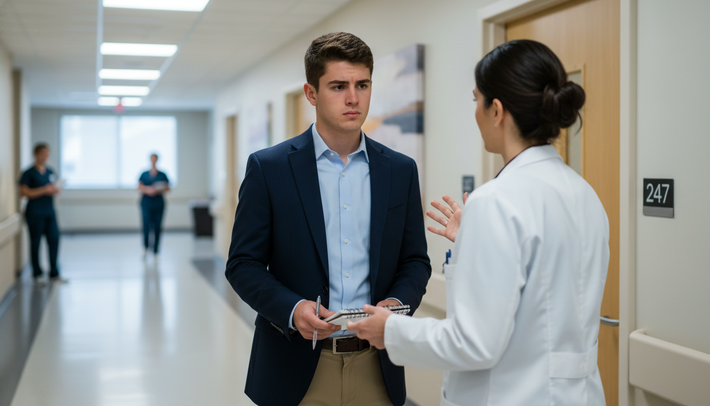
The biggest waste in premed shadowing is treating it like a tourism event instead of a job interview for long‑term mentorship.
Most students show up, follow a doctor around for a day, say thank you, and disappear. Then they wonder why they have no meaningful mentors, no strong letters, and nobody to call when the application cycle turns brutal.
You are not just “shadowing.” You are auditioning. For mentorship, for advocacy, and sometimes for your future specialty.
(See also: How to Politely Set Boundaries in Uncomfortable Shadowing Settings for more tips.)
Here is how to turn a single shadowing day into a real, durable mentoring relationship that actually shapes your career.
Step 1: Set the Foundation Before You Show Up
If you walk into a shadowing day without a plan, you have already wasted half the opportunity.
Clarify your objective
Decide what you want from this person long term. You will approach your day very differently depending on your goal:
- Possible goals:
- Ongoing career guidance in their specialty
- A future letter of recommendation
- Longitudinal clinical exposure (coming back regularly)
- Research or quality‑improvement projects
- Someone to call when you hit decision points (MCAT timing, gap year, specialty choice)
Choose one primary goal and one secondary goal. Write them down.
Example:
- Primary: Build a relationship that could lead to future mentorship and a strong letter.
- Secondary: Understand what day‑to‑day life in outpatient cardiology actually looks like.
Now your behavior can be intentional, not random.
Do your homework on the physician
Spend 20–30 minutes researching the physician before you go:
- Look up:
- Their specialty and subspecialty
- Practice setting (academic, private, community hospital, VA, etc.)
- Any leadership roles (program director, department chair, committee leads)
- Publications or particular clinical interests
- Sources:
- Institutional website bio
- PubMed (search their last name + initials)
- LinkedIn profile (if they have one)
Why this matters: Mentors are more likely to invest in someone who demonstrates specific interest in their work, not just in “medicine”.
Example framing:
“I read your work on diabetic foot ulcers in underserved populations. I am very interested in health disparities, so I am hoping to learn how that plays out in daily clinic.”
This tells them you are not just there to tick a box.
Pre‑shadow email that sets you apart
Most premeds send one‑line confirmations (if that). Send a short, professional note that:
- Confirms logistics
- Signals preparation
- Plants the seed for future contact
Sample email (adapt to your context):
Subject: Shadowing on [Date] – Thank you and quick confirmation
Dear Dr. [Last Name],
Thank you again for allowing me to shadow you on [day, date]. I am very grateful for the opportunity.
I wanted to quickly confirm:
- Location: [Clinic/Hospital Name, exact address or floor]
- Arrival time: [Time]
- Dress code: [Business casual / scrubs if appropriate – “I will plan to wear business casual with a white coat unless you advise otherwise.”]I have been reading about [specific aspect of their field or their work] and am looking forward to seeing how this appears in real‑world patient care.
Please let me know if there is anything you would like me to review beforehand or bring with me.
Sincerely,
[Full Name]
[Phone number]
You have now signaled: organized, respectful, prepared, and specifically interested. That is the baseline for mentorship.
Step 2: Treat the Day Like an Audition, Not a Passive Tour
Once you are there, everything you do is data for the physician. They are asking, consciously or not: “Is this someone I want to invest time in?”
Show up like a junior colleague
- Arrive:
- 10–15 minutes early
- With a small notebook and pen
- Phone silenced and put away (visible phones signal distraction)
- Dress:
- Business casual (slacks, closed‑toe shoes, modest top) and, if appropriate, a white coat labeled “Student”
- Clean, simple, no heavy perfume/cologne
- Body language:
- Upright posture
- Maintain appropriate eye contact
- Avoid leaning on walls, chairs, or exam tables
You are not trying to look like a peer. You are trying to look like a serious trainee who respects the space.
Ask high‑yield questions at the right times
What separates “shadowing tourist” from “future mentee” is the quality and timing of your questions.
Use a two‑bucket system:
Bucket 1: Real‑time brief questions (between patients)
These should be:
- Short (30–60 seconds)
- Clinically or career relevant
- Not Google‑able trivia
Examples:
- “What was most different about actual practice compared to residency expectations in this specialty?”
- “What are you thinking about when you decide whether to admit versus send home a borderline patient like that?”
- “You mentioned time pressure earlier. How do you balance thoroughness with the number of patients you have to see?”
Bucket 2: Deeper questions (end of clinic / during a break)
These signal mentorship potential:
- “If you were advising a premed interested in [their specialty], what would you tell them to pay attention to during medical school?”
- “Which habits did you develop as a student that you still use now?”
- “How do you decide which students or residents to invest mentorship time in?”
Write a few of these in your notebook beforehand. Use them strategically.
Show that you understand clinical professionalism
Physicians are more likely to mentor students who “get it” around patient interaction and privacy.
Key behaviors:
- HIPAA awareness:
- Do not take photos or record anything.
- Do not discuss identifiable patient details outside clinical spaces.
- In the room:
- Introduce yourself quickly when appropriate: “Hello, I am [Name], a premedical student shadowing Dr. X today.”
- Stay out of the way physically.
- Maintain a neutral, attentive facial expression.
- Defer appropriately:
- If a patient seems uncomfortable, step out graciously if the physician suggests it.
- Do not jump into conversations unless invited.
After a complex or emotional case, a brief comment like, “Thank you for letting me observe that; it helped me understand the emotional side of this work,” shows maturity.
Take focused notes
Not a transcript. Not every lab value. You are using your notebook as a relationship‑building tool.
Track:
- Specific topics you discussed with the physician
- Cases that led to interesting teaching points
- Things the physician emphasized (“Work‑life balance in this field is tough because…”)
- Any advice given
Why this matters later:
- Lets you send an intelligent follow‑up message
- Allows you to ask informed future questions (“Last time you mentioned X; since then I have been thinking about Y…”)
You are building a storyline for a longitudinal relationship.
Step 3: Convert “One Day” into “Ongoing Contact” Before You Leave
Most students make the fatal mistake of leaving without a clear bridge to future interaction. You will not.
Ask explicitly—but strategically—for continued connection
Do this toward the end of the session, when they are not rushed between patients.
Script it. This is where many students freeze.
Option 1: You want recurring shadowing / longitudinal exposure
“Dr. [Last Name], thank you again for letting me shadow today. I learned a great deal, especially about [specific aspect].
If your schedule ever allows it, I would be very interested in coming back to continue learning from you. Would you be open to me shadowing again on a semi‑regular basis, for example once or twice a month?”
You have:
- Expressed gratitude
- Referenced specific learning
- Proposed a concrete plan, not “sometime”
Option 2: You want mentorship more broadly
If the day went well and you felt a rapport, step slightly further:
“I really appreciated not only seeing your clinical work but also hearing about your path in [specialty]. Your perspective on [specific topic] was very helpful.
As I move through the premedical and medical school process, I would value your guidance. Would you be open to my occasionally reaching out with questions or updates about my progress?”
This is a gentle way to ask, “Will you be my mentor?” without putting awkward pressure on them.
Ask how they prefer to be contacted
If they say yes to anything future‑oriented, immediately clarify logistics.
- “Is email the best way to reach you, or do you prefer another method?”
- “Are there particular times of year when you are more available?”
Write their preferences down in your notebook.
Respecting their communication style is part of being easy to mentor.
Offer value, even as a premed
You have very limited skills now. But you can still offer something.
Two realistic offers:
Help with simple tasks on future days
- “If I am able to shadow more regularly, I am happy to help in small ways that do not interfere with patient care, like organizing patient education materials or helping with basic non‑clinical tasks, if your clinic allows that.”
Interest in future projects
- “If you ever have small research, quality‑improvement, or educational projects where a motivated student could help with literature review or data entry, I would be very interested, even if it is just a few hours a week.”
Many physicians will not take you up on this immediately. That is fine. You are planting a seed: “I am not just here to consume your time; I want to contribute.”
Step 4: Execute a High‑Impact 24–48 Hour Follow‑up
Your post‑shadow message is where short‑term exposure either dies or turns into a mentorship pipeline.
Write a specific, professional thank‑you email
Send this within 24 hours. It must:
- Be concise
- Be specific
- Invite a next step without being pushy
Template:
Subject: Thank you for allowing me to shadow on [Date]
Dear Dr. [Last Name],
Thank you again for the opportunity to shadow you on [day, date]. I appreciated your willingness to explain your thought process, especially in cases such as [very briefly describe, with no identifiers: “the patient with complex heart failure and multiple admissions”].
A few key lessons that stood out to me:
- [Example: The way you balanced clinic efficiency with taking time to address each patient’s main concern.]
- [Example: Your description of how you chose [specialty] and the importance of finding mentors early.]I found our discussion about [specific topic] particularly valuable, and it confirmed my interest in pursuing a path in [area, if true].
If it fits your schedule, I would be very grateful for the chance to shadow you again [propose frequency or specific timeframe], or to stay in touch for occasional advice as I progress toward medical school. I recognize that your time is limited and I will be respectful of it.
Thank you again for your time and teaching.
Sincerely,
[Full Name]
[School / Status, e.g., “Junior at X University, premedical student”]
[Phone number]
You are not begging. You are signaling seriousness and giving them an easy “yes” option.

Log what happened and what was said
That same day, open your notebook or a private digital file and record:
- Date, physician’s full name, specialty, institution
- What you observed
- Advice they gave you
- How you felt about the specialty and environment
- Whether they seemed open to future contact (and what exactly they agreed to)
This is not just for nostalgia. Months later, when you reach back out, you will use this record to build continuity.
Step 5: Build a Long‑Term Relationship Without Being a Burden
You have planted the seed. Now you need to cultivate it without overwatering.
Create a low‑pressure touchpoint structure
Think in terms of light but consistent touches, not constant messaging.
For a premed–physician relationship, a realistic cadence:
- 1 touch every 1–3 months, unless:
- They have given you a project or task
- They invite more frequent contact
Types of touchpoints:
Updates with a question
Example email every 2–3 months:
Dear Dr. [Last Name],
I hope you are well. I wanted to briefly update you that since we last spoke, I [took the MCAT / completed a clinical volunteering role / started a new research position in X]. Your advice about [specific advice] helped me [concrete impact].
I am currently deciding between [2–3 options, e.g., MCAT dates, types of clinical work, gap year plans]. Given your experience in [their field/role], I would value your perspective on [1 focused question].
I completely understand if your schedule is too busy, but any brief thoughts would be very helpful.
Sincerely,
[Name]Note the structure:
- Update
- Connection to their prior advice
- One focused question
- Explicit respect for their time
Sharing outcome of their advice
If you acted on something they suggested, tell them:
“You mentioned that getting longitudinal exposure in one setting would be valuable. Based on that, I committed to volunteering weekly at [clinic/hospital], and it has given me a much deeper understanding of [X]. Thank you again for that suggestion.”
This shows you are coachable. Coaches invest in coachable people.
Occasional request for in‑person check‑in
Once the relationship feels solid (after several interactions), you can ask:
“If your schedule permits at some point in the next few months, I would greatly appreciate a brief meeting (even 20–30 minutes) to discuss [specific decision or milestone]. I would be happy to adapt to whatever format and time is easiest for you.”
Do not ask for an hour‑long lunch as a first in‑person mentoring step.
Make their investment pay off: execute on advice
Nothing will kill a budding mentorship faster than ignoring everything they say.
You do not have to follow all advice. But if you ask for input and then:
- Repeatedly do the opposite without explanation
- Or never report back on outcomes
They will stop investing.
Better approach if you choose a different path:
“You had suggested considering [Option A]. After looking at [factors], I chose [Option B] because [reason]. Your framework for thinking about the decision was still very helpful.”
You have shown respect for their experience while maintaining your autonomy.
Recognize boundaries and quiet “no’s”
Not every physician will become a mentor. Signs that you should back off:
- Repeatedly delayed or no responses to respectful, spaced‑out emails
- Very short replies with no engagement or questions back
- Clear statements about limited bandwidth
If you get a clear or indirect “no,” maintain professionalism:
“Thank you for letting me know. I appreciate the time you already invested during my shadowing experience and your initial advice. Wishing you all the best.”
Then redirect your energy. Do not keep pushing.
Real mentorship is partly a numbers game. You may need to shadow multiple physicians before you find someone whose personality, bandwidth, and interests align with yours.
Step 6: When and How to Ask for Bigger Things (Letters, Projects, Advocacy)
If you have nurtured the relationship over months or years, there will come a time when you need more concrete support. Timing and phrasing are crucial.
Letters of recommendation
You should not ask for a letter after a single day of shadowing. Aim for:
- Multiple shadowing sessions over time
- Or longitudinal interaction (regular updates, occasional meetings)
- Or collaboration on a project / consistent clinical presence in their environment
Then ask this way:
“Dr. [Last Name], I am beginning to assemble letters of recommendation for my medical school applications. Given that you have seen my development over [time period] through [shadowing, projects, discussions], I wanted to ask whether you would feel able to write a strong letter of recommendation in support of my application.
If so, I can send you my CV, personal statement draft, and a brief summary of the work and experiences we have shared to make the process easier.”
Two critical features:
- You explicitly invite them to decline if they cannot write a strong letter
- You offer materials that reduce their workload
If they say no or seem hesitant, you have just avoided a weak letter. That is a win.
Projects and deeper involvement
At some point, you may want to join:
- Quality‑improvement initiatives
- Retrospective chart‑review research
- Educational projects (patient handouts, presentations)
You do not open with, “Can I do research with you?” Instead:
Show reliability in smaller things:
- Showing up on time for repeated shadowing
- Following up on advice
- Communicating like a professional
Then ask something like:
“You had mentioned that your group is working on improving [clinic process / patient education / outcome]. If there are any small components of that work where a student could be helpful, even in basic tasks like literature review or data collection, I would be very interested in contributing. I understand that this would require reliability and confidentiality, and I am prepared to commit to that.”
If they do not have anything for you, they might refer you to a colleague. That is also mentorship.
Step 7: Manage Multiple Mentors Across Premed and Medical School
Over time, you will ideally build a mentorship portfolio, not a single hero figure.
Keep a simple mentor map
Create a one‑page “mentor map” document listing:
- Mentor name, specialty, institution
- How you know them (shadowing, research, volunteering)
- Their main strengths for you:
- Career guidance in X specialty
- Application strategy
- Personal support / mindset
- Last contact date and next planned touchpoint
Review this every 1–2 months. It prevents accidental ghosting and keeps relationships alive.
Avoid playing mentors against each other
As you progress, you will get conflicting advice. Do not say:
- “Dr. A thinks your specialty is a bad idea.”
- “Dr. B said MCAT scores do not matter much.”
Instead, use them as multiple data points:
“I have heard several different perspectives on [issue]. One mentor emphasized [X], while another highlighted [Y]. I am trying to synthesize these views in a way that fits my situation.”
Mentors respect students who can think critically without gossip.
Update long‑term mentors at key milestones
Even if contact has become less frequent, send brief updates at:
- MCAT completion and score release
- Application submission
- Interview season
- Acceptance to medical school
- Major transitions (starting MS1, choosing a specialty interest)
Something as simple as:
“You played a meaningful role in my premedical journey, and I wanted you to know that I was accepted to [School] and will be starting in [Month, Year]. Thank you again for your early support and guidance.”
That is how you turn mentors into career‑long champions.
Three Things to Remember
- Treat every one‑day shadow like an audition for mentorship, not just a checklist item.
- Ask explicitly—but respectfully—for ongoing contact, then follow up with consistent, low‑pressure touchpoints that show you act on advice.
- Build a portfolio of mentors across time, track those relationships deliberately, and keep them updated at key transitions.