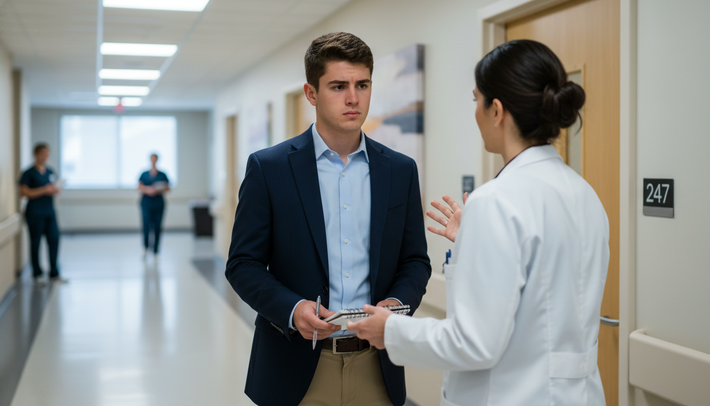
The way physicians judge students on their first shadowing day is far more ruthless—and far quieter—than anyone tells you.
You think they care about your GPA, your MCAT, your passion for medicine. They do not. Not on day one. On that first shadowing day, we are watching something much simpler and much more telling: how you move through a clinical world that isn’t built for you yet.
I’ve sat in those workrooms and call rooms as attendings dissected students after they left. I’ve heard the “we should support this one” and the “never again” conversations. The pivot point is rarely knowledge. It is almost always behavior, presence, and how you change the energy in the room.
(See also: shadowing etiquette for more details.)
Let me walk you through what physicians are actually noticing—what they say behind closed doors about your first shadowing day, and how that judgment quietly shapes who gets future opportunities, strong letters, and quiet advocacy down the line.
1. Your Arrival: The Judgment Starts Before You Say a Word
Physicians start forming an opinion of you before you speak your first sentence. This part nobody tells premeds, but every attending knows it.
When you walk onto the unit or into clinic, we’re clocking you like this:
- Are you on time, which in medicine means 10–15 minutes early?
- How do you enter the space—hesitant, entitled, or calmly curious?
- Do you look like you understand that this is a workplace, not a campus tour?
I watched an internal medicine attending at a large academic center in the Midwest look out the workroom window at 7:58 a.m. The student was supposed to meet him at 8:00.
“They’ll be five minutes late,” he said.
“How do you know?” I asked.
“Premeds who walk fast show up early. The ones who stroll in are late and have excuses.”
The student arrived at 8:07. Starbucks in hand. Nice kid. Never shadowed there again.
You think that’s harsh? Busy physicians don’t have time to train someone who can’t meet the baseline of showing up early without being told twice. It’s not about shadowing; it’s about: “What kind of colleague will this person become?”
The Wardrobe Test
We absolutely notice what you’re wearing. Not because we care about fashion, but because your clothes scream how seriously you take patient trust.
Here’s what quietly raises our eyebrows:
- Scrubs you bought online “to fit in” when you’re not part of the team
- Sneakers that look like you just left the gym
- Wrinkled shirts, loud colors, or overly tight clothing
- White coats. If you are not a medical student, do not wear one. Ever.
The students who stand out for the right reasons are usually boring: clean, simple, professional. Button-down or blouse, slacks or conservative skirt, comfortable but clean shoes, badge visible if you have one.
What we really notice is whether you look like you thought, “Real patients are going to see me today,” instead of, “What looks good for a premed Instagram post?”
2. How You Handle the First Ten Minutes
The first ten minutes determine how much access you’ll get for the rest of the day. Most attendings decide almost immediately which box to put you in:
- “Shadow only, low engagement”
- “Potentially teachable, give a little more”
- “This one gets opportunities”
What separates those categories has nothing to do with you knowing the difference between systolic and diastolic heart failure.
It’s how you introduce yourself.
The students who shoot themselves in the foot almost always start with themselves:
“I’m a premed at X university, I’m super passionate about cardiology, I’ve done research in…”
We’re polite. We nod. Internally, we’re thinking, “You haven’t asked a single question about the patients we are about to take care of.”
The students who get more from day one usually say something like:
“Thank you for letting me be here. I know you’re busy. I’d love to know your expectations for me today so I don’t get in the way.”
That single sentence signals self-awareness, respect for hierarchy, and understanding that this world is not centered around you.
The attending may not say it out loud, but the internal translation is: “This one won’t be a problem. Maybe even worth investing in.”
3. The Single Biggest Tell: How You Behave in Front of Patients
Here’s where the harshest judgments happen. Physicians watch you like a hawk in patient rooms, because you are now part of the clinical environment—even if you think you’re invisible.
Three things we notice instantly.
Your Eyes
We see where you look. You think you’re subtle; you’re not.
When a patient is crying, in pain, or exposed during an exam and you’re staring just a bit too long at something you’re curious about, we see it. So do they. So do the nurses.
A seasoned family medicine doc once said to me after a shadowing day:
“She kept staring at the patient’s mastectomy scar. Not glancing, staring. I don’t care if she’s 19. If she doesn’t feel the instinct to look away, that’s going to be a problem in this field.”
The students who impress us are curious but controlled. They look when appropriate, look away when things are emotionally or physically vulnerable, and never forget that they’re looking at humans, not pathology.
Your Introduction to Patients
We’re evaluating whether we can trust you with our patients’ emotional safety.
You don’t barge in and start talking. You follow the physician’s lead. When they introduce you, the right response is short and respectful:
“Nice to meet you. I’m just observing today.”
The wrong response? Oversharing, apologizing for being there, or turning it into your moment. I’ve heard:
“I’m applying to med school soon, so this is great experience for me.”
To a patient with metastatic cancer.
Imagine how that sounds. You just revealed your internal focus: this is about you, not them.
Your Silence
Attending physicians love a student who knows when not to talk.
We notice:
- Do you laugh at our jokes in the room when the patient isn’t really laughing?
- Do you ask questions in front of patients that should be asked outside?
- Do you share opinions or guesses about a diagnosis in front of the patient?
The students we quietly blacklist are the ones who turn a room into a performance. The ones we champion are usually quiet, present, and visibly engaged—but not trying to prove they’re smart.
A surgical attending at a large East Coast program kept letting the same undergrad shadow repeatedly. I asked why.
“She didn’t say a single unnecessary word in front of patients for two weeks. Not nervous silence. Disciplined silence. That’s rare.”
4. The Way You Interact With Staff (This Is Where Many of You Fail)
You think the attending runs the evaluation of you. Not entirely.
Here’s the truth: after you leave, attendings will often ask one or all of the following people about you:
- Front desk staff
- MAs
- Nurses
- Residents or fellows
Because we know how students behave when they think someone “doesn’t count.”
If you want the raw truth: the fastest way to be quietly blacklisted is to treat staff as background characters.
I’ve watched this play out. A premed shadows in clinic. Polite to the attending. Overly eager with questions. Then at the front desk, he stands off to the side, doesn’t introduce himself, barely acknowledges anyone, checks his phone constantly.
At the end of the day, the attending asks casually, “How was the student?”
The MA says, “Honestly? He didn’t really talk to us. Kind of just stood there.”
That one sentence is enough. No explicit ban. But that student won’t get a call back for more shadowing. And the attending certainly won’t remember him when it’s letter-writing season.
Physicians notice if you:
- Introduce yourself to staff the same way you do to physicians
- Say “thank you” when someone helps you or lets you stand in on a procedure
- Step out of the way when staff clearly need to get work done
- Ask smart, non-intrusive questions about workflow at appropriate times
A student who says to a nurse, “I’ve never seen how clinic runs from your perspective—what’s the hardest part of your day?” shows more emotional intelligence than someone rattling off pathophysiology facts.
And yes, we notice who you choose to humanize.
5. Your Body Language in the Workroom
Students think the action is in the exam rooms. It’s not. The workroom—the cramped nurses’ station, the physician workspace—that’s where your professional persona is judged most harshly.
I’ve watched attendings decide in under five minutes whether someone “feels like a doctor” based only on how they exist in that shared space.
What we quietly track:
- Do you sit before you’re invited to?
- Do you spin in the physician’s chair, stretch out, lean back like it’s a student lounge?
- Do you take up too much physical or conversational space?
- Do you place your bag right in the middle of high-traffic areas?
The strong shadowing students almost always default to standing or finding a spot that’s clearly out of the way until someone says, “Grab a seat.”
You don’t plop down at the physician workstation without being offered. That seems small. It isn’t. It’s how we test whether you read the room and understand hierarchy without needing it spelled out.
We also notice your tech behavior.
If you’re constantly pulling out your phone “to take notes,” nobody believes you. The attending who’s been on service for 20 years has seen every flavor of distracted student. You may think you’re discreet; you’re not.
The student who takes notes with a small notebook? Memorable. The one who keeps their phone out of sight unless asked to use it for something clinical? Trusted.
6. Curiosity vs. Performance: How You Ask Questions
Everyone tells you to “ask lots of questions.” That’s incomplete. Everyone in medicine loves curiosity; we despise performance.
What we really judge is timing, depth, and intent.
Here’s how it sounds on our side:
Performance questions:
- Asked in front of a team, residents, or other students
- Very complex or textbook-sounding, especially if basic stuff is shaky
- Clearly something you Googled on the elevator and want credit for knowing
Example I once heard: “Do you think the latest ESC guidelines will shift how you stratify this patient’s heart failure regimen?”
That’s not curiosity. That’s a monologue disguised as a question.
Real curiosity sounds different:
- Simple, focused, often starting with “Help me understand…”
- Usually asked after the patient leaves the room or between cases
- Connected to what just happened, not something random from a podcast
A student in an ED shadowing shift asked attending quietly:
“Help me understand how you separated what was truly urgent from what could wait. I felt overwhelmed by how many things were going on with that patient.”
The attending talked to her for fifteen minutes. Invited her back. Wrote a letter for her two years later.
We don’t expect you to know much. But we expect your questions to reveal that you’re actually thinking about patients and decisions, not trying to impress us with buzzwords.
And yes, if you don’t ask any substantive questions all day, we notice that too. Silence doesn’t protect you if it’s empty. It only protects you if it’s clearly reflective, observant silence.
7. How You React to Blood, Suffering, and Uncertainty
Most premeds are terrified of fainting in the OR. That’s not what we really judge you on.
Fainting happens. Residents faint. Medical students faint. Nobody blacklists you for a vasovagal episode, as long as you’re honest and safe about it.
What we do notice, and remember, is your response to difficult situations.
A few examples:
- When a patient gets bad news: Do you look bored? Uncomfortable? Compassionate? Do you stare at the floor like you want out, or do you hold emotional space quietly?
- When we say “I don’t know”: Do you look disappointed, surprised that attendings aren’t omniscient, or do you seem to understand that uncertainty is baked into this job?
- When something messy or graphic happens: Do you make a face, crack a joke, or break professional composure?
One attending told me about a premed who shadowed him in a trauma bay. Massive GI bleed. Team moving fast.
“She was pale, obviously overwhelmed,” he said. “But she kept her eyes on us, not on the blood. Didn’t say anything, didn’t try to be tough, just stayed present. Afterward she asked, ‘How do you go home after a case like that?’ I’ll remember that more than any 520 MCAT.”
We’re not scoring you on toughness; we’re gauging whether you can sit with the realities of this work without frivolity or detachment.
8. The End of the Day: Your Closing Move
That last interaction sticks harder than you think. It’s what we recall when someone emails us later asking, “Did you ever work with this student?”
Physicians notice whether you:
- Try to leave early without checking in
- Drag the day out when it’s clearly time for everyone to go home
- Ask for things before you’ve earned them
Here’s a move weak students pull: “Could you write me a letter of recommendation?” after a single four-hour shadowing session.
You think we’re offended by the ask; we’re not. We’re just unimpressed by the lack of judgment. A letter means “I know how this person behaves over time.” Shadowing rarely gives us that. You’ve signaled that you don’t understand what letters represent.
The students attendings remember in a good way usually end the day something like this:
“Thank you for letting me be here today. I learned a lot just from watching how you talk to patients. I’d love to come back if that ever fits your schedule. Either way, I appreciate your time.”
You acknowledge the gift of access. You name something specific you noticed (that tells us you were mentally present). You express interest without entitlement.
That’s the kind of student an attending might email back in a month offering, “We have a long clinic day next Thursday if you want to see more.”
9. The Quiet Ledger: What Gets Written in Our Mental File on You
Physicians won’t hand you a score sheet. But internally, they’re building one. It looks roughly like this:
- Reliability: Were you on time, reachable, where you said you’d be?
- Professional presence: Did you dress and behave in a way that earns patient trust?
- Emotional intelligence: Did you read the room? Respect vulnerability? Treat staff well?
- Teachable mindset: Did your questions and demeanor show humility and curiosity?
- Impact on workflow: Did you make the day harder, the same, or just a touch smoother?
Nobody expects perfection. We expect trajectory.
If you start the day nervous and a bit stiff but we see you gradually reading cues better, adjusting where you stand, timing questions more thoughtfully—that’s gold. Growth in a single day is one of the strongest signs you’re cut out for this journey.
Because here’s the real secret: on your first shadowing day, we’re not asking, “Are you ready to be a doctor?” We’re asking, “If this person keeps developing on this trajectory, could I imagine them as a colleague someday?”
And that question is answered not by how much you know, but by how you carry yourself in a space that is not about you.