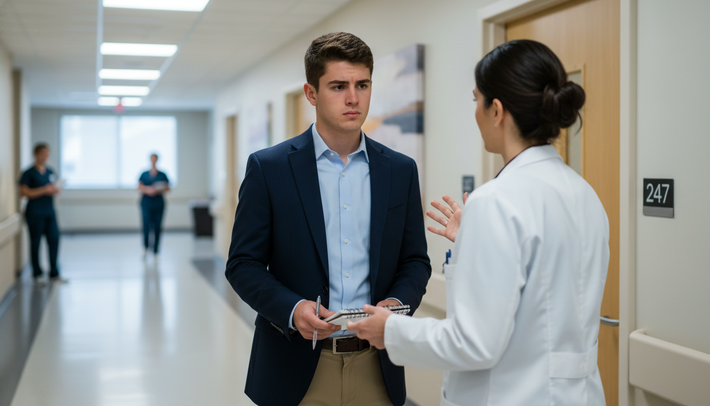
The way physicians test your professionalism during shadowing is mostly unspoken, and it starts long before you step into the exam room.
You probably think shadowing is about watching medicine. For the physicians evaluating you, it is about watching you. They are quietly asking: “Would I trust this person around my patients? Would I want them on my team at 2 a.m.?”
I have sat in those workrooms, listened to the hallway commentary, and watched students get written off in the first ten minutes without ever realizing it. I have also seen “average” students earn powerful letters because they passed tests they never knew they were taking.
Let me walk you through how physicians actually judge your professionalism during shadowing – the stuff nobody spells out on premed websites.
The First Test Starts Before You Say Hello
Physicians start assessing you the moment you first contact them. Not when you walk into clinic. When you send that first email.
They are asking: Do you understand that this is a professional relationship, not a favor from a family friend?
Here is how they test you quietly:
1. Your first email
Most students think, “I just need to sound polite.” The attending is thinking: “Does this person write like someone I’d trust to email a patient or a colleague someday?”
(See also: Shadowing Etiquette Doctors Expect but Never Explain Out Loud for more details.)
Red flags attendings talk about behind closed doors:
- An email that reads like a text: no greeting, no sign-off, “hey doc,” emojis.
- A vague ask: “Can I shadow sometime?” with no suggested dates or parameters.
- Sloppy writing: typos, no capitalization, unclear subject line.
What impresses them is not formality for its own sake. It is clarity, efficiency, and respect for their time. A short, clean email with a clear subject line, brief context, and 2–3 specific date options signals “this person gets how medicine actually works.”
The follow-up is where a lot of students quietly lose points.
Attendings and office managers notice:
- How quickly you respond to scheduling emails.
- Whether you read instructions the first time.
- Whether you confirm details (time, location, dress code) without needing multiple reminders.
If the office emails, “Please arrive at 7:30 a.m., check in at the front desk, and bring proof of vaccination,” and you reply, “What time should I be there?” that gets talked about.
I have heard variations of: “If they cannot read a three-sentence email carefully, I am not putting them near my patients.”
3. Day-before behavior
The student who sends a brief confirmation the day before – “Just confirming I’ll see you tomorrow at 7:15 a.m. in the main lobby. Thank you again for the opportunity.” – immediately reads as more reliable.
Do you need to do that every time? No.
Does it signal to a busy physician, “This person is not going to stand me up at 7 a.m.”? Absolutely.
That’s your first professionalism test, and most students do not even realize it happened.

Your Arrival: The First 30 Seconds Tell Them Almost Everything
Attendings form a working impression of you in the walk from the lobby to the workroom. That’s where the subtle tests begin.
They notice far more than you think.
1. Are you early, exactly on time, or cutting it close?
Being five minutes early is neutral to slightly positive. Ten to fifteen minutes early is good if you are not visibly hovering, disrupting the front desk, or clearly lost.
Cutting it close – showing up at the stroke of 7:30 or a couple minutes late – is deadly in a clinical environment where “on time” actually means “already ready.”
I have heard: “If they’re three minutes late to shadowing, they’d be ten minutes late to rounds as a student. Hard pass.”
2. Your visual presence
This is not about looking stylish. It is about signaling: “I understand I’m in a professional, clinical space.”
Attendings clock:
- Is your clothing clearly clean and pressed?
- Are your shoes closed-toe and practical, or do they say “I do not expect to be standing all day”?
- Is your bag small and discreet, or a giant backpack you drag into cramped spaces?
You are being evaluated not just on appearance, but on whether your appearance suggests situational awareness.
3. The handshake and introduction
Here is what physicians talk about afterward, especially when students are not present:
- Did the student introduce themselves to everyone they met, not just the attending? Nurses, front desk, medical assistants?
- Did they say their full name and role? (“Hi, I’m Alex Rivera, a premed student shadowing Dr. Patel today.”)
- Did they wait to be invited into spaces rather than just walking in?
Shadowing is one of the only times in medicine where you have almost no defined role. How you handle that ambiguity tells attendings a lot about your maturity.
In the Clinic or OR: The Silent Checklist
Here’s the part nobody tells you: once clinic starts, the attending is not just teaching; they’re running a mental checklist on you throughout the day.
They usually will not say any of this to your face. You just feel the temperature change.
Let’s go through the hidden criteria.
1. Confidentiality and boundaries
Every physician you shadow is watching for one thing obsessively: will you respect patient privacy without being babysat?
They pay attention to how you react the first time they say: “This is a sensitive visit. I’m going to have you step out.”
There is a right answer here.
The students who do well say something like, “Of course,” step out immediately, and do not look disappointed or defensive. They understand that patient comfort beats their educational experience every time.
The ones who get discussed later in the workroom:
- Roll their eyes when they keep getting asked to step out.
- Linger or move slowly, as if hoping the patient will say it’s fine for them to stay.
- Ask in front of the patient, “Is it okay if I stay?”
The faculty reaction is brutal: “If they cannot tolerate missing an encounter, how are they going to handle being left out as a medical student when something is not appropriate for their level?”
They are also watching what you do in the hallway. Do you talk about cases within earshot of patients or families? Do you mention a patient’s condition in the elevator? Say the wrong thing once, and any chance at a strong letter evaporates.
2. Phone behavior: the kiss of death
Here is the most reliable way to get written off without anyone saying a word: pull out your phone during clinic.
I do not care if it is “just to check the time” or “to take a quick note.” To most attendings, especially in older-school environments, phone out = disengaged, unprofessional, self-absorbed.
I have watched this exact scenario multiple times:
- Student looks at phone while attending is writing a note.
- Attending does not say anything.
- After clinic, in the workroom, they say to colleagues: “Yeah, not writing them a letter. They were on their phone half the time.”
The student usually has no idea they just failed the professionalism test.
If you must use your phone for notes, ask explicitly at the beginning of the day: “Is it okay if I take brief notes on my phone between patients, or would you prefer I use a notebook?” That transparency can flip the interpretation.
3. How you take up space
Shadowing students often forget they are extra bodies in already cramped exam rooms and hallways.
Physicians notice:
- Do you position yourself where you can see and stay out of the way?
- Do you step aside so nurses and staff can move freely, or do they constantly have to navigate around you?
- Do you wait for cues before sitting, or do you plop down in the only chair the attending usually uses?
I watched one student shadow a surgeon at a major academic center. Every time they moved from room to room, the student unconsciously took the rolling stool, leaving the attending standing. Nothing was said aloud. The surgeon later told me, “If they can’t read that room dynamic, they’re not ready for my OR.”
Situational awareness is professionalism. And physicians test it without announcing the test.

4. Conversational discipline
Attendings are constantly listening for whether you know what not to say.
They notice:
- Do you ever correct or contradict them in front of a patient?
- Do you volunteer medical opinions or guesses to patients without being asked?
- Do you share personal stories that shift focus away from the patient?
One of the fastest ways to be labeled unprofessional is to over-identify with the patient in a way that undercuts the physician.
Example I have seen more than once:
- Patient: “I really don’t want that test. It’s expensive.”
- Student (trying to be supportive): “Yeah, healthcare costs are so ridiculous. I wouldn’t want that either.”
- Attending’s mental note: “Never again.”
It is not that they disagree with you about costs. It is that you undermined the therapeutic relationship.
The best students keep their comments patient-centered, brief, and free of medical advice. They often wait to ask questions in the hallway rather than in front of the patient, unless the attending explicitly invites student questions in the room.
How You Treat Staff: The Test That Matters More Than You Think
If you remember only one thing from this article, remember this: physicians ask the staff what they thought of you.
Not sometimes. Often.
They will quietly check with:
- The front desk. “Was that student polite? Did they introduce themselves when they arrived?”
- The nurses and MAs. “How were they with you?”
- The OR team, if you are in surgery. Especially the scrub techs.
You might impress the attending and still lose the letter because the nurse says: “They didn’t say hello to anyone. They just followed you around.” Or: “They blocked the med cart three times and didn’t move when I asked.”
I have been in meetings where someone said, “The student seemed great,” and a nurse answered, “He was pretty dismissive with me,” and the discussion ended there. No letter. No support.
On the flip side, staff praise is rocket fuel. When a nurse says, “She was so respectful, always asked where she should stand, and thanked us at the end of the day,” that attending is suddenly much more invested in helping you.
Professionalism in medicine is evaluated socially, not just individually. You are being tested on how you fit into the team.
Curiosity, Humility, and the “Too Much/Too Little” Balance
Every attending is running an internal gauge on you: Are you engaged but not needy? Curious but not performative? Humble but not mute?
That balance is where many premeds quietly fail.
Too much:
- Firing off a question after every single patient, even when the attending is clearly behind schedule.
- Using questions to show what you already know rather than what you want to learn.
- Turning hallway walks into oral exams for yourself: “So for that patient with AFib, would you ever consider…”
Attendings sense when questions are about your ego rather than their teaching.
Too little:
- Never asking anything.
- Giving off a vibe of “I’m just trying not to mess up,” which makes you fade into the background.
The students who impress faculty hit a middle ground. They:
- Ask a few well-timed questions when the attending is not rushed.
- Occasionally say something like, “I noticed you handled that breaking-bad-news conversation very gently. Is that a style you developed, or something you were taught in training?” That shows insight without pretending expertise.
- Listen more than they talk, especially early in the day.
Humility is not saying “I don’t know anything” constantly. It is being honest about what you do not know, without turning it into a performance.
End-of-Day Behavior: The Exit Test
Attending memory is strange. You might think they’ll remember the complex case they explained to you. Often, what sticks is your last five minutes with them.
This is where many students miss a quiet opportunity.
1. How you say thank you
A quick, specific thank you lands better than a generic “Thanks for letting me come.”
What faculty remember is:
- Did you thank them for concrete things? (“I really appreciated seeing how you handled that difficult family meeting.”)
- Did you acknowledge the staff too? A simple, “Thanks for letting me shadow today” to the nurses as you leave is rare enough to be memorable.
2. Asking for future opportunities (or not)
There is a right way and a wrong way to angle for letters or ongoing shadowing.
Wrong way (and I have seen this verbatim): “Would you be willing to write me a letter of recommendation?” on the first or second day of shadowing.
To most faculty, that reads as transactional and premature. They barely know you.
Better:
- First, ask if continued shadowing is possible: “I’ve really enjoyed today and learned a lot. If your schedule allows, would you be open to me coming back a few more times this month?”
- Later, after more exposure: “I’ve really valued the time I’ve spent here and was wondering if you’d feel comfortable writing a letter for my application.” The words “feel comfortable” matter. They signal you care about the quality of the letter, not just ticking a box.
Physicians are quietly evaluating whether you respect that their signature has weight.
3. Do you close the loop on small things?
If you were late, or if you asked for a special accommodation (leaving early for an exam, for example), do you acknowledge it briefly?
“I appreciate you letting me slip out early today – thank you again” goes a long way.
Professionalism is often about how you handle your own imperfections, not pretending you do not have any.
The Hidden Long Game: Reputation After You Leave
Shadowing is not just about what happens that day. Physicians will sometimes hear your name again months or years later. That is when your earlier behavior comes back into play.
Here is what happens behind the scenes:
- A faculty member gets an email from another department: “You worked with a student named Maya Chen last year – would you recommend her?”
- A residency PD sees your name and casually mentions it in the hallway: “Did any of you work with this person as a student?”
Their snap response is built from hundreds of micro-observations of your professionalism during every shadowing and clinical encounter.
They will not remember your GPA. They will remember whether you were the student who:
- Stood when an elderly patient entered the room.
- Stepped aside for the nurse pushing the vitals cart.
- Put your phone away for eight straight hours without complaint.
- Thanked the scrub tech by name after your first OR case.
Those tiny, quiet choices compound into a reputation. That reputation follows you.
How to Use This Knowledge Without Becoming Paranoid
Now you know how you are being tested. The goal is not to walk into every clinic day thinking, “Everyone is judging me constantly.”
The goal is to align your behavior with how medicine actually functions:
- Patients and staff come first.
- Attention is one of the most valuable things you offer.
- Humility and reliability are worth more than raw intelligence during shadowing.
Pay attention. Read the room. Assume your behavior toward the lowest-status person in the building is the truest measure of your professionalism.
Do that, and you will quietly pass tests most of your peers never realize they are taking.