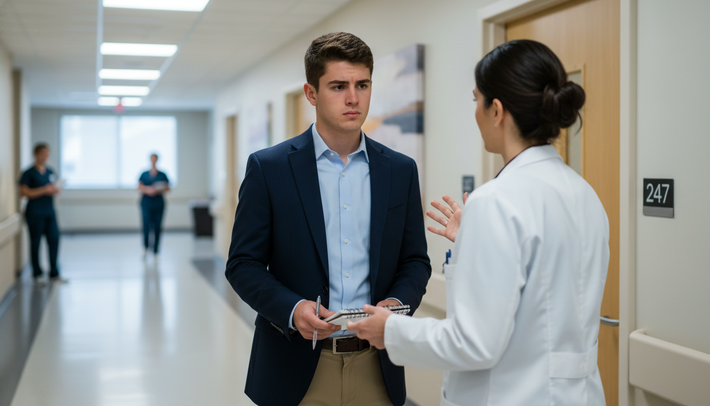
It’s late May. You just got your MCAT score back, you’re drafting your personal statement, and you suddenly realize almost all of your “clinical” hours are shadowing. No paid job. Minimal hands-on patient contact. Just a lot of time quietly standing in the corner of exam rooms.
You’re asking yourself the exact right question:
Can shadowing alone demonstrate “clinical experience” to admissions committees? Or is that going to be a red flag?
Here’s the direct answer and then the details on what to do next.
(See also: How Many Shadowing Hours Do You Really Need for Medical School? for more details.)
1. Short Answer: Shadowing Helps, But It Is Not Enough By Itself
Here’s the clear, no-spin version:
- Shadowing is necessary but not sufficient.
- Shadowing alone does NOT meet what most med schools mean by “clinical experience.”
- You should aim for both: shadowing and active, longitudinal clinical involvement.
Admissions committees (AdComs) see thousands of applications. A pattern has emerged across MD and DO programs:
Shadowing = exposure to the physician role and physician lifestyle.
Clinical experience = you personally engaging with sick or vulnerable people in a healthcare setting.
They are not the same thing.
Programs want evidence that:
- You’ve seen doctors work and understand the realities of the job (shadowing).
- You’ve worked with patients yourself, felt the discomfort, messiness, and emotional weight of illness, and still want to do this (clinical experience).
If your activities list is 200 hours of shadowing and almost nothing else clinical, many schools will question whether you truly know what you’re signing up for.
So the answer: Shadowing alone does not fully satisfy the “clinical experience” expectation for most AdComs, especially at MD schools.
2. What Admissions Committees Actually Mean by “Clinical Experience”
AdComs rarely sit around debating whether you hit some magic number of hours. They’re asking different questions:
- Has this person been responsible for real people in real distress?
- Has this person interacted directly with patients, not just watched others do it?
- Has this person persisted in a clinical setting long enough to see both the good days and bad days?
They usually look at three separate but related buckets:
Shadowing
- Observing a physician’s day.
- Focus: physician decision-making, time management, team dynamics, lifestyle.
- Often passive. You’re not charting, not touching patients, not making calls.
Clinical Experience (Active)
- You are part of patient care in some defined way.
- Examples:
- Medical assistant (MA)
- EMT/Paramedic
- CNA or PCA
- ED tech
- Scribe (borderline, but often counted as clinical if you’re interacting with patients)
- Hospice volunteer (with patient interaction)
- Inpatient volunteer with real tasks, not just stocking or filing.
- Key elements:
- Patients or families look to you, even in a small way.
- You have to communicate, comfort, listen, and respond.
Service to Vulnerable Populations (Clinical or Non-Clinical)
- Working with people who are sick, homeless, elderly, disabled, or otherwise vulnerable.
- Can be clinical (free clinic, hospice) or non-clinical (soup kitchen, crisis line).
- Shows that you’re willing to engage with human suffering, not just academic medicine.
AdComs want all three, if possible.
Shadowing answers “Do you know what doctors actually do all day?”
Clinical work answers “Can you handle working with patients?”
Service answers “Do you care about people beyond your own achievement?”
Shadowing checks only the first box.
3. When Is Shadowing Strong, and When Is It a Weak Spot?
Situations Where Shadowing Looks Strong
Shadowing can absolutely be a high-value piece of your application if:
- You have varied shadowing:
- Primary care (IM, FM, pediatrics)
- At least one specialty (e.g., general surgery, EM, OB/GYN)
- You have depth with at least one physician:
- 40–80+ hours with a single mentor over months
- Longitudinal relationship, maybe a letter of recommendation
- You can clearly articulate:
- Specific patient encounters you witnessed
- How they changed your understanding of medicine
- How you saw professionalism, communication, or ethical decision-making play out
But even great shadowing is still passive. It’s the “front row seat,” not being on the field.
Situations Where Shadowing Alone is a Problem
Your application will raise concerns if:
- You have:
- 150–300 hours of shadowing
- And <20–30 hours of any active clinical work
- Your only “patient contact” is:
- Sitting in the corner of exam rooms
- Observing OR cases
- Following attendings on rounds without speaking to patients
- You describe “clinical experience” in essays, but everything is framed as:
- “I watched Dr. X…”
- “I observed…”
- “I saw how physicians…”
Screens around secondary review will pick this up quickly. A committee member will ask:
“This student has clearly watched medicine. But have they actually worked with sick people themselves?”
If the honest answer is no, that’s a weakness you can and should fix before you apply.

4. What Does Count as Clinical Experience (Beyond Shadowing)?
Here are concrete roles AdComs typically accept as legitimate clinical experience:
Paid Clinical Roles
- Medical Assistant (MA) – outpatient clinics, urgent care, specialty practices
- Vitals, rooming patients, EKGs, injections (state-dependent), phone calls.
- Certified Nursing Assistant (CNA)/Patient Care Tech
- Inpatient units, rehab, nursing homes.
- ADLs, vitals, mobility, hygiene. Very hands-on.
- Emergency Medical Technician (EMT)
- Prehospital care, strong exposure to acute illness and trauma.
- ED Tech/Monitor Tech
- Inpatient or ED setting, direct patient monitoring and procedures.
- Scribe (often accepted, especially if you’re interacting with patients)
- You’re in the room, charting in real time, seeing clinical reasoning.
- Medical Assistant (MA) – outpatient clinics, urgent care, specialty practices
Clinical Volunteering (With Real Patient Contact)
- Hospital volunteer who actually works with patients:
- Transporting patients
- Sitting with elderly or confused patients
- Answering call lights, delivering meals, talking to patients at bedside
- Free clinic volunteer:
- Intake, vitals, translation, patient education.
- Hospice volunteer:
- Regular visits with dying patients and families.
- Nursing home or long-term care volunteer:
- Weekly visits, activities with residents, consistent relationships.
- Hospital volunteer who actually works with patients:
Borderline or “Depends How You Do It”
- Medical mission trips:
- Often viewed skeptically unless you have sustained local clinical work too.
- Research with patient interaction:
- Consenting patients, interviewing them, following up by phone can count.
- Medical mission trips:
The thread that ties all of these together is simple: patients know you exist. They talk to you. They rely on you in some way. You are part of their experience.
5. How To Fix an Application That’s Mostly Shadowing
You might be reading this thinking, “That’s me. My application is 90% shadowing. What now?”
Here’s a practical framework.
Step 1: Assess Your Timeline Honestly
- If you’re more than 9–12 months away from applying:
- You have enough time to build solid, meaningful clinical experience.
- If you’re 3–6 months from submitting and have almost no clinical:
- You should strongly consider delaying your application one year to avoid a predictable rejection cycle.
Step 2: Get Into an Active Clinical Role, Fast but Thoughtfully
Focus on roles that:
- Start quickly (weeks, not a year of training)
- Offer real patient interaction
- Can be sustained for 6–12+ months
Good short-to-midterm options:
- Hospital volunteer with patient-facing assignment (apply and specifically request roles with bedside interaction)
- Free clinic or community health center volunteer
- Hospice volunteer
- Part-time scribe position
- Part-time CNA/MA if you can credential quickly (depends on your state and prior training)
Do not chase prestige here. A low-profile nursing home role often looks better than a fancy unpaid “research intern” position with zero patients.
Step 3: Reframe Your Narrative
When you eventually apply, your story should look like this:
- Shadowing: Helped you understand what physicians do and confirm the career fit.
- Clinical work: Forced you to confront the realities of illness and vulnerability from the patient’s perspective.
- Result: You chose to move closer to patients, not away from them.
Concrete example for your personal statement:
“After 80+ hours of shadowing in outpatient cardiology and internal medicine, I understood a physician’s workflow, but I still felt like a spectator. When I started volunteering at the county hospital, that changed. Sitting at the bedside of a confused, post-operative patient and realizing that I was the only familiar face in the room shifted my understanding of care from procedures to presence…”
Shadowing becomes the starting point, not the entirety of your clinical identity.
6. How Many Hours of Shadowing vs Clinical Experience Do You Actually Need?
There are no universal cutoffs, but here are reasonable, commonly accepted ballparks:
Shadowing:
- Minimum: ~20–40 hours, ideally across at least 2 specialties
- Typical competitive range: 50–150 hours total
- More is fine, but beyond ~150–200 hours, extra shadowing adds little compared to more active patient work.
Clinical Experience (Active):
- Absolute bare minimum: ~50 hours is something, but weak on its own
- Reasonable target: 100–250+ hours of direct clinical experience at the time you apply
- Stronger applicants: Often have 300–1000+ hours, especially if working as an MA, CNA, EMT, or scribe
Remember: duration matters too. Six months to a year of consistent activity looks better than 4 weeks of intensive, one-time experience.
AdCom logic here is straightforward: if you’ve been around sick people weekly for 9–18 months and still want to do this, that’s much more convincing than someone who did one semester of volunteering and quit.
7. Special Situations: Is Shadowing Enough For Now?
There are some contexts where shadowing alone is acceptable as a starting point, though not as your final application profile:
- High school / early college:
- Fine if shadowing is your only clinical exposure so far. Use it to confirm interest, then build more active roles later.
- International students:
- Clinical job options may be limited. Shadowing plus robust patient-facing volunteering (even if non-clinical, like crisis hotline or disability support) can still show commitment.
- Non-traditional students in career transition:
- If you’ve worked with vulnerable populations in another field (social work, teaching special ed, mental health counseling), shadowing may complement that well.
- But you still want some healthcare-specific patient contact.
The pattern stays the same: shadowing opens the door. It just should not be the only thing behind the door.
FAQ: Shadowing vs Clinical Experience
1. Can I apply with only shadowing if my GPA and MCAT are very strong?
You can apply, but academically strong applicants still get rejected every cycle for lack of clinical experience. AdComs do not see this as a minor flaw; they see it as a major risk. A 520 MCAT with poor clinical exposure can be weaker than a 511 with excellent, sustained patient contact.
2. Does virtual shadowing count as clinical experience?
Virtual shadowing is a supplement at best. It can show initiative, especially during COVID-era constraints, but it does not replace real-world shadowing or active clinical work. Most schools will not count virtual-only experience as sufficient clinical or shadowing exposure.
3. Is scribing considered shadowing or clinical experience?
Scribing typically counts as clinical experience, especially if you are in the room with patients and part of the workflow. You’re not just watching; you’re contributing to documentation and seeing real-time decision-making. On AMCAS, it’s usually best categorized as “Paid Employment – Medical/Clinical.”
4. I’m an EMT but have no traditional shadowing. Is that a problem?
Usually not. Strong EMT experience with hundreds of hours and clear reflection on physician roles can compensate for limited shadowing. Still, 10–20 hours of targeted shadowing with a primary care or emergency physician can nicely round out your understanding of the physician perspective.
5. How should I list shadowing vs clinical experience on AMCAS/AACOMAS?
- Shadowing: Use the “Physician Shadowing/Clinical Observation” category.
- Clinical experience: Use “Paid Employment – Medical/Clinical” or “Volunteer – Medical/Clinical” as appropriate.
In your descriptions, make the patient contact aspect explicit for clinical roles, and the observation/insight into physician life aspect clear for shadowing.
6. If I’m applying this cycle and only have shadowing, should I delay my application?
If your “clinical experience” section is essentially blank or just shadowing, then yes, delaying by a year is often the smarter move. Use that year to gain meaningful, sustained clinical experience. One extra year with a strong application beats reapplying after predictable rejections.
Key points to carry forward:
- Shadowing alone does not satisfy AdCom expectations for clinical experience. It’s necessary but not sufficient.
- You need active, patient-facing work—paid or volunteer—where patients actually interact with you and rely on you.
- If your application is shadowing-heavy right now, you can fix it. Start clinical involvement as soon as possible, and give it time to become real, sustained experience.