
This article is for educational purposes only. It is not financial advice, not legal advice, and not tax advice. Figures vary by individual circumstances, so consult a qualified professional before acting.
Lead with the data: ICU and night float are not automatic match boosters
Here's the myth everyone repeats on the wards: suffer through ICU, survive night float, and your application looks tougher. More competitive. More matchable.
The data doesn't support that.
What program directors actually tell us, year after year in the NRMP Program Director Survey and in actual selection meetings, is they care about demonstrated competence, not rotation labels. Can you be trusted overnight? Can you prioritize when three things are happening at once? Can you communicate a sick patient clearly? It doesn't matter if you learned that on ICU or on a brutal inpatient medicine month. The label is irrelevant. The evidence is everything.
I've seen students with an ICU elective on their transcript and a letter that says, "performed adequately." That doesn't move the needle. I've seen students with no ICU at all but a sub-I letter that says, "I would trust this student to cross-cover my own family member." That does.
So here's the thesis: ICU and night float can improve your match odds, but indirectly and conditionally. They help when they generate the three things that actually count, stronger evaluation narratives, credible letters, and proof you can function like an intern. If they don't produce that evidence, they're just hard months you survived.
Why these rotations can help: the mechanisms that actually move the needle
When these rotations help, it's not because they sound hardcore. It's because of how you're observed.
On ICU, everything is high-stakes and tightly supervised. You can't hide. Your pre-round has to be efficient. Your presentation has to be prioritized, what's killing this patient today? Attendings watch how you handle escalation, how you respond to pushback from nursing or respiratory, whether you know when to ask for help. That's stamina, triage, and clinical reasoning under pressure. For procedural and inpatient-heavy fields, those are core competencies programs are screening for.
Night float is different, and in some ways more valuable. Day teams see your knowledge. Night teams see your character.
Can you give a clean, 30-second sign-out that doesn't miss the landmines? Can you handle cross-coverage without panicking or vanishing? Can you call a senior appropriately at 3am, not too early, not too late? Do you follow through so the day team isn't cleaning up your mess? Residents talk. A night float senior who says "rock solid overnight, great communicator, left me a clean list" is gold. That language shows up verbatim in evaluations.
And the hidden payoff? Stories.
Most personal statements and interview answers are generic. "I love teamwork. I'm passionate about critical care." Everyone says that.
ICU and night float give you specific, memorable moments. The COPD patient you re-tubed? No, the one where you caught that the high-flow wasn't working because you actually re-examined at 2am and escalated. The night you had to prioritize three simultaneous pages and explain your reasoning to the nurse supervisor. Those are concrete, not fluffy. Program directors remember concrete.
Where the payoff is real: specialties, evaluation style, and timing
This is specialty-dependent. Period.
If you're applying into internal medicine, anesthesia, emergency medicine, surgery, fields where nights, ICU, and inpatient chaos are the job, then proving you can do that job has direct value. PDs in those fields are actively looking for signals that you won't crumble when you're the overnight intern with 60 patients.
If you're applying dermatology, PM&R, psychiatry, outpatient peds? The signal is weaker. Not zero, but weaker. A derm program doesn't need night float heroics. They need clinic efficiency, continuity, attention to detail. You can still leverage ICU if you got an amazing letter from a well-known intensivist, but don't assume it will automatically impress them more than a stellar derm elective where you actually did the work of that specialty.
Timing screws people too.
Take ICU in early M3 when you're still learning how to write a soap note? You're going to get a "developing" evaluation. You won't have the scaffolding to shine. Take it late, like October of M4 after ERAS is already in, and even if you crush it, that evaluation arrives after your application is filtered. Great for rank meeting chatter at your home program, useless for getting interviews elsewhere unless you send an update letter with substance.
The distinction that matters: Is this rotation on paper, or is it in your application? A rotation only helps if its evaluation, letter, or anecdote makes it into ERAS or your interview talk track in time. Otherwise it's just a line on the transcript.
When they don't help: common myths, bad timing, and opportunity cost
Let's kill some myths.
Myth #1: A hard rotation automatically equals respect. Nope. A mediocre performance on a hard rotation hurts you more than an excellent performance on an "easier" one. I've seen the comments: "Struggled with prioritization on ICU, required significant supervision overnight." That is actively worse than "Excellent, reliable, thoughtful on primary care." Programs don't give you points for difficulty. They give you points for performance.
Myth #2: Programs count hours worked. They don't. No PD has ever said, "Wow, they did 28-hour call, we must rank them higher." They care if you were professional when tired, not if you were tired.
Myth #3: You need ICU to prove you're tough. You don't. You need evidence that you're ready to be an intern. There are many ways to get it.
And here's the real cost no one talks about: opportunity cost. Every month is zero-sum.
Choose MICU in September of M4 and you might be trading away a sub-internship in your target specialty, an away rotation that was your shot at a letter from a big-name program, or dedicated research time that would have yielded a poster. If you're a future anesthesiologist, that extra anesthesia sub-I where you intubate 40 times and get a letter from the PD is higher yield than a second ICU.
If you're applying psychiatry, family medicine, outpatient peds, spending a month rounding on vented patients when you could be showing continuity and relationship-building in clinic is a misalignment. It signals confusion, not strength.
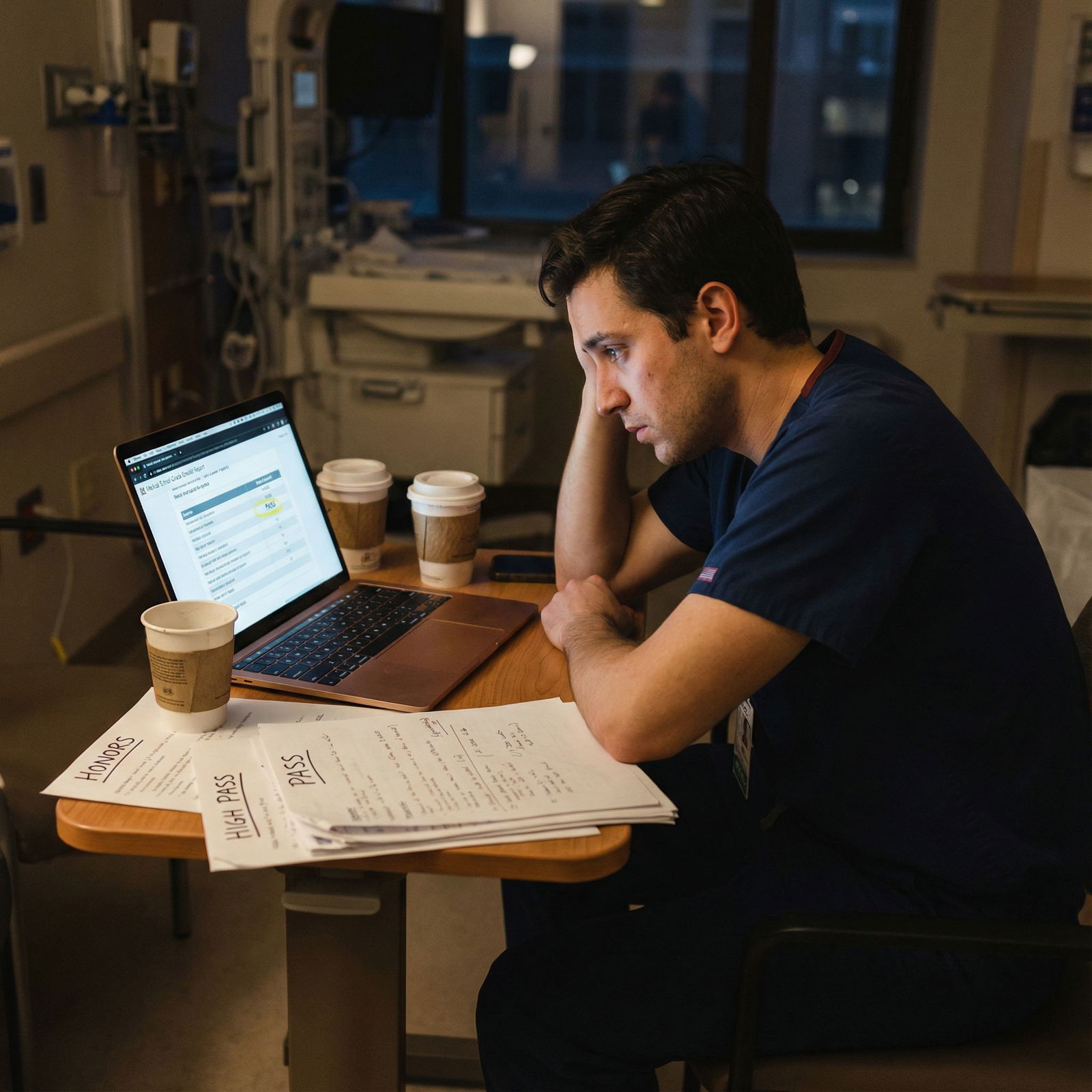
How to use ICU and night float strategically so the rotation works for you
So when should you actually pick them?
Pick ICU or night float when you have a clear use for the evidence it produces. You need inpatient credibility for an inpatient-heavy specialty. You need a letter writer who knows you better than a 2-week elective attending. You need stories that show reliability and escalation, not just fund of knowledge.
If you decide to do it, play it to win. Here's what separates the students who get a boost from those who just get tired:
Make your goals explicit on day one. Tell your resident and attending: "I'm applying internal medicine, I want to show I can own patients, handle sign-out, and escalate well. I'd love feedback on that." People can't evaluate what you don't tell them you want to show.
Pre-round like an intern, not a tourist. ICU rounds move fast. Know your vents, pressors, drips, overnight events. Have your assessment prioritized. Don't bury the lead with labs from three days ago.
Own sign-out. This is where night float students win or lose. Write sign-out others can actually use. Verbal handoff with if/then statements: "If this holds, continue. If that worsens, call me and consider X." Residents will quote that in evals.
Ask for mid-rotation feedback at day 10, not day 28. "What's one thing I should do differently the next two weeks to get honors-level evals?" Then actually do it. Close the loop. That improvement narrative makes letters stronger.
Document follow-through. Did you check on that culture at 5am? Did you update the family? Did you leave the day team a clean list? Those small acts get noticed overnight.
Reality check: this rotation is a tool, not a shortcut. It won't rescue a thin application. But if you're strategic, it can turn a vague application, "hard worker, good student", into a specific one: "reliable overnight, excellent sign-outs, handles sick patients calmly." Specific matches better than generic every single time.

Bottom line: Don't pick ICU and night float because you think suffering looks good. Pick them when you know exactly what evidence you want from them, when that evidence fits your target specialty, and when you have the bandwidth to actually excel. A great eval beats a prestigious rotation. Every time. Use these rotations to build proof, not to chase prestige.