
It is week three of your medicine clerkship. You are on the “busy” team. You know the one. Senior is efficient but blunt. Intern is fried. Attending is nice enough but distant. Everyone seems to have an inside joke you are not part of.
You present. They nod, say “okay,” move on. Nobody really talks to you unless they need something. You are staying late, pre-rounding early, and somehow you still feel… invisible and slightly in the way.
And now you are doing the math:
- This is a core clerkship.
- This eval is going to be visible on your MSPE.
- You are interested in a moderately competitive specialty.
You are not clicking with this team. At all. But you still need a good evaluation.
Here is how you fix that.
Step 1: Diagnose the Real Problem (It Is Usually One of Four Things)
Before you start “acting better,” you need to be brutally clear about what is actually going wrong. Vague anxiety is useless. Pattern recognition is not.
Most “I do not click with this team” scenarios break down into one (or more) of these:
- Personality mismatch
- Expectations mismatch
- Role confusion (what they think a student should do)
- System overload (they’re drowning and you’re collateral damage)
Let me walk through each, because the solution changes depending on which one you are dealing with.
1. Personality mismatch
Signs:
- You are doing the work, but small interactions feel off.
- Jokes land wrong. They are very dry; you are more animated, or vice versa.
- You feel self-conscious every time you speak.
This is common with certain teams and certain attendings. They are not “mean,” but they are not your people.
Fix:
- Stop trying to be liked. Switch to trying to be reliable.
- Narrow your communication: clear, concise, professional. Less banter, more substance.
- Assume they will like you retroactively when your work speaks for itself.
2. Expectations mismatch
Signs:
- You think you are prepared, but they keep saying “read more”, “know your patients better”, “you should have known that”.
- Feedback is vague: “Be more thorough,” “Be more concise” (yes, you can get both from different people in the same week).
Fix:
- You have to surface their expectations explicitly. Not in some wishy-washy way. In direct language.
Script (with senior or attending):
“I want to make sure I am improving in the way you care about. When you think of a really strong student on this rotation, what exactly are they doing on a typical day that makes you think, ‘this is an honors-level student’?”
Then:
- Write down what they say. Literally. In front of them.
- Clarify specifics: “For notes, do you want full H&Ps or focused? For presentations, aiming under 5 minutes per new patient?”
- Repeat back a brief summary: “So top priority is: (1) know my patients cold; (2) concise but organized presentations; (3) help the intern with checklists when possible.”
Now you have targets.
3. Role confusion
Signs:
- Nobody tells you what you should be doing.
- You are half-shadowing, half-trying to help, and fully in limbo.
- You feel useless most of the day.
Fix: Ask a version of this question to the intern or senior:
“Between now and the end of the week, what would be the most helpful way for me to plug in so that I am actually useful to you and the team?”
Then offer concrete options:
- “Pick up 1–2 new admits independently?”
- “Pre-chart labs / imaging before rounds?”
- “Call consults after you coach me through the first one?”
- “Start discharge summaries?”
Make them choose. People are bad at answering “What do you want?” but better with “Option A, B, or C?”
4. System overload
Signs:
- Census is insane. Everyone is staying late.
- Your senior has 9 open charts on their screen at all times.
- Teaching has collapsed to “good job, read about X tonight.”
When they are drowning, your evaluation becomes less about how much they liked you and more about a single question: Were you one of the people who made this bearable, or worse?
Fix:
- Your main job: decrease friction. Remove small burdens.
- Become the person who quietly solves problems and never adds drama.
Ask:
“If there is anything I can take off your plate, even small tasks, let me know. I have capacity to help.”
Then follow through. Every day.
Step 2: Shift Your Goal – From “Being Liked” to “Being Easy to Evaluate Well”
You are not trying to become their favorite student of the decade. You just need to make it very easy for them to write:
- “Hard-working”
- “Prepared”
- “Professional”
- “Pleasure to work with”
Those phrases drive evals, MSPE language, and often your final grade.
To do that, you design your days around behaviors that evaluators actually remember.
The four things teams remember about a student
Months later, when they fill out your evaluation at 11 p.m. after sign-out, they will remember:
- Did you know your patients and follow through on tasks?
- Were you professional and easy to have around?
- Did you get better during the rotation?
- Did you help the team, or add noise?
They do not remember:
- Your exact differential on day three.
- The one question you missed in front of the attending.
- The funny story you told in the workroom.
So you build the rest of this rotation around being unforgettable in the four ways that matter.
Step 3: Install a Daily Micro-Protocol That Signals “Strong Student”
You want something structured and repeatable. Not “try harder.” A micro-protocol.
Use this 5-part daily system:
- Pre-round like you are the intern on those patients
- Present with a consistent structure
- Own 1–2 logistics per patient
- Do one visible, unasked helpful act per day
- Close the loop before you leave
1. Pre-round like you are the intern
Stop doing “student pre-rounding lite.” It shows. Instead, for your patients:
- See them early.
- Check: vitals, overnight events, I/O, new labs, new imaging, new consult notes.
- Have a plan for each active problem. A real plan, not “continue to monitor.”
Example for a CHF patient:
- Overnight: any dyspnea? Tele events?
- I/O: net negative? Weight trend?
- Meds: diuretic dosing, changes.
- Exam: JVP, lung sounds, edema.
- Plan: “Increase IV lasix to 80 BID given still net positive 1L yesterday; add daily standing weights; repeat BMP at 15:00 to monitor K/Cr.”
If you present like that every day, I do not care if personalities do not click. People notice.
2. Present with a consistent structure
Pick a structure and stick to it. Attendings and seniors love predictability.
For example:
- One-liner
- Subjective (relevant, brief)
- Objective (vitals, pertinent labs/imaging)
- Problem-based assessment and plan
Ask on day 1 with a new team:
“For presentations, do you prefer system-based or problem-based? And roughly how long per patient do you want, so I can match your style?”
Then lock it in. If your attending knows what is coming each time you talk, they relax. That translates into better perceived performance.
3. Own 1–2 logistics per patient
You want to be the person where, if something is “on the student,” it is as good as done.
Pick concrete, verifiable tasks:
- Daily med rec updates
- Following one key lab and paging results
- Calling family once a day and documenting
- Preparing discharge instructions draft
Say explicitly on rounds:
“I will follow the afternoon BMP and let you know if Cr rises over 0.3 from baseline.”
Then do it. And close the loop:
“I checked the BMP—Cr is stable, 1.0 from 0.9.”
People remember that one sentence more than your 8-item differential for hyponatremia.
4. One visible, unasked helpful act per day
Not endless scut. One meaningful thing that a busy intern or senior would not have expected from a student.
Examples:
- Pre-populate discharge med list for tomorrow’s likely discharge.
- Call the outside hospital for old records before anyone asks.
- Create a simple patient list with up-to-date code status, isolation, key labs and share with the team.
And you tell them you did it. Briefly.
“By the way, I requested outside records from St. Mary’s for Mr. Lopez’s old echo; they said they will fax it within the hour.”
This builds a subtle narrative in their head: “This student makes my life easier.”
5. Close the loop before you leave
Do not just vanish.
End-of-day script:
“Before I head out, is there anything else I can help with? Otherwise, here is what I did and what I will follow up on tomorrow: I updated the note on Ms. Chen, called her daughter, and I will check tomorrow’s morning labs for Mr. Greene first thing.”
Three things this does:
- Signals professionalism and reliability.
- Gives them a chance to toss you a last, discrete task.
- Reminds them of your work in a compact summary they will mentally connect to your name.
Step 4: Force Mid-Rotation Feedback (And Actually Use It)
If you are on week two or three and you have not gotten feedback, you are flying blind. That is how good students end up with “Meets expectations” when they were aiming for “Honors.”
You fix this with something very simple and very un-optional: a feedback meeting you initiate.
How to do it without sounding needy
Ask your senior first; they usually drive the eval content.
Script:
“We are about halfway through my time on this team. Could I grab five minutes sometime today or tomorrow for focused feedback? I really want to make sure I am improving in the areas that matter most to you.”
When you sit down, you need to be specific and prepared.
Bring:
- A printed or digital copy of your rotation objectives (if your school has them).
- A short self-assessment (2–3 areas you think you are doing well, 2–3 you want to improve).
Then ask three questions:
“If you had to grade me today, what would it be and why?”
Forces them to anchor their assessment.“What is one thing that I am doing well that I should keep doing?”
You need to know what to preserve.“What is one specific behavior I should change tomorrow that would make the biggest difference in your evaluation?”
Not “any tips?”—that gets fluff. This gets a real answer.
Then repeat it back:
“So your main point is that I need to tighten my presentations and make clearer assessment and plan statements, with a bit more ownership. I will work on that starting tomorrow.”
And then, importantly, stage a follow-up:
“Would it be okay if I check back with you in a few days to see if you are noticing improvement?”
Now they are watching for improvement. That is gold for eval language.
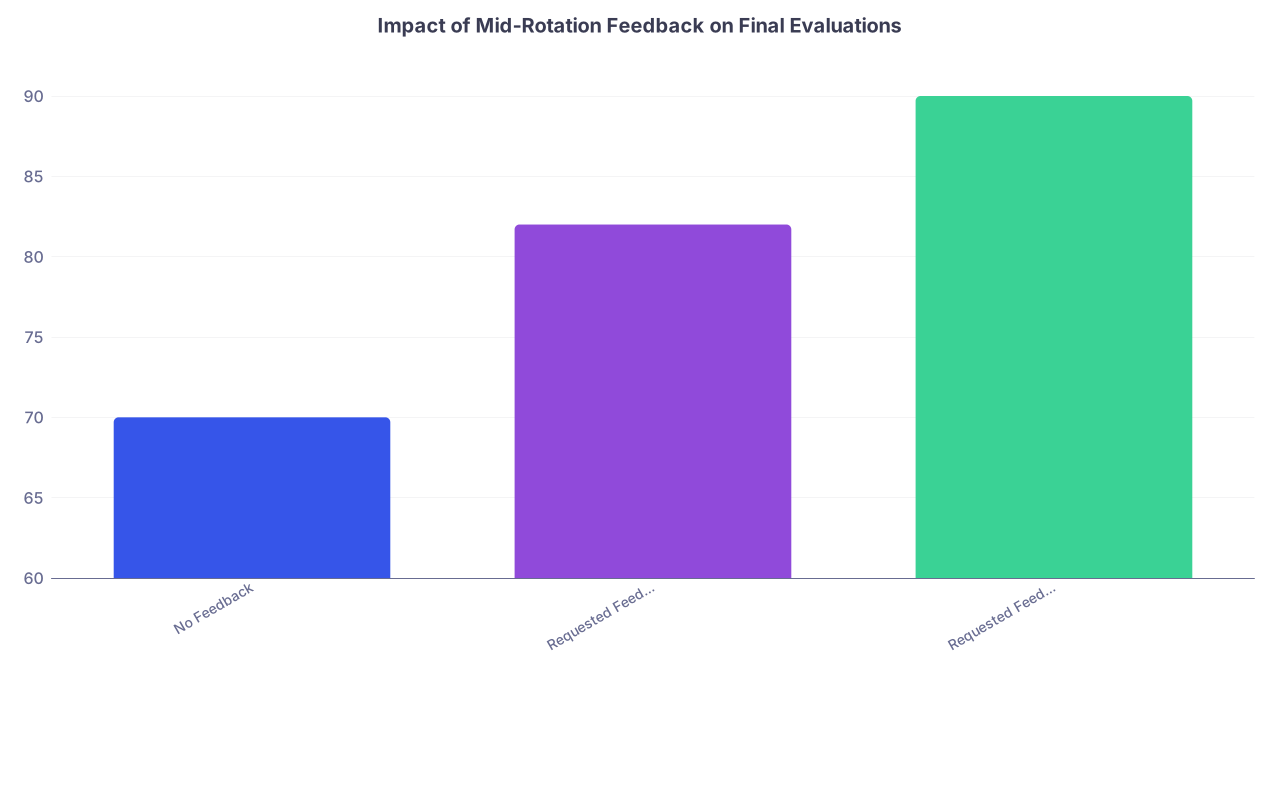
| Category | Value |
|---|---|
| No Feedback | 70 |
| Requested Feedback Once | 82 |
| Requested Feedback Twice | 90 |
Step 5: Use Strategic Self-Advocacy Near the End (Without Being Annoying)
You are not going to “hustle” a good evaluation out of a bad performance. But you can keep a decent performance from being forgotten or misremembered.
End-of-rotation, you have two jobs:
- Make your contributions visible.
- Directly ask key evaluators to complete your evaluation.
Make your contributions visible
Last few days, you briefly remind your senior or attending what you have been doing.
Something like:
“This week I picked up two new admits and wrote full H&Ps, managed three of our follow-up patients with daily notes, and took responsibility for discharge planning on Ms. Ramos. I appreciate all the feedback—it helped a lot.”
You are not writing your own eval, but you are handing them the bullet points they will later turn into phrases like:
- “Actively involved in patient care”
- “Took ownership of discharge planning”
- “Responded well to feedback and improved.”
Which is exactly what you are after.
Directly ask for evaluation completion
Too many students tiptoe around this. Do not.
Script for attending, 2–3 days before you leave:
“I have really appreciated working with you. My last day is Friday. I know you are busy, but my school sends an evaluation link—if you are able to fill that out based on what you have seen, I would really appreciate it.”
If they say they have not seen the link:
“No problem, I will ping our coordinator to resend it.”
You are not being a pest; you are doing basic career maintenance.
Step 6: When the Team Is Actively Cold or Dismissive
Sometimes the problem is not you. The team is just bad at working with students. You still need to extract value and not get wrecked by their dysfunction.
Here is the protocol when the vibe is objectively negative:
Emotionally detach from their tone. Attach to behaviors.
Measure your day by: “Did I complete my tasks, learn something, and document what I did?” Not “Did they smile at me?”Find one micro-ally.
Often the intern or a fellow. Someone who is at least neutral.Ask them quietly:
“I am having a hard time reading how I am doing with the team. Is there anything specific you think I should change?”
Sometimes they will translate the team dynamics for you in a way that saves your grade.
Document your work for yourself.
Create a simple log (in a personal, secure file—not hospital systems) of:
- Patients you followed
- Notes you wrote
- Tasks you completed (e.g., “Called 3 families”, “Coordinated 2 discharges”)
- Feedback you received and how you addressed it
Why? If the eval is terrible and disconnected from reality, this log becomes evidence when you speak to the clerkship director.
- Time-limited escalation if things are truly bad
If a resident or attending is:
- Belittling you in public
- Assigning inappropriate work
- Blocking you from seeing patients or participating
Then you escalate—but do it with specifics, not vibes.
Email or meet the clerkship director:
“I am having some difficulty on my current team and I want to get your advice early so I can correct course. I am working hard, but I am getting very little feedback and feel shut out from patient care. Here are three examples… I would really appreciate guidance on how to improve this situation.”
You are not asking them to fix the team. You are asking for guidance. That is much harder to ignore, and they know you are trying.
Step 7: Position This Rotation Correctly in Your Residency Application
Let’s say you did all of this. You still ended up with an evaluation that is fine but not glowing. Or just “Meets expectations.” Does it tank your residency application? Usually not, if you handle it strategically.
How programs actually read this stuff
Programs look at:
- Pattern of performance across rotations
- Narrative MSPE language
- Trend: Did you improve over time?
- Consistency with letters of recommendation
One lukewarm medicine eval in an otherwise solid packet rarely kills you. What kills you is a pattern.
So here is what you do:
Make sure your strongest rotations are in the specialty (or adjacent) you apply to.
If your medicine eval was mediocre, but your Sub-I in IM or heme/onc elective was great, you are fine for IM.Choose letter writers who actually know you.
Do not chase big names who barely remember you.You want:
- “This student consistently followed through on all tasks.”
- “Took feedback seriously and improved.”
- “Will be an asset to any residency.”
If asked in an interview about a weaker eval, own it. Briefly.
Example:
“On my third-year medicine rotation, I was still figuring out how to be efficient on the wards. My feedback was that my presentations needed to be tighter and I needed to take more ownership of the plan. Since then, on my Sub-I and ICU rotation, I focused heavily on those areas. You can see in those evaluations that I improved significantly in presenting succinctly and anticipating next steps.”
Straight, no drama, and anchored in evidence.

Step 8: If You Are Midway and Things Feel Unsalvageable
Sometimes a rotation is simply going off the rails in your head. If you are midway and thinking, “There is no way this ends well,” use this 48-hour reset plan.
48-Hour Reset Plan
Day 1 – Information and clarity
- Ask for pointed feedback (as above).
- Clarify expectations for:
- Number of patients you should carry
- Notes they expect from you
- Procedures or tasks you should attempt
- Pick 2–3 concrete behaviors to change immediately.
Example changes:
- Cut your presentations from 8 minutes to 4 minutes.
- Come in 30 minutes earlier to read about each patient’s primary diagnosis.
- Start every plan item with “Given X, I think we should Y.”
Day 2 – Overcorrect and narrate
Show visible change.
If they said “be more concise,” be obviously concise the very next day.Name the change briefly.
- After your first presentation:
“I tried to make that more focused based on your feedback yesterday. Please tell me if that is closer to what you want.”
- After your first presentation:
Ask a quick follow-up. End of day:
“How did today compare to earlier in the week? Is this closer to what you are looking for?”
Most evaluators will give you credit for course correction. Many will explicitly write, “Responded well to feedback” which program directors love.

| Step | Description |
|---|---|
| Step 1 | Realize rotation is going badly |
| Step 2 | Request focused feedback |
| Step 3 | Clarify expectations and deficits |
| Step 4 | Choose 2-3 concrete behavior changes |
| Step 5 | Implement changes next day |
| Step 6 | Name changes to team |
| Step 7 | Ask if performance improved |
Example: Turning a Cold Team into a Decent Eval
Let me give you a condensed real-world style scenario.
- Third-year student on surgery.
- Senior is old-school, not warm. Attending barely speaks to students.
- Week 1: Student is mostly retracting, getting little teaching, feeling useless.
What they did:
Asked the senior on Friday:
“What does a great surgery student do on your team? I want to meet that bar.”
Senior said:
- “Know your post-ops cold.”
- “Write clear brief notes.”
- “Be in the OR before me.”
Week 2:
- Pre-rounded meticulously on all post-ops.
- Kept a running complication checklist.
- Started scrubbing in 10 minutes earlier, had room set up with key info (last Hgb, urine output, etc.).
-
“If you had to grade me today, where would I land? And what would I need to change to be at the next level?”
Senior:
- “You are fine, but I need you to speak up more. Tell me the plan without me dragging it out.”
Student overcorrected:
- On rounds, started saying: “Given X, I think we should Y” on each patient.
- Brief, no fluff.
Last week:
- Reminded the senior:
“Thank you for the feedback earlier. I have been trying to speak up with plans more and keep tight notes on our post-ops. I hope that has been closer to what you were looking for.”
- Reminded the senior:
Result:
- Eval: “Hard working, knew post-operative patients very well, took ownership of plans, improved over the course of the rotation.”
- Grade: Honors, despite zero “warm fuzzy” interactions.
That is what you are aiming for.

Quick Comparison: What You Control vs What You Do Not
| You Control | You Do Not Control |
|---|---|
| Preparation for your own patients | Team personality dynamics |
| How you respond to feedback | Team workload and census |
| Visibility of your contributions | Attending teaching style |
| Professionalism and reliability | Rotation scheduling and timing |
| Who you ask for letters of recommendation | Exact wording some evaluator uses |
Focus relentlessly on the left column. Accept the right column without taking it personally.
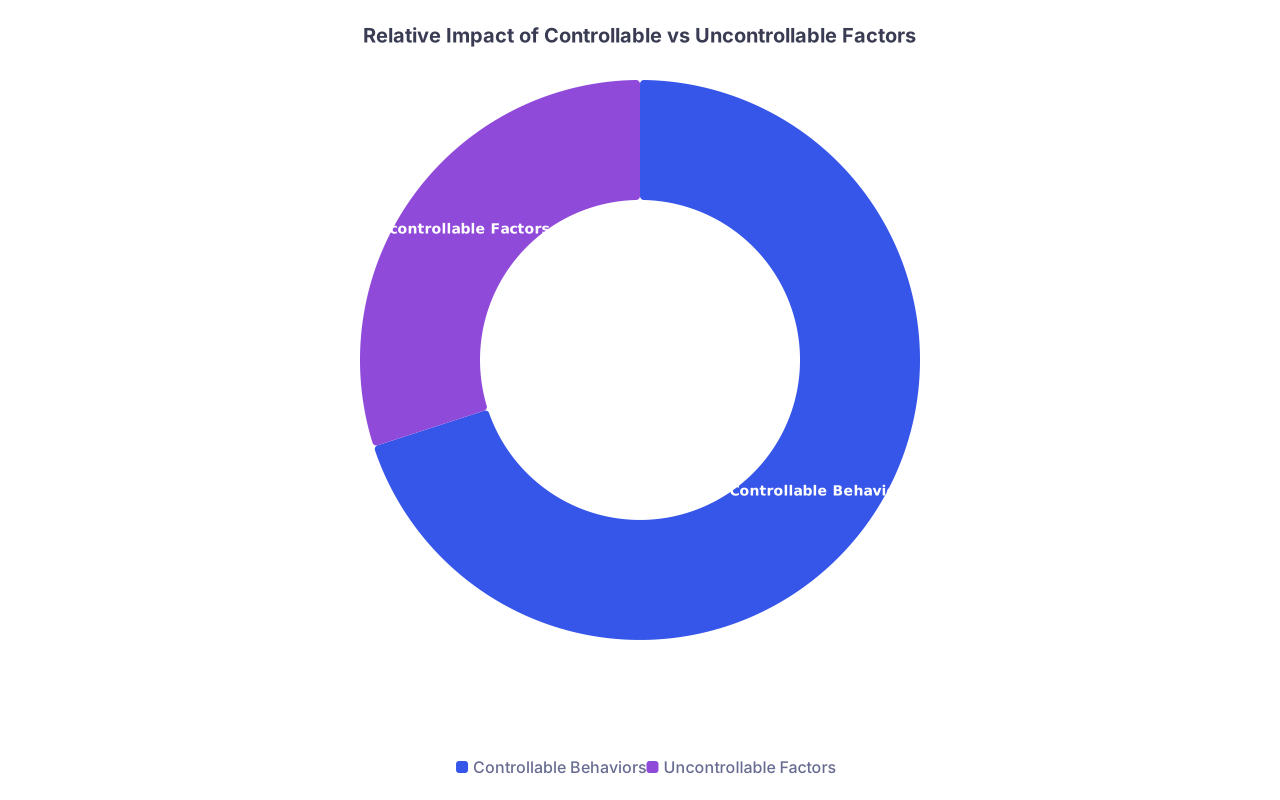
| Category | Value |
|---|---|
| Controllable Behaviors | 70 |
| Uncontrollable Factors | 30 |
Final Thoughts: What Actually Gets You a Good Evaluation
Three points to walk away with:
You do not need to “click” with a team to earn a strong evaluation. You need to be reliable, prepared, visibly improving, and mildly useful. That is it.
Mid-rotation feedback and visible course correction are your insurance policy. They convert a shaky first impression into “responded well to feedback,” which reads very well on your MSPE.
Residency programs care about patterns, not single bad vibes. One awkward team will not ruin your application if your overall trajectory is solid and you learn to extract good evaluations even from less-than-ideal rotations.
You are not there to be adopted by the team. You are there to learn, contribute, and quietly build a track record that makes residency program directors think, “This person will not be a problem at 3 a.m. on call.” Focus on that. The rest is noise.