

You do not “find” a great letter writer. You build one, brick by brick, through how you structure your clerkships and how you show up on those rotations.
Most students treat letters of recommendation as a last‑minute scavenger hunt. Two months before ERAS: mild panic, awkward emails, vague hope that the generic “hard‑working, pleasant to work with” letter will somehow carry them into dermatology or ortho.
That is how you lose.
If you want letters that move the needle—letters where a PD pauses, actually reads, and says, “We should interview this one”—you engineer them. Intentionally. With targeted clerkships, targeted relationships, and targeted performance.
Let me break this down specifically.
The Real Job of a Residency Letter (And Why Most Fail)
A strong residency letter does exactly three things:
- Places you in a clear performance tier relative to peers.
- Provides specific, credible examples of your clinical behavior and growth.
- Aligns you with the values and priorities of your target specialty.
Most letters fail because:
- The writer barely remembers the student.
- The writer only saw the student for 1–2 weeks.
- The student never pushed beyond “nice, on time, reads a bit.”
- The clerkship was chosen for convenience, not strategy.
Program directors read hundreds of letters. The vague ones blur together. The engineered letters stand out.
You engineer by controlling three levers:
- Who evaluates you
- Over what time window
- In what clinical context
Targeted clerkships are how you control all three.
Step 1: Reverse Engineer What Your Specialty Wants
Before you choose a single rotation, you need a working model of what your target specialty actually values in LORs.
Not what the brochure says. What PDs actually care about when they skim a letter at 11:30 p.m. between service notes.
For most core specialties, the “quiet checklist” looks something like this:
- Internal Medicine: Clinical reasoning, reliability, ownership of patients, quality of written notes, ability to function as “sub‑intern.”
- General Surgery: Work ethic, team fit, composure under stress, procedural potential, willingness to grind.
- Pediatrics: Communication with families, patience, adaptability, emotional maturity, team‑based care.
- Emergency Medicine: Clinical efficiency, decision‑making under uncertainty, ability to multitask, teamwork and communication, resilience.
- OB/GYN: Comfort in the OR and L&D, work ethic, ability to manage emotionally charged encounters, technical potential.
- Psychiatry: Interview skills, empathy, patience, insight into complex behavior, team communication.
Now, you do not need a committee meeting to derive this. Talk to residents and chief residents in the specialty:
- “If you read a great letter on a student, what does it say?”
- “What are the behaviors from a med student that make you think: this person will be a good resident?”
You will hear the same 4–5 themes on repeat. Write them down. That is your target skill set.
Now your job with clerkships is to:
- Place yourself in rotations that showcase those skills.
- Work with attendings who actually care about teaching and feedback.
- Stay in one place long enough that someone can credibly say you grew.
Step 2: Design a Letter‑Focused Rotation Calendar
You have limited real estate: usually a few months of 3rd year plus a 4th‑year schedule. You cannot maximize everything. You are going to design around letters.
Think in terms of three categories:
- Home core rotation in your specialty (3rd year or early 4th)
- Home sub‑I / acting internship in your specialty
- Away / audition rotations (if applicable to your specialty)
The letter‑engineering question for each:
- Who here is realistically going to know me well enough, long enough, to write a detailed, comparative letter?
If you cannot answer that, the rotation is a poor letter investment.
Where letters actually come from
For most successful applicants in competitive and semi‑competitive specialties, you will see this pattern:
| Specialty | Ideal # From Home | Ideal # From Away | Chair/Dept Letter? |
|---|---|---|---|
| IM | 2 | 0–1 | Sometimes |
| Surgery | 1–2 | 1–2 | Often |
| EM | 1–2 SLOEs | 1–2 SLOEs | Required SLOE |
| Psych | 2 | 0–1 | Sometimes |
| Derm | 1–2 | 2 | Common |
If your specialty uses formalized letters (EM SLOEs, some surgical departmental letters), your clerkships become even more critical because those letters are weighted heavily.
So you plan backward:
- Aim for 2–3 specialty‑specific letters from people who saw you clinically for at least 3–4 weeks.
- Then 1 “wildcard” letter (research PI, non‑specialty attending who knows you extremely well, etc.).
Step 3: Choose Rotations That Maximize Exposure, Not Prestige
Students chase “big name” institutions and obscure subspecialty electives for prestige. That is occasionally useful. But for letters, the calculus is simpler and less glamorous.
Ask yourself four blunt questions about any potential clerkship:
- Will I work closely and repeatedly with 1–2 attendings?
- Are attendings and residents actually present, or are they constantly in clinic / OR and barely see me?
- Does the structure give me defined patient ownership (sub‑I, primary team, longitudinal clinic)?
- Have prior students actually gotten strong letters from this site?
If the answer to #4 is “nobody knows” or “probably not,” be cautious.
High‑yield clerkship structures for letters
The best rotations for letter building usually have:
- One primary team, limited attendings.
- Daily rounds with the same people.
- Clear patient assignments to you.
- A culture of feedback and teaching.
Examples that tend to be fertile ground:
- Medicine sub‑I on a general medicine team (not a subspecialty service that swaps attendings every 3 days).
- Surgery sub‑I on a busy but resident‑heavy general surgery service.
- EM rotation at a site that routinely hosts EM‑bound students and produces SLOEs.
- Psych inpatient unit with stable attending coverage.
- Continuity clinics where you are integrated into the team rather than floating.
Bad for letters:
- Highly fragmented consult services where you see 1 new patient a day and three attendings a week.
- Electives with only fellows, minimal attending contact.
- Rotations where you function as an extra body but never “own” anything.
You want depth over breadth. Better to shine in one place than to “visit” five.
Step 4: Engineer Your Relationship With Potential Letter Writers
Having the right clerkship is necessary. Not sufficient. You still need proximity and relationship.
You need:
- Face recognition: they know who you are on sight by week 1–2.
- Name recognition: they use your name naturally.
- Performance memory: they can recall specific patients and moments with you.
That does not happen by accident. You engineer it.
Week 1: Make yourself impossible to ignore (in a good way)
On day one or two, you identify your likely letter writer candidates:
- The attending who will be on service most of your rotation.
- The associate PD or education‑minded faculty.
- In EM, the faculty who writes or aggregates SLOEs.
Then you do three things quickly:
Introduce your intentions clearly.
“I am a rising fourth‑year very interested in internal medicine, and I am hoping to match in academic IM. I am using this sub‑I to both learn and to build strong letters. I would really value any feedback along the way.”Ask for learning goals guidance.
“If you had to pick two things that distinguish a strong sub‑I who will be a good intern, what would they be? I want to focus on those.”Ask explicitly for ongoing feedback.
“Could I check in once a week for a brief feedback conversation so I can adjust in real time?”
This does two things. It flags you as intentional and coachable. And it gives them a mental script: “Oh, this is one of the students I should be paying attention to.”
How you show up daily
You already know the basics: on time, prepared, read about your patients. That is the floor. For letters, you are aiming above that.
Concrete behaviors that become bullet points in a letter:
- Prepared, concise presentations that get tighter over the rotation.
- Owning routine tasks without being asked: updating problem lists, pre‑rounding thoroughly, calling families, following up on consults.
- Proactive reading that you bring back to the team: “I reviewed the recent CHEST guidelines on COPD management and wondered if…”.
- Professional follow‑through: if you say you will do something, it happens. No dropped balls.
You want your attending to see a clear trajectory from week 1 to week 3–4. That gives them honest material like, “By the end of the month she was functioning at the level of a strong intern.”
Step 5: Turn Feedback Moments Into Letter‑Shaping Data
Mid‑rotation and end‑of‑rotation feedback are not formalities. They are your script‑writing sessions for the eventual letter.

| Step | Description |
|---|---|
| Step 1 | Start Rotation |
| Step 2 | State Goals and Interest |
| Step 3 | Weekly Feedback Check ins |
| Step 4 | Adjust Performance |
| Step 5 | End of Rotation Meeting |
| Step 6 | Request Letter with Specifics |
Weekly: “What would it take for you to call me a top student?”
Ask something like:
- “If you had to write my evaluation today, how would you describe my performance?”
- “What would I need to demonstrate in the next two weeks for you to feel comfortable calling me in your top group of students?”
Two things happen:
- You get actionable data.
- You plant a phrase: “top group of students.” That phrasing often recycles directly into the letter.
When they say, “You need to be a bit more concise,” you fix it. Visibly. Attending sees the change. That becomes, “He was highly receptive to feedback and improved his presentations considerably over the rotation.”
You are feeding them narrative beats.
End of rotation: close the loop
End‑of‑rotation conversation should include:
- “What do you see as my strengths?”
- “Where do you see room for growth?”
- “Based on what you have seen, do you feel you know me well enough to write a strong letter of recommendation for internal medicine?”
That last question is non‑negotiable. Not: “Will you write a letter?”
You say, “strong letter.” Out loud. Pause. Wait for the answer.
If there is hesitation, you do not want that letter. You say, “I appreciate your honesty; I may ask someone who worked with me for longer for a letter, but I am very grateful for your feedback.”
If they say yes enthusiastically—“Absolutely, I would be happy to”—now you are ready to engineer the content.
Step 6: Provide a Letter Packet That Guides Without Dictating
Faculty are busy. They forget details. The best way to get a good letter is to make their job absurdly easy while still leaving them full control.
Within a week of the rotation ending (do not wait months), you send a concise but useful packet:
- Updated CV.
- One‑page “Letter Info Sheet” with:
- Your target specialty and type of programs.
- 3–4 bullet points of strengths they mentioned in feedback.
- 2–3 specific patient encounters or behaviors that seemed to resonate.
- ERAS letter upload instructions and due date.
This is not fluff. It is ammo.
Example of that one‑pager:
- “You mentioned that by the end of the rotation I was functioning at the level of a strong intern, particularly in independently managing overnight cross‑cover issues.”
- “You commented on my work with Mr. J (the decompensated cirrhosis patient) and how I coordinated his care and daily family updates.”
Those concrete reminders often reappear almost verbatim in letters. That is not gaming; that is jogging memory.
Step 7: Time Your Rotations To Maximize Letter Impact
Letters have a shelf life and a workflow problem.
Real constraints:
- Faculty forget specifics after ~3–4 months unless they take meticulous notes.
- ERAS opens in June and applications go out in September.
- Early specialty applications (like EM SLOEs or some surgical subs) expect letters by early September.
So you place your letter‑generating rotations strategically:
- Core speciality rotation: Late 3rd year or very early 4th year, so the letter is current.
- Sub‑I or audition rotation: Between April–August of application year, with enough cushion for them to write the letter before ERAS submission.
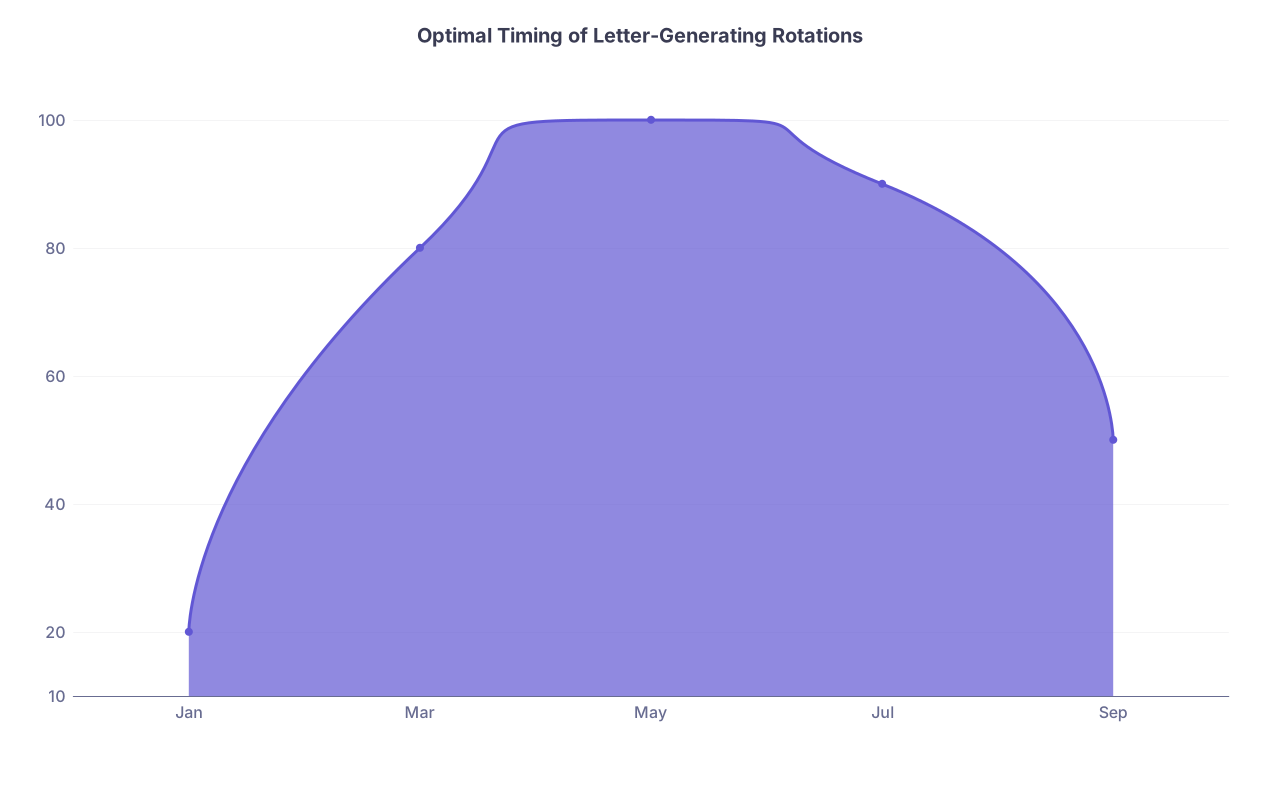
| Category | Value |
|---|---|
| Jan | 20 |
| Mar | 80 |
| May | 100 |
| Jul | 90 |
| Sep | 50 |
Interpretation: likelihood of getting a detailed, fresh letter peaks when the rotation ends 1–3 months before ERAS submission. Earlier or much later, letter quality tends to decay.
If your dream attending rotation is in November of 4th year, that letter is nearly useless for your initial application. You can sometimes add it later, but it will not influence early interview decisions.
Step 8: Use Away Rotations Intelligently (Not Desperately)
Away rotations are not tourist trips. They are month‑long interviews. And they are fertile—and dangerous—ground for letters.
An away letter is high‑yield if:
- The program is realistic for you on paper (scores, class rank, etc.).
- The writer is known in the field or clearly respected locally.
- You had sustained, close contact.
- You did not simply “survive” the month; you impressed.
An away letter is high‑risk if:
- You go to an ultra‑competitive place where you are one of ten rotators and no one really sees you.
- You land on a malignant service and just try to stay invisible.
- You have mediocre or inconsistent performance and still ask for a letter.
Be selective. One powerful away letter where someone writes, “We would be delighted to have her in our program,” is worth more than three “fine” ones from name‑brand places.
Step 9: Special Cases and Tough Realities
What if your home department is weak or disorganized?
You compensate by:
- Identifying one or two faculty who actually teach and mentor, even if they are not the chair.
- Doing an early away rotation at a well‑organized academic program and getting a letter there.
- Using a research mentor in the field who knows you well and can speak to your specialty commitment.
A well‑written letter from a mid‑tier but teaching‑oriented faculty often beats a lazy two‑paragraph note from a famous name.
What if you rotated but underperformed?
If you know you were inconsistent, late, or disengaged at times, do not ask that attending for a letter. Period. Letters are durable. One lukewarm or subtly negative letter can sink an otherwise solid application.
Instead:
- Fix the behavioral issues.
- Seek out a different rotation where you can be intentional from day one.
- Be honest with yourself about fit for the specialty if this is a pattern.
What about non‑specialty letters?
One non‑specialty letter can be powerful if:
- It shows something missing elsewhere—leadership, resilience, longitudinal growth.
- The writer clearly knows you better than any other clinician.
For example, a medicine‑bound student with a stellar letter from a palliative care attending describing communication skills and professionalism. Or an ortho applicant with a passionate letter from a trauma surgery attending on work ethic in the OR.
But do not stack your file with letters from random specialties “just because they offered.”
Step 10: How You Know Your Engineering Worked
When a letter has been properly engineered through targeted clerkships and intentional relationship‑building, it reads differently. You will not see it (usually), but you will hear about it.
Common signals:
- Programs mention specific letter content on interview day.
“Your sub‑I attending spoke very highly of your ability to function like an intern on a busy service.” - People you barely know in the department greet you with, “I have heard good things about you from Dr. X.”
- You are getting interviews above your Step score / school tier.
Under the hood, those letters probably contain:
- Clear comparative language (“among the top 5% of students I have worked with”).
- Specific cases (“managed a complex decompensated cirrhosis patient with minimal supervision”).
- Growth arc (“over the month she grew from… to…”).
- Explicit endorsement (“I recommend him without reservation”).
You cannot force a faculty member to write that. But you can give them every opportunity to see you in a way that makes such statements honest.
That is what you have been engineering.
Practical Example: Engineering a Letter on an IM Sub‑I
Let me spell out what this looks like on the ground.
You are a rising M4, IM‑bound, planning a July general medicine sub‑I with Dr. Patel, a known educator and associate PD.
Week 0 (before rotation):
You email: “I am very interested in academic internal medicine and using this sub‑I to prepare for intern year. I would really value your feedback as we go—especially on how I can function closer to an intern level by the end of the month.”
Week 1:
You show up 30 minutes early, know every patient cold. After rounds you ask: “If you had to pick two things that make a sub‑I stand out, what are they?” She says: “Clear, efficient presentations and truly owning your patients.” You focus there.
Week 2:
You ask: “If you wrote my evaluation today, how would you describe me?” She says: “Strong knowledge base, but you can be a bit long‑winded in presentations.” You deliberately tighten. By the end of week 2, your one‑liners are crisp, plans clear.
Week 3:
You take overnight call, handle cross‑cover pages with composure, and present succinct sign‑outs. You call families daily on your sickest patient and document goals‑of‑care discussions thoroughly.
End of Week 4:
You schedule a sit‑down. She says: “You really progressed. By the end you were functioning at an intern level on several patients.” You then ask: “Would you feel comfortable writing a strong letter for my internal medicine residency applications?” She smiles: “Yes, absolutely.”
Within three days you send:
- Your CV.
- A one‑pager reminding her of:
- Her own words (“functioning at an intern level”).
- The cirrhosis patient you managed.
- The improvement in your presentation style.
Three months later, PDs are quoting her letter back to you on interview day.
That is not luck. That is engineered.
FAQs
1. How many “engineered” letter‑generating rotations do I really need?
For most students, you need 2–3 carefully chosen rotations where your primary objective is to earn a high‑impact letter: usually your home specialty rotation, a sub‑I, and (if your specialty uses them) one away/audition rotation. The rest of your schedule can prioritize breadth, interests, or gaps in your training.
2. Is it pushy to mention letters or say “strong letter” to attendings?
No—if you do it respectfully and at the right time. Faculty are used to being asked for letters. What they are not used to is students being direct and professional about whether the letter will be enthusiastic. Framing it as, “Do you feel you know me well enough to write a strong letter?” gives them an honorable way to decline if needed.
3. Can a research mentor’s letter substitute for a clinical letter?
It can supplement, but usually not substitute, especially in procedure‑heavy or acute care specialties. A research PI who is clinically active in your field and has seen you work on the wards is ideal. A pure bench PI who has never watched you with a patient can write about your intellect and persistence, but PDs still want at least 2 letters describing your actual clinical performance.
4. What if my best clinical experiences were early in 3rd year—are those letters too old?
Not automatically. A stellar letter from an early 3rd‑year rotation can still be useful if the writer remembers you and updates the letter. You can re‑engage that attending with an email, a brief update on your progress, and ask if they would be willing to write or refresh a letter based on their experience with you. But you should still prioritize at least one recent (late 3rd or early 4th year) letter that reflects your current level.
You now have the blueprint: identify what your specialty values, choose rotations that let those traits be seen, and work deliberately with attendings to turn daily behaviors into narrative evidence.
With that foundation, your letters stop being generic filler and start acting like targeted endorsements. And once your letters are working for you, not against you, you can turn your attention to the next battlefield in this process: crafting an application that tells one coherent, irresistible story. But that is a story for another day.


