

The smartest applicants stop hiding from hard rotations and start weaponizing them.
If you use ICU and night float electives correctly, they do two things simultaneously: they develop real clinical skill, and they broadcast “grit” to program directors in a way that personal statements never will. A tired attending glancing at your schedule and reading two lines of narrative from your ICU eval will believe that more than three paragraphs of “I am hardworking and resilient.”
Let me break this down specifically.
Why ICU and Night Float Scream “Grit” to Program Directors
Program directors are not subtle about this. On Zoom rank meetings I have heard variations of:
- “She did a sub-I on nights and still got strong comments. She can probably survive our q4 call.”
- “This guy only did the easiest electives and his ICU eval mentions ‘struggled with stress.’ Hard pass.”
- “Her medicine ICU was at [high-volume county hospital] and the attending wrote ‘I would take her as an intern tomorrow.’ That matters.”
They are watching for three things that ICU and night float showcase perfectly:
- Can you function when you are tired and stressed.
- Can you manage acutely sick patients without emotionally fracturing.
- Do attendings and senior residents trust you when things get ugly.
You do not prove those with a dermatology elective.
ICU and night float rotations are sharpened tools. Used well, they cut through noise in your application. Used poorly, they expose cracks. The point is not just “take ICU.” It is: pick the right type of ICU and night float, at the right time, with the right strategy, and then extract explicit, written evidence of grit that ends up in letters and MSPE comments.
Understanding the Landscape: Types of ICU and Night Float Rotations
Not all ICU and night experiences are created equal. Program directors know this.
Common ICU Electives (and what they signal)
| Rotation Type | Grit Signal Strength | Typical Match Impact |
|---|---|---|
| Medical ICU (MICU) | Very High | IM, EM, Anesthesia |
| Surgical ICU (SICU) | High | Surgery, Anesthesia |
| Neuro ICU | Moderate–High | Neuro, IM, EM |
| Cardiac ICU / CCU | Moderate | Cards interest, IM |
| Step-down / Progressive | Moderate | Context-dependent |
Medical ICU at a busy academic center or county hospital is the flagship. Heavy admissions, constant codes, ventilators, pressors, endless labs. If you perform well here, it is method-acting for intern year.
Surgical ICU and trauma ICU also read as “grit-heavy,” but they sometimes emphasize procedure volume and operative culture more than longitudinal daily management. Still very good signals, particularly for surgery, anesthesia, EM.
Neuro ICU, CCU, and step-down can all help, but you and I both know: if your ICU exposure is only “Neuro ICU (private hospital, light census)” and nothing else, no one is giving you extra credit for suffering.
Night Float: Student vs Sub-I vs Intern-level Systems
You need to differentiate three patterns:
Student Night Float Elective
Often a 2–4 week elective, usually “paired” with a night resident. Less responsibility, but if the culture is right, you can still take first call for cross-cover, write notes, and manage pages with supervision.Night Component of a Sub-Internship
The most valuable. You are on the official cross-cover list. Nurses call you first. You staff with a resident or nocturnist but you are the one answering the phone and walking to the bedside. Program directors love this if you perform.Token Night Shifts on Day Rotations
Some schools add one or two “exposure” nights. These do not count as “night float” in the mind of a PD. Helpful for you personally, but do not try to sell this as proof of grit. They will see right through it.
Your goal: have at least one rotation where you can honestly say, “I was the first person called overnight for multiple patients, handled pages, triaged issues, and escalated appropriately, and this is reflected in my evaluations.”
When to Schedule These Rotations for Maximum Match Impact
Timing can make or break how much value you actually harvest from these rotations.
Core principles
- Letters and narrative comments must be ready before ERAS locks in.
- You need enough baseline skill not to drown.
- But not so late that nobody can vouch for you in writing.
For most U.S. MD and DO students applying in a semi-competitive field, the sweet spot:
- First serious ICU rotation: late M3 or early M4
- Grit-showcasing ICU/night float for letters: between May and August of the application year
A concrete timeline example
You are an internal medicine–bound student, applying in September:
- Jan–Mar M3: Core medicine inpatient
- Apr–Jun M3: Surgery, OB, peds
- Jul–Aug M3: Electives; a light consult elective here is fine
- Sep–Oct M3: Medicine ICU rotation (first exposure)
- Feb–Apr M4: Sub-I in medicine, days
- May–Jun M4: MICU or SICU with clear plan for a letter
- Jul–Aug M4: Medicine night float sub-I at your home or away program
By September, your ERAS has:
- A MICU or SICU attending letter explicitly referencing your resiliency and performance in critical situations
- A sub-I or night float letter describing you functioning as “intern-equivalent at night”
That combination is enormously powerful for IM, EM, anesthesia, even psych if you frame it correctly.
If you back-load ICU to October–November of M4, you get experience, but not narrative visibility for the Match.
How ICU Rotations Create Concrete Evidence of Grit
“Grit” is a vague term. Program directors are not looking for you to say “I am gritty.” They want very specific behaviors, under pressure, described by other people.
Here is what ICU can show, if you engineer it.
1. Staying effective under cognitive overload
ICU is weaponized cognitive load:
- 10–14 patients, each on ventilators, pressors, multiple drips
- Labs dropping at all hours
- Conflicting data: lactate up, but urine output fine; family demands escalation; surgeon wants fluids, intensivist wants pressors
Your job as a student:
- Know “your” patients cold: vents, drips, last lactate, last ABG, cultures, antibiotics day, sedation strategy
- Anticipate morning rounds: already looked up overnight vitals trends, new imaging, culture results
- Handle endless “mental tab-switching” without getting flustered
You want comments in your evaluation like:
- “Handled a heavy census without losing track of details.”
- “Remained calm and organized when three patients deteriorated simultaneously.”
That is how grit shows up on paper.
2. Tolerance of emotional intensity
ICU is also concentrated emotional trauma:
- Families begging for miracles
- Young patients dying on ECMO
- Nurses crying after a failed code
I have seen this pattern repeat: some students intellectually excel but crumble emotionally. They cannot function after a death. Or they disappear when families get angry. Program directors know this because ICU attendings write comments like, “Seemed overwhelmed when multiple patients declined; needed frequent breaks.”
Your goal is not to be emotionally numb. It is to:
- Be present and compassionate without disintegrating
- Still write notes, place orders (under supervision), call consults, even after a code
- Seek debriefs and support in a proactive, adult way rather than melting down or vanishing
Helpful phrases that often show up in strong evals:
- “Demonstrated maturity and emotional resilience”
- “Provided calm, steady presence for families during end of life discussions”
You want those.
3. Ownership in a brutal environment
ICU is the opposite of passive observation. The best students:
- Come in early, leave late, and no one has to ask them
- Pre-round thoroughly: real assessment and plan, not “we will follow labs” laziness
- Speak up on rounds with a coherent, ICU-appropriate plan
If you want to stand out as gritty:
- Volunteer for high-stress tasks with supervision: running to the bedside for a decompensation, pulling initial labs, calling the family after a major change
- Ask to write the first draft of death notes or code notes. Ugly but memorable.
- Offer to help co-manage the sickest patient, not just the easy post-op pneumonia
This creates the kind of memory that makes attendings tell PDs later, “She leaned into the hard work. She did not hide.”
Night Float: The Purest Stress Test You Will Get Before Intern Year
Night float is where bravado dies. There is no hiding in a quiet workroom with a latte and UpToDate. It is:
- Two to three residents
- One nocturnist or night attending
- Dozens of cross-cover patients
- Admissions stacking up
- 200+ pages some nights
This is where you can show, in vivid detail, that you do not panic.
What “grit” looks like on night float
You pick up the pager without reluctance.
Everyone is tired at 3 a.m. Gritty students say, “I will go see 604-B while you place orders on the new admit.” Non-gritty ones stare at the floor.You develop a disciplined approach to cross-cover pages.
Instead of flailing, you run a tight script:- Clarify the concern
- Identify vital trends
- Decide: bedside now vs orders vs watchful waiting
- Call your senior early if you are uneasy
You keep your temper when systems fail.
Labs delayed. Transport never shows up. CT scanner down. This is fertile ground for complaining, victimhood, and eye-rolling. Program directors hear comments like “became negative and cynical on nights.” That is lethal.
What you want written instead: “Even on busy nights, maintained a positive, team-oriented attitude and continued to volunteer for tasks.”
Common ways students sabotage “grit” on night float
I have watched this too many times:
Hiding in the workroom.
You chart, you read, but every time there is a new call or admission, you are suddenly “finishing something.” Everyone sees this.Being visibly resentful of work.
Sighing when a new admission hits at 5:30 a.m., complaining about not getting “protected sleep.” You think you are being honest; what they hear is “this person will be a nightmare intern.”Melting down after one bad night.
You are allowed to be exhausted. But if the senior spends an hour calming you down after a rough code, that will end up, in some form, in their impression of you. Do your breakdown in private, after shift, with someone you trust. On the job, be functional.
Night float can absolutely make your application. It can also quietly kill it. The difference is how visibly you shoulder the load.
Choosing ICU and Night Float Rotations Strategically by Specialty
Different specialties extract different signals from these rotations. Let’s be brutally specific.
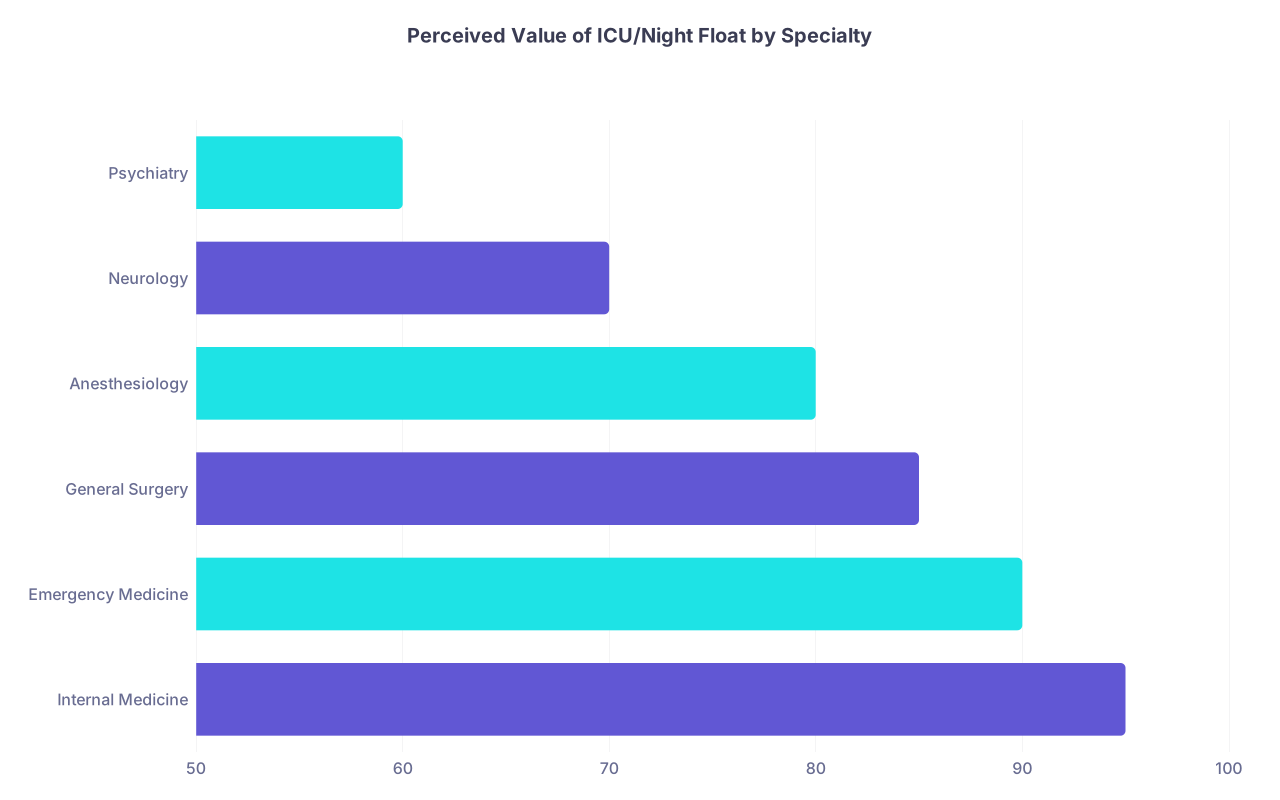
| Category | Value |
|---|---|
| Internal Medicine | 95 |
| Emergency Medicine | 90 |
| General Surgery | 85 |
| Anesthesiology | 80 |
| Neurology | 70 |
| Psychiatry | 60 |
Internal Medicine
ICU and medicine night float are nearly pure gold.
What IM PDs want to see:
- You have seen real decompensation: septic shock, DKA, GI bleeds, ARDS
- You can manage cross-cover chaos at 2 a.m. under supervision
- Your letters use words like “intern-ready,” “handles high workload,” “critical care mindset”
Suggested structure:
- MICU elective or acting internship at your home or a well-known IM program
- Medicine night float sub-I where you are explicitly functioning as first-call for pages
Frame it in your application as: “I sought MICU and night float experiences to stress-test myself in environments that mirror intern year, and to develop disciplined approaches to decompensation and cross-cover.”
Emergency Medicine
EM directors care about ICU and nights because they approximate ED chaos in a different setting.
Particularly valuable:
- MICU with high ED-to-ICU flow, so you see resuscitation and transitions of care
- Night float where you help with rapid response calls and admissions from the ED
Your letters should highlight:
- Comfort with unstable patients and codes
- Ability to quickly prioritize among multiple sick patients
- Emotional steadiness in resuscitation scenarios
You do not need three ICUs. One strong MICU plus a well-run EM sub-I with nights often suffices. But if your Step/COMLEX is marginal, a stellar MICU letter that screams maturity and work ethic can compensate.
General Surgery
Surgery values SICU/trauma ICU and true night float on surgical services.
What stands out:
- Trauma activations, ex-laps gone bad, septic post-ops
- Willingness to stay late to help with late-night consults and OR cases
- Zero complaining when a “post-call” day evaporates because someone else called out
You want comments like: “Operated with the stamina of a junior resident; never hesitated to take on additional work overnight.”
One warning: some surgical ICUs are extremely resident-focused with limited student autonomy. Choose sites where students can write notes, present on rounds, and follow patients longitudinally, not just shadow procedures.
Anesthesiology
Anesthesia loves ICU because it shows you have seen:
- Ventilator modes
- Sedation/analgesia debates
- Hemodynamic management
Pair MICU or SICU with:
- A solid anesthesia elective
- Ideally, night call with OB anesthesia or trauma rooms
In your personal statement, you can concretely say: “My MICU month, followed by overnight OB anesthesia call, gave me repeated exposure to airway crises and hemodynamic instability and confirmed that I want a career managing these high-stakes moments.”
That is specific, credible grit.
Neurology / Psychiatry
You are not required to do ICU, but it can help in two ways:
- For neurology: Neuro ICU shows you have seen stroke codes, status epilepticus, neuro exams on vented patients.
- For psychiatry: Night float with delirium, agitation, and medically complex psych patients shows you can manage behavioral crises in medically sick people.
You frame it differently:
- Emphasize your tolerance of high-acuity stress and your ability to maintain rapport and clear thinking in chaotic settings, not your love of managing pressors.
Extracting Grit into Letters and Narrative Evaluations
Rotations do not speak for themselves. You have to actively convert your ICU and night float performance into documented evidence.
Step 1: Make your grit visible to the right people
Identify early who actually writes the evaluations:
- ICU attending(s)
- Senior resident(s) whose narrative may be solicited
- Night float supervising attending or nocturnist
Then, over the first week:
- Tell them explicitly: “I am applying in X. I chose this rotation because I want to push myself in high-acuity environments and grow. I would really value any feedback on how I am handling the workload and stress.”
- Translate: “Watch how I behave under pressure; I care about this.”
Then you behave accordingly.
Step 2: Ask for feedback with a grit lens
Mid-rotation, ask:
- “How do you feel I am handling busier days?”
- “Do you see areas where I could improve in managing stress or juggling multiple tasks?”
- “If I were an intern on this service, what worries would you have?”
You then fix the issues. And you signal that you take resilience and reliability seriously, not just test scores.
Step 3: Request letters strategically
If, by the last 3–5 days, you are getting clear positive feedback:
- Ask the attending directly: “Would you feel comfortable writing me a strong letter of recommendation for [specialty], specifically reflecting on how I functioned in the ICU/on nights and handled difficult situations?”
Key words: “strong letter,” “specifically reflecting on.” This invites them to anchor on grit-related anecdotes.
You can then subtly prime them with a short email later summarizing:
- Number of sick patients you routinely followed
- Specific tough scenarios you handled (without embellishment)
- Any quotes they gave you like “you are functioning at intern level”
You are not writing the letter for them. You are resurfacing the evidence they already saw.
Framing ICU and Night Float in Your ERAS and Interviews
Do not let all that suffering stay invisible.
ERAS experiences section
Under an ICU elective, your description should not be:
“Cared for critically ill patients, presented on rounds, participated in procedures.”
No one cares. Show grit and responsibility:
- “Managed daily care for 4–6 ventilated patients including titration discussions for pressors, sedation and fluid strategy; frequently first at bedside for overnight decompensations.”
- “Acted as intern-equivalent on night float, fielding initial cross-cover calls, performing bedside assessments, and escalating to residents and attendings for rapidly decompensating patients.”
Be precise but not theatrical. You are painting a workload picture.
Personal statement
You get only one or two ICU/night examples. Make them count.
Wrong approach:
- “My ICU month taught me the importance of teamwork, resilience, and communication.”
Right approach:
- “On my third night in the MICU, we had three simultaneous rapid responses from the floor. My resident handed me the pager and said, ‘You are primary on 6B.’ I remember my heart rate spiking as I walked down the hall, but I also remember working through the same simple structure we had practiced all week: airway, breathing, circulation, brief neuro, call for help early. The patient was in florid pulmonary edema. By the time the attending arrived, we had already started noninvasive ventilation, obtained the stat EKG, and drawn labs. What I took from that night was not a love of adrenaline. It was the realization that disciplined habits and calm thinking can be built and preserved under stress. That is the physician I am working to become.”
Notice: specific, unromantic, focused on process and growth.
Interviews
You will be asked some version of:
- “Tell me about a stressful situation you managed on the wards.”
- “Tell me about a time you were overwhelmed and how you handled it.”
- “What rotations challenged you the most?”
You should have 2–3 polished, honest ICU/night stories that:
- Start with a brief situation
- Focus on what you did, how you felt, what you changed afterwards
- End with how it shapes your readiness for intern year, not how “heroic” you are
Avoid drama-vomiting (“This one time seven people coded at once and I saved them all”). You are not the protagonist. The story is about your reliability and growth under pressure.
Avoiding Burnout and Backfire: Grit Without Self-Destruction
There is a line between demonstrating grit and glorifying self-harm. Smart program directors recognize that the “I never slept and loved it” persona is a liability.
Use ICU and nights to show:
- You can function when sleep-deprived, yes
- But you also recognize your limits, ask for help early, and practice basic self-care
That looks like:
- Owning your schedule: on nights, you do not stack 3 other high-intensity electives before and after with zero break.
- Taking your post-call time seriously: sleep, basic nutrition, short breaks.
- Being honest with your seniors: “I am safe to work, but I am feeling stretched; can we prioritize this list together so I do not miss something important?”
If you present yourself as a martyr who thrives only on chaos, good programs will be wary. They want resilient, not reckless.
Putting It All Together
You are not doing ICU and night float because some advisor told you to “show interest.” You are doing them to produce concrete, checkable outcomes:
- At least one letter that explicitly describes you handling high acuity and heavy workload well.
- MSPE or evaluation language that uses key phrases: “intern-level,” “handles stress calmly,” “reliable under pressure.”
- ERAS experiences and interview stories that show, not tell, that you can manage real clinical responsibility when conditions are bad.
That combination makes your application read very differently from the hundreds of “hardworking, compassionate team player” clones.
You now understand how to weaponize ICU and night float rotations to demonstrate actual grit. The next move is choosing where to do them—home vs away, community vs academic, county vs private—and how to align that with your target programs’ cultures and expectations. That is the next layer of strategy. And that is a conversation for another day.

| Step | Description |
|---|---|
| Step 1 | Plan Specialty Target |
| Step 2 | Schedule Core ICU Late M3 or Early M4 |
| Step 3 | Identify High-Yield ICU Site |
| Step 4 | Perform and Seek Feedback |
| Step 5 | Secure Strong ICU Letter |
| Step 6 | Add Night Float SubI if Possible |
| Step 7 | Extract Grit Stories for ERAS |
| Step 8 | Highlight in Personal Statement and Interviews |
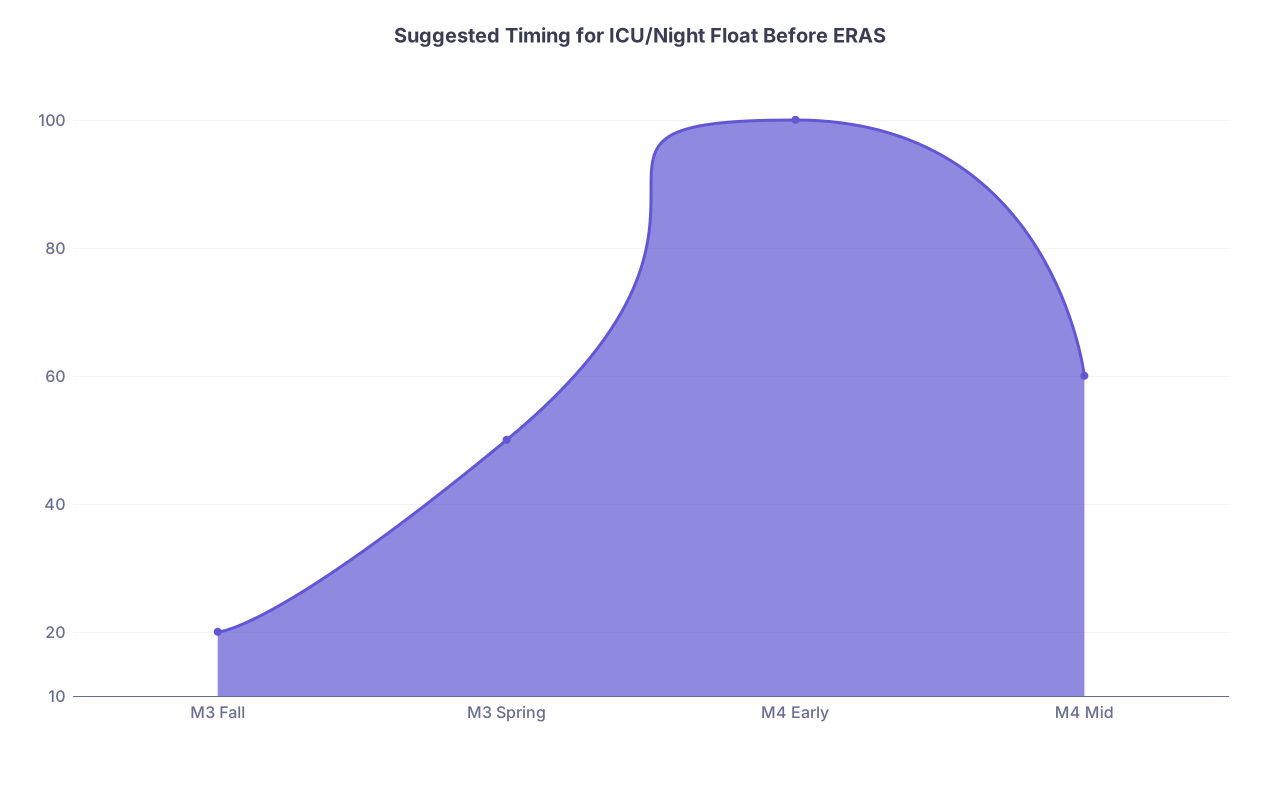
| Category | Value |
|---|---|
| M3 Fall | 20 |
| M3 Spring | 50 |
| M4 Early | 100 |
| M4 Mid | 60 |


