

It is late October of your fourth year. ERAS is in. You are staring at your MSPE draft and those mysterious “summative comments” pulled from clerkship evaluations. Admissions committees are going to read every line of that section. You, meanwhile, are trying to figure out:
Do these phrases scream “rock star” or “solid but forgettable”?
Let me break this down specifically: the language used in clerkship comments is not random. It is coded. Faculty and clerkship directors know exactly what they are doing when they choose “solid” versus “exceptional,” “pleasant” versus “indispensable.” PDs know it too.
You need to understand that code.
1. How Programs Actually Use Clerkship Comments
Here is the reality behind closed doors.
On a busy rank meeting, a PD or APD pulls up your application. Three things usually get skimmed side by side:
- MSPE (especially the clerkship comment composites)
- Transcript (honors / HP distribution)
- Letters of recommendation
Nobody is reading every narrative word-by-word for 200 applicants. But they scan for signal phrases. Certain words and constructions make the room perk up. Others function like a quiet warning siren.
Programs lean on clerkship comments for three big reasons:
- They are seen as more “standardized” than individual letters.
- They give a longitudinal pattern across specialties.
- They are harder to game than a single glowing letter from your mentor.
So when a PD says: “Read me the comments from Medicine and Surgery,” they are not asking for your shelf scores. They want to hear the adjectives. The comparisons. The “among the best”–type language.
2. The Translation Key: What Different Tiers of Comments Actually Mean
Let’s be very direct. Faculty use a pretty consistent hierarchy of praise. The exact phrasing varies, but the structure is predictable.
A. True Top‑Tier: “Write This Person An Interview”
These are the phrases that mark you as a top‑tier applicant. They usually include:
Explicit ranking against peers
- “Among the best students I have worked with in the past several years.”
- “Top 5% of students at their level.”
- “One of the strongest students I have supervised.”
Language of indispensability or near-intern level
- “Functioned at the level of an intern.”
- “Indispensable member of the team.”
- “We treated them like a subintern by the end of the rotation.”
Strong anticipatory endorsements
- “I would be delighted to have them as a resident in our program.”
- “Will be an outstanding resident and future leader.”
- “I give my highest possible recommendation.”
Multiple domains highlighted (not just ‘nice to have around’)
Usually you see a cluster: clinical reasoning + work ethic + team skills + professionalism.
Examples of composite top-tier phrases you might see in MSPE summaries:
- “One of the best students rotating on our service this year; demonstrated excellent clinical reasoning, ownership of patient care, and consistently functioned at or above the expected level.”
- “Stood out as a top performer; quickly integrated into the team, independently gathered data, formulated accurate assessments, and was a role model for peers.”
When a PD sees that style of comment repeating across core clerkships, you are firmly in the “this person will succeed anywhere” bucket.
| Signal Type | Example Phrase |
|---|---|
| Comparative ranking | "Top 5% of students I have worked with" |
| Near-intern function | "Functioned at the level of an intern" |
| Indispensability | "Indispensable member of the team" |
| Future projection | "Outstanding future resident and leader" |
| Global endorsement | "My highest recommendation without reservation" |
B. Strong But Not Elite: “Definitely Interview, Maybe Not First On The List”
These are very good comments. Many matched residents have mostly this tier with one or two top-tier standouts.
Common features:
Positive but not superlative comparisons
- “One of the stronger students on this rotation.”
- “Consistently performed above expectations.”
- “Exceeded expectations for their level of training.”
Clear strengths, but not framed as rare
- “Hardworking and reliable member of the team.”
- “Developed strong rapport with patients.”
- “Demonstrated solid clinical reasoning and growth.”
Some comparative context, but not top‑5‑percent language
- “Performed at the level of an advanced third-year student.”
- “Comparable to our strongest students.”
Endorsement without the “highest” or “without reservation” qualifiers
- “I recommend them highly for residency training.”
- “Will be a very good resident.”
On committee, this translates to: good, safe, likely to succeed. Not necessarily the “we will regret it if we lose them” group, but absolutely worth ranking solidly.
C. The Faint Praise Zone: “Fine, But Probably Middle Of The Pack”
This is where students get blindsided. They think these comments are positive. PDs read them and think: average. Replaceable.
Classic faint-praise phrases include:
Vague but nice-sounding adjectives
- “Pleasant to work with.”
- “Well liked by patients and staff.”
- “Conscientious and dependable.”
Description of basic expectations as if they are strengths
- “Arrived on time and was prepared for rounds.”
- “Completed all assigned tasks.”
- “Accepted feedback appropriately.”
Absence of comparative language
No “among the best,” no “top,” no “strongest,” no “stood out.”Overemphasis on personality without performance
- “Always had a positive attitude.”
- “Very nice and polite.”
These students usually did not cause problems. But they also did not stand out. On rank lists, they are solid mid or lower unless something else in the application is exceptional.
D. The Soft Red Flag: “We Are Subtly Telling You There Was A Problem”
Not every red flag uses the word “unprofessional.” Faculty are more subtle than that, especially in MSPE summaries.
Phrases that should make you nervous:
“With support” or “with guidance” constructions
- “With close supervision, was able to complete assigned tasks.”
- “With guidance, demonstrated improvement in clinical reasoning.”
- “With frequent feedback, met expectations.”
Growth framed as rescue
- “After initial difficulty, eventually met expectations.”
- “Showed improvement following several discussions about time management.”
Qualified positives
- “When prepared, could give an adequate presentation.”
- “When prompted, participated appropriately in patient care.”
Mentions of missed basics
- “Occasionally required reminders about deadlines and follow-through.”
- “At times struggled to complete documentation in a timely manner.”
On the PD side, these comments will get discussed. They may not sink you alone, but in a competitive pool, they matter.
3. Domain‑Specific Phrases: What Different Strengths Look Like On Paper
Top-tier comments usually hit multiple domains. Let me break the main ones down and show you what the “gold standard” phrasing looks like versus the generic stuff.
A. Clinical Reasoning and Knowledge
This is the backbone. If PDs hear nothing else, they want to know: does this student think well?
Top-tier clinical reasoning language:
- “Consistently developed accurate and prioritized problem lists and plans.”
- “Integrated data from history, exam, and diagnostics to formulate sophisticated differentials.”
- “Anticipated next steps in management and adjusted plans appropriately as new information emerged.”
- “Demonstrated clinical judgment beyond the expected level of training.”
Mid-tier / generic:
- “Demonstrated growing knowledge base.”
- “Understands common conditions.”
- “Can formulate basic assessments and plans with supervision.”
If an evaluator reviews you as “very personable, great with patients” but says nothing about your reasoning, that is not a win. That is a gap.
B. Work Ethic and Ownership
Call it “grit,” call it “initiative,” this is what teams remember on busy services.
Top-tier phrases:
- “Took full ownership of her patients, following up on results and updating the team without prompting.”
- “Frequently stayed late to ensure all tasks were completed and patient questions were addressed.”
- “Volunteered to help with admissions and cross-coverage beyond required duties.”
Program directors interpret these as: this person will not vanish at 3:59 pm, and they will not “just be a student.”
Middle of the road:
- “Completed all assigned work.”
- “Reliable in performing tasks given by the team.”
- “Came in on time and stayed until work was done.”
The difference is initiative and anticipation versus simple compliance.
C. Teamwork and Communication
This domain can save you or sink you. Residents and nurses are not shy about reporting problem students.
Top-tier language:
- “Quickly became a trusted member of the team.”
- “Communicated clearly and respectfully with nurses, residents, and attending physicians.”
- “Freely shared information and ensured that everyone was up to date on patient care.”
- “Frequently helped peers and junior learners understand patient cases and workflow.”
Faint praise / problematic phrasing:
- “Got along with most team members.”
- “Interactions with staff were generally appropriate.”
- “Sometimes needed reminders about communication expectations.”
The word “most” or “generally” in an evaluation is doing a lot of quiet work. PDs notice.
D. Professionalism
Red flags in professionalism will stop an application cold. Positive comments here are powerful, but negative or hedged language is lethal.
Top-tier professionalism:
- “Impeccable professionalism; consistently respectful, honest, and reliable.”
- “Handled difficult situations with maturity and composure.”
- “Responded to feedback with reflection and rapid improvement.”
- “Role model of professionalism for peers.”
Coded concerns:
- “After feedback, demonstrated some improvement in punctuality.”
- “Was receptive to feedback about professional expectations.”
- “Ultimately met expectations for professionalism.”
“Ultimately met expectations” is not a compliment. That is a warning that there was a problem getting there.
E. Teaching and Leadership
This is where you differentiate from the pack. Especially important if you are going into academic or competitive specialties.
Top-tier language:
- “Natural leader; informally led the team’s organization and teaching.”
- “Frequently offered to orient new students and help them adjust to the service.”
- “Delivered clear and concise presentations that added value to rounds.”
Generic:
- “Participated in teaching when asked.”
- “Gave a few short presentations.”
Those are fine. They do not move you into the memorable category.
4. Example: Side‑By‑Side Comment Translation
Let me show you how small differences in phrasing change the entire signal.
| Version | Sample Comment Snippet |
|---|---|
| Top‑tier | "Among the best students I have worked with; functioned at an intern level, took ownership of patients, and demonstrated clinical reasoning beyond expectations." |
| Strong but not elite | "Performed above expectations; was a reliable team member, had strong fund of knowledge, and consistently completed assigned tasks." |
| Faint praise | "Pleasant and easy to work with; completed all required duties and showed improvement throughout the rotation." |
| Soft red flag | "With guidance, was able to meet expectations; required reminders about timeliness and follow-through early in the rotation." |
On a rank committee, those four sentences produce four entirely different reactions, even though none of them uses the word “bad.”
5. How These Comments End Up In Your MSPE (And Why Some Students Lose Out)
Here is the part most students do not understand: what you see in the MSPE is usually not the exact evaluation a resident or attending wrote. It is a curated, sometimes sanitized composite.
Typical pipeline:
- Residents / attendings fill out evaluation forms with narrative comments.
- Clerkship admins or directors pull key phrases and summary language.
- The Dean’s office compiles these into a standardized MSPE comment for each clerkship.
- Some schools normalize language to reduce “grade inflation.” Others do not.
So what?
It means three practical things:
- Overly generic evaluators hurt you. If your attendings only ever write “pleasant and hard working,” you will not get those top-tier comparative phrases, even if you deserved them.
- One strong attending who writes, “top 5% of students I have worked with” can anchor the entire composite upward.
- A single professionalism incident, even if “resolved,” often still leaks into the final wording as “ultimately met expectations.”
You cannot fully control who writes what. But you have more influence than you think.
6. Behaviors That Predict Top‑Tier Language
Programs do not hand out “top 5%” lightly. There is a recognizable pattern in the students who consistently get that kind of praise.
I have seen the same profile on Medicine at MGH, Surgery at a busy county hospital, Peds at a midwestern academic center. Very different environments, same signal.
These students typically:
- Show up already having read on their patients and the relevant topics. Not just UWorld explanations, but guidelines or key reviews.
- Ask for responsibility explicitly: “Can I follow two more patients?” “Can I try to write the first draft of the note?”
- Close the loop. If they say, “I will check that MRI result,” the next time the attending hears about it is in a concise update with plan implications.
- Present clearly. No wandering, no fishing for the diagnosis from the attending. They commit to an assessment and defend it.
- Respect the team’s time. They do not ambush residents with long questions during sign‑out or at 4:58 pm. They read on their own and bring targeted, thoughtful questions.
- Avoid creating work for others. Notes are readable. Orders (where allowed) are correct. Handoffs, even as students, are crisp.
And they ask for feedback early enough to act on it. Which leads to the practical part.
7. How To Steer Your Clerkship Comments While You Are Still On The Rotation
You cannot write your own evaluation. But you can shape what is easy for an attending to say about you.
A. Ask Targeted, Not Vague, Feedback
At the end of week one or two, do not ask, “How am I doing?” You will get, “You are doing fine.”
Try this instead:
- “I am really working on my presentations and clinical reasoning. Is there one thing I could change this week that would make me closer to intern level?”
- “I want to be sure I am adding value to the team. Are there tasks or responsibilities you think I am ready to take on more independently?”
You are planting concepts: intern-level, adding value, taking responsibility. When they later sit at their computer to write, those same words echo.
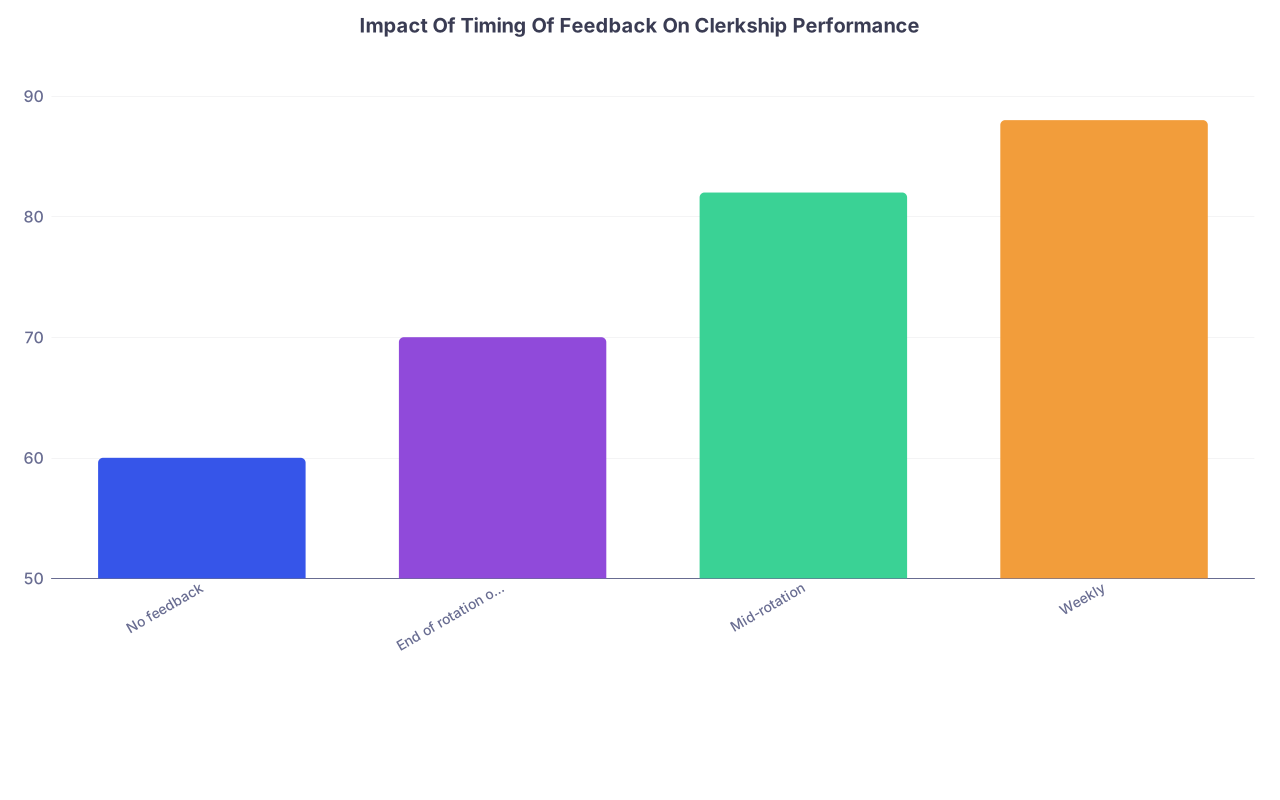
| Category | Value |
|---|---|
| No feedback | 60 |
| End of rotation only | 70 |
| Mid-rotation | 82 |
| Weekly | 88 |
(Think of these numbers as “typical subjective performance scores” out of 100. Students who get and act on feedback mid-rotation or weekly do better. Consistently.)
B. Telegraphed Growth That Becomes A Strength, Not A Liability
There is a difference between:
- “Struggled with presentations but improved after multiple discussions,” and
- “Actively sought feedback and made rapid, noticeable improvements in presentation skills.”
You want the second.
So when you get feedback, verbalize the plan and then execute:
- “Thank you, I will start structuring my assessment with problem-based prioritization and commit to an A/P before looking things up. I would appreciate it if you could tell me in a few days whether you notice a difference.”
You are writing your own narrative: reflective, coachable, rapid improvement.
C. Make Yourself Easy To Praise On Specific Domains
Want phrases like “ownership,” “indispensable,” and “functioned at intern level”? Then do the work that naturally inspires those words:
- For each patient you follow, you know: new labs, imaging, consult recommendations, and overnight events without being asked.
- You volunteer for “annoying but critical” tasks: triaging pages with your resident, calling families, tracking down outside records.
- On a chaotic day, you anticipate: start discharge summaries early, pre-chart, prep patient lists.
A lot of attendings write evaluations in under two minutes. They remember emotional impressions. “This student made my life easier” is the strongest emotional memory you can create.
D. Explicitly Signal Your Career Interest – Strategically
For the clerkships linked to your chosen specialty, you want an extra bump. Attendings are far more likely to write, “We would be lucky to have her in our program,” if they know you actually want that field.
Do not be weird about it. Simple:
- “I am strongly considering Internal Medicine and would love to train in an academic program like this one. If there are extra teaching or patient care opportunities I could take on to grow, please let me know.”
Now they see you as a potential future colleague, not just a transient student.
8. Using Clerkship Comments Strategically In Your Application
By the time you are applying, most of this is baked in. But you are not powerless.
A. Align Your Personal Statement With Your Strongest Themes
If your comments repeatedly say:
- “Takes ownership of patients”
- “Excellent clinical reasoning”
- “Natural teacher”
Then your personal statement should not lean heavily on “I like procedures and fast-paced environments” without touching those strengths.
You want resonance:
- “On every rotation, I found myself gravitating toward understanding the full story of each patient and tracking their progress day by day…”
A PD reading your PS and then your comments should think, “Yes, that matches what we see.”
B. Choose Letter Writers Who Use Strong Comparative Language
You have read your comments. You know who “got” you and who wrote wallpaper.
If you need two Medicine letters and one Surgery, do not pick the “nice guy” attending who wrote, “Pleasant, worked hard, will be a good resident,” when you have a hospitalist who wrote, “One of the strongest students I have worked with this year.”
Letters and MSPE comments that echo each other create a convincing profile.
C. Address Real Problems Directly If Needed
If you have a known soft red flag in a key clerkship, you are often better off addressing it briefly in your MSPE addendum or advisor letter than hoping PDs will not notice.
Something like:
- “During my third-year Medicine clerkship, I struggled initially with time management and prioritization. After structured feedback from my attending, I adopted a new pre-rounding workflow and task-tracking system, which led to significantly improved evaluations on my subsequent rotations.”
Then your later comments need to back that up with language like “organized,” “efficient,” “managed a heavy patient load well.” If they do, many PDs will accept that storyline.

| Step | Description |
|---|---|
| Step 1 | On-rotation behaviors |
| Step 2 | Attending impression |
| Step 3 | Written evaluation |
| Step 4 | Clerkship composite comment |
| Step 5 | MSPE summary |
| Step 6 | Program director impression |
| Step 7 | Interview and rank decision |
That is the whole pipeline. Change the input, and the output changes. But not instantly and not by magic.
FAQ (Exactly 6 Questions)
1. My comments are all “hardworking, pleasant, good team player,” but no “top 5%.” Am I in trouble for matching?
Not necessarily. Many students match with that profile, especially in less competitive specialties or at their home program. It does mean your clerkship narrative is “solid but not distinctive.” You will need other parts of your application (Step 2, strong specialty letters, research, away rotations) to provide the “wow” factor. If your comments are uniformly positive, even if bland, you are far better off than someone with professionalism or performance concerns.
2. How many top‑tier comments do I need to be seen as a top‑tier applicant?
One outstanding comment alone is not enough, but three or more strong, comparative comments across core clerkships (especially Medicine, Surgery, and your target specialty) create a very powerful signal. PDs like patterns. If every rotation says “top student,” you are in the high-priority interview and rank group almost by default, assuming your scores and letters are not discordant.
3. My Surgery clerkship comment mentions I was “quiet” and “could participate more.” Does that hurt if I am going into another specialty?
Yes, a bit, but context matters. A single comment about being quiet or reserved is not fatal, particularly if later rotations describe you as engaged and communicative. If you are applying to a non-surgical specialty and your Medicine/Peds/Psych comments are enthusiastic, most programs will treat the Surgery comment as mild noise. They might wonder about assertiveness, but it will not outweigh a strong pattern elsewhere.
4. Can I ask attendings to use specific phrases in my evaluations?
You should not script their wording. But you can invite the concepts you want. For example: “I am really trying to reach intern-level performance in taking ownership of my patients. If you see opportunities for me to do that better, I would appreciate feedback.” If you then actually perform at that level, many attendings will naturally describe you using similar language like “intern-level” or “took ownership.” That is the ethical way to influence evaluations.
5. What if my school standardizes comments and almost nobody gets ‘top 5%’ language?
Program directors who routinely receive applications from your school know that. They see the pattern over years. In that case, they look for relative distinctions within your school’s system (e.g., “one of the strongest this year” vs “performed at expected level”) and they lean more heavily on your individual letters. Still, even in highly standardized systems, some faculty manage to signal exceptional performance. If you never see any comparative language in any comment, your performance was probably perceived as competent, not outstanding.
6. Is it better to have one hyper-glowing comment and one lukewarm one, or two uniformly ‘good but not great’ comments?
I would pick the mixed profile over two lukewarm ones. A single truly outstanding comment, especially from a core clerkship in your chosen specialty, can anchor a committee’s perception of you. The lukewarm one will be discussed but can be contextualized as a poor fit, bad day, or growth moment, particularly if your timeline and narrative suggest clear improvement. Two “fine” comments, on the other hand, create no hook. Committees remember spikes, not flat lines.
Key takeaways:
- Clerkship comments are coded; phrases like “top 5%,” “intern-level,” and “indispensable” mark you as a top-tier applicant, while vague praise signals average performance.
- Programs care most about patterns across rotations—consistent language about clinical reasoning, ownership, professionalism, and teamwork builds a powerful case.
- You can influence your comments by your on-rotation behavior and how you seek feedback, then use those themes strategically in your letters and personal statement to present a coherent, compelling profile.


