

Most students drift through clerkships collecting evals; the smart ones build a home base and walk out with champions.
Let me be blunt: the residency match does not reward “well‑liked floaters.” It rewards applicants who are clearly owned by a department or team—people for whom attendings will say, without hesitation, “This is one of ours.”
That “ours” is your home base. And if you do not intentionally create it, you will be at the mercy of lukewarm MSPE adjectives and generic “hard‑working, pleasant to work with” comments that program directors skim and forget.
Let me break down how you actually engineer a home base on rotations—and convert it into powerful, specific advocacy for your residency applications.
What a “Home Base” Really Is (And What It Is Not)
A home base is not just “the specialty I like” or “the rotation where I got an Honors.”
A true home base has three components:
- A place – a specific department / service / site where people recognize your name and face.
- People – 2–4 faculty and 1–2 residents or fellows who are willing to go to bat for you.
- Proof – concrete work you have done with them that justifies strong, specific letters and behind‑the‑scenes advocacy.
If you have all three, you have a home base. If you only have one—say, you liked peds and got an Honors—you do not.
You are aiming for something like:
- “He basically became part of our inpatient GI team. We all know him; he was on with us for 4 weeks, then came back for an elective, helped with a QI project, and still drops by to see the fellows. I would rank him in the top 5% of students I have worked with in the last decade.”
That is home base language.
Contrast that with:
- “She was pleasant, hard working, and took good care of patients.”
That is death by blandness.
Why Home Base Matters For the Match
Program directors are not reading your file thinking, “Is this a generic solid applicant?” They are asking:
- Who has actually seen this person work?
- Who is willing to stick their neck out?
- Who is this applicant’s tribe?
Home base feeds into three high‑yield elements of the residency application:
Letters of recommendation (LORs) – Especially for competitive or mid‑tier specialties, the difference between “good” and “decisive” LORs is often one well‑cultivated home department.
MSPE and department summary – Departments that think of you as “theirs” push for you in the summary language, the ordering of comments, and informal conversations with PDs.
Back‑channel communication – Emails, texts, or calls from influential faculty that never appear in ERAS but absolutely influence rank lists.
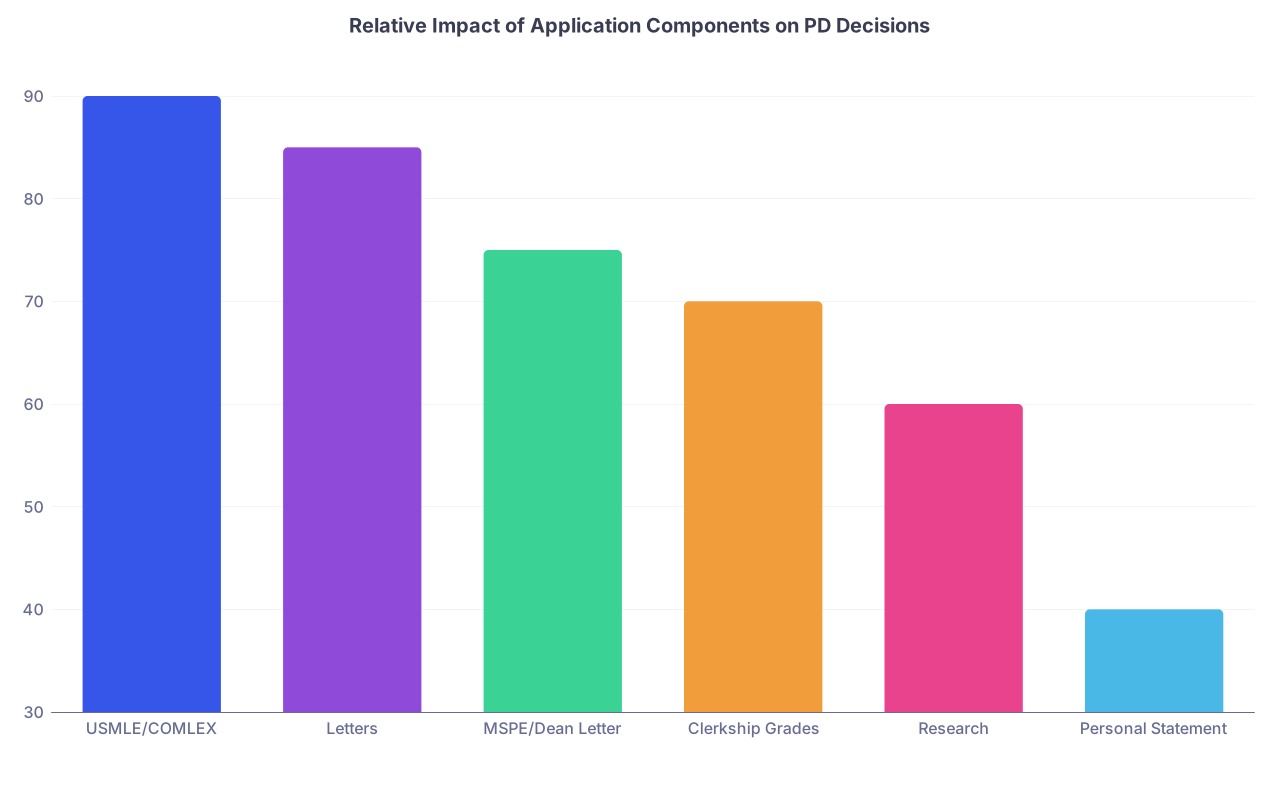
| Category | Value |
|---|---|
| USMLE/COMLEX | 90 |
| Letters | 85 |
| MSPE/Dean Letter | 75 |
| Clerkship Grades | 70 |
| Research | 60 |
| Personal Statement | 40 |
I am not fantasizing these numbers; survey after survey of program directors shows letters and MSPE commentary rival exam scores for importance once you clear basic cutoffs. The home base is where those letters and comments are forged.
Step 1: Identify Where Your Home Base Could Be
You cannot build a home base on every rotation. You are going to have, realistically, one primary and maybe one secondary.
So you need to triage.
Ask yourself, before or early in third year:
- What specialty am I seriously considering?
- Where in my school’s system does that specialty have the strongest internal reputation?
- Where can I realistically get continuity with the same people (not constantly rotating attendings)?
You are looking for alignment between interest + opportunity + continuity.
Examples:
- You want internal medicine. There is the main university hospital and a busy VA site. The VA IM team has more stable attendings, fewer fellows, and students actually present at morning report. That is a fantastic candidate for home base.
- You are leaning OB/Gyn. The labor and delivery service is chaos, new attendings daily, and students constantly shuffled. But the Gyn Onc or High Risk clinic has one or two core faculty who love teaching and see students often. That clinic might be your anchor.
If you are truly undecided, your early home base does not have to match your final specialty. It simply has to generate:
- 1–2 strong, detailed letters
- A reputation as “one of our strongest students this year”
- A department willing to quietly signal, “This person is the real deal,” when PDs reach out
That brand carries, even across specialties.
Step 2: Show Up Differently From Day 1
You cannot ooze into a home base. You declare yourself by how you show up during the first 3–4 days.
Concrete moves:
- Pre‑rotation email to the clerkship site director or key attending
Keep it simple and specific:
- Introduce yourself.
- Express genuine interest in their service.
- Signal that you want feedback and growth, not just a grade.
- Ask if there are any expectations or resources you should review.
You are not begging; you are signaling seriousness and giving them permission to invest in you.
- On day 1, ask about the team’s pain points
During a calm moment, something like:
“I’d like to be as useful as possible while I am here. On this service, what do students do that genuinely helps the team the most?”
You are trying to figure out what this team values: pre‑rounding deeply, writing great notes, patient education, getting discharges out, managing follow‑up, whatever.
Then you lean into those.
- Pick 1–2 focus tasks you will absolutely own
On a given service, this could be:
- On inpatient medicine: rock‑solid prerounds + discharge summaries
- On surgery: thorough pre‑op workups + timely post‑op checks
- On ambulatory: actionable, accurate documentation + patient instructions
Your home base status is not built by “helping a bit with everything.” It is earned by being predictably excellent at things that matter to the team.

Step 3: Turn a Good Rotation Into a Home Base
Many students stop at “I worked hard, got good feedback.” You are aiming for something more deliberate.
Here is how you convert initial goodwill into a real home base.
A. Create continuity with 1–2 key faculty
You need faces and names who can say, “I actually worked closely with this student.”
Once you identify attendings who like teaching and seem positively disposed toward you:
- Ask for mid‑rotation feedback that is actionable
Not “How am I doing?” but:
“If I wanted to be the best student you have had on this service this year, what one or two specific things would I need to improve or change?”
Then you actually change. Rapidly. And visibly.
When you circle back a week later and show you acted on their suggestions, you plant the idea: “This is a high‑ceiling learner I should invest in.”
- Seek small repeat interactions
- Ask to present again at morning report.
- Volunteer for an extra clinic half‑day with them.
- If they staff a continuity clinic, request to be placed there later in the year.
The point is not to become clingy. It is to create 2–3 distinct episodes of them seeing you work, so their eventual letter has depth rather than “I worked with the student for one week and…”
B. Attach yourself to a resident “sponsor”
Students underrate resident advocacy. That is a mistake.
Residents:
- Tell attendings which students are actually useful or just performative.
- Often co‑write or strongly influence evaluations.
- Are future fellows and faculty that PDs may know personally.
Choose well. You want residents who:
- Are respected by attendings.
- Are not so burned out that they hate having students.
- Actually notice clinical work, not just test talk.
Then you do two things:
Ask explicitly for feedback early:
“You have worked with a lot of students. What have the really strong ones done that set them apart on this service?”
Offer to make their life easier in concrete ways:
- Pre‑populate discharge summaries.
- Track down outside records.
- Call families with updates (when appropriate).
- Help follow up on labs/consults.
Residents talk. “This student actually helped us” is a powerful narrative.
Step 4: Build Tangible “Artifacts” of Your Contribution
Abstract impressions are fragile. “I liked that student” fades quickly.
You want artifacts—concrete things you did that stick in faculty memory and give them something to write about.
Examples that work extremely well:
- A mini‑presentation or chalk talk you prepared on a case‑related topic.
- A clearly improved note structure that your attending adopted or praised.
- A discharge or follow‑up process you streamlined.
- A patient/family who specifically singled you out for praise.
- A small QI or educational project you started or contributed to.
The key is not size. The key is specificity and ownership.
Make artifacts easy to remember:
- Email slides or a one‑page handout to your attending after your talk.
- Send a brief follow‑up email summarizing a QI idea you discussed.
- Keep a log of “memorable cases and contributions” with dates and attendings.
This sounds neurotic. It is not. It is how you later jog a letter writer’s memory:
“On your GI inpatient service in April, I presented a short talk on spontaneous bacterial peritonitis and helped develop the new SBP order set checklist with Dr. X and the residents.”
Suddenly their letter has teeth.

| Step | Description |
|---|---|
| Step 1 | Start of Rotation |
| Step 2 | Identify potential home service |
| Step 3 | Engage key faculty |
| Step 4 | Align with team needs |
| Step 5 | Create tangible contributions |
| Step 6 | Seek targeted feedback |
| Step 7 | Return for elective or follow up |
| Step 8 | Request strong letters and advocacy |
Step 5: Lock It In – From “They Know Me” to “They Own Me”
You know you are moving from generic good impression to home base when you see signs like:
- The program coordinator or chief resident recognizes you by name.
- A faculty member references you in front of others (“This is the student I told you about who did that talk on X”).
- You are invited back for conferences, clinics, or small projects.
- Someone explicitly says, “If you apply here, let me know.”
At that point, you do not just smile and walk away. You formalize the connection.
A. Say the quiet part out loud (politely)
Near the end of your time there, with a faculty member who has seen you work well:
“I have really enjoyed working with this team and see this department as my home base here. I am strongly considering applying in [specialty]. If I continue to perform at this level or better, would you feel comfortable supporting me with a strong letter and being an advocate for me when I apply?”
This does three things:
- Forces them to reflect honestly on how strong their support can be.
- Creates clarity that you view them as a central figure in your application story.
- Opens the door for them to say, “Yes, and here is what you should do next.”
If their answer is hesitant, you still learned something valuable. And you can shift your investment elsewhere.
If they are enthusiastic, you now have a real anchor.
B. Return and deepen
If possible, schedule:
- An away‑type elective at the same institution / service.
- A sub‑internship on that team.
- A research or QI block under one of your supporters.
You want at least two separate calendar blocks with this home base. That is how you get:
- “I worked with the student as a third year on wards, then again as a sub‑intern, and mentored them on a QI project.”
This structure sells far better to PDs than a single 4‑week impression.

Translating Home Base Into Letters and Advocacy
Home base without letters is just vibes. You need it to convert into things that live in ERAS and in other people’s emails.
A. The LOR playbook from a home base
When you request letters from home base faculty:
- Remind them of your artifacts and timeline
Your email should include:
- When you worked with them.
- Specific patients or projects.
- Any presentations, initiatives, or feedback you integrated.
- State clearly what you are aiming for
Example:
“I am applying to categorical internal medicine with a strong interest in academic general medicine. I view the inpatient medicine service and your team as my home base here, and I would be honored if you feel you can write a very strong letter on my behalf.”
Notice the phrase “very strong.” It forces them to introspect.
- Offer a short “CV packet”
Not a 10‑page saga. A 1–2 page summary:
- Bullet list of key contributions on their service.
- Updated CV.
- Draft of your personal statement (even if not final).
Letters from home base should:
- Comment on your growth over time.
- Highlight your fit for that specialty’s culture.
- Include a clear ranking statement (“top 5–10% of students I have worked with”).
If your home base letter does not contain at least one ranking / comparison statement, you probably did not leverage the relationship fully.
B. Back‑channel advocacy: how it really works
Here is what actually happens when you have a good home base in a department that likes you:
- You submit ERAS.
- PDs at outside programs see letters from Dr. X and Dr. Y at your home base.
- If those names are known, they get extra weight. If not known, strong content still helps.
- For programs you are particularly serious about, you email your home base advocates and say, “These three programs are my top choices; if you know anyone there, I would be grateful for any advocacy you feel comfortable offering.”
Behind the scenes:
Your faculty mentor may email a PD at another institution:
“We have an excellent student this year, [Name]. Strong clinical reasoning, work ethic, and a great team player. I hope you will take a close look at their application.”
Or they may mention you at a national meeting, or when they chat with former fellows now on faculty elsewhere.
You cannot micromanage this. But you maximize the odds by:
- Being specific about your interests and top programs.
- Giving them enough lead time (early in application season).
- Having already proven that you are worth staking their name on.
Common Failure Modes (And How to Avoid Them)
I have watched students sabotage their home base potential in predictably avoidable ways.
Let me call out a few:
1. Trying to have three or four “primary” homes
Spreading yourself thin across three services where you are “pretty strong” is inferior to having one where you are unmistakably outstanding and known.
Choose. Then commit.
2. Confusing being liked with being advocated for
Residents may enjoy chatting with you, attendings may compliment your personality, but if no one can speak concretely about your clinical growth and contributions, you do not have advocates. You have acquaintances.
Push interactions toward patient care and learning, not just social comfort.
3. Over‑indexing on research at the expense of clinical presence
Research with a department helps, but a PD trying to rank you wants to know:
- Can you carry a patient load?
- Do nurses trust you?
- Do you show up at 6:30 without complaining?
If you are always “stepping out for research stuff,” you risk being labeled uncommitted to daily work. Use research to deepen relationships, not to substitute for them.
4. Never actually saying you want to be “one of theirs”
Faculty are not mind readers. If you never once say, “I see this department as my home base,” they may simply grade you well and move on. You must declare your intention at some point, even if it feels slightly vulnerable.
How This Fits Into Your Overall Match Strategy
Home base is one pillar. But you need to see where it slots into the bigger picture.
| Component | Primary Function |
|---|---|
| Home Base | Strong LORs and advocacy |
| Step 2 / Level 2 | Screening and basic competitiveness |
| Away Rotations | Demonstrate fit at target programs |
| Research | Academic trajectory, niche interests |
| Personal Statement | Narrative and motivation |
Notice what home base does best: credibility and specificity.
Away rotations might get you a letter and familiarity with another program. But that letter is often based on 3–4 weeks of high‑intensity performance where you are basically a visiting audition. Your home base letter usually comes from someone who has seen you longitudinally.
Smart move:
- One strong home base.
- One strategically chosen away in the same or related specialty.
- Coherent story tying your home department, your away, and your stated interests together.
| Category | Value |
|---|---|
| Early MS3 | 10 |
| Mid MS3 | 40 |
| Late MS3 | 70 |
| Early MS4 | 85 |
| Application Season | 100 |
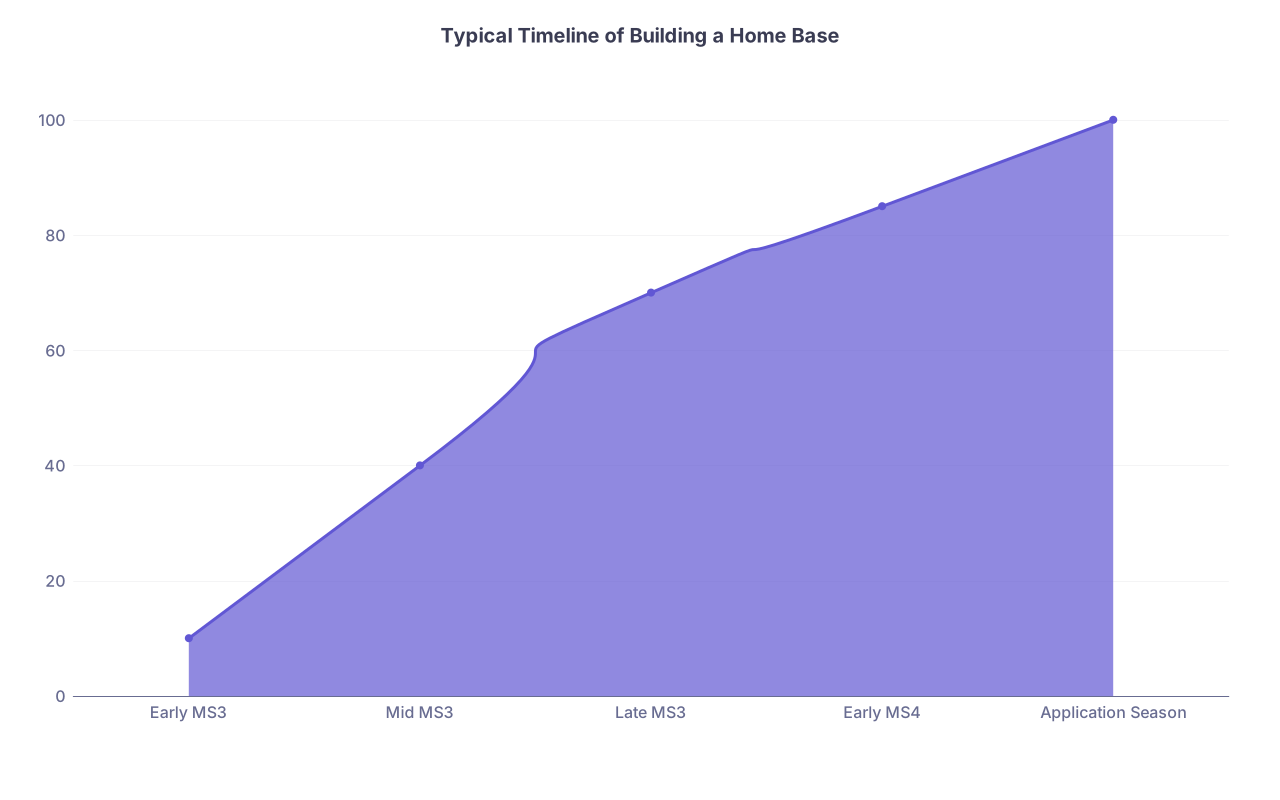
That 0–100 scale represents “strength of home base.” Most students hover at 30–50. You are aiming for 80+ by the time you submit ERAS.
Practical Scripts You Can Actually Use
I will finish the main content with very concrete language you can adapt.
Early in the rotation (to attendings)
“I am very interested in [specialty], and I am hoping to find a home base within the department where I can really invest and grow. I would appreciate any feedback on how I can be as helpful as possible to this team.”
To a resident you respect
“You see a lot of students rotate through. What do the ones who end up with strong letters or really good relationships with the department do differently?”
Mid‑rotation to a potential faculty advocate
“I have gotten a lot from working with you so far. If there is one or two things I could do over the rest of this rotation to really stand out as a future [specialty] resident, what would they be?”
Late rotation, framing the home base idea
“I have really connected with this service and the way you all care for patients. I see this as my home base here, regardless of where I match. If I keep developing along this path, would you be comfortable being a strong advocate for me when I apply?”
Email later for a letter
“Dear Dr. X,
I hope you are well. I am writing to ask if you would be willing to write a very strong letter of recommendation in support of my application to [specialty] residency. I greatly valued working with you on [specific service] in [month/year], especially [concrete example]. I consider your team my home base here, and your support would mean a great deal to me.
I have attached a brief summary of my contributions on your service, my updated CV, and my current personal statement draft. I am happy to provide any additional information that would be helpful.”
You do not have to copy this word for word. But you should be this clear and this direct.

Looking Forward
Once you have a genuine home base, everything else in your application snaps into place more easily. Your story has a center of gravity. Your letters have a unified voice. Your “fit” is no longer theoretical—it is documented.
From here, the next level is learning how to use that home base to target specific programs, signal interest without groveling, and handle interview questions in a way that makes PDs think, “This person will be our home‑grown success story.”
But that is the next step in the journey.
FAQ (Exactly 6 Questions)
1. What if my home base ends up being in a different specialty than the one I choose?
That is not fatal. A strong home base in, say, internal medicine can still help you match into neurology, psychiatry, or even radiology. The key is that letters emphasize transferable skills: clinical reasoning, work ethic, communication, professionalism. You will still want at least one specialty‑specific letter, but a powerful general medicine or surgery letter often carries more weight than a mediocre “in‑field” letter.
2. Can I have more than one home base? For example, IM and EM?
You can have a primary and a secondary, but trying to be “fully claimed” by multiple departments rarely works. It starts to look like you are hedging. Usually you want one department that is clearly “yours” for advocacy, then one or two additional strong pockets of support that align with specific interests (e.g., critical care, global health, or a subspecialty exposure).
3. How late is too late to build a home base? I am already late MS3.
Late MS3 is not too late, but you must be intentional. Use your next major rotation or your first MS4 sub‑I as your target. Tell the team up front that you are aiming to establish a long‑term relationship with the department. Then follow through by returning for an elective, getting involved in a small project, or staying engaged through conferences and email. What is truly hard is trying to build a home base after ERAS has already been submitted.
4. What if my school’s department in my chosen specialty is weak or has a bad reputation?
Then you have two parallel tasks. First, still build the best possible home base locally; even “weaker” departments have individuals with strong networks or reputations. Second, deliberately use away rotations or regional electives to create an external pseudo‑home base—a program elsewhere that sees you as “their” student, even if only for 4–8 weeks. Your strategy just has to be more geographically and politically savvy.
5. How do I handle it if an attending I thought was a supporter hesitates about writing a ‘very strong’ letter?
You thank them and you do not push. A lukewarm or even neutral LOR hurts you. Say something like, “I appreciate your honesty and your feedback. I will plan to ask someone who has seen me more in [X context]. If you have specific suggestions for how I can improve going forward, I would value that.” Then redirect your efforts toward faculty who are clearly enthusiastic. The hesitation is information, not a personal attack.
6. Does building a home base look different for very competitive specialties like derm, ortho, or ENT?
The fundamentals are the same but the bar is higher, and you often need tighter integration with the department earlier. For these fields, home base usually involves: an early clinical rotation where you stand out, research or QI with key faculty, visible presence in departmental conferences, and explicit mentorship from at least one person whose name carries weight nationally. You cannot just be a good rotating student; you have to become “our ortho applicant this cycle” or “our derm person,” with everyone in the department knowing exactly who that refers to.


