Why Away Rotations Matter So Much for US Citizen IMGs in Med-Peds
For a US citizen IMG interested in Medicine-Pediatrics (Med-Peds), away rotations can be one of the most powerful tools to strengthen your residency application—and sometimes, the difference between matching and going unmatched.
As an American studying abroad, you face a few specific challenges:
- Limited or no US clinical experience in your home medical school curriculum
- Potential bias or uncertainty from program directors about your training environment
- Less access to built-in networks, mentors, and home program advocacy
Well-planned away rotations (also called visiting student rotations or electives) help you:
- Prove you can function at the level of a US final-year medical student
- Demonstrate your communication skills and professionalism in real US clinical settings
- Secure strong US letters of recommendation from Med-Peds faculty
- Show serious, informed interest in Med-Peds and in specific programs
- Increase visibility at programs that are IMG-friendly and truly open to US citizen IMGs
This article walks through a step-by-step away rotation strategy tailored specifically to US citizen IMGs targeting Med-Peds: how to choose rotations, when and where to apply, how many away rotations to do, and how to maximize each month for your medicine pediatrics match chances.
Understanding Med-Peds and the Away Rotation Landscape
What Makes Med-Peds Unique
Medicine-Pediatrics is a four-year combined residency that provides full board eligibility in both Internal Medicine and Pediatrics. Compared with categorical Internal Medicine or Pediatrics:
- Fewer residency spots nationwide
- Smaller programs (often 8–16 residents total per year across 3–4 hospitals)
- Close-knit resident cohorts and faculty
- Emphasis on adaptability—switching between adult and pediatric care blocks
Program directors in Med-Peds tend to value:
- Maturity and reliability (you’ll handle very sick adults and children)
- Strong clinical reasoning and flexibility
- Clear understanding of what Med-Peds is (and isn’t)
- Evidence that you can thrive in both adult and pediatric environments
Away rotations become one of the best ways to prove you are a good fit for this demanding but rewarding combined specialty.
Why Away Rotations Are Especially Important for US Citizen IMGs
As a US citizen IMG or American studying abroad, you’re often evaluated differently than US MD/DO students:
- Programs want to see recent, supervised US clinical experience
- They rely heavily on US letters of recommendation, ideally from core specialties
- They may not fully understand your school’s curriculum or grading system
Away rotations address all three concerns at once, particularly when completed at:
- A Med-Peds residency site
- A strong Internal Medicine or Pediatrics department with active teaching
- US academic centers that regularly host IMGs
For many US citizen IMGs in Med-Peds, away rotations function as:
- Extended in-person interviews
- A trial period demonstrating your clinical skills and work ethic
- A network-building opportunity in a small specialty
Planning Your Strategy: How Many Away Rotations and Where
How Many Away Rotations Should a US Citizen IMG Do?
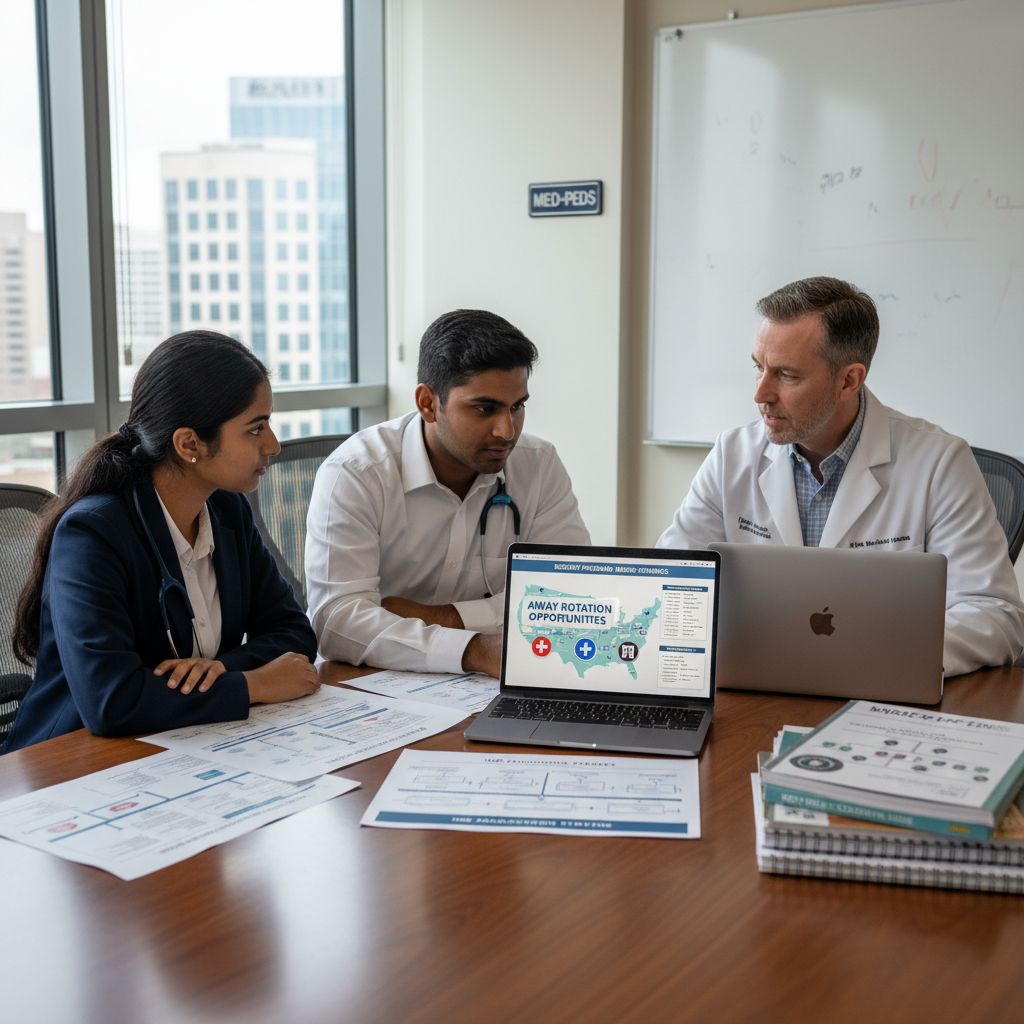
There is no single correct number, but for a US citizen IMG targeting Med-Peds, a common and realistic strategy is:
- Minimum: 2 away rotations
- Ideal (if feasible): 3–4 away rotations
- Upper limit: 4 away rotations (beyond this, returns often diminish and scheduling becomes risky)
A solid plan might look like:
- 1 Med-Peds elective at a program with a Med-Peds residency
- 1 Internal Medicine rotation (ward or sub-internship)
- 1 Pediatrics rotation (ward, sub-I, or NICU/PICU if allowed)
- Optional 4th rotation at a “reach” program or in a location you strongly prefer geographically
When thinking about how many away rotations you can manage, be realistic:
- Are you able to take that many months off at the right time in your final year?
- Are you able to afford the travel, housing, and application fees for each month?
- Can you maintain strong performance if you’re constantly moving between hospitals and cities?
For many US citizen IMGs, 3 away rotations is the sweet spot: enough exposure and letters without overwhelming your schedule or finances.
Prioritizing Sites: Where Should You Rotate?
Your highest priority should be Med-Peds programs that regularly consider or have matched US citizen IMGs. To identify them:
Program websites & resident bios
- Look for residents who attended Caribbean, Irish, UK, Israeli, or other non-US medical schools.
- Note if these are US citizen IMGs; that’s a positive sign for you.
FREIDA and NRMP data
- Check whether programs list IMGs as “accepted” or “sponsored.”
- Avoid programs that explicitly state “No IMGs” or “US MD/DO only.”
Networking with current residents and faculty
- Reach out to Med-Peds residents on email or LinkedIn and ask:
“Do you currently or recently have US citizen IMGs in your program?” - Ask if the program welcomes visiting student rotations from IMGs.
- Reach out to Med-Peds residents on email or LinkedIn and ask:
Geographic logic
- Where do you want to live for four years?
- Are there regional clusters of Med-Peds programs (e.g., Midwest, Northeast) you can target with multiple rotations?
Balancing Med-Peds vs Categorical Rotations
You do not need every away rotation to be explicitly “Med-Peds.” Programs are equally interested in:
- Your performance on Internal Medicine wards or sub-Is
- Your performance on Pediatrics wards, sub-Is, or key electives
- Your ability to handle bread-and-butter and moderately complex cases
A common strategy:
- Rotation 1: Med-Peds elective (e.g., Med-Peds clinic, combined continuity clinic, Med-Peds inpatient service if available)
- Rotation 2: Internal Medicine ward, sub-I, or ICU at a Med-Peds or IMG-friendly institution
- Rotation 3: Pediatrics ward or sub-I at another Med-Peds or IMG-friendly institution
- Optional Rotation 4: A second Med-Peds program or a geographically strategic categorical rotation where Med-Peds faculty are active
This structure lets you collect balanced letters that collectively say: “This US citizen IMG can function at the level of a US senior student in both adult and pediatric care.”
Timing and Logistics: When and How to Apply
Ideal Timing for Away Rotations
For the medicine pediatrics match, your most valuable away rotations are those completed before ERAS applications are due (usually mid-September).
Optimal timing:
- May–September of the calendar year you apply (often your final year)
Practical target:
- 2 away rotations before September 15 (so letters can be uploaded by October)
- Remaining away(s) in September–November, which can still influence interviews and your rank list.
If your school schedule is rigid, prioritize:
- At least one strong US rotation (Med-Peds, IM, or Pediatrics) by late summer
- Enough time afterward to secure and upload letters
Application Pathways: VSLO vs Direct
Many US schools use the Visiting Student Learning Opportunities (VSLO) platform. But as a US citizen IMG, you may encounter:
- Schools that do not accept IMGs via VSLO
- Schools that require direct institutional agreements
- Additional steps such as letters from your dean or international office
Action steps:
Identify Programs Early (10–12 months before rotations)
- List Med-Peds and categorical IM and Peds programs you’re targeting.
- Check each hospital’s visiting student page: do they accept IMGs? US citizen IMGs?
Clarify Eligibility
- Email the visiting student or medical education office:
- Confirm they accept “US citizen students from international medical schools.”
- Ask about any additional documentation (transcripts, immunizations, malpractice coverage, visa status if relevant).
- Email the visiting student or medical education office:
Submit Early and Broadly
- Many competitive programs fill early, particularly in Med-Peds.
- Apply to more sites than you ultimately need; it’s normal to get fewer acceptances than applications.
Backup Plan
- Have some community or smaller academic hospitals on your list that are friendly to IMGs.
- Consider at least one site where prior students from your school have rotated successfully.
Managing Practical Barriers: Housing, Cost, Logistics
Away rotations can be expensive, especially if you’re completing 3–4 months in different cities.
Cost considerations:
- Application fees (VSLO and/or institution-specific)
- Background checks, drug screens, additional immunizations, N95 fit-testing
- Short-term housing (Airbnb, student housing, shared apartments)
- Local transportation and parking
- Food and incidental living expenses
Tips to manage costs:
- Ask about student housing options through the hospital or university.
- Look for Facebook groups or forums where current residents or students sublet their rooms.
- Cluster rotations by geographic region when possible to reduce repeated cross-country travel.
- Apply for any small student travel grants or IMG-specific scholarships available through schools or professional organizations.

Choosing Specific Rotations: What Type of Rotations Help Most
High-Yield Rotations for Med-Peds Applicants
For a US citizen IMG, high-yield rotations are ones that:
- Allow direct interaction with Med-Peds or core IM/Peds faculty
- Include meaningful patient responsibility under supervision
- Lead to a strong letter of recommendation
Top choices:
Med-Peds Elective / Sub-Internship
- Med-Peds inpatient service (if available)
- Med-Peds continuity clinic
- Combined adult and pediatric complex care clinics
Internal Medicine Ward or Sub-I
- General medicine floor teams
- Hospitalist service with strong teaching
- In some programs, a sub-internship that allows you to act at “intern-level” responsibilities
Pediatrics Ward or Sub-I
- General pediatrics inpatient service
- Pediatrics sub-I, where you’re assigned your own patients
- Optionally, NICU or PICU if you already have general peds exposure and the program allows senior students/visitors.
What Rotations Are Less Helpful?
- Highly specialized electives (e.g., dermatology, radiology) with minimal patient contact
- Observerships with no direct patient care responsibilities
- Rotations in non-core specialties that don’t demonstrate your Med-Peds readiness
These are not useless—especially if you’re truly interested in those domains—but for the medicine pediatrics match, away time is most powerful when spent in:
- Hands-on internal medicine
- Hands-on pediatrics
- Integrated Med-Peds settings
Example Rotation Plans for Different Applicant Profiles
Scenario 1: US Citizen IMG with No Prior US Clinical Experience
Goal: Build foundational US experience and letters.
- Rotation 1 (June): Internal Medicine ward at an IMG-friendly academic hospital
- Rotation 2 (July): Pediatrics ward or sub-I at a Med-Peds program
- Rotation 3 (August): Med-Peds elective/sub-I at a second Med-Peds program
- Optional Rotation 4 (September/October): Additional Med-Peds or IM/Peds rotation in your desired geographic area
Scenario 2: US Citizen IMG with Some US Observerships but Limited Hands-On Rotations
Goal: Show you can function in a hands-on role and obtain strong LORs.
- Rotation 1 (May/June): Pediatrics ward at a Med-Peds site
- Rotation 2 (July): Med-Peds inpatient/clinic at a strong teaching hospital
- Rotation 3 (August): Internal Medicine ward or sub-I at a second institution
Scenario 3: Already Strong in US IM Experience, Weak in Peds
Goal: Balance your portfolio for a combined specialty.
- Rotation 1: Pediatrics inpatient or sub-I
- Rotation 2: Med-Peds elective
- Rotation 3: Additional Pediatrics or a second Med-Peds site
Maximizing Each Rotation: How to Stand Out and Earn Strong Letters
Show You Understand What Med-Peds Is
Faculty want reassurance that you’re not using Med-Peds as a fallback because you “couldn’t pick between medicine and pediatrics.” Demonstrate that you:
- Understand the career paths (primary care, hospital medicine, subspecialty, transitional care, complex chronic disease, etc.)
- Appreciate the challenges: frequent switching between adult and pediatric mindsets, heavy clinical load, four-year training
- Have real experiences that sparked your interest in caring for patients across the age spectrum
During your away, when you meet Med-Peds attendings or residents:
- Have a concise, authentic story explaining why Med-Peds aligns with your goals.
- Ask specific questions about their training structure, combined clinics, and Med-Peds career paths.
Behaviors That Med-Peds Faculty Notice
Across both adult and pediatric settings, Med-Peds faculty tend to value:
- Reliability and ownership
- Show up early, prepared, and consistent.
- Follow through on tasks without needing reminders.
- Adaptability
- Switch comfortably between adult and pediatric encounters.
- Adjust communication style for different ages and family dynamics.
- Curiosity and initiative
- Read about your patients’ conditions.
- Volunteer to present short teaching points or articles.
- Communication skills
- Clear, structured presentations: HPI, assessment, and plan tailored to each patient.
- Empathic communication with families, especially in pediatrics.
Make it easy for attendings to say in a letter:
“[Student] functioned at or above the level of a US senior medical student on our service, took ownership of patients, and demonstrated strong potential as a Med-Peds resident.”
Ask Intentionally for Letters of Recommendation
As a US citizen IMG, you typically want:
- At least one letter from Internal Medicine faculty
- At least one letter from Pediatrics faculty
- Ideally one from a Med-Peds trained physician, if possible
Timing and tactics:
- Ask near the end of the rotation, once they’ve seen your work for 2–4 weeks.
- Ask face-to-face if possible, or via a professional email if schedules are tight.
- Phrase the request clearly:
- “I am applying to Medicine-Pediatrics residency this fall. Based on my performance during this rotation, would you feel comfortable writing me a strong letter of recommendation?”
If they hesitate, thank them and consider asking someone else who has seen more of your work.
Provide them:
- Your updated CV
- A brief summary of your Med-Peds interest and any major experiences
- A rough draft of your personal statement (even if not final)
- ERAS letter request instructions and deadlines
Use Each Rotation to Build Your Story
Keep a simple clinical reflection log during your rotations:
- Interesting Med-Peds-relevant cases (adult congenital heart disease, transition-age patients with chronic pediatric-onset conditions, complex family systems, etc.)
- Times you felt particularly effective or challenged
- Specific attending feedback you received and how you responded
These reflections become powerful material for:
- Your Med-Peds personal statement
- Interview answers (e.g., “Tell me about a challenging patient case”)
- Demonstrating growth, resilience, and insight as a US citizen IMG navigating a new system
Putting It All Together: Integrating Away Rotations Into Your Match Strategy
Aligning Rotations With Your Application Timeline
Early Rotations (May–August):
- Critical for letters and initial ERAS application.
- Prioritize IMG-friendly Med-Peds programs and strong IM/Peds departments.
Mid Rotations (September–November):
- Can still lead to late letters and additional interview offers.
- Great for confirming geographic preferences and building relationships.
Late Rotations (December–January):
- Less helpful for interviews that cycle, but valuable for your own learning.
- Can influence how confidently you rank programs and build future networks.
Example Integrated Strategy for a US Citizen IMG in Med-Peds
Year Before Application (MS3 equivalent)
- Identify Med-Peds programs that have matched US citizen IMGs.
- Build an Excel sheet tracking: program, location, IMG-friendliness, rotation options, deadlines, and fees.
- Reach out to alumni from your school who matched in Med-Peds or IM/Peds.
Application Year – Spring
- Finalize rotation list and backup options.
- Submit VSLO/direct applications as early as allowed (often January–March).
- Begin drafting Med-Peds–focused CV and personal statement outline.
Summer–Early Fall
- Complete 2–3 core away rotations.
- Ask for letters at the end of each rotation.
- Keep notes on each program’s culture, teaching, and Med-Peds structure.
ERAS Submission and Interview Season
- Highlight your most impactful away rotations in your personal statement and experiences section.
- During interviews, reference concrete examples of what you learned at specific away sites.
Rank List Time
- Revisit your notes from each rotation:
- Did you feel supported as a US citizen IMG?
- Could you see yourself thriving in that program’s culture?
- How did Med-Peds residents and faculty interact with you?
- Revisit your notes from each rotation:
Your away rotations are not just auditions; they’re also your best opportunity to learn what kind of training environment you want for four intense years.
FAQs: Away Rotations for US Citizen IMGs in Medicine-Pediatrics
1. As a US citizen IMG, do I have to do away rotations to match into Med-Peds?
They’re not formally required, but in practice, away rotations are extremely valuable for US citizen IMGs in Med-Peds. Most successful applicants from international schools have:
- At least 2–3 months of US clinical experience
- Letters from US Internal Medicine and Pediatrics faculty
- Ideally some exposure to Med-Peds faculty or programs
If you absolutely cannot do away rotations, it becomes essential to maximize other forms of US experience (e.g., extended observerships that allow some hands-on work, robust research, strong Step scores), but your path is harder.
2. Should my away rotations all be at Med-Peds programs?
Not necessarily. A balanced portfolio works best:
- At least one rotation at a Med-Peds residency site is ideal, to show direct interest.
- Strong Internal Medicine and Pediatrics rotations are equally important.
Programs want to know you can function as a capable resident on both sides; they will piece together this picture from a combination of Med-Peds, IM, and Peds letters and evaluations.
3. How many away rotations is too many for a US citizen IMG?
In most cases, 4 away rotations is the practical upper limit. Beyond that:
- The financial and logistical costs surge
- You risk fatigue and diminishing performance
- You have less time to reflect, study, and prepare for exams or applications
For many US citizen IMGs targeting Med-Peds, 3 solid away rotations in Med-Peds, IM, and Peds is both realistic and effective.
4. What if a program I love doesn’t accept IMGs for visiting student rotations?
You still have options:
- Rotate at a nearby affiliated hospital that does accept IMGs, if available.
- Build a strong overall profile with away rotations at other IMG-friendly Med-Peds sites.
- Apply to the program anyway, emphasizing:
- Your understanding of Med-Peds
- Strong US letters in IM and Peds
- Any regional ties (family, prior education, etc.)
Some programs may not host you as a student but will still consider you as a residency applicant—especially if your overall application is strong.
Thoughtful, well-timed away rotations can transform your trajectory as a US citizen IMG aiming for a medicine pediatrics match. By choosing the right sites, planning for at least 2–3 high-yield rotations, and performing at your best on each rotation, you not only strengthen your application—you also step into the Med-Peds community and start building the professional identity you’ll carry throughout your career.